This Report Provides In-Depth Analysis of the Low Pressure Die Casting Machines Market Report Prepared by P&S Intelligence, Segmented by Type (Horizontal, Vertical, Tilting), Automation Level (Fully Automatic, Semi-Automatic, Manual), End-Use Industry (Automotive, Aerospace & Defense, Industrial Manufacturing, Electronics & Electrical), and Geographical Outlook for the Period of 2019 to 2032
Low Pressure Die Casting Machines Market Valuation
Key Highlights
Study Period
2019 - 2032
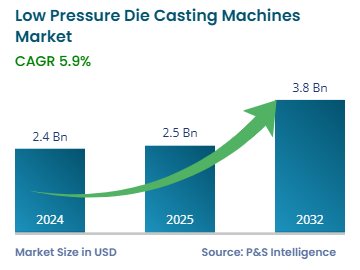
Market Size in 2024
USD 2.4 Billion
Market Size in 2025
USD 2.5 Billion
Market Size by 2032
USD 3.8 Billion
Projected CAGR
5.9%
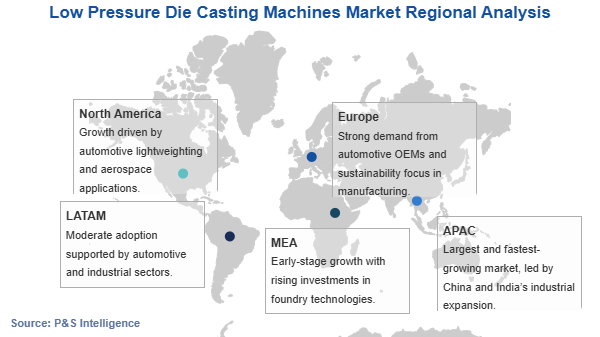
Largest Region
APAC
Fastest Growing Region
North America
Market Structure
Fragmented
Market Size
Explore the market potential with our data-driven report
Low Pressure Die Casting Machines Market Overview
The global low pressure die casting machines market size was USD 2.4 billion in 2024, which is predicted to reach USD 3.8 billion by 2032, growing at a CAGR of 5.9% during 2025–2032.
The increasing demand for lightweight, high-precision metal components in the automotive and aerospace sectors is driving substantial growth in the low-pressure die casting machines market worldwide. According to the World Health Organization (WHO), in 2025, more than 1 billion people worldwide are living with mental health disorders, with anxiety and depression being the most prevalent conditions. The evolution of low-pressure die casting technology has enabled manufacturers to produce complex aluminum and magnesium components with superior mechanical properties and minimal porosity, making these machines increasingly vital for industries pursuing lightweighting strategies and enhanced product performance. The automotive industry's transition towards electric vehicles has particularly amplified demand for low-pressure die casting machines, as manufacturers require sophisticated equipment capable of producing large, integrated battery housings and structural components with exceptional dimensional accuracy and air-tightness requirements.
The integration of Industry 4.0 technologies and automation capabilities in modern low-pressure die casting machines has transformed production efficiency, enabling real-time process monitoring, predictive maintenance, and enhanced quality control systems that significantly reduce scrap rates and improve overall equipment effectiveness. Rising investments in aerospace manufacturing facilities, particularly in emerging markets, coupled with stringent quality requirements for critical components such as turbine blades and structural parts, continue to strengthen market demand for advanced low-pressure die casting equipment with precise temperature control and vacuum-assisted capabilities.
Low Pressure Die Casting Machines Market Growth Factors
Technological Advancements and Industry 4.0 Integration Are Key Trend
Cloud-based platforms enable centralized data collection and sharing across facilities, allowing better coordination in multi-plant operations.
Advanced human–machine interfaces (HMIs) improve operator control and usability, reducing training requirements and increasing safety.
The U.S. Department of Energy’s Advanced Materials & Manufacturing Technologies Office (AMMTO) announced a USD 33-million funding opportunity in July 2024 for digitalization, IoT, and AI-enabled production systems.
The automation of metal pouring and mold handling enhances consistency and minimizes material wastage.
The integration of AI-driven defect detection during production helps in identifying flaws early, improving product quality.
Energy-efficient machine designs leverage smart controls to lower power consumption and reduce environmental footprint.
Predictive analytics extend machine lifespan by forecasting potential failures and scheduling proactive maintenance.
Customization through software upgrades allows quick adaptation of machines to different alloys and casting geometries.
Enhanced traceability systems supported by Industry 4.0 ensure compliance with regulatory standards and quality certifications.
Cyber-physical systems enable continuous communication between physical equipment and digital control systems, increasing production flexibility.
Collaborative robotics (cobots) support semi-automated operations, improving throughput while maintaining operator involvement.
As per studies, sales of mobile cobots could reach USD 6.8 billion in value by 2030.
Rising Demand for Lightweight Automotive Components Is Accelerating Market Growth
The growing adoption of electric vehicles (EVs) increases demand for lightweight aluminum components to extend driving range and improve efficiency.
Automotive OEMs are focusing on fuel efficiency and emission reduction, driving the shift from heavier steel parts to lighter aluminum die-cast components.
In 2023, global transportation carbon dioxide (COâ‚‚) emissions increased by 3.4% year-on-year, reaching approximately 8.2 billion metric tons (GtCOâ‚‚).
The European Union has set a target to reduce COâ‚‚ emissions from cars and vans by 30% by 2030, compared to 2021 levels. Major automakers, including BMW, Ford, General Motors,
Mercedes-Benz, Renault, Toyota, Volvo, and Volkswagen have committed to reducing Scope 1 and 2 greenhouse gas emissions by 50% to 80% by 2030, and Scope 3 emissions by 30% to 50%, in line with Science-Based Targets.
Low-pressure die casting machines are ideal for producing complex, thin-walled, lightweight automotive parts such as engine blocks, transmission cases, and structural components.
Studies indicate that a 10% reduction in vehicle weight can lead to a 6–8% improvement in fuel economy.
For instance, reducing a vehicle's weight by 50 kg (110 lbs) can decrease COâ‚‚ emissions by up to 5 grams per km and improve fuel economy by up to 2%.
The rising consumer demand for high-performance vehicles pushes manufacturers to adopt lightweight solutions for better speed, handling, and durability.
The regulatory pressure for COâ‚‚ emission reduction in Europe, North America, and Asia-Pacific accelerates the adoption of lightweight die-cast parts.
The U.K. government has granted GBP 2.9 million to support Project PIVOT by Sarginsons Industries, which is part of a GBP 5.8-million initiative aimed at advancing lighter, sustainable aluminum cast solutions in vehicle production.
Increasing use of aluminum alloys in body and chassis parts creates significant opportunities for low-pressure die casting machine adoption.
Demand for cost-effective mass production of lightweight parts makes low-pressure die casting an attractive solution for automotive manufacturers.
In Georgia, U.S., the state government is backing a USD 184 million plant run by GF Casting Solutions (part of Georg Fischer AG), specializing in lightweight, aluminum automotive components. The incentive package includes up to USD 28 million in tax breaks and financial support.
Low Pressure Die Casting Machines Market Segmentation Analysis
Type Analysis
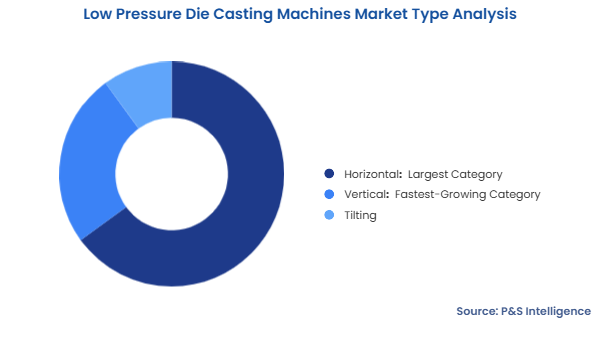
The horizontal category commanded the largest market share in 2024, of 65%, primarily due to their widespread adoption in high-volume automotive component production, including wheels, cylinder heads, and transmission cases. These machines offer superior accessibility for mold changes, easier automation integration, and enhanced operator ergonomics, making them the preferred choice for manufacturers focused on maximizing productivity and minimizing changeover times in multi-product manufacturing environments.
The vertical category is experiencing the fastest growth trajectory, during 2025–2032, driven by their advantages in producing tall, cylindrical components and their smaller footprint requirements that enable better space utilization in constrained manufacturing facilities. Vertical machines excel in applications requiring gravity-assisted metal flow and are increasingly favored for producing complex aerospace components, turbocharger housings, and electric motor rotors where superior metallurgical properties and reduced gas entrapment are critical quality requirements.
These types are covered:
Horizontal (Largest Category)
Vertical (Fastest-Growing Category)
Tilting
Automation Level Analysis
The fully automatic category dominated the market in 2024 with 60% share, and it will have the highest CAGR. This reflects the industry's progress toward smart manufacturing and lights-out production capabilities, which minimize labor costs, while maximizing consistency and throughput. These advanced systems incorporate robotic part handling, automatic core setting, integrated quality inspection systems, and closed-loop process control that can maintain casting parameters within ±1% variation across thousands of production cycles.
These automation levels are covered:
Fully Automatic (Largest and Fastest-Growing Category)
Semi-Automatic
Manual
End-Use Industry Analysis
The automotive category held the dominant position with 40% market share in 2024, driven by the sector's extensive use of low-pressure die casting for manufacturing critical powertrain components, structural parts, and electric vehicle battery enclosures. The automotive sector's transition towards electric mobility has intensified demand for large-format low-pressure die casting machines capable of producing integrated battery trays measuring up to 2000 mm x 1500 mm with complex cooling channel geometries and mounting provisions for battery management systems. The world manufactured 92,504,338 vehicles in 2024, as per OICA.
The aerospace & defense category is anticipated to register the highest CAGR through 2032, propelled by increasing aircraft production rates, rising defense expenditures, and the adoption of lightweight materials in next-generation aircraft designs. The stringent quality requirements in aerospace applications, including radiographic inspection standards and mechanical property specifications exceeding 300 MPa tensile strength, necessitate advanced low-pressure die casting machines with precise process control and comprehensive data logging capabilities.
According to the Stockholm International Peace Research Institute (SIPRI), global military expenditure reached a record USD 2,718 billion in 2024, marking a 9.4% increase from the previous year—the steepest year-on-year rise since at least the end of the Cold War. As of the end of 2024, Boeing had 6,245 unfilled commercial aircraft orders, worth approximately USD 600 billion, while Airbus held 8,658 unfilled orders, with a combined value of about USD 629 billion.
These end-use industries are covered:
Automotive (Largest Category)
Aerospace & Defense (Fastest-Growing Category)
Industrial Manufacturing
Electronics & Electrical
Others
Drive strategic growth with comprehensive market analysis
Low Pressure Die Casting Machines Market Geographical Outlook
Asia-Pacific Low-Pressure Die Casting Machines Market Size
Asia-Pacific secured the largest regional market share, of 40%, in 2024, driven by the region's dominant position in global automotive manufacturing, rapid industrialization, and substantial investments in electric vehicle production infrastructure. The region's automotive industry produces over 50 million vehicles annually, with China alone accounting for approximately 30 million units, creating an enormous demand for low-pressure die casting machines to support component manufacturing across the extensive supplier ecosystem.
China Low-Pressure Die Casting Machines Market Size
In 2024, about 6.6 million consumers applied for the incentive, 60% of whom bought an electric car in China, demonstrating the massive scale of electric vehicle adoption that is driving investments in advanced casting equipment for battery housing and structural component production. The establishment of gigafactories and integrated manufacturing facilities by leading electric vehicle manufacturers, including BYD, Tesla, and NIO has catalyzed demand for high-capacity low-pressure die casting machines with clamping forces exceeding 2,000 tons for producing large, single-piece structural components.
Japan Low-Pressure Die Casting Machines Market Size
Japan's low-pressure die casting machines market benefits from the country's technological leadership in manufacturing automation and precision engineering, with domestic machine manufacturers supplying advanced equipment featuring proprietary vacuum systems, electromagnetic stirring technology, and AI-powered quality control systems to global automotive and electronics manufacturers. The presence of major automotive OEMs, including Toyota, Honda, and Nissan, combined with their extensive supplier networks, sustains consistent demand for replacement equipment and technology upgrades to maintain competitive manufacturing capabilities.
Europe Low-Pressure Die Casting Machines Market Share
Europe maintained a substantial market position with 30% share in 2024, supported by the region's strong automotive manufacturing base, stringent environmental regulations driving lightweighting initiatives, and technological innovation in sustainable casting processes. Germany's automotive industry, producing over 4 million vehicles annually and hosting premium manufacturers, including BMW, Mercedes-Benz, and Volkswagen, represents the largest national market for low-pressure die casting machines in Europe, with particular emphasis on equipment capable of producing high-integrity structural components for luxury and performance vehicles.
The region's commitment to achieving carbon neutrality by 2050 has accelerated the adoption of energy-efficient low-pressure die casting machines featuring regenerative hydraulic systems, optimized heating technologies, and waste heat recovery capabilities that can reduce energy consumption by up to 30% compared to conventional equipment. Italy's specialized machinery manufacturing sector, particularly concentrated in the Brescia region, has established global leadership in low-pressure die casting technology innovation, with companies developing advanced tilt-gravity hybrid systems and integrated automation solutions exported worldwide.
North America Pressure Die Casting Machines Market Value
North America is set to register the highest growth rate, of approx. 6.0%, CAGR through 2032, with growth driven by reshoring initiatives, investments in domestic electric vehicle production capacity, and modernization of aerospace manufacturing facilities. The U.S. automotive industry's transition towards electric vehicles, supported by federal incentives and infrastructure investments exceeding USD 7.5 billion, has triggered substantial capital expenditures in new casting equipment for battery component and lightweight structural part production.
The implementation of the USMCA trade agreement has strengthened regional automotive supply chains, encouraging investments in advanced manufacturing technologies, including low-pressure die casting machines to meet local content requirements and maintain competitiveness against imports. Mexico's expanding role as a manufacturing hub for North American automotive production, with over 3.5 million vehicles produced annually, continues to drive demand for cost-effective yet technologically advanced casting equipment to serve both domestic and export markets.
The regions and countries analyzed in this report are:
North America (Fastest-Growing Regional Market)
U.S. (Larger Country Market)
Canada (Faster-Growing Country Market)
Europe
Germany (Largest Country Market)
U.K. (Fastest-Growing Country Market)
France
Italy
Spain
Rest of Europe
Asia-Pacific (Largest Regional Market)
Japan (Fastest-Growing Country Market)
China (Largest Country Market)
India
South Korea
Australia
Rest of APAC
Latin America
Brazil (Largest Country Market)
Mexico (Fastest-Growing Country Market)
Rest of LATAM
Middle East and Africa
Saudi Arabia (Largest Country Market)
South Africa
U.A.E. (Fastest-Growing Country Market)
Rest of MEA
Low Pressure Die Casting Machines Market Share Analysis
The low-pressure die casting machines market is fragmented in nature, characterized by the presence of a large number of regional and global players operating across various geographies. This fragmentation is primarily driven by the diverse application requirements of end-use industries such as automotive, aerospace, and electronics, which demand customized casting solutions. Numerous small- and medium-sized manufacturers serve specific regional or niche markets, offering machines tailored to the alloy type, component size, and production volume required. Although prominent players like Buhler, Italpresse Gauss, Idra Group, and Yizumi have a notable presence, their collective market share is not large enough to consolidate the industry. Furthermore, the market's technological landscape is varied, with companies competing on automation capabilities, energy efficiency, alloy compatibility, and service offerings. This variety of value propositions supports the continued participation of multiple players, thereby maintaining a fragmented market structure.
Key Low Pressure Die Casting Machines Companies:
Italpresse Gauss S.r.l.
Kurtz Ersa GmbH
Bühler AG
Shibaura Machine Co., Ltd.
L.K. Technology Holdings Limited
Guangdong Yizumi Precision Machinery Co., Ltd.
Ube Machinery Corporation, Ltd.
Toyo Machinery & Metal Co., Ltd.
Aluminium Bahrain B.S.C.
Oskar Frech GmbH + Co. KG
Dynacast International LLC
Italtech S.p.A.
Colosio S.r.l.
Zhejiang Wanfeng Technology Development Co., Ltd.
Ningbo Haitian Die Casting Equipment Co., Ltd.
Low Pressure Die Casting Machines Market News
In April 2025, ItalPresseGauss S.r.l. became an independent entity via a management buy-out from Norican Group. This strategic transition is aimed at boosting agility, innovation, and customer responsiveness.
In April 2025, Kurtz Ersa GmbH confirmed it will debut its made-in-China one-stop LPDC solution, developed in partnership with Mold Expert KPMC, at the upcoming Shanghai International Diecasting and Nonferrous Exhibition.
In January 2024, Bühler AG highlighted its Carat, Evolution, and upgraded Ecoline DS series—designed for aluminum and magnesium casting from small parts to large structural components—at the Euroguss fair in Nuremberg. With a focus on zero scrap, shorter cycle times, and increased automation, Bühler also demonstrated its SmartCMS cell management system for integrated control and optimization of the casting process.
In December 2023, LK Group and Chery Automobile Co. Ltd. unveiled its dual‑injection die‑casting process exceeding 10,000 tonnes at a debut event in Wuhu, Anhui. This system integrates a single lock mechanism with dual parallel injection units, addressing challenges associated with large-scale single-point injection and enabling future mega-scale integrated castings.
Want a report tailored exactly to your business need?
Leading companies across industries trust us to deliver data-driven insights and innovative solutions for their most critical decisions. From data-driven strategies to actionable insights, we empower the decision-makers who shape industries and define the future. From Fortune 500 companies to innovative startups, we are proud to partner with organisations that drive progress in their industries.
Client Testimonials
Working with P&S Intelligence and their team was an absolute pleasure – their awareness of timelines and commitment to value greatly contributed to our project's success. Eagerly anticipating future collaborations.
McKinsey & Company
India
Unmatched Standards
Our insights into the minutest levels of the markets, including the latest trends and competitive landscape, give you all the answers you need to take your business to new heights
Complete Data Security
We take a cautious approach to protecting your personal and confidential information. Trust is the strongest bond that connects us and our clients, and trust we build by complying with all international and domestic data protection and privacy laws