Explore the market potential with our data-driven report
Low-GWP Refrigerant Leak Detection Sensors Market Outlook
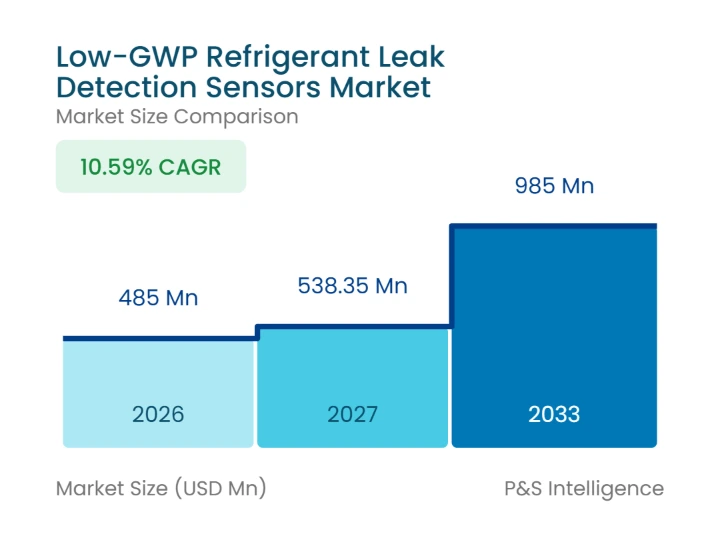
The global low-GWP refrigerant leak detection sensors market is estimated at USD 485.00 Million in 2026 and is projected to reach USD 538.35 Million in 2027. Revenue is projected to climb to USD 985.00 Million by 2033, advancing at a CAGR of 10.59% during 2027-2033. HVAC manufacturers redesigning ducted systems, heat pumps, and room air conditioners around mildly flammable refrigerants buy a factory-fitted sensor for every unit charged above safety-standard limits, while supermarket and cold-storage operators add continuous monitoring to meet leak-rate rules. Suppliers that win OEM platform qualifications can hold that volume for the life of each equipment line.
Hydrofluorocarbon phase-down schedules are forcing equipment makers onto refrigerants that are flammable, toxic, or run at high pressure, and each of those properties writes a detection requirement into the equipment specification. As per the UNEP Ozone Secretariat, 175 parties have ratified the Kigali Amendment to the Montreal Protocol, which commits them to cut HFC production and consumption on fixed timetables. The amendment sets national targets and leaves equipment rules to safety codes such as IEC 60335-2-40 and EN 378, so sensor orders tend to follow each country's adoption of those codes, which favors suppliers whose modules already carry the certifications.
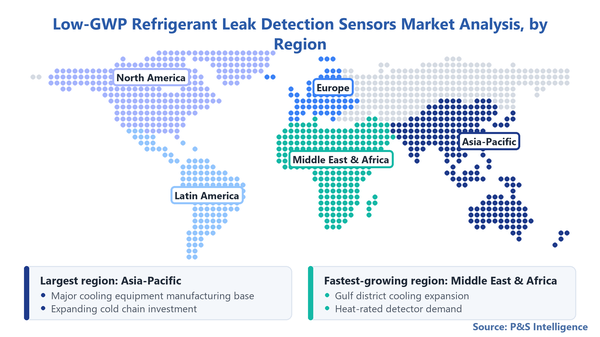
Asia-Pacific accounted for 36.0% of 2026 revenue, as equipment plants in China, Japan, South Korea, and India assemble a large share of the world's room air conditioners and heat pumps. Middle East & Africa is projected to grow fastest, at a CAGR of 11.55% during 2027-2033, from a small base. District cooling, hotel, and residential tower projects in Saudi Arabia and the U.A.E. are widening low-GWP refrigerant leak detection sensors market demand for machine-room monitoring and detectors that stay stable in extreme heat.
Key market insights
By technology, non-dispersive infrared (NDIR) / optical sensors held 42.0% in 2026, while Photoacoustic, Catalytic & Ultrasonic Sensors is set to expand at a 12.09% CAGR during 2027-2033.
By refrigerant type, synthetic A2L low-GWP refrigerants (R-32, R-454B, R-1234yf, R-454C) held 54.0% in 2026 and is also projected to grow fastest, at an 11.23% CAGR during 2027-2033.
By installation type, fixed OEM integrated modules (factory installed in HVAC/R) held 52.0% in 2026 and is also projected to grow fastest, at an 11.55% CAGR during 2027-2033.
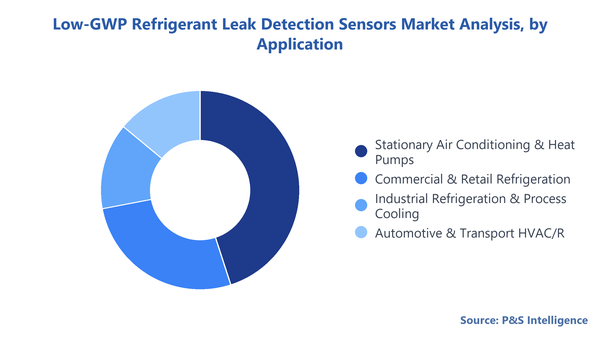
By application, stationary air conditioning & heat pumps held 45.0% in 2026 and is also projected to grow fastest, at a 10.92% CAGR during 2027-2033.
By geography, Asia-Pacific held 36.0% in 2026, while Middle East & Africa is projected to post the fastest growth, at an 11.55% CAGR during 2027-2033.
Shrinking hydrofluorocarbon quotas are reshaping the sensor mix toward natural refrigerants
Supermarket chains and heat pump manufacturers in Europe are replacing HFC blends with CO2, propane, and ammonia, and each of those refrigerants calls for a different detector. CO2 racks need sensors that warn of toxic concentrations in occupied stores, propane appliances need sensors that alarm well below the flammability limit, and ammonia plant rooms rely mainly on electrochemical cells. As stores and factories convert, purchases move from single-gas HFC detectors toward infrared and electrochemical heads, often specified to run several gases from one controller.
Figures from the European Commission put HFC production rights from 2025 at 60% of producers' average annual output in 2011-2013, falling to 15% by 2036, with HFCs phased out of the EU by 2050. Shrinking quota is likely to raise the cost of keeping HFC plants in service, which favors natural-refrigerant systems when retailers refit stores. Detector makers holding certified CO2 and R-290 product lines stand to see a growing portion of European orders tied to those gases.
Flammable-refrigerant safety rules are driving factory-fitted sensor demand in HVAC equipment
Residential and light commercial HVAC manufacturers moving from R-410A to A2L refrigerants such as R-454B and R-32 now have to design leak detection into many indoor units. UL 60335-2-40 requires a refrigerant detection system on A2L equipment whose charge exceeds limits set by the room it serves, and the sensor must start mitigation, usually running the blower and switching off nonessential electrical loads, before gas reaches 25% of the lower flammability limit. The standard sets performance, not a sensing principle, yet it turns the sensor into a factory-purchased component for every qualifying air handler, evaporator coil, and rooftop unit.
The timing of each conversion wave is set in federal rules. The US Environmental Protection Agency's sector restriction tables set a 700 GWP limit for residential and light commercial air conditioning and heat pump systems from January 1, 2025, and the same limit for variable refrigerant flow systems from January 1, 2027. VRF installations spread refrigerant across many occupied rooms, which can raise the number of sensors per project. Suppliers already holding recognition for several A2L gases face a shorter qualification path when VRF makers finalize their designs.
Mandatory automatic leak detection is opening a retrofit channel for facility monitoring systems
Supermarket chains, cold-storage warehouses, and food processors running large HFC refrigeration plants face a compliance step that periodic handheld checks cannot satisfy. Federal rules now require automatic leak detection on qualifying new systems, and existing systems installed since 2017 follow from January 1, 2027. Operators can comply with direct systems, meaning fixed multi-zone monitors and sensor heads in machine rooms and on sales floors, or with indirect systems that infer leaks from refrigerant level and pressure data, so detector vendors compete with controls-based approaches at each plant.
According to the Federal Register notice of the 2024 Emissions Reduction and Reclamation final rule, new commercial refrigeration and industrial process refrigeration appliances with a full charge of 1,500 pounds or more must install an automatic leak detection system from January 1, 2026, at installation or within 30 days. Because the requirement covers HFCs and substitutes with a GWP above 53, CO2 and ammonia plants fall outside it, which can tilt some refit decisions toward natural refrigerants. Vendors whose detectors feed leak data into compliance record-keeping software are better positioned with operators that must document repairs.
Cyclical swings in HVAC equipment shipments are limiting volume visibility for OEM sensor suppliers
Factory-fitted sensors are bought per unit of HVAC equipment built, so OEM module suppliers inherit the volatility of residential cooling demand. When distributors stock up ahead of a refrigerant changeover and then work down inventory, sensor call-offs fall with production schedules even though the safety requirement has not changed. Residential OEM lines are also price-sensitive, which steers many of them toward lower-cost MOS modules and limits the revenue earned per unit.
AHRI data show US shipments of central air conditioners and air-source heat pumps fell 20.0% in 2025 to 7,749,529 units, with central air conditioners down 26.2%. Those units size the equipment base that could carry a sensor, not actual sensor fitment, since smaller systems below charge limits need none. Sensor makers have responded with designs rated for long service lives without field recalibration, which lowers warranty exposure for OEMs, yet module volumes remain tied to build rates when shipments weaken.
Segmentation Analysis
Technology
Non-dispersive infrared (NDIR) / optical sensors accounted for 42.0% of low-GWP refrigerant leak detection sensors market revenue in 2026. Infrared sensing reads a gas-specific absorption band, so household aerosols and cleaning agents that can trip cheaper sensors seldom cause false alarms, and optical heads hold calibration over long service lives. Facility owners monitoring machine rooms and OEMs wary of warranty callbacks specify NDIR for continuous duty, which supports higher selling prices and helps this category lead on revenue.
photoacoustic, catalytic & ultrasonic sensors are projected to expand fastest, at a CAGR of 12.09% during 2027-2033, from the smallest base on this axis. Sensata confirms in its October 26, 2023 launch release that its Resonix RGD sensor detects A2L gases by monitoring the acoustic resonance of surrounding air, with UL recognition for R-454A, R-454B, R-454C, and R-32 under the fourth edition of UL 60335-2-40. Acoustic and photoacoustic methods also suit high-pressure transcritical CO2 lines, giving vendors in this category openings in both residential OEM programs and industrial plants.
Refrigerant Type
Synthetic A2L low-GWP refrigerants (R-32, R-454B, R-1234yf, R-454C) held 54.0% of revenue in 2026. Ducted residential HVAC in North America, room air conditioners across Asia, and vehicle air conditioning on R-1234yf all run on A2L gases, giving this group the largest base of newly built equipment. The A2L flammability class triggers sensor and mitigation requirements in safety standards once charges exceed room-based limits, so sensor revenue rises with every A2L platform an OEM launches.
The A2L category is also set to post the quickest growth, at a CAGR of 11.23% during 2027-2033, because the conversion is still under way. Commercial packaged units, rooftop equipment, and multi-room systems are following residential lines into A2L designs on later timetables, and each wave opens a fresh sensor qualification program at the OEM. Suppliers holding multi-gas certifications are better positioned here, because one module can then serve R-32 and R-454B platforms without a second approval cycle.
Installation Type
Fixed OEM integrated modules (factory installed in HVAC/R) represented 52.0% of 2026 revenue. Safety standards make the detection system part of the certified appliance, so the HVAC manufacturer, not the installing contractor or the building owner, chooses and buys the sensor. Volumes follow OEM production schedules, and a design win can last for the life of an equipment platform. Standalone monitors and handheld tools count toward this market only when rated for at least one low-GWP refrigerant, so detectors sold solely for legacy HFC service fall outside it.
Factory-installed modules are also projected to register the highest growth, at a CAGR of 11.55% during 2027-2033. Requalifying an appliance is expensive, so an OEM that certifies a sensor within its safety system seldom switches mid-cycle, while new A2L and R-290 platform launches keep adding volume. Sensors are also moving to digital links with unit controllers that trigger blower and shutdown responses. For component makers, the reward goes to those that secure a platform at the design stage, because the next opening at that OEM arrives only with its next redesign.
Application
Stationary air conditioning & heat pumps accounted for 45.0% of revenue in 2026, the largest share of any end use. Cooling and heating equipment for homes and offices ships in far higher unit volumes than refrigeration plants, and the A2L conversion has placed a sensor requirement on many new ducted and split systems. Heat pump programs in Europe and rising cooling needs across Asia widen the same equipment base, so OEMs serving buildings account for the largest block of sensor purchases.
This application is also expected to grow fastest, at a CAGR of 10.92% during 2027-2033. Split heat pumps place refrigerant-carrying coils inside living spaces, and electrification retrofits put those coils into existing homes where room volumes are often small, which can push more installations above charge limits. Propane monobloc units in European homes and A2L split systems in North America each need detection matched to their gas. Sensor makers certified for both A2L and A3 refrigerants can serve both product families from one platform.
The following segments are analysed in this report.
Fixed OEM Integrated Modules (Factory Installed in HVAC/R)
Standalone Room & Facility Leak Detection Systems
Portable & Handheld Service Detectors
Application
Stationary Air Conditioning & Heat Pumps
Commercial & Retail Refrigeration
Industrial Refrigeration & Process Cooling
Automotive & Transport HVAC/R
Copyright P&S Intelligence. Reuse requires attribution under CC BY 4.0.
Geographical Outlook
Asia-Pacific low-GWP refrigerant leak detection sensors market outlook
Asia-Pacific held 36.0% of revenue in 2026, the largest regional share, because the region builds much of the world's cooling equipment. Sensor demand comes from factory lines in China, Japan, South Korea, and India producing R-32 room air conditioners and heat pumps for domestic sale and export. Equipment destined for markets that apply IEC 60335-2-40 needs certified detection above charge limits, which ties sensor orders to export programs as well as home demand and rewards module makers whose test data several national certification bodies accept.
China is the region's largest market. The region's lead is likely to hold through 2033, as cold chain construction adds commercial refrigeration demand to the residential base and each revision of export safety codes reaches production lines of that scale.
Middle East & Africa low-GWP refrigerant leak detection sensors market growth
Middle East & Africa is projected to post the fastest regional growth, at a CAGR of 11.55% during 2027-2033, from a small revenue base. Gulf district cooling plants serving business districts, malls, and residential towers run large chillers in machine rooms that need continuous refrigerant monitoring, and hotel projects add packaged and VRF systems. High ambient temperatures complicate the switch to low-GWP refrigerants, because equipment must hold capacity in extreme outdoor heat, which makes sensor stability under heat a buying criterion.
The Government of Dubai Media Office puts the connected capacity of Empower's district cooling network at about 1.7 million refrigeration tons across 90 plants in 2025, a measure of the chiller base that detectors protect, not of detector purchases. Saudi Arabia is set to be the region's fastest-growing country market, as large residential, hospitality, and mixed-use developments add cooling plants. In Africa, demand centers on supermarket refrigeration in South Africa and food and vaccine cold storage, and vendors supplying heat-rated detectors through regional distributors are better placed as Gulf projects specify A2L and natural-refrigerant equipment.
Copyright P&S Intelligence. Reuse requires attribution under CC BY 4.0.
Europe market analysis
Europe grows more slowly than the global average, with demand shaped by the move to natural refrigerants. Heat pump makers are shifting monobloc units to propane, and supermarket chains run transcritical CO2 racks, so European orders lean toward A3 and CO2 detectors and toward electrochemical and infrared heads. Subsidy-backed heat pump programs add residential volume, though sales swing with national incentive schemes and energy prices.
The European Heat Pump Association recorded heat pump sales of 2.9 million units across 21 European countries in 2025, bringing the installed stock to 29.3 million. That stock sizes the equipment platform, not sensor fitment, because detection rules for monobloc units sited outdoors can differ from those for indoor split systems. Detector makers certified for R-290 in compact, low-cost formats are better placed to win heat pump OEM programs as product lines move away from fluorinated refrigerants.
Latin America market analysis
Latin America holds a smaller share of revenue, with demand led by food exporters and retail chains upgrading refrigeration. Fruit, meat, and seafood exporters in Brazil, Chile, and Mexico invest in cold storage and packhouses where ammonia and CO2 systems need continuous monitoring, and supermarket chains modernizing stores add commercial rack detection. Residential split air conditioners across the region are also moving toward R-32, and HVAC plants in Mexico that build equipment for the U.S. market add OEM module demand as they retool for A2L platforms.
Agência Senado, the Brazilian Federal Senate's news service, notes that under the Kigali Amendment developing countries such as Brazil must freeze HFC consumption by 2024 and cut it 10% by 2029. Those dates push domestic equipment makers and importers to specify lower-GWP refrigerants over the forecast period, with sensor requirements arriving as Brazilian standards adopt the international safety codes. Suppliers with local distribution and Portuguese- and Spanish-language technical support are likely to convert this regulatory timetable into orders sooner than export-only competitors.
North America market analysis
North America trails Asia-Pacific only narrowly, and its demand comes from redesigning equipment for an existing replacement market. Ducted split systems and rooftop units sold to replace aging R-410A equipment now ship on A2L refrigerants with factory-fitted detection, so sensor volume tracks replacement installations more than new construction. Supermarket chains add a second demand stream, because federal leak-repair rules and enforcement push operators toward continuous monitoring of large racks.
In April 2026, the US Department of Justice announced a proposed settlement under which Kroger would spend an estimated USD 100 Million over three years to cut refrigerant leaks, retrofit or replace 600 large commercial refrigeration systems, and hold its average leak rate to 9.5% a year. The decree takes effect only if entered by the court and names no sensor technology, but meeting a company-wide leak-rate cap is likely to depend on knowing where and when refrigerant escapes. Facility monitoring vendors with multi-zone systems and compliance software are better positioned with grocers facing similar enforcement.
The following geographies are analysed in this report.
Competition in the low-GWP refrigerant leak detection sensors market splits across two supplier layers with different buyers and qualification routes. Component makers sell sensing elements and modules to HVAC OEMs, where a sensor must pass appliance-level certification and is then locked into a platform for years. Detector and system makers sell to contractors, facility owners, and service technicians, where distribution reach, multi-gas coverage, and compliance software matter more. The structure is evolving as A2L and natural-refrigerant rules pull new sensing technologies into both layers, and because each refrigerant needs its own certification, product ranges differ widely between suppliers.
In the OEM component layer, Sensata Technologies, Figaro Engineering, and Senseair compete on sensing principle, ranging from acoustic and infrared to metal-oxide designs, and on the number of refrigerants each module is certified for. In the facility and service layer, Danfoss, Copeland, MSA Safety through its Bacharach brand, Honeywell, and INFICON compete through multi-zone monitors, controller integration, and handheld detectors sold through HVAC/R wholesalers. Several of these companies also sell into the other layer, which blurs the boundary for large accounts.
Qualification cost is one of the more persistent barriers to entry. An OEM that certifies a sensor inside its safety system faces fresh testing to change suppliers, which protects incumbents during a platform's life and makes each redesign the main point at which share can move. For buyers, a sensor choice made early in an A2L or R-290 program sets component cost for years, so procurement teams weigh lifetime calibration needs and multi-refrigerant certification alongside unit price.
Major Companies in Low-GWP Refrigerant Leak Detection Sensors Market:
Sensata Technologies Holding plc
Honeywell International Inc.
Danfoss A/S
Copeland LP
MSA Safety Incorporated (Bacharach Inc.)
INFICON Holding AG
Figaro Engineering Inc. (New Cosmos Electric Co. Ltd.)
In January 2026, MSA Safety Incorporated announced Bacharach X30 and X50 Refrigerant Monitors for debut at the AHR Expo in Las Vegas, built for easy installation or system upgrades, alongside its 16-zone Chillgard 5000 for more than 60 refrigerants. It targets operators adding continuous monitoring as automatic leak detection rules take effect.
In October 2025, Honeywell International Inc. completed the spin-off of Solstice Advanced Materials, its former Advanced Materials business including low-GWP refrigerants, which began trading on Nasdaq with about 4,000 employees and 24 manufacturing sites. The separation leaves Honeywell's detection and building automation offerings independent of the Solstice refrigerant franchise.
Last Updated: October 2026
Frequently Asked Questions About This Report
How big is the low-GWP refrigerant leak detection sensors market?+
The global low-GWP refrigerant leak detection sensors market is estimated at USD 485.00 Million in 2026 and is projected to reach USD 538.35 Million in 2027.
Why do low-GWP refrigerants require leak detection?+
Hydrofluorocarbon phase-down schedules are forcing equipment makers onto refrigerants that are flammable, toxic, or run at high pressure, and each of those properties writes a detection requirement into the equipment specification.
Which sensor technology leads the low-GWP refrigerant leak detection sensors market?+
By technology, non-dispersive infrared (NDIR) / optical sensors held 42.0% in 2026, while photoacoustic, catalytic & ultrasonic Sensors is set to expand at a 12.09% CAGR during 2027-2033.
Who installs A2L refrigerant detection systems in HVAC equipment?+
Safety standards make the detection system part of the certified appliance, so the HVAC manufacturer, not the installing contractor or the building owner, chooses and buys the sensor.
Which region leads the low-GWP refrigerant leak detection sensors market?+
Asia-Pacific held 36.0% of revenue in 2026, the largest regional share, because the region builds much of the world's cooling equipment.
Who makes A2L refrigerant leak detection sensors?+
In the OEM component layer, Sensata Technologies, Figaro Engineering, and Senseair compete on sensing principle, ranging from acoustic and infrared to metal-oxide designs, and on the number of refrigerants each module is certified for.
Which region is growing fastest in refrigerant leak detection sensors?+
Middle East & Africa is projected to post the fastest regional growth, at a CAGR of 11.55% during 2027-2033, from a small revenue base.
Want a report tailored exactly to your business need?
Leading companies across industries trust us to deliver data-driven insights and innovative solutions for their most critical decisions. From data-driven strategies to actionable insights, we empower the decision-makers who shape industries and define the future. From Fortune 500 companies to innovative startups, we are proud to partner with organisations that drive progress in their industries.
Client Testimonials
Working with P&S Intelligence and their team was an absolute pleasure – their awareness of timelines and commitment to value greatly contributed to our project's success. Eagerly anticipating future collaborations.
McKinsey & Company
India
Unmatched Standards
Our insights into the minutest levels of the markets, including the latest trends and competitive landscape, give you all the answers you need to take your business to new heights
Complete Data Security
We take a cautious approach to protecting your personal and confidential information. Trust is the strongest bond that connects us and our clients, and trust we build by complying with all international and domestic data protection and privacy laws