Key Highlights
| Study Period | 2019 - 2032 |
| Market Size in 2025 | USD 31.3 Billion |
| Market Size in 2026 | USD 33.1 Billion |
| Market Size by 2032 | USD 48.7 Billion |
| Projected CAGR | 6.8% |
| Largest Region | APAC |
| Fastest Growing Region | APAC |
| Market Structure | Consolidated |

| Study Period | 2019 - 2032 |
| Market Size in 2025 | USD 31.3 Billion |
| Market Size in 2026 | USD 33.1 Billion |
| Market Size by 2032 | USD 48.7 Billion |
| Projected CAGR | 6.8% |
| Largest Region | APAC |
| Fastest Growing Region | APAC |
| Market Structure | Consolidated |
Explore the market potential with our data-driven report
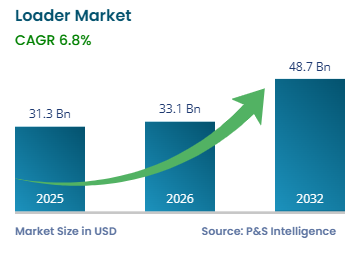
The global loader market size is estimated at USD 31.3 billion in 2025, which is predicted to reach USD 48.7 billion by 2032, growing at a CAGR of 6.8% during 2026–2032.
The major factors driving the expansion include increasing infrastructure development worldwide, rising urbanization rates, growing mining activities, and the integration of advanced technologies such as automation and electrification into loader machinery. More than half of the world's population now lives in urban areas, with projections indicating this proportion will increase to 68% by 2050. This rapid urbanization is creating unprecedented demand for infrastructure development, residential construction, and commercial projects, all of which require efficient material handling equipment.
Additionally, technological advancements in loader design are reshaping the market landscape. Manufacturers are increasingly focusing on developing electric and hybrid loader models to comply with stringent emission regulations while reducing operational costs for end users. The integration of telematics, IoT sensors, and automation features is enhancing operational efficiency and safety standards across various applications, making modern loaders indispensable assets for industries worldwide.
The wheel loaders category holds the largest share in the global loader market in 2025, of approximately 35%, and is expected to maintain its dominant position during the forecast period. This lead stems from wheel loaders' exceptional versatility across diverse terrain types and applications, making them the preferred choice for construction, mining, and agricultural operations. Wheel loaders offer superior mobility compared to tracked variants, allowing rapid repositioning across job sites and efficient operation on paved surfaces, gravel, and moderately uneven terrain.
The operational advantages of wheel loaders contribute significantly to their market dominance. These machines provide excellent maneuverability through articulated steering mechanisms, enabling tight turns and precise positioning in confined spaces. Their hydraulically powered lifting arms deliver substantial loading capacity while maintaining stability, making them ideal for handling bulk materials, such as soil, gravel, sand, aggregates, and demolition debris. Additionally, wheel loaders typically feature lower acquisition and maintenance costs compared to specialized loader variants, enhancing their appeal to cost-conscious operators and small-to-medium enterprises.
The skid steer loaders category is projected to witness the fastest growth during the forecast period. This rapid expansion is driven by increasing adoption in urban construction projects, landscaping operations, and agricultural applications where compact equipment is essential. Skid steer loaders' zero-turn radius capability enables operation in extremely confined spaces, making them invaluable for residential construction, interior demolition, and utility installation projects in densely populated urban environments.
The versatility offered by skid steer loaders through extensive attachment compatibility further accelerates their adoption. These machines can rapidly switch between buckets, forks, augers, trenchers, and numerous other implements, transforming a single unit into multiple specialized tools. This multi-functionality reduces equipment costs and maximizes operational efficiency for contractors handling diverse project requirements. Furthermore, compact track loaders—a skid steer variant featuring tracks instead of wheels—are gaining popularity for their enhanced traction on soft, muddy, or sandy terrain, expanding the addressable market for this category.
These types are covered:
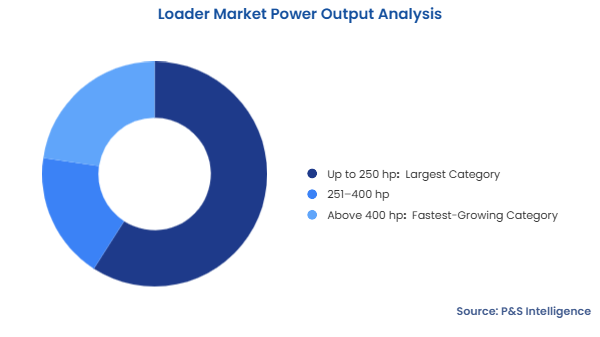
The up to 250 hp category dominates the loader market in 2025 with approximately 65% share, and it is expected to retain this leadership position throughout the forecast period. This category's dominance reflects the optimal balance these engines provide between adequate power output and fuel efficiency, making them suitable for most of the construction, agricultural, and light-to-medium mining applications. Loaders equipped with engines in this capacity range deliver sufficient torque and hydraulic power for standard material handling tasks while maintaining acceptable operational costs.
The widespread adoption of loaders with up-to-250-hp engines is particularly evident in developing economies where cost-effectiveness and fuel efficiency are primary purchasing considerations. These machines serve effectively in residential construction projects, road building activities, agricultural operations, and small-to-medium scale mining sites. Their moderate fuel consumption compared to higher-capacity engines reduces operating expenses significantly over the machine's lifecycle, improving return on investment for operators. Additionally, engines in this range typically meet emission standards more easily, simplifying regulatory compliance for manufacturers and end users.
The above 400 hp category is projected to grow the fastest during 2026–2032, driven by the increasing demand for high-capacity loaders in large-scale mining operations and major infrastructure projects. These powerful machines are essential for handling heavy loads and operating continuously in demanding environments where productivity and efficiency are paramount. Large open-pit mines, quarries, and mega construction projects require loaders with exceptional lifting capacity and durability, which necessitates engines exceeding 400 hp.
These power outputs are covered:
The internal combustion engine category holds the largest market share in 2025, of approximately 65%, reflecting the continued dominance of diesel and gasoline-powered loaders across global markets. ICE-powered loaders are popular due to established fuel infrastructure, reliability in harsh operating conditions, superior power output for heavy-duty applications, and longer operational range. The extensive service network for ICE engines and the familiarity of operators and maintenance personnel with this technology further reinforce market preference.
Diesel engines specifically dominate the ICE category due to their fuel efficiency, high torque output, and durability in continuous operation scenarios. Mining companies and large construction firms particularly favor diesel-powered loaders for their ability to operate extended shifts without performance degradation. The widespread availability of diesel fuel in remote mining locations and construction sites globally ensures operational continuity, making ICE loaders the practical choice for projects in areas lacking electrical charging infrastructure.
The electric category is anticipated to register the fastest growth rate during the forecast period. This accelerated expansion is driven by increasingly stringent emission regulations, rising environmental consciousness among end users, and substantial improvements in battery technology that are eliminating traditional electric vehicle limitations. Electric loaders offer significant operational advantages, including zero emissions, reduced noise levels, lower maintenance requirements, and decreased fuel costs, making them increasingly attractive for urban construction projects and indoor applications.
Government incentives and subsidies promoting clean energy adoption in construction and mining sectors are accelerating electric loader adoption globally. European Union countries are implementing aggressive emission reduction targets for construction equipment, compelling manufacturers to expand their electric loader portfolios. Battery technology advancements are extending operational hours and reducing charging times, addressing previous concerns about electric loader viability. As charging infrastructure expands and battery costs decline, electric loaders are expected to capture increasing market share, particularly in developed regions prioritizing sustainability.
These power sources are covered:
The construction application holds the largest share in the loader market in 2025, of 30%, and is expected to maintain its dominant position throughout the forecast period. Construction activities encompass a vast array of projects, including residential buildings, commercial complexes, industrial facilities, roads, bridges, airports, and urban infrastructure, all requiring extensive loader deployment for earthmoving, material handling, excavation, and site preparation operations. The continuous expansion of construction activities driven by urbanization and infrastructure investment sustains robust demand for loaders across this application category.
The mining application is projected to witness the fastest growth during the forecast period. This accelerated expansion reflects the surging global demand for minerals and metals driven by industrial growth, technological advancement, and energy transition initiatives. Mining operations require heavy-duty loaders with exceptional lifting capacity, durability, and reliability to handle ore, waste rock, and processed materials efficiently in challenging environments, including open-pit mines, underground operations, and quarries.
In 2023, global iron ore production reached approximately 2.4 billion tonnes, marking a 1.1% increase from 2022. Coal production increased by 0.8% in 2024 to 9,068 million tonnes. In 2023, global copper mine production reached approximately 22.36 million tonnes, while in 2023, global bauxite production reached approximately 387 million tonnes.
These applications are covered:
Drive strategic growth with comprehensive market analysis
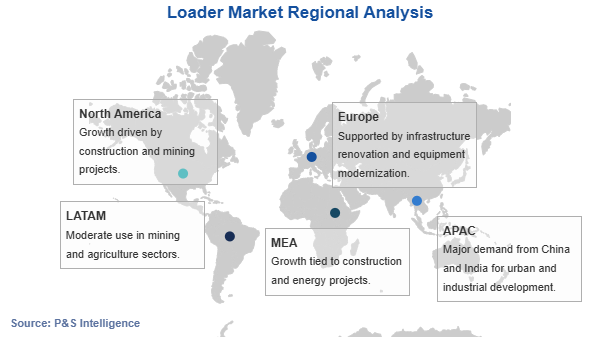
Geographically, Asia-Pacific holds the largest share in the global loader market in 2025, of approximately 40%, and is expected to maintain its leadership position throughout the forecast period. This regional dominance is primarily driven by rapid infrastructure development, extensive construction activities, and industrial expansion across emerging economies, including China, India, Southeast Asian nations, and developing economies in the region. The combination of massive population bases, accelerating urbanization, and government-led infrastructure initiatives creates unprecedented demand for construction equipment.
The mining sector's expansion in Asia-Pacific further amplifies loader demand across the region. Australia maintains its position as a leading global mining hub, with extensive iron ore, coal, and gold extraction operations requiring continuous deployment of high-capacity loaders. Indonesia's mineral wealth, including significant copper, nickel, and coal reserves, drives mining equipment adoption, while countries across the region pursue mineral extraction to support industrial growth and export revenues.
North America is projected to witness steady growth during the forecast period at a CAGR of around 7.5% from 2026 to 2032. This growth trajectory is supported by infrastructure modernization initiatives, residential and commercial construction activity, and the robust mining sector across the United States and Canada. The United States drives the majority of North American loader demand through extensive construction activity across residential, commercial, and infrastructure segments.
Canada's mining industry represents another significant demand driver for loaders in North America. The country's vast mineral resources, including potash, uranium, iron ore, copper, and gold, require continuous deployment of mining equipment. The energy transition is amplifying demand for minerals such as lithium, cobalt, and rare earth elements, driving exploration and development of new mining projects that require substantial loader fleets. Additionally, agricultural operations across the region utilize loaders extensively for grain handling, feed distribution, and general farm maintenance, contributing to sustained market demand.
Europe is expected to register moderate growth during the forecast period, driven by infrastructure renewal projects, urban redevelopment initiatives, and the region's transition toward sustainable construction practices. European Union emission regulations are accelerating the adoption of electric and hybrid loaders, with manufacturers developing region-specific models to comply with stringent environmental standards.
The regions and countries analyzed in this report are:
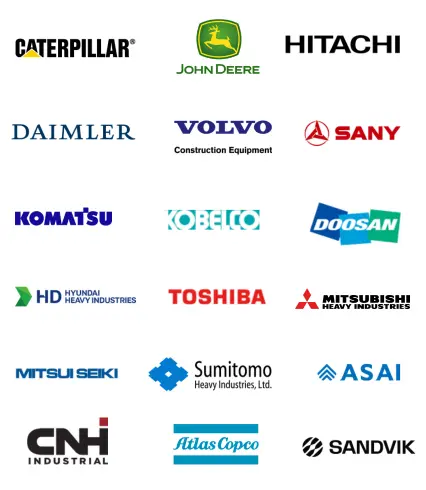
The global loader market exhibits a consolidated competitive structure, reflecting the significant capital requirements, technological expertise, and global distribution networks necessary to compete effectively in the loader industry. The market leaders have established strong brand recognition, extensive dealer networks, comprehensive after-sales service capabilities, and continuous research and development investments that create substantial barriers to entry for new competitors.
The leading players maintain their market positions through several strategic advantages, including economies of scale in manufacturing, diversified product portfolios spanning multiple loader types and capacity ranges, established relationships with major construction and mining companies, and continuous technological innovation. These companies invest heavily in developing advanced features such as telematics systems, operator assistance technologies, emission reduction solutions, and automation capabilities that differentiate their products and justify premium pricing.
Want a report tailored exactly to your business need?
Request CustomizationLeading companies across industries trust us to deliver data-driven insights and innovative solutions for their most critical decisions. From data-driven strategies to actionable insights, we empower the decision-makers who shape industries and define the future. From Fortune 500 companies to innovative startups, we are proud to partner with organisations that drive progress in their industries.

Working with P&S Intelligence and their team was an absolute pleasure – their awareness of timelines and commitment to value greatly contributed to our project's success. Eagerly anticipating future collaborations.
McKinsey & Company
India
Our insights into the minutest levels of the markets, including the latest trends and competitive landscape, give you all the answers you need to take your business to new heights

We take a cautious approach to protecting your personal and confidential information. Trust is the strongest bond that connects us and our clients, and trust we build by complying with all international and domestic data protection and privacy laws


Customize the Report to Align with Your Business Objectives

Request the Free Sample Pages