This Report Provides In-Depth Analysis of the Liquid Packaging Market Report Prepared by P&S Intelligence, Segmented by Material Type (Plastics, Paperboard, Glass, Metal), Packaging Type (Rigid, Flexible), Technology (Form-FillvSeal, Aseptic Liquid Packaging, Blow-Molding), End-Use Industry (Food & Beverage, Pharmaceutical, Personal Care, Household Care, Industrial), and Geographical Outlook for the Period of 2019 to 2032
Explore the market potential with our data-driven report
Liquid Packaging Market Overview
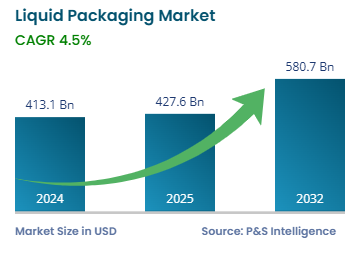
The liquid packaging market size was USD 413.1 billion. in 2024, which is predicted to reach USD 580.7 billion by 2032, growing at a CAGR of 4.5% during 2025–2032.
This substantial growth reflects the increasing demand for convenient, safe, and sustainable packaging solutions across diverse liquid product categories, including beverages, pharmaceuticals, personal care items, and household chemicals. The rising preference for ready-to-drink products, coupled with increasing urbanization and changing consumer lifestyles, has created unprecedented demand for efficient liquid packaging solutions that ensure product safety, extend shelf life, and provide convenience.
Technological advancements in packaging materials and manufacturing processes are revolutionizing the industry landscape.
In March 2025, Constantia Flexibles acquired a majority stake in Aluflexpack AG, a European flexible packaging producer serving the food and pharmaceutical sectors. The demand for safe, durable, and sustainable liquid packaging is intensifying, primarily fueled by rising consumption of packaged beverages and liquid foods, particularly in emerging economies. With the growing urban population, increasing disposable incomes, and rising health and hygiene consciousness, the preference for ready-to-consume, on-the-go liquid formats has significantly expanded the market base.
In parallel, industries such as pharmaceuticals, nutraceuticals, and industrial chemicals are adopting high-barrier and tamper-evident liquid packaging solutions to meet stringent safety and compliance regulations. Technological developments such as aseptic packaging, smart closures, multi-layer laminates, and sustainable materials are further redefining product offerings, while also addressing environmental concerns associated with plastic waste.
Liquid Packaging Market Dynamics
Technological Innovations in Aseptic Packaging Are Key Trends
Aseptic packaging enables the filling of sterilized liquids into pre-sterilized containers in a sterile environment, extending shelf life without preservatives or refrigeration.
Global aseptic packaging demand is increasing due to the growth in shelf-stable dairy, juices, plant-based beverages, and liquid pharmaceuticals.
In the Middle East & Africa, Saudi Arabia and the U.A.E. have invested a combined USD 145 million to build over 30 aseptic packaging centers.
They have also signed 17 technology transfer agreements with European and U.S. suppliers to accelerate local aseptic packaging capabilities.
Recent innovations include electron beam (e-beam) and pulsed light sterilization, which offer faster, chemical-free sterilization of packaging materials.
The use of multilayer high-barrier films, including EVOH and aluminum-free structures, enhances oxygen and moisture resistance, improving product stability.
Robotics and AI-integrated aseptic filling systems are reducing human intervention, increasing line efficiency, and ensuring microbiological safety.
Manufacturers are adopting single-material recyclable aseptic packaging to meet sustainability targets without compromising barrier properties.
Real-time sterilization validation systems with IoT-enabled sensors are improving process monitoring, ensuring compliance with stringent food safety regulations.
New aseptic technologies allow for the safe packaging of low-acid products like soups, broths, and protein drinks, expanding application scope.
Governments in Brazil and Mexico have collectively allocated approximately USD 1.1 billion in grants to modernize aseptic production lines, especially for pharmaceuticals.
Additionally, they have invested USD 320 million to develop localized packaging hubs focused on pediatric and vaccine products.
Demand for lightweight, space-efficient aseptic pouches and bag-in-box formats is rising in food service and industrial applications.
SIG, Tetra Pak, and Ecolean are launching tethered caps, fiber-based aseptic cartons, and carbon-neutral packaging lines.
Aseptic PET bottle technology is gaining traction in emerging markets for high-volume beverage filling with low logistical and energy costs.
Rising Consumer Demand for Convenience and On-the-Go Products Drives Market Growth
The global shift toward fast-paced lifestyles, especially among working professionals and urban populations, is driving the demand for conveniently packaged, ready-to-consume liquid products.
As per the International Labour Organization, as of 2024, the global employment rate is 58.37%, with approximately 3.71 billion people in the labor force.
In high-income countries, such as the U.S., UK, and Australia, ultra-processed foods account for 50–60% of daily calorie intake.
Single-serve formats such as tetra packs, spouted pouches, and PET bottles are gaining popularity for beverages like juices, dairy drinks, plant-based alternatives, and energy drinks.
The Economic Development Administration (EDA) awarded USD 500,000 to the University of Wisconsin–Stevens Point, matched by local funds, to acquire sustainable packaging testing equipment—supporting innovations that also benefit liquid food and beverage packaging.
The growth in out-of-home consumption and increased travel has led to a rising demand for spill-proof, lightweight, and resealable packaging.
E-commerce and food delivery platforms have raised their procurement of tamper-evident and easy-to-carry liquid packaging that maintains quality during transit.
Reclosable caps, ergonomic shapes, and on-pack dispensing mechanisms are being incorporated to enhance consumer usability and functionality.
The trend extends beyond beverages to include liquid personal care, cooking oils, sauces, and healthcare products designed for ease of use and portability.
The U.K. government, through Innovate UK’s SSPP Challenge, awarded grants of GBP 500,000 to 1.5 million to support reuse and refill packaging projects for liquid food and beverages—such as milk, soft drinks, and sauces, aimed at replacing single-use formats through in-store pilot programs.
Packaging companies are innovating with flexible packaging formats that combine convenience, sustainability, and aesthetic appeal to meet evolving expectations.
Liquid Packaging Market Segmentation Analysis
Material Type Analysis
The plastics category dominated the liquid packaging market in 2024 with a 35% share, reflecting its versatility, cost-effectiveness, and superior liquid compatibility properties. Polyethylene (PE), polypropylene (PP), and polyethylene terephthalate (PET) provide lightweight, durable, and leak-proof characteristics, essential for liquid product protection and transportation efficiency.
The plastic category's market lead is driven by its adaptability across diverse applications, from flexible pouches for beverages to rigid bottles for pharmaceuticals. The rapid expansion of e-commerce and food delivery industries has amplified demand for lightweight, shatterproof packaging that reduces shipping costs while ensuring product safety. Different plastic types offer specialized benefits: PET provides excellent clarity and barrier properties for beverages, HDPE offers chemical resistance for household products, and LDPE delivers flexibility for pouches and films.
The paperboard category is experiencing the fastest growth, during 2025–2032, driven by the escalating demand for sustainable packaging alternatives. Paperboard's renewable nature, excellent recyclability, and compatibility with barrier coatings make it increasingly attractive for dairy products, juices, and plant-based beverages. Companies are investing in advanced coating technologies that enhance paperboard's moisture resistance and structural strength, enabling performance comparable to traditional materials while maintaining environmental benefits.
Glass maintains significance in premium liquid packaging applications, particularly for alcoholic beverages, pharmaceuticals, and high-end personal care products. Its superior barrier properties, chemical inertness, and 100% recyclability without quality loss position glass as the preferred choice for products requiring maximum preservation and premium positioning. Metal packaging, including aluminum cans and tinplate containers, continues serving specialized applications requiring extended shelf life and superior protection against light and oxygen.
These material categories include:
Plastics (Largest Category)
Paperboard (Fastest-Growing Category)
Glass
Metal
Others
Packaging Type Analysis
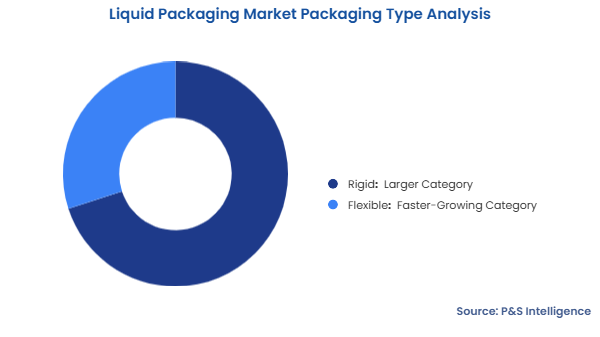
The rigid category commanded the larger market share at 70% in 2024, driven by its durability, structural integrity, and superior shelf presence across retail environments. Rigid packaging formats, including bottles, cans, jars, containers, and cartons, provide robust protection for liquid products while offering enhanced brand visibility and consumer confidence in product quality.
Rigid packaging's market dominance stems from its suitability for products requiring structural stability, extended shelf life, and tamper-evident features. The pharmaceutical industry particularly relies on rigid packaging for syrups, injectables, and liquid medication, where product integrity and sterility are paramount. Similarly, alcoholic beverages and premium personal care products utilize rigid formats to convey quality positioning and ensure product protection throughout distribution channels.
The flexible category is projected to achieve the higher CAGR, during the forecast period, reflecting growing consumer preference for convenient, space-efficient, and cost-effective packaging solutions. Flexible formats, including pouches, films, bags, and sachets, offer significant advantages in terms of material reduction, storage efficiency, and transportation cost savings compared to rigid alternatives.
Flexible packaging innovation has accelerated dramatically, with developments in barrier films, spout technologies, and stand-up pouch designs enabling applications previously dominated by rigid formats. The category benefits from increasing adoption in personal care products, food sauces, and beverage concentrates, where convenience and portion control are valued. Advanced flexible packaging technologies now provide comparable protection levels to rigid formats while offering superior sustainability profiles through reduced material usage.
Manufacturing efficiency drives additional flexible packaging adoption, with form-fill-seal technologies enabling integrated production processes that reduce handling, minimize contamination risks, and lower overall packaging costs. This technological advantage is particularly relevant for high-volume liquid products where production efficiency directly impacts market competitiveness.
These packaging types include:
Rigid (Larger Category)
Bottles
Cans
Jars
Containers
Cartons
Flexible (Faster-Growing Category)
Pouches
Films
Bags
Sachets
Technology Analysis
The form–fill–seal (FFS) category dominated the market with a 65% share in 2024, owing to its exceptional efficiency in combining multiple packaging processes into single continuous operations. FFS technology integrates material shaping, product filling, and package sealing, enabling rapid production cycles that meet high-volume manufacturing demands while maintaining consistent quality standards.
FFS technology's market lead reflects its cost-effectiveness and operational flexibility across diverse liquid packaging applications. The technology eliminates multiple handling stages, reduces labor requirements, and minimizes contamination risks through enclosed processing environments. These advantages translate into lower production costs and improved product safety, making FFS the preferred choice for manufacturers seeking to optimize operational efficiency while maintaining quality standards.
The aseptic liquid packaging category is experiencing the fastest growth, during 2025–2032, driven by the increasing demand for extended shelf-life products that maintain nutritional value without preservatives. Aseptic technology enables ambient storage of perishable liquids, including dairy products, fruit juices, and liquid foods, opening global distribution opportunities previously limited by cold chain requirements.
Aseptic packaging usage growth is particularly pronounced in emerging markets where cold-chain infrastructure remains limited, yet the consumer demand for high-quality liquid products continues expanding. The technology's ability to preserve product freshness, eliminate preservative requirements, and enable global distribution makes it increasingly valuable for multinational food and beverage companies seeking market expansion opportunities.
The food & beverage category dominated the market with a 30% share in 2024, reflecting the sector's massive scale and diverse liquid packaging requirements spanning water, juices, dairy products, alcoholic beverages, sauces, and liquid food ingredients. This category's market leadership is underpinned by continuous innovation in packaging formats that enhance product preservation, extend shelf life, and improve consumer convenience.
The category benefits from the rising health consciousness, increasing demand for functional beverages, and expanding ready-to-drink product categories. For instance, in June 2025, the California Beverage Container Redemption Innovation Grant Program, worth up to USD 73.33 million, was launched to support recycling initiatives, such as reverse vending machines and mobile collection systems.
The pharmaceutical category is projected to achieve the fastest growth, during 2025–2032, driven by the expanding global healthcare markets, aging populations, and increasing demand for liquid dosage forms. Pharmaceutical liquid packaging requires specialized materials and technologies that ensure product stability, prevent contamination, and maintain accurate dosage delivery throughout product lifecycles.
Pharmaceutical packaging usage growth is accelerated by the healthcare infrastructure expansion in developing countries and increasing prevalence of chronic diseases requiring liquid medications. The category demands high-precision packaging solutions, including vials, ampoules, syringes, and specialized bottles, that meet stringent regulatory requirements while ensuring patient safety and medication efficacy. As per studies, the fill–finish technology market will reach USD 20.7 billion, vial sales could cross USD 3 billion, and USD 3.6 billion worth of prefilled syringes could be bought worldwide by 2030.
These end-use industries are covered:
Food & Beverage (Largest Category)
Pharmaceutical (Fastest-Growing Category)
Personal Care
Household Care
Industrial
Others
Drive strategic growth with comprehensive market analysis
Liquid Packaging Market Geographical Analysis
Asia-Pacific Liquid Packaging Market Size
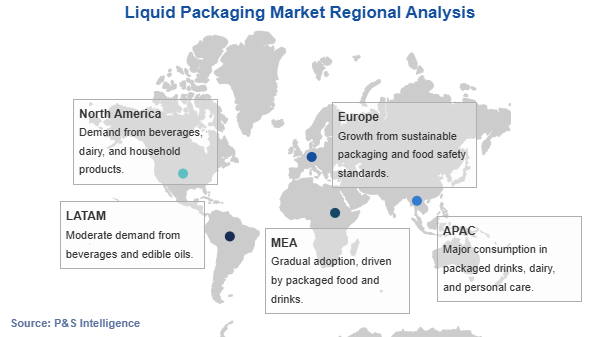
Asia-Pacific held the largest market share, of 40%, in 2024, primarily due to its massive population base, led by China and India. The region is experiencing rapid urbanization and rising disposable incomes, especially in emerging economies such as Vietnam, Indonesia, and the Philippines. This socio-economic shift is driving increased demand for convenient, on-the-go, and ready-to-consume liquid products across categories like beverages, dairy, edible oils, and personal care liquids.
Additionally, the widespread adoption of e-commerce and food delivery platforms has amplified the need for durable, spill-proof, and tamper-evident packaging formats. Health-conscious consumers in APAC are fueling demand for functional beverages, plant-based drinks, and ready-to-drink products, leading to the rise of innovative and flexible packaging solutions. Governments across the region, including in Japan, South Korea, India, and China, are also promoting sustainable and recyclable packaging regulations, pushing manufacturers toward more advanced packaging technologies.
Europe Liquid Packaging Market Growth
Europe demonstrates the fastest growth, with a CAGR, of approx. 5.0%, during 2025–2032, driven by the stringent environmental regulations, consumer preference for sustainable solutions, and advanced recycling infrastructure that supports circular economy initiatives. The European Commission's goal to reduce packaging waste by 15% per capita by 2040 creates regulatory momentum for innovative packaging solutions that minimize environmental impact while maintaining functionality.
Germany Liquid Packaging Market Growth
Germany represents the largest European market for liquid packaging, supported by strong manufacturing capabilities, advanced technology adoption, and consumer preference for premium packaging solutions. The country's leadership in automotive, pharmaceutical, and chemical industries creates substantial demand for specialized liquid packaging applications requiring high performance and reliability.
In November 2024, Amcor plc agreed to acquire Berry Global Inc. in an all-stock deal valued at around USD 8.43 billion, forming a dominant player with cross-sector reach, including food & beverage packaging.
The regions and countries analyzed in this report are:
North America
U.S. (Larger Country Market)
Canada (Faster-Growing Country Market)
Europe (Fastest-Growing Regional Market)
Germany (Largest Country Market)
U.K. (Fastest-Growing Country Market)
France
Italy
Spain
Rest of Europe
Asia-Pacific (Largest Regional Market)
Japan
China (Largest Country Market)
India (Fastest-Growing Country Market)
South Korea
Australia
Rest of APAC
Latin America
Brazil (Largest Country Market)
Mexico (Fastest-Growing Country Market)
Rest of LATAM
Middle East and Africa
Saudi Arabia (Largest Country Market)
South Africa
U.A.E. (Fastest-Growing Country Market)
Rest of MEA
Liquid Packaging Market Share
The global liquid packaging market exhibits a moderately fragmented competitive structure, characterized by the presence of numerous established players alongside emerging companies specializing in innovative packaging solutions. The market fragmentation reflects diverse customer requirements across multiple end-use industries, regional preferences, and varying technological sophistication levels that create opportunities for companies with different strategic focuses.
Market competition intensifies around sustainability innovation, technological advancement, and cost optimization capabilities. Leading companies are investing substantially in research and development to create packaging solutions that meet evolving environmental regulations, consumer preferences, and operational efficiency requirements. The competitive landscape features both multinational corporations with comprehensive product portfolios and specialized companies focusing on niche applications or innovative materials.
Key Liquid Packaging Companies:
Amcor plc
Tetra Pak / Tetra Laval International S.A.
Sonoco Products Company
Berry Global Inc.
SIG Combibloc / SIG Group
Mondi PLC
Evergreen Packaging Inc.
Constantia Flexibles
ProAmpac
Liqui?Box Corporation
Elopak AS
Nippon Paper Industries Co., Ltd.
Liquid Packaging Market News
In April 2025, Reusables.com raised USD 2.6 million (CAD 3.6 million) in seed funding from leading Canadian climate technology and B2B SaaS investors, and launched its reusable packaging platform at University of California campuses (UCLA and UC Riverside) as part of an Earth Day initiative.
In March 2025, VYTAL Global GmbH, a Cologne-based smart reusable packaging provider, secured EUR 14.2 million in growth capital to accelerate international expansion and enhance product innovation strategies for sustainable packaging solutions.
In December 2024, Jubilant Bhartia Group acquired 40% shares in Hindustan Coca-Cola Potables Pvt. Ltd. for approximately ₹10,000 crore, supporting Coca-Cola's asset-light strategy while leveraging Jubilant's bottling operation expertise for market expansion.
In September 2024, The Humble Co. partnered with Elopak to introduce sustainable carton packaging for mouthwash products, replacing previous PET containers with environmentally friendly alternatives that support circular economy principles.
In May 2024, ITO EN launched two new chunky drinks in SIG SmileSmall carton packs, leveraging SIG Drinksplus technology in SIG SmileSmall 24 Aseptic filling machines to expand liquid packaging applications for textured beverages.
In February 2024, Amcor plc, in collaboration with Stonyfield Organic and Cheer Pack North America, introduced an all-polyethylene (PE) spouted pouch for YoBaby refrigerated yogurt. This mono-material, recycle-ready packaging replaces prior multi-laminate structures, using Amcor’s AmPrima Plus PE film and Cheer Pack’s Vizi cap, offering reduced plastic usage and improved recyclability.
Want a report tailored exactly to your business need?
Leading companies across industries trust us to deliver data-driven insights and innovative solutions for their most critical decisions. From data-driven strategies to actionable insights, we empower the decision-makers who shape industries and define the future. From Fortune 500 companies to innovative startups, we are proud to partner with organisations that drive progress in their industries.
Client Testimonials
Working with P&S Intelligence and their team was an absolute pleasure – their awareness of timelines and commitment to value greatly contributed to our project's success. Eagerly anticipating future collaborations.
McKinsey & Company
India
Unmatched Standards
Our insights into the minutest levels of the markets, including the latest trends and competitive landscape, give you all the answers you need to take your business to new heights
Complete Data Security
We take a cautious approach to protecting your personal and confidential information. Trust is the strongest bond that connects us and our clients, and trust we build by complying with all international and domestic data protection and privacy laws