Linear Pluggable Optics Market Size & Share Analysis - Trends, Drivers, Competitive Landscape, and Forecasts (2025 - 2032)
This Report Provides In-Depth Analysis of the Linear Pluggable Optics Market Report Prepared by P&S Intelligence, Segmented by Data rate (Up to 200G, 400G, 800G, 1.6T and above), Form factor (QSFP (including QSFP-DD and QSFP112), OSFP (including OSFP-XD), SFP, CFP), Fiber type (Single-mode fiber, Multimode fiber), Application (Data centers, Telecommunications, Enterprise networks), and Geographical Outlook for the Period of 2021 to 2032
Explore the market potential with our data-driven report
Linear Pluggable Optics Market Overview
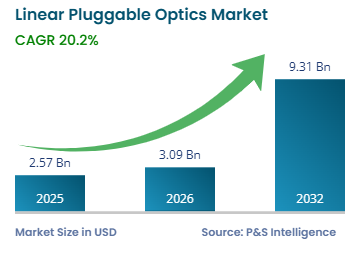
The global linear pluggable optics market was valued at USD 2.57 billion in 2025, and 2026 revenue is estimated at USD 3.09 billion. Sales are projected to reach USD 9.31 billion by 2032, advancing at a 20.2% CAGR over 2026-2032. Cloud providers and AI cluster builders are buying linear modules because dropping the signal processor from each transceiver lowers power, heat, and cost across the thousands of short links that tie GPU servers to switches. For module makers, a handful of these operators now set both order volumes and product specifications.
Power budgets explain much of this growth. The International Energy Agency estimates that data centers used around 415 TWh of electricity in 2024 and expects that figure to roughly double to around 945 TWh by 2030, with AI-oriented accelerated servers growing fastest. Every watt saved in the optical interconnect can go to compute inside a fixed site power allocation, so operators now weigh module power alongside price during qualification. Linear pluggable optics demand follows new AI cluster builds closely, and suppliers able to ship qualified 800G modules in volume tend to win the earliest orders.
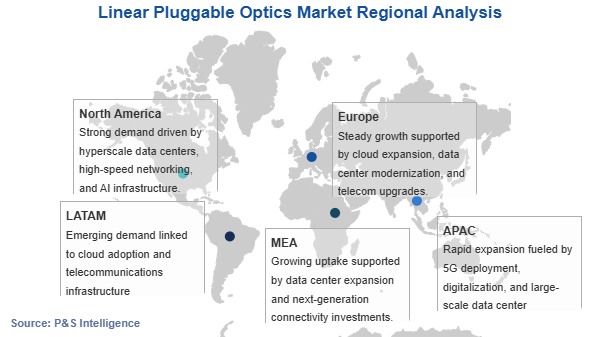
North America accounted for 38% of revenue in 2025, led by the U.S., where cloud providers running the largest AI training clusters were early to qualify linear modules on their own switch and network-card platforms. Asia-Pacific is projected to expand at a 23.1% CAGR during 2026-2032, the fastest of any region. China combines most of the world's high-speed module production with a growing base of domestic AI data centers, while Japan, South Korea, and India add new capacity. Asia-Pacific growth leans on new builds, whereas North American spending increasingly comes from speed upgrades in existing clusters.
Key market insights
By data rate, 400G modules held 35% of linear pluggable optics revenue in 2025, while the 1.6T and above tier is set to post the fastest growth over 2026-2032.
By form factor, QSFP (including QSFP-DD and QSFP112) held 47% in 2025, while OSFP (including OSFP-XD) is set to expand at a 34.8% CAGR over 2026-2032.
By fiber type, single-mode fiber led the market in 2025, while multimode fiber is on course for the quickest gains over 2026-2032.
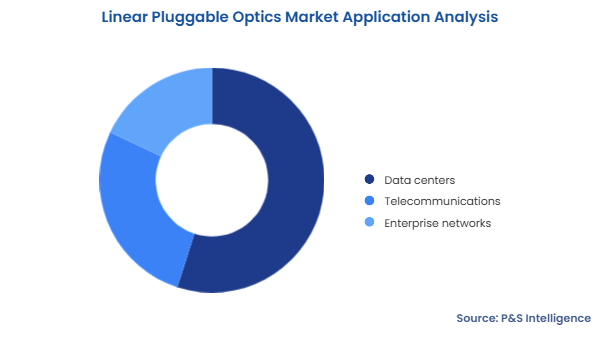
By application, data centers held 55% in 2025 and are also on track to be the fastest-growing application over 2026-2032.
By geography, North America held 38% in 2025, while Asia-Pacific is set to expand at a 23.1% CAGR over 2026-2032.
Linear Pluggable Optics Market Trends and Growth Drivers
AI cluster build-outs are driving orders for lower-power short-reach modules
Operators building GPU training and inference clusters buy optical modules in large batches, and the power each module draws is multiplied across every server-to-switch and switch-to-switch link in the fabric. Removing the digital signal processor from a pluggable can cut a large part of that draw, along with the latency the chip adds. Linear modules therefore let an operator fit more accelerators inside a fixed power and cooling allocation, which makes power per link a purchase criterion alongside price.
NVIDIA Corporation reported Data Center revenue of USD 193.7 billion for its fiscal year 2026, which ended in January 2026, up 68% from the prior year. Accelerator spending at that scale matters for optics because each new rack must connect to the network fabric, so module orders tend to rise with compute spending, though not in fixed proportion. Module makers already qualified on the leading GPU and switch platforms are best placed to take that volume, because operators seldom add a new supplier in the middle of a cluster build.
Multi-vendor specifications are reshaping how buyers qualify linear modules
Early linear deployments paired one module design with one switch or network card, which kept buyers tied to short supplier lists and made second sourcing slow. Industry groups are now publishing shared optical and electrical limits so that a module from one maker works with hosts from several others. For hyperscale buyers, those shared limits cut the testing needed to add a second or third supplier, which makes dual sourcing practical at production volumes.
The LPO MSA, a group of more than 50 networking, semiconductor, and optics companies, released its 400G-FR4-LPO specification in September 2025, covering links of at least 500 meters over a pair of single-mode fibers. The document followed a 100G-DR-LPO specification issued in March 2025 and extends linear designs to the duplex fiber runs common in existing data center cabling. Suppliers that certify against these specifications early can bid for multi-source contracts, and buyers gain bargaining power on price from a wider pool of qualified vendors.
Half-retimed designs are opening linear optics to mixed-vendor networks
Fully linear modules leave all signal recovery to the host chip, which works well in single-vendor AI clusters but is harder to guarantee when switches, network cards, and modules come from different suppliers. Half-retimed designs keep a retimer on the transmit side and drive only the receive side linearly, keeping much of the power saving while tolerating a wider range of hosts. That trade makes linear-style modules a realistic option for enterprise, colocation, and front-end cloud networks, where fully linear parts are a harder sell.
The Optical Internetworking Forum published an implementation agreement in November 2025 for a 112 Gb/s retimed-transmitter, linear-receiver interface between a host chip and an optical module. A published interface gives switch makers and module vendors a common design target, which can shorten qualification for buyers running mixed equipment. Module suppliers able to offer fully linear and half-retimed versions of the same product could sell into cloud and enterprise accounts from one production platform, spreading development costs across a broader customer base.
Tighter signal budgets at 200G per lane are challenging next-generation linear modules
Linear modules rely on the host chip's SerDes to clean up the optical signal, an approach proven at 100G per lane. Moving to 200G per lane for 1.6T ports doubles the signaling rate and tightens the loss allowed between switch chip and module, so fewer combinations of host, board trace, and module can run fully linear. Buyers planning 1.6T fabrics may stay with DSP-based optics or move to co-packaged designs for some links, which could hold down the linear share of the newest port generation.
The IEEE's 802.3dj project, which adds Ethernet physical layers at 200 Gb/s per lane up to 1.6 Tb/s, was still listed as a draft standard in September 2026. Until its electrical specifications are final, host and module makers are designing against moving targets, and fully linear modules carry more interoperability risk at that speed than retimed ones. For suppliers, the delay raises development costs and pushes back volume revenue from 200G-per-lane linear products, while vendors that also sell DSP-based modules can hedge across both designs.
Linear Pluggable Optics Market Segmentation Analysis
Data Rate
400G modules accounted for 35% of linear pluggable optics revenue in 2025. Much of the switch and network-card base installed during the first wave of AI cluster builds runs 400G ports, and operators adding capacity to those clusters tend to match the existing port speed so they can reuse cabling, spares, and approved module lists. 400G links also serve storage and front-end connections, where operators want lower module power without redesigning the network. Suppliers with mature, low-cost 400G linear lines keep earning from that installed base as newer speeds arrive.
The 1.6T and above tier is expected to post the fastest growth through 2032, and modules at 800G and above as a group are projected to grow at a 35.0% CAGR over 2026-2032. Broadcom Inc. began shipping its Tomahawk 6 switch chip in June 2025, with 102.4 Tb/s of switching capacity on a single chip built on 200G SerDes. A switch of that size needs 1.6T-class ports to use its full bandwidth, so each new AI fabric pulls module demand toward higher speeds. Suppliers with 1.6T linear samples in customer testing are best placed for the first large orders.
Form Factor
QSFP modules, including QSFP-DD and QSFP112, held 47% of linear pluggable optics revenue in 2025. Most data center switches shipped over the past decade use QSFP-family cages, so operators can adopt linear modules without replacing line cards or front panels. QSFP-DD ports also accept older QSFP28 and QSFP56 modules, which lets a buyer mix older and newer optics in one chassis during an upgrade instead of replacing everything at once. That compatibility keeps switching costs low for buyers and favors vendors with broad QSFP catalogs that span several speed generations.
OSFP modules, including OSFP-XD, are projected to grow at a 34.8% CAGR during 2026-2032, faster than any other form factor. The larger OSFP housing sheds more heat, which matters as 800G and 1.6T modules draw more power per port. According to the OSFP MSA, the OSFP-XD variant carries 16 electrical lanes, doubling faceplate density over standard OSFP and supporting 1.6 Tb/s on 100G lanes. That lane count lets linear designs reach 1.6T on proven 100G-per-lane signaling, giving suppliers built around OSFP an earlier route into next-generation AI fabrics.
Fiber Type
Single-mode fiber modules generated the most linear pluggable optics revenue in 2025. Hyperscale operators connect servers to leaf and spine switches across rows and halls that often span hundreds of meters, distances multimode links generally cannot cover at 100G per lane. Single-mode cabling also carries several speed generations, so an operator installs it once and upgrades only the optics. Each speed step then becomes a module purchase on the same fiber plant, which benefits suppliers of single-mode linear modules built on EML or silicon photonics designs.
Multimode fiber modules are set to record the quickest growth over the forecast period. Denser AI racks place GPUs and switches within a few meters of each other, where VCSEL-based multimode modules cost less per link and draw less power than single-mode parts. Operators are also replacing passive copper inside racks and between adjacent racks, because copper reach shrinks as lane speeds rise. Those short links give VCSEL suppliers and multimode module makers a fresh volume market that copper cables used to serve.
Application
Data centers accounted for 55% of linear pluggable optics revenue in 2025. Cloud providers and AI cluster operators run the largest numbers of short, high-speed links, and they control both the switch and the module specification, which lets them qualify linear designs tuned to a specific host chip. Their purchase volumes also justify the joint engineering and testing that linear links require. For suppliers, a single approval from a large cloud buyer can open orders across many sites at once.
Data centers are also expected to be the fastest-growing application through 2032, led by AI and high-performance computing clusters. Each training cluster adds a back-end network of GPU-to-switch links beside the conventional front-end network, which multiplies optical port counts per server. Telecommunications and enterprise networks run longer links on mixed equipment, where retimed modules remain the default choice for most buyers today. Vendors that concentrate sales and engineering on a few large data center accounts are likely to see the fastest order growth, although they take on heavy customer concentration.
The following segments are analyzed in this report:
Data Rate
Up to 200G
400G
800G
1.6T and above
Form Factor
QSFP (including QSFP-DD and QSFP112)
OSFP (including OSFP-XD)
SFP
CFP
Fiber Type
Single-mode fiber
Multimode fiber
Application
Data centers
Telecommunications
Enterprise networks
Drive strategic growth with comprehensive market analysis
Linear Pluggable Optics Market Geographical Analysis
North America Linear Pluggable Optics Market outlook
North America held 38% of global linear pluggable optics revenue in 2025. The region hosts the largest AI training clusters, run by U.S. cloud providers that design their own network fabrics and can qualify a linear module against a specific switch or network card. Several of the host-chip and switch vendors whose platforms linear modules plug into are based in the U.S., which shortens joint testing between host and module suppliers. The U.S. is the region's largest market, while Canada adds smaller cloud and colocation builds.
Census Bureau data show U.S. spending on data center construction running at a seasonally adjusted annual rate above USD 75 billion in July 2026, nearly 60% higher than a year earlier. Networking gear goes in after each building is finished, so that construction points to optics orders continuing beyond 2026. North America's share is likely to ease as Asia-Pacific builds faster, although its buyers move first to 800G and 1.6T, which keeps revenue per module higher. Suppliers with U.S.-qualified products and production outside China may hold an edge as trade policy weighs on sourcing decisions.
Asia-Pacific is set to grow faster than any other region, at a 23.1% CAGR over 2026-2032. China anchors that growth twice over, as home to large module makers such as Zhongji Innolight, Eoptolink, and Accelink, and as a buyer through domestic cloud and AI operators. Japan and South Korea add demand from cloud providers and carriers upgrading data center networks, while new hyperscale and colocation campuses in India and Australia create greenfield orders. Suppliers with production in the region can serve these buyers with short lead times.
Figures from China's Ministry of Industry and Information Technology put the country's intelligent computing capacity at 1,590 EFLOPS in 2025. A large part of that capacity is likely housed in recently built AI data centers with few legacy constraints, where operators can design their fabrics around linear modules from the start. As more of that compute moves from pilot projects into production clusters, module orders are likely to follow. Suppliers holding qualifications with Chinese cloud operators, along with capacity to serve export customers from plants outside China, are well positioned to capture the added volume.
Europe contributes a smaller share of global linear pluggable optics demand than North America or Asia-Pacific, with purchases concentrated in cloud and colocation hubs in Germany, the United Kingdom, and France. European operators have built fewer dedicated AI training clusters, so more of their spending still goes to front-end networks where retimed modules are the default. Constrained grid connections in several hubs do make module power a sharper buying criterion, which gives linear designs an argument even in conventional cloud halls.
The European Commission plans to mobilize EUR 20 billion for AI gigafactories, and an informal call drew 77 proposals for 60 sites across 16 member states before the formal call was published in July 2026. If those projects are awarded and built, each would add a large back-end GPU network of the kind where linear modules compete best. Suppliers with European sales and support teams could win early positions as these sovereign AI projects move from bids to construction.
Latin America contributes a modest portion of global demand, led by Brazil and Mexico, where cloud providers and colocation operators are adding capacity around São Paulo and Querétaro. Most regional sites serve cloud and enterprise workloads, so purchases lean toward proven 400G and 800G modules bought through the same global contracts that supply North American builds. High taxes on imported equipment have long raised the cost of building data centers in Brazil and slowed local capacity growth.
Brazil's Federal Senate reports that Law 15.504, signed in September 2026, set up a special tax regime for data center services that suspends import duty and federal taxes on equipment bought for qualifying projects. Optical modules installed in those projects are likely to benefit, lowering the landed cost of network hardware for operators that meet the law's clean-energy, water-efficiency, and domestic-supply conditions. Module suppliers with local distribution and import experience in Brazil stand to gain as more projects qualify.
The Middle East and Africa hold a smaller share of the market, with demand concentrated in the United Arab Emirates and Saudi Arabia, where state-backed programs are funding national AI and cloud capacity. These projects tend to be large campuses built with U.S. technology partners, so their optics purchases follow the same 800G module specifications used in those partners' home clusters. South Africa adds smaller colocation demand from enterprises and cloud regions.
Gulf buyers often place large orders tied to a single campus phase, which makes regional revenue uneven from one year to the next. U.S. export licensing for advanced AI chips also affects timing, since a cluster cannot be wired until its accelerators are cleared for shipment. Module suppliers already approved by the global cloud providers operating in the Gulf are the most likely winners, because campus operators typically copy the bill of materials from their partners' existing sites.
The following geographies are analysed in this report.
North America
U.S.
Canada
Asia-Pacific
China
Japan
South Korea
India
Australia
Rest of Asia-Pacific
Europe
Germany
U.K.
France
Italy
Spain
Rest of Europe
Latin America
Brazil
Mexico
Rest of Latin America
Middle East and Africa
Saudi Arabia
U.A.E.
South Africa
Rest of Middle East & Africa
Linear Pluggable Optics Market Share Analysis
The Linear Pluggable Optics Market is moderately fragmented, with module makers, laser and chip suppliers, and switch vendors each controlling a different part of every link. A linear link only works when the host chip and the module are tuned together, so no single company controls the outcome and influence is spread across several suppliers. Qualification by a small group of hyperscale buyers is one of the main hurdles, and suppliers that clear it can add volume quickly. The structure is still shifting, as the largest module makers add capacity faster than smaller rivals.
Module manufacturers such as Zhongji Innolight, Eoptolink, Accelink, and CIG Shanghai compete on production scale, cost per module, and speed of qualification with cloud buyers. A second cluster of component suppliers, including Coherent, Broadcom, MACOM, and Semtech, competes on lasers, drivers, amplifiers, and host SerDes whose performance decides whether a linear link works at all. Switch vendors such as Arista and Cisco shape demand by certifying which modules run on their platforms. Several of these companies also helped write the industry's shared linear specifications, giving them a say in the limits rivals must meet.
This layered structure keeps module pricing competitive, since several qualified makers can build to the same multi-source specification. Switching costs are higher at the host level, where a change of switch silicon can force buyers to requalify every module in the network. Component suppliers that sell to several module makers are partly shielded from shifts in module share, while module makers dependent on one or two cloud customers face sharper swings in orders.
Leading Companies in the Linear Pluggable Optics Market:
In September 2026, MACOM Technology Solutions Holdings, Inc. demonstrated linear drivers and transimpedance amplifiers for SFP56 and SFP112 linear optical modules aimed at 5G-Advanced and 6G fronthaul links at ECOC 2026 in Málaga, Spain. The parts point to a telecom use for linear optics beyond AI data centers, which could widen the customer base for SFP-format modules.
In March 2026, Semtech Corporation launched a family of 224 Gbps-per-lane transimpedance amplifiers and modulator drivers for linear, half-retimed, near-packaged, and co-packaged optics serving 800G, 1.6T, and 3.2T transceivers, with three devices available immediately. Chips shipping at this lane speed let module makers start building 200G-per-lane linear products for AI clusters.
In March 2026, Eoptolink Technology Inc. Ltd. showcased a 1.6T transceiver series built on 200G-per-wavelength optics in fully retimed, half-retimed, and linear versions at OFC 2026 in Los Angeles, alongside a 6.4T near-packaged optics module. Offering all three versions of one product lets cloud buyers choose the interface per link without changing supplier.
Frequently Asked Questions About This Report
Why are cloud providers adopting linear modules?+
Cloud providers and AI cluster builders are buying linear modules because dropping the signal processor from each transceiver lowers power, heat, and cost across the thousands of short links that tie GPU servers to switches.
How important is power efficiency in module selection?+
Every watt saved in the optical interconnect can go to compute inside a fixed site power allocation, so operators now weigh module power alongside price during qualification.
What determines success for module suppliers?+
Linear pluggable optics demand follows new AI cluster builds closely, and suppliers able to ship qualified 800G modules in volume tend to win the earliest orders.
Why is North America a major market for linear optics?+
The region hosts the largest AI training clusters, run by U.S. cloud providers that design their own network fabrics and can qualify a linear module against a specific switch or network card.
What is Asia-Pacific's role in the linear optics market?+
China anchors that growth twice over, as home to large module makers such as Zhongji Innolight, Eoptolink, and Accelink, and as a buyer through domestic cloud and AI operators.
How does Europe's market differ from other regions?+
European operators have built fewer dedicated AI training clusters, so more of their spending still goes to front-end networks where retimed modules are the default.
What are half-retimed designs?+
Half-retimed designs keep a retimer on the transmit side and drive only the receive side linearly, keeping much of the power saving while tolerating a wider range of hosts.
Want a report tailored exactly to your business need?
Leading companies across industries trust us to deliver data-driven insights and innovative solutions for their most critical decisions. From data-driven strategies to actionable insights, we empower the decision-makers who shape industries and define the future. From Fortune 500 companies to innovative startups, we are proud to partner with organisations that drive progress in their industries.
Client Testimonials
Working with P&S Intelligence and their team was an absolute pleasure – their awareness of timelines and commitment to value greatly contributed to our project's success. Eagerly anticipating future collaborations.
McKinsey & Company
India
Unmatched Standards
Our insights into the minutest levels of the markets, including the latest trends and competitive landscape, give you all the answers you need to take your business to new heights
Complete Data Security
We take a cautious approach to protecting your personal and confidential information. Trust is the strongest bond that connects us and our clients, and trust we build by complying with all international and domestic data protection and privacy laws