Explore the market potential with our data-driven report
LIB Cathode Conductive Auxiliary Agents Market Outlook
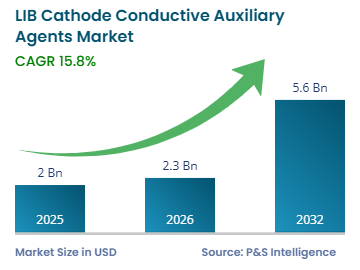
The LIB cathode conductive auxiliary agents market size was USD 2.0 billion for 2025, and it will grow by 15.8% during 2026–2032, to reach USD 5.6 billion by 2032.
The market growth is primarily driven by increasing need for higher performance, fast charge and longer range Lithium-Ion Battery Cathodes, which are used in both electric vehicles and consumer electronics. Battery manufacturers are focusing on increasing energy density, reducing charge time, and extending cycle life. These objectives are being achieved through the use of conductive auxiliary agents including carbon black, carbon nanotubes, graphene-based additives, and hybrid conductive networks, that allow for superior cathode performance and electrochemical efficiency. The International Energy Agency reported that global electric car sales were approximately 17 million units in 2024 and accounted for over 20% of all vehicle sales in 2024.
The rapid electrification of transportation has created sustained demand for advanced battery materials that provide improved conductivity, reduced internal resistance, and enhanced thermal stability. conductive auxiliary agents enable cathode chemistries like lithium nickel manganese cobalt (NMC) and lithium iron phosphate (LFP) to meet performance benchmarks necessary for fast charging and long-range electric vehicle operation.
Advanced Carbon Nanomaterial Development Is Key Trend
Innovative developments in advanced carbon nanomaterials are fundamentally changing the market for conductive materials, such that they exhibit much greater electrical conductivity and performance than do conventional carbon black products. The single-walled carbon nanotubes (SWCNTs) show many advantages over multiwall carbon nanotubes and traditional carbon black products including greater tensile strength and thermal conductivity, as well as better inherent electrical conductivity, which translates to significant improvements in performance over traditional carbon black products.
Research articles appearing in peer-reviewed scientific journals indicate that additives containing graphene can improve the electrical conductivity of batteries by 1.4 times, or more, in addition to improving the thermal management characteristics of the battery necessary for high power applications. Commercialization of graphene-based conductive additives specifically designed to meet very high energy density targets in lithium ion batteries using extremely low amounts of conductive additive compared to conventional conductive additives have been achieved by leading manufactures such as Cabot Corporation.
Electric Vehicle Production Scaling and Battery Capacity Expansion Are Biggest Drivers
The major demand driver for cathode conductive auxiliary agents is the rapidly expanding global electric vehicle production and corresponding increase in battery manufacturing capacity. Projections based on International Energy Agency reports indicate that more than one in four new vehicle sales in 2025 would have been electric.
Construction of battery gigafactories in Asia, North America, and Europe is translating electric vehicle sales into proportionate demands for cathode conductive agents. In Europe, the European Commission has identified battery manufacturing and electric mobility as strategic value chains under its industrial and climate policy agenda, and is providing support for large-scale investment in battery production capacity.
China's dominance of electric vehicle production accounting for more than half of all electric vehicles produced globally, combined with announced North American battery production investments exceeding USD 100 billion under Inflation Reduction Act incentives through 2030, ensure that demand for cathode conductive agents will continue to grow in multiple regions and create a distributed supply chain opportunity for suppliers of conductive agents.
The shift to nickel rich NMC cathode chemistries for premium electric vehicles and lithium iron phosphate for cost sensitive applications, create different requirements for cathode conductive agents, with high nickel formulations requiring advanced carbon nanotube networks to maintain conductivity as cobalt content is decreased, and lithium iron phosphate chemistries benefiting from the cost effectiveness and reliability of carbon black in lower voltage applications, creating a growing demand for a variety of products from conductive agent suppliers.
The carbon black category held the largest market share, of 60%, in 2025, due to it being relatively inexpensive, having an extensive manufacturing base and the fact that it has been utilized in virtually all of the battery cathode chemistries that have come into existence such as nickel manganese cobalt and lithium iron phosphate. The dominance of carbon black also comes from its widespread use in mass market electric vehicles and consumer electronics.
There is a strong demand for an economical performance rather than the highest level of conductivity and because of the extensive process knowledge that battery manufacturers have developed using optimized techniques for dispersing carbon black and coating electrodes over the past few decades of lithium-ion battery production.
The carbon nanotubes category will have the highest CAGR, of 16.0%, as they offer a superior method of transporting electrons and enable battery manufacturers to develop higher energy density batteries and to achieve faster charging times. CNTs are capable of achieving a high level of electrical conductivity, which enables battery manufacturers to reduce the amount of additive required, freeing up space in the electrode for active materials, while providing mechanical strength.
This supports silicon-anode integration when traditional carbon blacks are unable to support electrode integrity through the expansion of volume. In addition, CNTs offer superior performance in high-nickel cathodes where cobalt is being replaced or significantly reduced to meet regulatory requirements. As such, CNTs can provide improved conductivity compensation at lower weight percent than traditional additives.
The conductive additive types analyzed in this report are:
The nickel manganese cobalt category held the largest market share, of 45%, in 2025, as these are widely used in premium electric vehicle platforms due to their higher energy density than other chemistries that allow for longer driving ranges and support fast-charging performance requirements demanded by automotive OEMs. The large number of automotive OEMs seeking to achieve competitive vehicle ranges have led to a preference for higher energy density chemistries, such as NMC.
The large number of suppliers that exist to support scaled NMC production throughout Asia, North America, and Europe and the requirement for materials that remain conductive as nickel content increases and cobalt decreases in next generation formulations such as NMC811 and NMC9 variants that are designed to reduce material costs while maintaining electrochemical performance have contributed to NMC's dominant position in the conductive auxiliary agent market.
The lithium iron phosphate category will have the highest CAGR, driven by rapid adoption across cost-sensitive electric vehicle and energy storage applications. In addition, the elimination of cobalt and nickel supply chain constraints that are inherent with LFP chemistries will also contribute to the rapid adoption of these chemistries. This growth is further supported by the leading-edge technology of Chinese battery manufacturers that have achieved LFP energy densities approaching 180 Wh/kg, closing the performance gap with NMC while maintaining cost advantages, and by the increasing demand for grid energy storage that prioritize cycle life and safety over absolute energy density.
These factors make LFP chemistries particularly appealing for grid scale and commercial energy storage applications, where long cycle life, enhanced thermal stability and low total cost of ownership are critical considerations.
The cathode chemistries analyzed in this report are:
Nickel Manganese Cobalt (NMC) (Largest Category)
Lithium Iron Phosphate (LFP) (Fastest-Growing Category)
Nickel Cobalt Aluminum (NCA)
Lithium Cobalt Oxide (LCO)
Lithium Manganese Oxide & High-Voltage Cathodes
Application Analysis
The EVs category held the largest market share, of 70%, in 2025, and it will have the highest CAGR, of 16.1%, due to continued government policies to promote the use of electric vehicles throughout China, Europe and North America. In addition to promoting increased demand for batteries and, therefore, increasing the use of conductive agents, these same governments have also implemented performance standards for batteries in electric vehicles that require rapid charge capabilities and extended battery life.
This can only be achieved with conductive agents that provide enhanced conductivity and durability for the electrodes. The growth in demand for electric vehicles is being driven by several factors including the reduction in the cost of electric vehicles to parity with internal combustion engine vehicles, the increasing number of models available to consumers as automakers begin to electrify their entire product line, ranging from compact cars to commercial trucks, and the continued expansion of public charging infrastructure across major markets.
The applications analyzed in this report are:
Electric Vehicles (EVs) (Largest and Fastest-Growing Category)
Energy Storage Systems (ESS)
Consumer Electronics
Industrial Batteries
Specialty Applications
Others
Physical Form Analysis
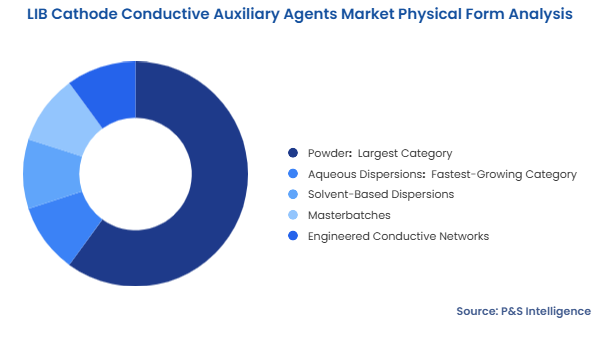
The powder category held the largest market share, of 60%, in 2025, due to the lower manufacturing cost of powder formulations compared to other forms of conductive agents, because they are easier to handle and coat onto electrodes in existing battery manufacturing facilities, and because battery manufacturers have developed expertise in optimizing powder dispersion techniques in order to maximize the performance of their products.
The dominance of powder formulations is further attributed to the ease of handling dry powders in battery manufacturing facilities, the cost savings of eliminating carrier liquids and associated handling equipment to reduce material costs by 10–15% compared to pre-dispersed alternatives, and the longer shelf life of powdered materials compared to liquid dispersions. This enables battery manufacturers to buy powdered materials in bulk and store them for months without degrading the quality of the dispersion or its electrochemical properties.
The aqueous dispersions category will have the highest CAGR, driven by growth in demand for aqueous dispersions include the need to replace toxic solvents in electrode manufacturing processes in accordance with environmental regulations, the benefits of reduced mixing energy and improved dispersion uniformity relative to solvent-based systems, and the potential cost savings of aqueous systems in comparison to solvent-based systems due to the elimination of expensive solvent recovery equipment and ventilation systems.
The growth in demand for aqueous dispersions is also being driven by technological advancements in binder formulation for aqueous processing, which have overcome earlier problems related to adhesion and the economic feasibility of aqueous dispersions when considering the total manufacturing cost of the material, including energy consumption, waste disposal, and equipment investments. As a result of these factors, aqueous dispersions are gaining significant traction in the industry, especially in connection with the construction of new gigafactories with aqueous electrode coating lines incorporated in the design of the facility rather than retro-fitting existing NMP-based coating lines.
The physical forms analyzed in this report are:
Powder (Largest Category)
Aqueous Dispersions (Fastest-Growing Category)
Solvent-Based Dispersions
Masterbatches
Engineered Conductive Networks
Drive strategic growth with comprehensive market analysis
LIB Cathode Conductive Auxiliary Agents Market Regional Outlook
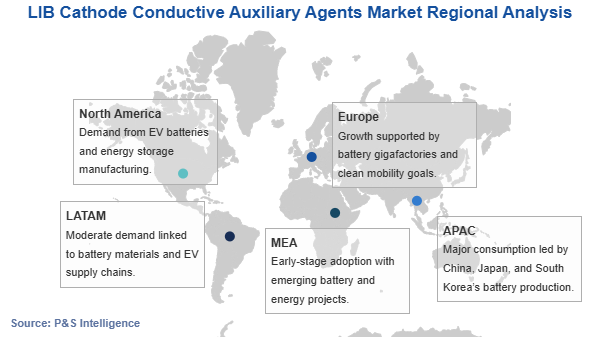
Asia-Pacific held the largest market share, of 45%, in 2025, and will have the highest CAGR, of 15.9%. The dominance of this geographic market can be attributed to the fact that Asia-Pacific has an extremely consolidated battery manufacturing environment, with China, Japan and South Korea being responsible for an overwhelming majority of the world-wide lithium ion battery manufacturing capacity. Asia-Pacific benefits from vertically integrated supply chains that span from raw material extraction and processing, through cell manufacturing, with the support of numerous government incentives for the manufacture of electric vehicles and energy storage systems. The extensive technical knowledge base in Asia for the design and manufacture of advanced cathode materials enables the rapid introduction of next generation conductive additives.
Additionally, South Korea will provide support for the development of next-generation battery technologies through their strength in high-performance battery production for premium automotive and energy storage applications, while Japan will lead the way in terms of technology for precision carbon materials and advanced dispersion techniques. For instance, Japan’s Green Growth Strategy and South Korea’s K-Battery Strategy will continue to promote investment in next-generation battery materials, including high-performance carbon-based conductive additives, to allow for the rapid commercialization of advanced cathode technologies throughout the Asia-Pacific region.
China LIB Cathode Conductive Auxiliary Agent Market Size
China represents the largest and fastest-growing country market in Asia-Pacific due to the government’s electric vehicle programs, domestic battery production capacity, and vertically integrated supply chains that control the manufacturing of cathode active materials. International Energy Agency (IEA) data confirmed that China remained the global electric car manufacturing hub in 2024 with domestic OEMs producing virtually all of the country’s electric vehicles, a significant increase from approximately 2/3 in 2021. This level of manufacturing concentration will drive similar levels of demand for cathode conductive auxiliary agents for NMC, LFP and other high voltage cathode chemistries utilized by domestic battery producers for both passenger vehicle and commercial fleet applications.
Moreover, China’s market growth trend will continue at an accelerated pace through 2032 based on policy incentives and investments in domestic conductive additive manufacturing, investments in carbon nanotube and graphene production facilities, and investments in battery recycling infrastructure development to support the circular economy for recovered conductive materials. China’s focus on battery technology self-sufficiency and export competitiveness will ensure continued growth of the market across all categories of conductive additives. Additionally, national battery recycling regulations will provide additional stimulus to invest in carbon nanotubes, graphene, and hybrid conductive additive production, while providing models for the circular economy for recycled conductive materials.
North America LIB Cathode Conductive Auxiliary Agent Market Size
North America represents the second largest geographic market behind Asia-Pacific, characterized by government policy support for domestic battery production through the Inflation Reduction Act, which includes tax credits and manufacturing incentives, commitment by major OEMs to electrify their automotive fleets through establishment of battery gigafactories, and expanding energy storage system deployments to support the integration of renewable energy into the grid and energy storage.
North America’s regional market growth will be further enhanced by the expanding energy storage system deployments, with utility-scale battery deployments requiring high-performance lithium-ion batteries with optimized conductive additives to achieve rapid charge/discharge cycling and extended operational lifetimes. The emphasis of North America on ensuring supply chain security and domestic sourcing of critical minerals will provide opportunities for domestic conductive additive producers using domestically sourced carbon precursors.
U.S. LIB Cathode Conductive Auxiliary Agent Market Forecast
The United States represented the largest country market in North America and is primarily driven by ambitious federal and state electric vehicle adoption targets, substantial private sector investments in battery manufacturing capacity exceeding USD 100 billion in announced commitments through 2030, and existing conductive additive supply relationships with Asian manufacturers supplemented by emerging domestic production capabilities.
Additionally, U.S. Department of Energy battery manufacturing grants and state-level zero-emission vehicle programs will further enhance the growth of gigafactories and energy storage deployments, increasing demand for high-performance lithium-ion batteries with optimized conductive additives.
The regions and countries analyzed in this report include:
North America
U.S. (Largest and Fastest-Growing Country Market)
Canada
Europe
Germany (Largest and Fastest-Growing Country Market)
U.K.
France
Italy
Spain
Rest of Europe
Asia-Pacific (Largest and Fastest-Growing Region)
China (Largest and Fastest-Growing Country Market)
The market is a semi-consolidated structure, characterized by several well-established carbon materials suppliers who produce various carbon products along with specialized conductive additive suppliers who can meet the needs of different battery chemistries, in addition to supplying different regions and countries. The market structure reflects the relatively low barriers to producing conventional carbon black grades, when compared to the higher level of technical expertise required to produce advanced carbon nanotubes and graphene formulations.
Established major players such as Cabot Corporation, Birla Carbon, Orion S.A., etc., maintain a strong market presence through a broad range of products, which include conventional carbon black grades for cost sensitive applications, specialty conductive blacks for use in battery electrodes, and emerging carbon nanotubes for premium performance applications. A growing trend among major players is the formation of partnerships between suppliers of conductive agents and manufacturers of batteries.
As companies form these partnerships, they enter into long term supply agreements, which secure capacity allocations for both parties, and engage in joint development programs to create next generation formulations. This trend toward consolidation of the supply chain will continue to reduce fragmentation in the industry as the relationships become stronger and the switching costs become greater through increasing technical dependencies.
In September 2024, Cabot Corporation awarded contract negotiation of up to USD 50 million by the U.S. Department of Energy for the development of a U.S.-based manufacturing facility that will produce commercially scalable battery grade carbon nanotubes and conductive additive dispersions.
In January 2024, Birla Carbon plans to expand greenfield capacities exceeding 240 kilotons in the Asia-Pacific region with new facilities planned in India and Thailand to produce specialty carbon black for battery applications.
In March 2023, Cabot Corporation opened a new Battery Application Technology Center in Münster, Germany to provide technical assistance to European customers for the development of conductive carbon additives, carbon nanotubes and carbon nanostructures. The new Battery Application Technology Center enhances Cabot’s capability to develop battery materials in the EMEA region and places it close to major European battery research institutions and automotive producers.
In January 2023, Cabot Corporation invested approximately USD 200 million over five years in an expansion of its conductive carbon additives production capacity in the U.S., in order to support the development of the U.S. EV battery supply chain.
Frequently Asked Questions About This Report
What is the LIB cathode conductive auxiliary agents market?+
The LIB cathode conductive auxiliary agents market refers to conductive additives used in lithium-ion battery cathodes to enhance electrical conductivity and electrochemical performance.
What is the market size and forecast for LIB cathode conductive auxiliary agents?+
The market was valued at USD 2.0 billion in 2025 and is expected to grow at a CAGR of 15.8% during 2026
Which materials are used as conductive auxiliary agents in LIB cathodes?+
The common materials used for the market include conductive carbon black, acetylene black, carbon nanotubes, and hybrid conductive additives.
What is the role of conductive auxiliary agents in lithium-ion battery cathodes?+
They form conductive networks within the cathode, reduce internal resistance, and improve charge-discharge efficiency.
What are the key drivers of the LIB cathode conductive auxiliary agents market?+
Key drivers include growth in electric vehicle adoption, expansion of battery manufacturing capacity, and demand for high-energy-density batteries.
Want a report tailored exactly to your business need?
Leading companies across industries trust us to deliver data-driven insights and innovative solutions for their most critical decisions. From data-driven strategies to actionable insights, we empower the decision-makers who shape industries and define the future. From Fortune 500 companies to innovative startups, we are proud to partner with organisations that drive progress in their industries.
Client Testimonials
Working with P&S Intelligence and their team was an absolute pleasure – their awareness of timelines and commitment to value greatly contributed to our project's success. Eagerly anticipating future collaborations.
McKinsey & Company
India
Unmatched Standards
Our insights into the minutest levels of the markets, including the latest trends and competitive landscape, give you all the answers you need to take your business to new heights
Complete Data Security
We take a cautious approach to protecting your personal and confidential information. Trust is the strongest bond that connects us and our clients, and trust we build by complying with all international and domestic data protection and privacy laws