Key Highlights
| Study Period | 2019 - 2032 |
| Market Size in 2024 | USD 9.4 Billion |
| Market Size in 2025 | USD 9.8 Billion |
| Market Size by 2032 | USD 14.4 Billion |
| Projected CAGR | 5.6% |
| Largest Region | APAC |
| Fastest Growing Region | Europe |
| Market Structure | Fragmented |

| Study Period | 2019 - 2032 |
| Market Size in 2024 | USD 9.4 Billion |
| Market Size in 2025 | USD 9.8 Billion |
| Market Size by 2032 | USD 14.4 Billion |
| Projected CAGR | 5.6% |
| Largest Region | APAC |
| Fastest Growing Region | Europe |
| Market Structure | Fragmented |
Explore the market potential with our data-driven report
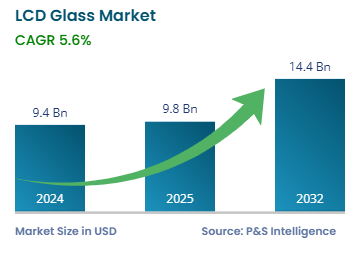
The LCD glass market size was USD 9.4 billion in 2024, which is predicted to reach USD 14.4 billion by 2032, growing at a CAGR of 5.6% during 2025–2032.
The growth of this market is primarily driven by the escalating demand for consumer electronics, which continues to dominate overall consumption. Smartphones, tablets, laptops, and televisions account for the bulk of demand, as consumers increasingly prefer larger screens, higher resolutions, and ultra-thin, lightweight devices. This has led manufacturers to invest in advanced glass substrates, particularly alkali-free borosilicate glass, which offers superior thermal stability, chemical resistance, and durability needed for next-generation displays. Alongside electronics, the automotive sector has emerged as a rapidly growing application area, with modern vehicles incorporating multiple display panels for infotainment, digital instrument clusters, heads-up displays, and rear-seat entertainment systems. The shift toward electric and autonomous vehicles further accelerates this trend, as advanced driver assistance systems (ADAS) and human–machine interfaces require high-quality LCD glass that can withstand harsh automotive conditions while delivering excellent optical clarity.
In addition, industrial applications such as monitors, control systems, and specialized equipment are contributing to demand, highlighting how LCD glass is becoming indispensable across diverse sectors. This combined push from consumer electronics, automotive innovation, and industrial adoption continues to reinforce the strong growth outlook for the LCD glass market.
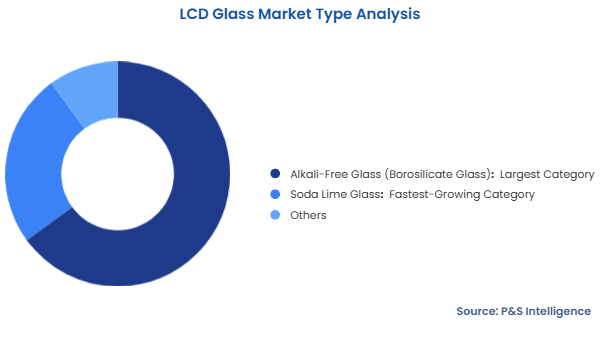
The alkali-free glass category dominated the LCD glass market in 2024 with an approximately 65% share, and it is expected to maintain its leading position throughout the forecast period. This dominance stems from alkali-free glass's superior thermal stability, minimal thermal expansion coefficient, and excellent chemical resistance, making it the preferred choice for thin-film transistor (TFT) LCD manufacturing. The absence of alkali metal oxides prevents ion migration that could compromise the electrical properties of semiconductor components, ensuring reliable display performance over extended operational lifespans.
Manufacturing facilities utilizing alkali-free glass report yield improvements of 15% to 20% compared to alternative glass types, justifying the premium pricing of these substrates. The increasing adoption of high-resolution displays requiring precise pixel control has further reinforced the demand for alkali-free glass substrates, particularly in premium consumer electronics and medical display applications.
The soda-lime glass category is projected to witness the fastest growth, during 2025–2032, driven by cost-conscious applications in entry-level consumer electronics and industrial displays. While offering lower performance characteristics compared to alkali-free alternatives, soda-lime glass provides an economical solution for applications where extreme precision and durability are not critical requirements.
The ongoing improvements in soda-lime glass formulations, including enhanced surface treatments and strengthening processes, are expanding its applicability in mid-range display products. The growing demand from emerging markets, where price sensitivity remains a primary purchasing factor, has prompted manufacturers to develop optimized soda-lime glass compositions that balance performance with affordability.
These types are covered:
The Generation 8 and above category held the largest market share in 2024, of 40%. These large-format substrates, measuring over 2,200 mm x 2,500 mm, are primarily utilized in television panel manufacturing, where economies of scale are critical for maintaining competitive pricing. The ability to produce multiple large-screen panels from a single substrate has made Generation 8+ facilities the backbone of the global LCD television supply chain. Chinese manufacturers have invested over USD 20 billion in Generation 10.5 production lines, further solidifying the dominance of large-generation substrates in the market.
The Generation 5/5.5 category is experiencing the highest growth rate, through 2032, driven by the surging demand from smartphone and tablet manufacturers. These substrates, optimized for producing 5-inch to 10-inch displays, benefit from the explosive growth in mobile device adoption across emerging markets. The flexibility to produce various display sizes from a single substrate generation has made Generation 5/5.5 facilities particularly attractive for manufacturers serving diverse product portfolios.
These generation sizes are covered:
The largest category in the LCD glass market is the 1 mm to 2 mm, with 45% share in 2024, as it serves as the standard for most mainstream applications, including televisions, computer monitors, and laptops. This range provides the ideal balance of durability, light transmission, and cost efficiency, making it the most widely adopted thickness across large-volume LCD production. Its ability to withstand handling and assembly processes, while maintaining optical clarity, has solidified its dominance in the market.
The fastest-growing category is below 0.5 mm, primarily driven by the rising demand for ultra-slim, lightweight, and flexible displays. This category is increasingly used in high-end consumer electronics such as smartphones, tablets, foldable devices, and OLED panels, where manufacturers seek to reduce device weight and enable new form factors. Continuous innovations by leading players in ultra-thin and flexible glass technology are accelerating adoption, making this segment the most dynamic in terms of growth within the LCD glass market.
These thickness categories are covered:
The television category dominated the LCD glass market in 2024, accounting for 30% revenue, driven by the global transition toward larger, higher-resolution displays. The average television screen size has increased from 42 inches in 2020 to 55 inches in 2024, with 65-inch and larger models representing the fastest-growing category. The adoption of 4K resolution as the standard for mid-range and premium televisions has necessitated the use of high-quality glass substrates capable of supporting pixel densities exceeding 140 pixels per inch. Smart television penetration, reaching 70% of all television sales globally, has further reinforced demand for advanced LCD glass substrates that can support touch functionality and enhanced durability.
The smartphones & tablets category is projected to grow at the highest CAGR, during the forecast period, fueled by the continuous innovation in mobile display technologies. The smartphone market, with annual shipments exceeding 1.2 billion units, represents a consistent source of demand for high-performance LCD glass substrates. The trend toward edge-to-edge displays and increased screen-to-body ratios has driven demand for specialized glass processing techniques, including 2.5D and 3D forming capabilities. Tablet computers, experiencing renewed growth due to remote work and education trends, contribute significantly to this category's expansion.
These applications are covered:
Drive strategic growth with comprehensive market analysis
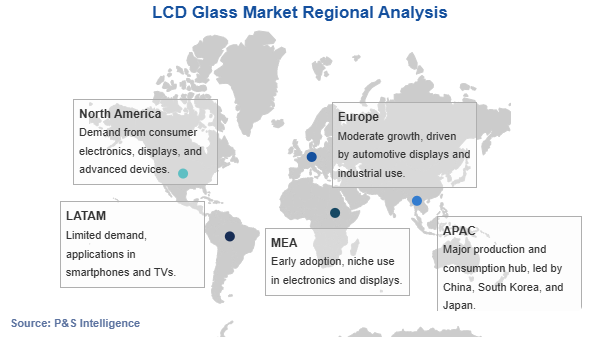
Asia-Pacific dominated the global LCD glass market with 40% share in 2024, underpinned by the region's position as the global manufacturing hub for consumer electronics and display panels. The region's market leadership is attributed to the presence of major LCD panel manufacturers and the concentration of Generation 8 and above production facilities in China, South Korea, Japan, and Taiwan. According to the Display Supply Chain Consultants, Asia-Pacific accounts for over 85% of global LCD panel production capacity, directly translating to dominant LCD glass substrate consumption.
The smartphone manufacturing ecosystem in Asia-Pacific, producing over 1.25 billion units annually, creates sustained demand for small and medium-sized LCD glass substrates. India's emergence as a smartphone manufacturing hub, with production capacity exceeding 300 million units per year, has attracted significant investments from global display component manufacturers. Vietnam and Thailand are also gaining prominence as alternative manufacturing locations, benefiting from favorable trade policies and lower labor costs compared to China.
China alone represents approximately 45% of Asia-Pacific's LCD glass consumption, driven by massive investments in display manufacturing infrastructure. The Made in China 2025 initiative is China’s strategic policy to boost high-tech manufacturing, including semiconductors and display technologies. While it is backed by large state funding through subsidies, loans, and investment funds, no official allocation of USD 150 billion specifically for semiconductors or LCD glass has been confirmed. Verified support includes around USD 2.9 billion for the Advanced Manufacturing Fund and about USD 20.2 billion for the National Integrated Circuit Industry Investment Fund (“Big Fund”), with later phases bringing total commitments to nearly USD 95–100 billion.
Major Chinese cities, including Hefei, Wuhan, and Chengdu, have emerged as display manufacturing clusters, each hosting multiple Generation 10.5 LCD facilities that consume millions of square meters of glass substrates annually. The vertical integration strategies adopted by Chinese display manufacturers have led to increased domestic glass substrate production, reducing dependence on imports from Japan and South Korea.
Europe is projected to grow at a CAGR of approx. 6.5% during 2025–2032, supported by the region's leadership in automotive innovation and Industry 4.0 technologies. The development of autonomous vehicles and smart city infrastructure across European capitals is creating new applications for LCD glass in public information displays, interactive kiosks, and transportation systems. France's investments in digital transformation, including EUR 7 billion allocated for technology infrastructure development, are expected to boost demand for display technologies across various sectors.
The European Union's Green Deal initiative, targeting carbon neutrality by 2050, has prompted LCD glass manufacturers to invest in sustainable production technologies. Several European facilities have achieved carbon-neutral operations through renewable energy adoption and process optimization, appealing to environmentally conscious consumers and meeting stringent regulatory requirements. The circular economy principles embraced by European manufacturers have led to the development of glass recycling programs that recover up to 90% of manufacturing waste for reuse in production processes.
The regions and countries analyzed in this report are:
The LCD glass market is fragmented in nature, as it consists of numerous suppliers spread across different regions and product categories rather than being dominated by a single company. The fragmented structure is driven by the presence of regional supply chains in markets such as Asia, where local manufacturers play a strong role, alongside international producers serving global demand. Variation in product types, including alkali-free glass, soda-lime glass, high-generation size glass, and ultra-thin glass, further adds to the diversity of suppliers. In addition, the market caters to a wide range of applications, such as televisions, monitors, smartphones, tablets, automotive displays, and industrial or medical devices, which creates opportunities for multiple participants to coexist. Overall, while some large companies maintain significant market shares, the industry remains fragmented due to its regional diversity, product specialization, and broad end-use applications.
Want a report tailored exactly to your business need?
Request CustomizationLeading companies across industries trust us to deliver data-driven insights and innovative solutions for their most critical decisions. From data-driven strategies to actionable insights, we empower the decision-makers who shape industries and define the future. From Fortune 500 companies to innovative startups, we are proud to partner with organisations that drive progress in their industries.

Working with P&S Intelligence and their team was an absolute pleasure – their awareness of timelines and commitment to value greatly contributed to our project's success. Eagerly anticipating future collaborations.
McKinsey & Company
India
Our insights into the minutest levels of the markets, including the latest trends and competitive landscape, give you all the answers you need to take your business to new heights

We take a cautious approach to protecting your personal and confidential information. Trust is the strongest bond that connects us and our clients, and trust we build by complying with all international and domestic data protection and privacy laws


Customize the Report to Align with Your Business Objectives

Request the Free Sample Pages