This Report Provides In-Depth Analysis of the Land Mobile Radio Market Report Prepared by P&S Intelligence, Segmented by Product Type (Form Factor / Component) (Handheld / Portable Radios, In-Vehicle / Mobile Radios, Base Stations & System Infrastructure), Technology / Standard (Digital Systems, Analog Systems), Frequency Band (UHF (Ultra High Frequency, 380-512 MHz), 700/800/900 MHz, VHF (Very High Frequency, 136-174 MHz)), End-Use Sector / Application (Public Safety & Defense, Commercial & Industrial), and Geographical Outlook for the Period of 2022 to 2033
Explore the market potential with our data-driven report
Land Mobile Radio Market Overview
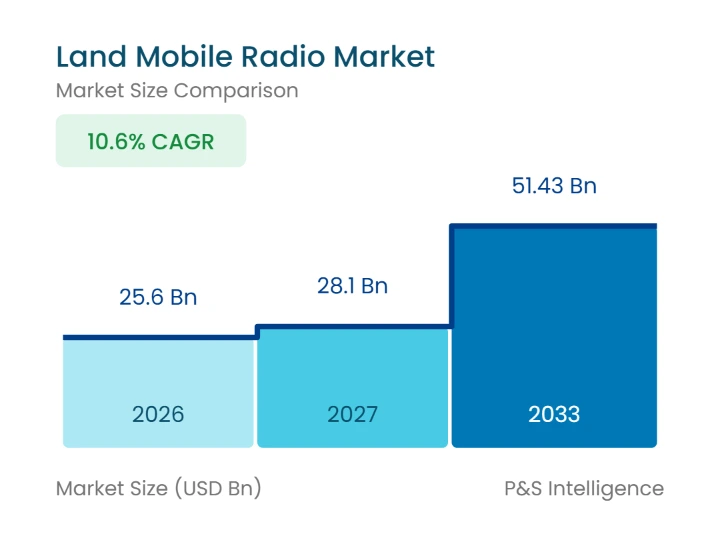
The global land mobile radio market size is estimated at USD 25.60 Billion in 2026 and is projected to reach USD 28.10 Billion in 2027. Revenue is projected to climb to USD 51.43 Billion by 2033, advancing at a CAGR of 10.6% during 2027-2033. Police forces, fire services, corrections agencies, and federal land managers are replacing aging handheld fleets and rebuilding trunked networks on digital standards, because their voice traffic has to keep working when public cellular coverage fails. For radio OEMs, that refresh work tends to arrive as multi-year system contracts that bundle infrastructure, consoles, and handsets.
Public safety agencies that run their own trunked networks account for the larger part of spending, because operators refresh a network built to carry voice through outages in stages as its radios and base stations age. Germany shows the scale. Figures from BDBOS, the federal agency that runs the country's TETRA network for police, fire, and rescue services, put it at about 1.3 million registered devices and 5,000 base stations. Fleets of that size tend to be replaced in waves, which gives the land mobile radio market a recurring core of handset and infrastructure orders.
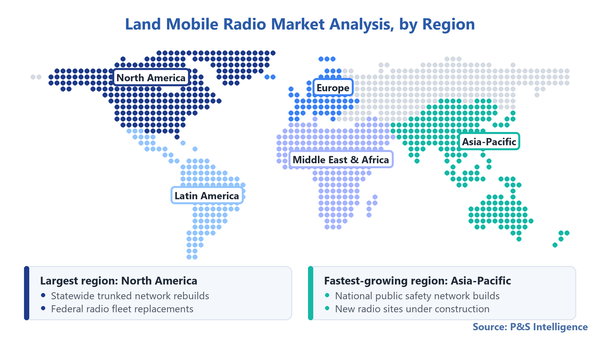
North America accounted for more than a third of global revenue in 2026, with the United States generating most of it through statewide P25 rebuilds and federal fleet replacements. Asia-Pacific is set to grow fastest, at a 12.8% CAGR during 2027-2033, as India, Southeast Asian countries, Australia, and New Zealand fund new or rebuilt public safety networks. The two regions grow for different reasons. North American revenue comes mainly from replacing installed systems, while Asia-Pacific revenue depends more on networks still under construction, which lifts infrastructure orders alongside handsets.
Key market insights
By product type, handheld / portable radios held 58.5% in 2026 and are also expected to expand fastest, at an 11.2% CAGR during 2027-2033.
By technology, digital systems held 71.5% in 2026 and are also expected to lead growth, at a 12.4% CAGR during 2027-2033.
By frequency band, UHF (ultra high frequency, 380-512 MHz) held 39.0% in 2026, while 700/800/900 MHz is expected to expand at an 11.6% CAGR during 2027-2033.
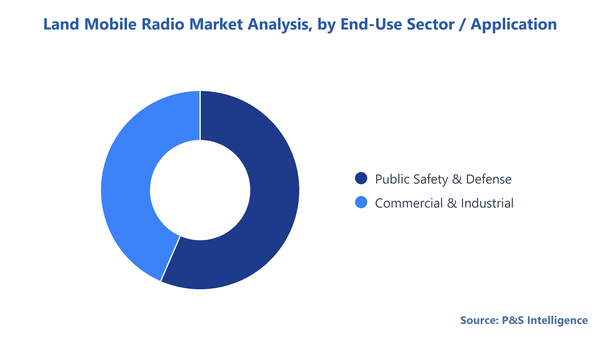
By end use, public safety & defense held 56.5% in 2026, while commercial & industrial is expected to rise at an 11.4% CAGR during 2027-2033.
By geography, North America held 37.5% in 2026, while Asia-Pacific is expected to advance at a 12.8% CAGR during 2027-2033.
Land Mobile Radio Market Growth Drivers & Challenges
Delayed broadband cutovers are fueling continued spending on dedicated radio networks
Several governments that planned to move police, fire, and ambulance voice onto broadband networks keep pushing back their switch-off dates, and every delay keeps them buying for networks they expected to retire. An operator can rarely let a TETRA or P25 system degrade during a drawn-out transition, so replacement handsets, base-station refurbishment, spare parts, and software support stay in annual budgets. Revenue from installed systems can therefore run well beyond the original contract dates, and network vendors gain service years they had not planned for.
The United Kingdom offers the clearest case. According to the annual report for 2024 that Motorola Solutions filed with the U.S. Securities and Exchange Commission, the Home Office issued a notice in March 2024 seeking to extend the national shutdown target for the Airwave service from December 31, 2026, to December 31, 2029, adding three years of services. For incumbent operators and handset suppliers, an extension of this kind can turn a scheduled wind-down into a further buying cycle. Police, fire, and ambulance services, for their part, keep paying network charges and refreshing devices for longer than budgeted.
Converged handhelds are reshaping how agencies specify radio fleets
Public safety agencies increasingly write tenders for handhelds that combine LMR voice with a cellular data path, because officers already depend on broadband for video, location, and records but still need radio for group calls where networks fail. A converged portable typically costs more than a voice-only radio, so this shift tends to raise spending per officer more than it changes fleet size. It also links radio purchases to broadband subscriptions and device-management software, which extends the vendor relationship beyond the handset sale.
Broadband use among U.S. responders indicates how large that buying pool could become. The FirstNet Authority's June 2026 board minutes recorded 8.2 million device connections and more than 30,000 agencies on the FirstNet network through the end of April 2026, a broadband measure that sizes the potential user base, not converged-radio adoption. OEMs with in-house cellular integration and carrier certification experience are better positioned in converged-device tenders, since such a radio has to clear both radio and network approval before agencies can deploy it.
Interagency wildfire operations are opening demand for multi-band portables
Wildland fire crews often work alongside agencies whose radio systems run on different bands, so a portable that covers VHF, UHF, and 700/800 MHz in one unit spares them from carrying or swapping several radios. Federal and state forestry agencies and county fire departments buy these multi-band handhelds in lifecycle batches, and each additional agency on an incident strengthens the case for them. Multi-band units are usually priced above single-band models, so each replacement order raises revenue per responder.
National Interagency Fire Center data show 77,850 wildland fires in the United States in 2025, up from 64,897 in 2024, even though burned area fell to 5.13 million acres from 8.92 million. More fires can mean more occasions on which crews from different agencies must share channels, which supports multi-band portables in forestry and fire budgets. Suppliers whose radios are approved for interagency fire use could gain from that wider buying base, since approval lists shape what land-management agencies are allowed to purchase.
Shared regional systems are limiting the pace of handset replacement
Many U.S. counties and cities run joint radio systems in which each member agency pays an annual per-radio fee and funds its own handset replacement. The arrangement keeps network costs shared, but it also means a migration to P25 can move only as fast as the members with the tightest budgets, since school districts, small fire districts, and tribal agencies replace radios on their own cycles. Vendors therefore see system migrations stretch over several fiscal years, with handset revenue arriving in small, uneven orders.
Washoe County, Nevada, puts numbers on the lag. The budget comparison for its regional communications system for fiscal year 2026-27 counts about 7,100 active radios, of which 6,127 still run on the legacy EDACS platform and 921 on P25. Proposed operating contributions range from USD 322.28 to USD 354.51 per radio a year, depending on how much is set aside for infrastructure. Fees of this kind draw on the same small budgets as handset purchases, which helps explain why subscriber replacement can trail network upgrades.
Segmentation Analysis
Product Type
Handheld / portable radios accounted for 58.5% of land mobile radio revenue in 2026, because an officer, firefighter, corrections officer, or plant technician on shift typically carries a portable, while one repeater site can serve hundreds of users. Portables also wear out sooner than fixed equipment. They are dropped, soaked, and charged daily, and their batteries lose capacity, so agencies and enterprises tend to replace them on shorter cycles than base stations or dispatch consoles. Batteries, chargers, and remote speaker microphones are bought alongside each fleet, which raises the value of every handset order.
Handheld / portable radios are also expected to post the quickest growth, at an 11.2% CAGR during 2027-2033, as fleets move to multi-band and converged models that carry higher unit prices than the single-band radios they replace. Intrinsically safe portables add a separate stream of orders from refineries, chemical plants, and mines, where only certified devices may enter hazardous zones. For OEMs, this mix shift means handheld revenue can rise faster than unit shipments, provided one platform can be certified across several bands and hazardous-area approvals.
Technology and Standard
Digital systems accounted for 71.5% of revenue in 2026, a lead that spectrum rules helped build. The Federal Communications Commission required most private land mobile licensees in the VHF and UHF bands to operate on 12.5 kHz channels, or meet an equivalent efficiency standard, by January 1, 2013, and digital radios offered a way to comply while adding capacity. Encryption, GPS location, and trunking features that P25, TETRA, and DMR support natively have since made digital the default specification in public safety tenders.
Digital systems are also projected to lead growth, at a 12.4% CAGR during 2027-2033, as utilities, transport operators, and industrial sites retire analog fleets that are reaching end of life. DMR is a common replacement path for these users because it fits existing 12.5 kHz channel licenses and lets operators keep analog channels running during a phased cutover. The DMR Association counts more than 160 members worldwide, spanning equipment manufacturers, system integrators, and operators, which points to a wide pool of interoperable suppliers. For dealers, analog-to-DMR migration can bring repeat work in programming, site upgrades, and accessories.
Frequency Band
UHF (ultra high frequency, 380-512 MHz) accounted for 39.0% of revenue in 2026. European TETRA networks for police and emergency services operate at the bottom of this range, and UHF also carries much of the world's business and industrial radio because its signals penetrate buildings well, which suits city policing, factories, and campuses. Under ECC Decision (08)05 of the Electronic Communications Committee within CEPT, the 380-385 MHz and 390-395 MHz bands are harmonized for narrowband public protection and disaster relief, which lets one TETRA handset platform serve many national networks.
700/800/900 MHz is set to grow fastest, at an 11.6% CAGR during 2027-2033. In the United States, these bands host many of the statewide and county P25 trunked systems now being built or rebuilt, and 700 MHz narrowband channels give agencies room to add talkgroups without crowding older VHF and UHF assignments. Many converged P25 radios are bought for 700/800 MHz systems, which adds to demand in this band group. Vendors whose portables and site equipment cover both 700 and 800 MHz on one platform can compete for the larger statewide rebuilds.
End-Use Sector
Public safety & defense accounted for 56.5% of revenue in 2026, reflecting how many separate agencies each buy, run, and replace their own radio fleets. In its 2018 census, the Bureau of Justice Statistics identified 17,541 state and local law enforcement agencies in the United States, each with its own budget and procurement cycle. Fire, emergency medical, corrections, and military users add further buying points. Public safety buyers also pay for the costliest equipment tiers, since encryption, interoperability with neighboring agencies, and coverage guarantees are standard requirements in their tenders.
Commercial & industrial users are the faster-growing end use, projected to expand at an 11.4% CAGR during 2027-2033, as utilities, rail operators, mines, and oil and gas sites replace analog fleets and add data features such as lone-worker alarms and location tracking. Safety rules shape what many of these sites buy. The European Union's ATEX Directive 2014/34/EU sets conformity requirements for equipment used in potentially explosive atmospheres, which covers radios carried into such zones, although the directive does not require radio use itself. That certification step narrows the field to suppliers with approved intrinsically safe models.
The following segments are analysed in this report.
Product Type (Form Factor / Component)
Handheld / Portable Radios
In-Vehicle / Mobile Radios
Base Stations & System Infrastructure
Technology / Standard
Digital Systems
Analog Systems
Frequency Band
UHF (Ultra High Frequency, 380-512 MHz)
700/800/900 MHz
VHF (Very High Frequency, 136-174 MHz)
End-Use Sector / Application
Public Safety & Defense
Commercial & Industrial
Copyright P&S Intelligence. Reuse requires attribution under CC BY 4.0.
Regional Analysis
North America land mobile radio market outlook
North America held 37.5% of global revenue in 2026. The United States, the region's largest market, drives most of that spending through state, county, and federal agencies that operate P25 trunked systems and replace them in large, publicly funded programs. Each statewide rebuild moves agencies onto a newer core and tends to bring subscriber radio and dispatch console orders with it. L3Harris Technologies announced in June 2024 a contract worth up to USD 153 million to move Wisconsin's statewide public safety network to P25 on an IP-based design serving the state's cities and counties.
North American revenue is expected to rise at a 9.8% CAGR during 2027-2033, below the global rate, because it depends mainly on replacing and upgrading a large installed base. Federal buyers add a steady layer of demand, since corrections, land-management, and wildland fire agencies buy portables in fleet-wide batches. Canada contributes a smaller share through provincial and municipal systems. The region's lead looks stable through 2033, and vendors with incumbent cores in statewide systems are better positioned for follow-on handset and maintenance orders, because agencies often standardize on equipment already proven on their network.
Asia-Pacific land mobile radio market growth
Asia-Pacific is projected to grow fastest among regions, at a 12.8% CAGR during 2027-2033. A larger part of spending goes to networks that are still being built, so a single award can cover core switching, new transmission sites, dispatch consoles, and complete handset fleets. Police and emergency agencies in Southeast Asia are moving from analog and single-site systems to trunked digital networks, while Australia and New Zealand are replacing older state and national networks. India is among the region's main sources of new demand, as state police forces modernize radio fleets and new metro rail lines specify trunked radio.
New Zealand's program explains how a national build turns into equipment orders. Tait Systems, which is delivering the radio portion of the country's Public Safety Network, states that 500 sites are required nationwide and that each region will be handed over to police, fire, and ambulance services through 2026 and 2027. Programs of this kind bring infrastructure revenue first, then handset and console demand as regions go live. Asia-Pacific's growth lead is likely to hold while several national networks remain in build, which favors vendors able to supply site equipment and terminals under one contract.
Copyright P&S Intelligence. Reuse requires attribution under CC BY 4.0.
Europe market analysis
Europe accounts for a large, replacement-led share of global revenue, built on national TETRA and Tetrapol networks that police, fire, and rescue services have used for well over a decade. Spending centers on keeping those networks current. Operators are moving base-station links to IP, hardening sites against power and transmission failures, and refreshing handsets on fixed cycles, while broadband successors are planned but not yet ready to carry mission-critical voice. Handset and service contracts therefore keep renewing in markets that, on paper, are preparing to migrate.
Germany illustrates the pattern. In a March 2026 answer to a parliamentary question, the Federal Government said the current TETRA voice service will remain available until the next-generation broadband system can replace it, and cited IP migration and network hardening as interim measures. An open-ended timeline of this kind gives incumbent infrastructure vendors steady modernization and service revenue. It also keeps German and other European emergency services buying TETRA handsets well into the forecast period, even as broadband trials expand across the region.
Latin America market analysis
Latin America contributes a smaller share of revenue, with spending led by state-level public security networks and by mining and energy operators working across remote terrain. In Brazil and Mexico, individual states often buy their own trunked digital networks, so demand arrives as a series of separate regional contracts. Coverage gaps in rural, border, and Amazon areas mean many awards fund new base stations as well as handset refreshes, which raises the infrastructure share of each contract.
A contract extract published in September 2026 by the Public Security Secretariat of Goiás, Brazil, covers the purchase and installation of new radio base stations to expand the state's TETRA trunked network, with funding drawn from federal resources. Transfers of this kind let states add sites that their own budgets might not fund alone. Suppliers with local subsidiaries and installation crews can compete more effectively in such tenders, because awards like this one bundle site works with equipment supply.
Middle East & Africa market analysis
The Middle East & Africa contributes a smaller share of revenue, but much of its spending comes from a few large government programs. Gulf interior ministries run national TETRA networks for police, civil defense, and major events, and they tend to specify fully redundant infrastructure, which raises the value of each site. Oil, gas, and petrochemical operators in the Gulf and North Africa add demand for intrinsically safe radios used inside hazardous plant areas, which can be bought through engineering contractors as part of larger facility projects.
Elsewhere in Africa, utilities, mines, and security services lean toward DMR and analog systems, which cost less per site, and their purchases often depend on government capital budgets or development finance. Some Gulf network operators are adding LTE alongside TETRA, which could raise spending on gateways and dual-mode terminals over the forecast period. Vendors working through established regional integrators are better placed to reach these buyers, because local integrators handle installation, licensing, and long-term maintenance that ministries and plant operators expect.
The following geographies are analysed in this report.
North America
U.S.
Canada
Asia-Pacific
Japan
South Korea
Taiwan
China
India
Malaysia
Singapore
Thailand
Vietnam
Indonesia
Philippines
Australia
Rest of Asia-Pacific
Europe
Germany
U.K.
France
Italy
Netherlands
Spain
Switzerland
Sweden
Belgium
Austria
Finland
Denmark
Rest of Europe
Latin America
Brazil
Mexico
Chile
Argentina
Colombia
Rest of Latin America
Middle East & Africa
Saudi Arabia
U.A.E.
Israel
Qatar
Oman
Kuwait
South Africa
Egypt
Morocco
Nigeria
Rest of Middle East & Africa
Land Mobile Radio Market Competition Analysis
Competition in the land mobile radio market splits by layer. Statewide and national networks are bought as multi-year system contracts covering core switching, sites, consoles, and maintenance, and a limited group of vendors has qualified P25 or TETRA cores at that scale. Once a core is installed, replacing it means re-engineering sites, consoles, and interfaces, so switching costs are high and the incumbent often carries the follow-on handset and service work. The terminal layer is more open, because open standards let agencies buy compatible radios from several manufacturers, and commercial DMR is sold through dealers on price and range.
Motorola Solutions and L3Harris Technologies compete head-to-head for U.S. statewide and county P25 systems, each pairing core networks with its own handheld and vehicular portfolio and, increasingly, converged broadband devices. Airbus competes mainly for national TETRA and Tetrapol networks, where long service contracts matter as much as the equipment. Hytera Communications and JVCKENWOOD sell broad terminal ranges through dealer networks, Hytera mainly in DMR and TETRA, and JVCKENWOOD in DMR, NXDN, and P25, where it has added broadband push-to-talk to its Viking radios. Smaller specialists compete on niche approvals, such as fire-qualified multi-band portables or rugged TETRA terminals.
For buyers, the main point of leverage comes at core refresh, when an agency can re-tender the whole system instead of extending an incumbent contract. Converged devices are shifting competition toward software, cellular certification, and device management, which favors vendors that can update radios over the air and support both networks under one service agreement. Between refresh points, buyers have more room to negotiate on terminals and accessories than on infrastructure.
Top Land Mobile Radio Manufacturers:
Motorola Solutions Inc.
L3Harris Technologies Inc.
Hytera Communications Corporation Limited
JVCKENWOOD Corporation
Icom Incorporated
Sepura Limited
BK Technologies Corporation
Leonardo S.p.A.
Airbus SE
Tait Communications
Simoco Wireless Solutions
Teltronic S.A.U.
Land Mobile Radio Market News & Developments
In October 2026, Motorola Solutions Inc. won a contract worth nearly USD 140 million from the U.S. Federal Bureau of Prisons to replace radios and dispatch consoles at 63 federal correctional facilities over two years, including 22,000 new radios. The award shows federal agencies buying enterprise-wide radio refreshes as one program.
In September 2026, Hytera Communications Corporation Limited launched the DIB-R6 SMART, an outdoor TETRA base station weighing under 17.5 kg that supports up to four carriers, with software-configured channel capacity and redundancy at base-station and transmission-link level. The design lets pipeline, transit, and perimeter-corridor operators scale TETRA capacity without adding hardware at each site.
In July 2026, JVCKENWOOD Corporation completed its acquisition of 100% of San Luis Aviation, Inc., which trades as ESChat, making the California-based broadband push-to-talk provider a consolidated subsidiary. ESChat's platform powers the Viking Connect hybrid service launched in March 2026, so the deal brings LMR-to-broadband switching for Viking radios under direct ownership.
In April 2026, BK Technologies Corporation debuted the BKR 9500 multiband in-vehicle radio at FDIC International in Indianapolis, with FCC approval targeted for the second half of 2026 and shipments in the first half of 2027. The model extends the company's multiband line from portables into fire and forestry vehicles.
In March 2026, L3Harris Technologies Inc. unveiled the XL-300P, a P25 portable that switches between P25, LTE/5G, Wi-Fi, and satellite networks, with customer shipments scheduled for July 2026. The company describes it as the first portable radio with both 5G and non-terrestrial network connectivity, which raises the feature baseline for converged public safety handsets.
Last Updated: November 2026
Frequently Asked Questions About This Report
What is the size of the land mobile radio market?+
The global land mobile radio market size is estimated at USD 25.60 Billion in 2026 and is projected to reach USD 28.10 Billion in 2027.
What is driving demand for land mobile radios?+
Police forces, fire services, corrections agencies, and federal land managers are replacing aging handheld fleets and rebuilding trunked networks on digital standards, because their voice traffic has to keep working when public cellular coverage fails.
Which region has the largest share of the land mobile radio market?+
North America accounted for more than a third of global revenue in 2026, with the United States generating most of it through statewide P25 rebuilds and federal fleet replacements.
Which region is the fastest-growing land mobile radio market?+
Asia-Pacific is set to grow fastest, at a 12.8% CAGR during 2027-2033, as India, Southeast Asian countries, Australia, and New Zealand fund new or rebuilt public safety networks.
Why are public safety agencies moving from analog to digital radio?+
Encryption, GPS location, and trunking features that P25, TETRA, and DMR support natively have since made digital the default specification in public safety tenders.
Will broadband replace TETRA radio networks in Europe?+
Operators are moving base-station links to IP, hardening sites against power and transmission failures, and refreshing handsets on fixed cycles, while broadband successors are planned but not yet ready to carry mission-critical voice.
Who are the key companies in the land mobile radio market?+
Motorola Solutions and L3Harris Technologies compete head-to-head for U.S. statewide and county P25 systems, each pairing core networks with its own handheld and vehicular portfolio and, increasingly, converged broadband devices.
Want a report tailored exactly to your business need?
Leading companies across industries trust us to deliver data-driven insights and innovative solutions for their most critical decisions. From data-driven strategies to actionable insights, we empower the decision-makers who shape industries and define the future. From Fortune 500 companies to innovative startups, we are proud to partner with organisations that drive progress in their industries.
Client Testimonials
Working with P&S Intelligence and their team was an absolute pleasure – their awareness of timelines and commitment to value greatly contributed to our project's success. Eagerly anticipating future collaborations.
McKinsey & Company
India
Unmatched Standards
Our insights into the minutest levels of the markets, including the latest trends and competitive landscape, give you all the answers you need to take your business to new heights
Complete Data Security
We take a cautious approach to protecting your personal and confidential information. Trust is the strongest bond that connects us and our clients, and trust we build by complying with all international and domestic data protection and privacy laws