This Report Provides In-Depth Analysis of the Knowledge Management Software Market Report Prepared by P&S Intelligence, Segmented by Component (Software, Services), Functionality (Document Management, Knowledge Discovery, Knowledge Sharing & Transfer, Collaboration, Decision Support, Intelligent Chatbots & Virtual Agents), Deployment (Cloud, On-Premises, Hybrid), Organization Size (Large Enterprises, Small & Medium Enterprises), End User (IT & Telecom, Healthcare & Life Sciences, BFSI, Manufacturing, Retail & E-commerce, Government & Public Sector, Education), and Geographical Outlook for the Period of 2021 to 2032
Explore the market potential with our data-driven report
Knowledge Management Software Market Overview
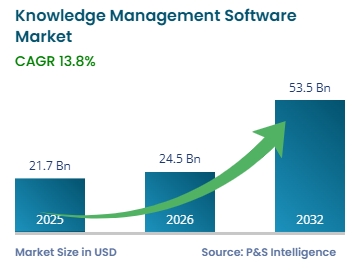
The knowledge management software market size was USD 21.7 billion for 2025, and it will grow by 13.8% during 2026–2032, to reach USD 53.5 billion by 2032.
This growth is supported by accelerating enterprise adoption of cloud-native platforms, generative AI-enabled search, and collaborative content repositories that help distributed workforces capture, organize, and retrieve institutional knowledge more efficiently. Enterprises across information technology, banking and financial services, and healthcare are increasingly embedding document management and knowledge discovery capabilities into core workflows.
Intelligent chatbot capabilities are being embedded in the same workflows, reducing duplicated effort and accelerating decision-making. Eurostat data shows that AI technology adoption among EU enterprises climbed to 20.0% in 2025 from 13.5% in 2024, reflecting the broader digitalization wave reshaping how organizations manage internal knowledge assets. The U.S. Bureau of Labor Statistics indicates that telework rates among workers aged 25 and older reached 24.9% in the first quarter of 2024, up from 21.5% a year earlier. This increase is intensifying demand for centralized, cloud-accessible platforms that keep distributed teams aligned around a single source of institutional knowledge.
Key Market Insights
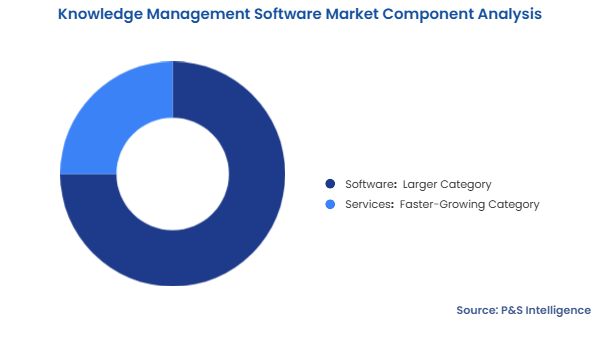
The software category holds the larger market share, of 75%, in 2025, driven by growing enterprise investment in AI-powered knowledge management and document management platforms.
The document management category holds the largest market share, of 35%, in 2025, driven by enterprise demand for structured content management and regulatory compliance.
The cloud category holds the largest market share, of 60%, in 2025, and it will have the highest CAGR, of approximately 14.2%, driven by low upfront costs and vendor-managed updates.
The IT & telecom category holds the largest market share, of 25%, in 2025, driven by widespread adoption of enterprise knowledge management platforms.
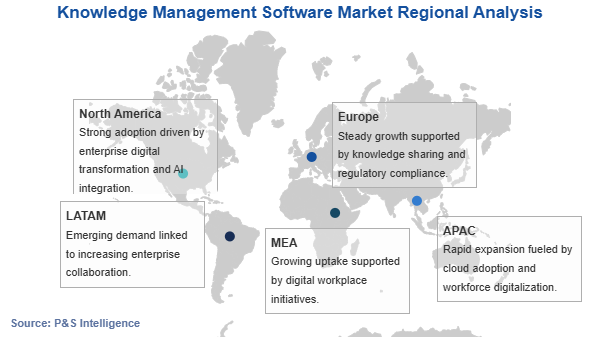
North America holds the largest market share, of 40%, in 2025, driven by its strong enterprise software ecosystem, early cloud adoption, and large enterprise base.
Knowledge Management Software Market Trends and Drivers
Generative AI and Intelligent Search Are Key Trends
Knowledge management software is undergoing a structural shift from static, keyword-based document repositories toward AI-native platforms. These platforms are capable of semantic search and automated content tagging, and they support conversational knowledge retrieval. Advances in large language models are driving this transformation, enabling platforms to synthesize answers from unstructured enterprise content rather than merely surface matching documents, and fundamentally changing how employees interact with institutional knowledge. According to the OECD, generative AI is already in use by 31% of SMEs across surveyed economies, reflecting its growing role in enterprise knowledge workflows. The OECD reports that increases in digital skill use intensity linked to software-specialist capabilities contribute productivity gains of up to 10.3% for enterprises adopting advanced digital tools, underscoring the value of intelligent knowledge management systems.
Vendors are increasingly embedding intelligent chatbots and virtual agents directly into knowledge repositories, with AI-powered enterprise search capabilities layered in to deliver contextual, real-time access to organizational knowledge. Microsoft Corporation exemplifies this trend with its September 2025 launch of Knowledge Agent in SharePoint, which uses AI-driven metadata enrichment and enterprise search to improve Microsoft 365 Copilot's knowledge retrieval capabilities. This evolution is accelerating the transition from document-centric repositories to intelligent knowledge ecosystems and is expected to remain a defining technology trend as generative AI becomes the default interface for enterprise knowledge interaction.
Distributed Workforce Expansion Is Biggest Driver
The expansion of hybrid and remote work models is increasing enterprise demand for centralized knowledge management software by creating the need for secure, cloud-accessible repositories that enable employees to capture, organize, and retrieve organizational knowledge from any location. As enterprises continue to operate distributed workforces, organizations are increasingly investing in document management and enterprise search, with knowledge discovery and collaboration platforms also seeing significant investment. This investment is improving productivity and reducing information silos, while helping maintain business continuity across geographically dispersed teams.
According to the U.S. Bureau of Labor Statistics, telework among workers with a bachelor's degree or higher increased from 35.2% in the first quarter of 2023 to 40.4% in the first quarter of 2024, reflecting the growing share of knowledge-intensive employees working remotely. Growth in distributed knowledge work is accelerating enterprise investment in cloud-based knowledge management platforms, with these platforms supporting seamless collaboration and standardized information access, and enabling long-term organizational knowledge retention.
Digital Skills Gaps and Legacy System Fragmentation Are Key Restraints
Despite growing enterprise demand, the adoption of knowledge management software is constrained by persistent digital skills shortages and the fragmentation of legacy content repositories across disconnected systems. Many organizations continue to manage knowledge assets through siloed file shares, email archives, and department-specific applications, creating significant migration complexity that delays platform consolidation and enterprise-wide deployment.
These challenges are particularly pronounced among mid-sized organizations that often lack dedicated knowledge management and data governance teams, making large-scale implementation more complex and resource-intensive. Although vendors are increasingly investing in AI-assisted migration tools, automated content classification, and low-code deployment capabilities to simplify implementation, these challenges are expected to continue moderating the pace of enterprise adoption throughout the forecast period.
Untapped SME Digitalization Is Biggest Opportunity
A significant gap remains between large enterprises and small and medium enterprises (SMEs) in the adoption of structured knowledge management tools, creating substantial growth opportunities for vendors offering simplified, subscription-based cloud platforms. According to Eurostat, AI technology adoption reached 55.03% among large enterprises in 2025, compared with 30.36% among medium enterprises and 17.0% among small enterprises.
This adoption gap signals significant unmet demand among SMEs, which have historically lacked the budget and IT resources required for enterprise-grade knowledge management systems. Vendors offering low-friction, self-service cloud deployments with tiered pricing are well positioned to capture this underserved segment as SMEs increasingly digitize their operations to remain competitive. The continued digitalization of SMEs presents a substantial untapped market opportunity for knowledge management software vendors. Expanding cloud infrastructure and increasing availability of affordable SaaS-based platforms are expected to enable vendors to penetrate this underserved market and unlock new revenue opportunities during the forecast period.
The software category holds the larger market share, of 75%, in 2025, driven by enterprises prioritizing investments in software platforms for document management, enterprise search, knowledge discovery, and AI-powered knowledge management over implementation and support services. According to the OECD, cloud computing was used by an average of 49% of enterprises with 10 or more employees across OECD countries in 2023, highlighting the growing reliance on cloud-based software platforms.
The services category will have the higher CAGR, of approximately 14.4%, driven by the increasing need for platform implementation, content migration, AI integration, customization, employee training, and ongoing platform optimization services. Seamless integration with enterprise applications and regulatory compliance needs are driving demand for specialized professional and managed services, and continuous system optimization needs are sustaining this demand. This evolution is reflected in Zoho Corporation Pvt. Ltd.'s July 2025 launch of Zia LLM and the expanded Zia Agent Studio. These offerings introduced proprietary generative AI capabilities and no-code AI agent development to enhance enterprise knowledge search and automation, while strengthening workflow management across the Zoho ecosystem.
The components analyzed in this report are:
Software (Larger Category)
Services (Faster-Growing Category)
Professional Services
Managed Services
Functionality Analysis
The document management category holds the largest market share, of 35%, in 2025, driven by decades of enterprise investment in structured content repositories and regulatory recordkeeping requirements. Federal recordkeeping mandates requiring the transition to electronic formats have reinforced document management as the foundational layer of enterprise knowledge platforms, enabling organizations to maintain secure, auditable, and searchable digital records. According to the National Archives and Records Administration (NARA), federal agencies continue transitioning to fully electronic records management under government-wide policy directives.
The intelligent chatbots & virtual agents category will have the highest CAGR, driven by rapid advances in large language models that enable conversational, context-aware knowledge retrieval and improve employee access to enterprise information. Growing demand for AI-powered assistance, automated support, and real-time knowledge discovery is accelerating adoption across organizations. This trend is reflected in Salesforce, Inc.'s October 2025 launch of Agentforce 360, which introduced Enterprise Search and the Channel Expert agent to deliver real-time conversational access to enterprise knowledge across Slack, Google Drive, GitHub, and Jira.
The cloud category holds the largest market share, of 60%, in 2025, and it will have the highest CAGR, reflecting its dual advantage of low upfront costs and continuous feature delivery through vendor-managed updates. According to Eurostat, 52.74% of EU enterprises reported using paid cloud computing services in 2025, an increase of 7.42 percentage points compared with 2023, with adoption reaching 84.67% among large enterprises. This scalability advantage is particularly pronounced for knowledge management workloads, which benefit from elastic storage, seamless software updates, integrated AI-powered search capabilities, and easier enterprise-wide collaboration compared with on-premises deployments.
The deployments analyzed in this report are:
Cloud (Largest and Fastest-Growing Category)
On-Premises
Hybrid
Organization Size Analysis
The large enterprises category holds the larger market share in 2025, reflecting their complex, multi-department knowledge governance requirements and greater capacity to fund enterprise-wide platform deployments. The OECD's research on AI adoption by firm size confirms that meaningful gaps persist between small and large enterprises in adopting advanced digital and AI-enabled technologies. Larger organizations consistently lead adoption across functions such as logistics, research and development, and information and communication technology.
The small & medium enterprises category will have the higher CAGR, of approximately 14.1%, driven by cloud-native deployment models, subscription-based pricing, and simplified implementation that are reducing barriers to adoption. Increasing digital transformation initiatives and growing adoption of AI-enabled business applications are encouraging SMEs to invest in scalable knowledge management solutions to improve collaboration and operational efficiency, while supporting organizational knowledge sharing.
The organization sizes analyzed in this report are:
Large Enterprises (Larger Category)
Small & Medium Enterprises (SMEs) (Faster-Growing Category)
End User Analysis
The IT & telecom category holds the largest market share in 2025, driven by the sector's extensive use of enterprise knowledge repositories, technical documentation, software development workflows, and IT service management platforms that require centralized knowledge management. The industry's rapid adoption of cloud computing, DevOps practices, and AI-enabled enterprise applications continues to strengthen demand for knowledge management software.
The healthcare & life sciences category will have the highest CAGR, of approximately 14.5%, driven by the sector's accelerating shift toward digitized clinical knowledge and interoperable health information systems. According to the U.S. Office of the National Coordinator for Health Information Technology (ONC), more than 99% of non-federal acute care hospitals and 91% of office-based physicians had adopted certified electronic health record systems as of 2024, creating a substantial volume of digital clinical information requiring structured knowledge management.
The end users analyzed in this report are:
IT & Telecom (Largest Category)
Healthcare & Life Sciences (Fastest-Growing Category)
BFSI
Manufacturing
Retail & E-commerce
Government & Public Sector
Education
Others
Drive strategic growth with comprehensive market analysis
North America Knowledge Management Software Market Size
North America holds the largest market share, of 40%, in 2025, driven by the region's dense concentration of enterprise software vendors, early and broad cloud infrastructure adoption, and a mature base of large enterprises with complex, multi-department knowledge governance needs spanning BFSI, healthcare, and IT services. Continued enterprise digitization initiatives are further reinforcing demand for centralized knowledge repositories integrated with CRM, ERP, and HRM systems. U.S. Census Bureau data indicates that respondents to its Annual Business Survey identified cloud-based and specialized software as the two most important technologies for improving business processes and methods, underscoring the structural demand base for knowledge management platforms in the region.
Moreover, Canada is the fastest-growing country in the North America market during the forecast period, driven by accelerating enterprise AI adoption, expanding cloud-based digital transformation initiatives, and increasing investments in intelligent workplace technologies. According to Statistics Canada, 12.2% of Canadian businesses reported using artificial intelligence to produce goods or deliver services in 2025, up from 6.1% in 2024, reflecting the rapid pace of enterprise digitalization and the resulting growth in demand for knowledge management software.
U.S. Knowledge Management Software Market Size
The U.S. is the largest market within North America, driven by the concentration of major global knowledge management software vendors headquartered in the country and sustained enterprise investment in AI-enhanced knowledge discovery and virtual assistant tools. U.S. Census Bureau Business Trends and Outlook Survey data indicates that AI usage among U.S. businesses ranged from 17% to 20% between December 2025 and May 2026, with adoption notably higher among large enterprises and businesses in the information sector, supporting demand for AI-enabled knowledge management platforms.
Moreover, demand in the U.S. is expected to increasingly favor generative AI-native platforms over legacy document repositories as enterprises prioritize contextual search and automated knowledge synthesis to improve workforce productivity and reduce training and operational costs.
Asia-Pacific will have the highest CAGR, of approximately 14.7%, driven by large-scale digital transformation programs across China and India, rapid enterprise cloud migration, and the expanding adoption of knowledge management platforms by technology and BFSI enterprises. According to the Ministry of Electronics and Information Technology (MeitY), the digital economy's contribution to national income is projected to rise to 13.42% in FY 2024–25 from 11.74% in FY 2022–23, reflecting the rapid pace of enterprise digitalization supporting the adoption of knowledge management software across the country.
India is expected to be the fastest-growing country market in Asia-Pacific during the forecast period, driven by the rapid expansion of multinational enterprises' global capability centers (GCCs), which are increasing demand for standardized knowledge infrastructure, enterprise collaboration, and AI-enabled knowledge management platforms. Moreover, Japan, South Korea, and Australia contribute steady incremental demand through their advanced enterprise IT sectors, high cloud adoption, and increasing integration of AI-powered enterprise applications, supporting sustained investment in knowledge management software across the region.
China Knowledge Management Software Market Size
China is the largest individual market within Asia-Pacific, driven by sustained government-backed digital economy initiatives and rapid enterprise adoption of AI-integrated productivity software across manufacturing, technology, and financial services sectors. According to the National Bureau of Statistics of China, the value added of the country's core digital economy industries reached CNY 14.0891 trillion in 2024, accounting for 10.5% of GDP, compared with 9.9% in 2023. A large enterprise customer base and rapid cloud and AI adoption reinforce the country's leadership, while sustained investment in digital transformation strengthens this position. This momentum is driving widespread deployment of knowledge management platforms to improve collaboration and operational efficiency, while strengthening enterprise decision-making.
The regions and countries analysed in this report are:
The market is fragmented, characterized by the presence of numerous global enterprise software providers and specialized knowledge management vendors serving diverse enterprise requirements. Horizontal platforms such as Microsoft, IBM, SAP, Oracle, Salesforce, ServiceNow, and Atlassian integrate knowledge management capabilities into broader productivity, ERP, CRM, and IT service management ecosystems, while specialized vendors including OpenText, M-Files, Bloomfire, Zoho, Freshworks, and eGain focus on content governance, enterprise search, self-service documentation, customer knowledge bases, and industry-specific applications. Although barriers to entry are relatively low, high switching costs associated with content migration, AI-powered search integration, enterprise security, and regulatory compliance create strong customer retention. Continuous innovation in generative AI, cloud-native architectures, and vertical-specific solutions enables both diversified incumbents and specialized vendors to sustain strong competitive positions across the market.
Leading Companies in the Knowledge Management Software Market:
Microsoft Corporation
ServiceNow, Inc.
Atlassian Corporation
Salesforce, Inc.
OpenText Corporation
IBM Corporation
Oracle Corporation
SAP SE
Glean Technologies, Inc.
M-Files Corporation
Bloomfire, Inc.
Freshworks Inc.
Zoho Corporation Pvt. Ltd.
Coveo Solutions Inc.
eGain Corporation
Knowledge Management Software Market Developments
In May 2026, ServiceNow, Inc. launched Otto, a unified AI experience combining conversational AI, enterprise search, AI voice agents, and an AI data explorer, unveiled at its Knowledge 2026 conference. The launch consolidates fragmented knowledge-access tools into a single interface, reinforcing ServiceNow's push to govern enterprise AI knowledge workflows at scale.
In April 2026, Atlassian Corporation Plc launched Remix, a generative AI feature in Confluence that converts existing page content into charts, infographics, scorecards, and presentation-ready summaries while preserving links to the source material. The feature targets the presentation problem in knowledge management, where teams historically had to manually reformat documented knowledge for different audiences.
In November 2025, OpenText Corporation expanded its collaboration with SAP SE by announcing that OpenText Core Content Management for SAP achieved certification for SAP S/4HANA Cloud Public Edition. The collaboration enables AI-ready cloud content management by unifying structured and unstructured enterprise content, strengthening governance, compliance, and enterprise knowledge management capabilities.
In May 2024, IBM Corporation expanded its strategic partnership with SAP SE through the Value Generation Partnership initiative to deliver generative AI-powered enterprise solutions using IBM watsonx and SAP technologies. The collaboration helps organizations improve enterprise knowledge discovery, workflow automation, and AI-driven business processes.
Frequently Asked Questions About This Report
How does AI enhance knowledge management software?+
AI enhances knowledge management software by automating content classification, semantic search, document summarization, intelligent recommendations, and conversational assistance, enabling employees to locate relevant information faster and improve productivity.
Why are organizations adopting cloud-based knowledge management software?+
Cloud-based solutions provide scalability, lower deployment and maintenance costs, remote accessibility, automatic software updates, faster implementation, and seamless integration with enterprise applications.
What are the key features of modern knowledge management software?+
Key features include document management, enterprise search, AI-powered knowledge discovery, collaboration tools, workflow automation, version control, analytics dashboards, role-based access control, and third-party integrations.
How is generative AI changing the knowledge management software market?+
Generative AI enables intelligent chatbots, automated content generation, contextual search, document summarization, multilingual knowledge retrieval, and AI assistants, making enterprise knowledge more accessible and actionable.
Why is enterprise search becoming increasingly important in knowledge management?+
Enterprise search enables employees to quickly find information across multiple repositories from a single interface, reducing search time, eliminating duplicate work, improving collaboration, and supporting faster business decisions.
Want a report tailored exactly to your business need?
Leading companies across industries trust us to deliver data-driven insights and innovative solutions for their most critical decisions. From data-driven strategies to actionable insights, we empower the decision-makers who shape industries and define the future. From Fortune 500 companies to innovative startups, we are proud to partner with organisations that drive progress in their industries.
Client Testimonials
Working with P&S Intelligence and their team was an absolute pleasure – their awareness of timelines and commitment to value greatly contributed to our project's success. Eagerly anticipating future collaborations.
McKinsey & Company
India
Unmatched Standards
Our insights into the minutest levels of the markets, including the latest trends and competitive landscape, give you all the answers you need to take your business to new heights
Complete Data Security
We take a cautious approach to protecting your personal and confidential information. Trust is the strongest bond that connects us and our clients, and trust we build by complying with all international and domestic data protection and privacy laws