Iron Ore Market Size & Share Analysis - Trends, Drivers, Competitive Landscape, and Forecasts (2026 - 2032)
This Report Provides In-Depth Analysis of the Iron Ore Market Report Prepared by P&S Intelligence, Segmented by Type (Hematite, Magnetite, Limonite, Siderite), Form (Fines, Pellets, Lumps, Concentrate/Sinter), End-Use (Steel Production, Construction, Automotive), and Geographical Outlook for the Period of 2019 to 2032
Explore the market potential with our data-driven report
Iron Ore Market Overview
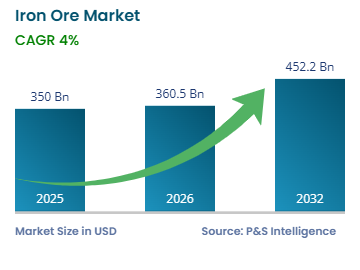
The global iron ore market size was USD 350.0 billion in 2025, which is predicted to reach USD 452.2 billion by 2032, growing at a CAGR of 4.0% during 2026–2032.
The key factors driving the market expansion include sustained demand from the steel industry, accelerating infrastructure development across emerging economies, and technological advancements in mining and processing operations that enhance extraction efficiency and product quality.
Iron ore remains the fundamental raw material for steel production, with approximately 98% of the mined iron ore utilized in steelmaking processes. As per the World Steel Association, global crude steel production reached 1,882.6 million tonnes in 2024, underscoring the massive demand base for iron ore. The market is experiencing significant transformation as steel producers increasingly adopt sustainable production methods, including hydrogen-based direct-reduced iron (H2-DRI), coupled with the electric arc furnace (EAF) technology, which requires higher-grade iron ore to achieve emission reduction targets.
The Asia-Pacific region continues to dominate global iron ore consumption, with China alone accounting for the majority of global imports. Over the first eight months of 2024, China's iron ore imports reached 814.95 million tonnes, representing a 5.2% increase from 2023. This sustained demand from the world's largest steel producer provides a stable foundation for market growth, despite concerns about potential demand moderation as China transitions toward higher-quality steel production and increases its focus on scrap steel recycling.
Iron Ore Market Dynamics
Technological Innovations in Green Steel Production Is a Key Trend
Green steel production focuses on reducing carbon emissions by using alternative technologies to traditional coal-based blast furnaces.
The H2-DRI technology is a leading innovation using green hydrogen produced from renewable energy sources to drastically cut emissions.
The Australian government has launched the Green Iron Investment Fund, a AUD 1 billion fund to boost low‑emission iron and steel production.
Up to AUD 500 million is earmarked for the transformation of the Whyalla Steelworks, and the other half is open to both existing and new projects around the country.
The EAF technology complements green steel by recycling scrap steel and reducing reliance on raw materials and fossil fuels.
Electrochemical ironmaking and other emerging methods aim to produce steel with near-zero carbon emissions by leveraging clean electricity and innovative chemical processes.
The National Development Stream of the Green Iron Investment Fund is providing at least AUD 500 million in grants to support early mover commercia-scale green iron production projects, intended to help cover capital costs and de‑risk investments.
Green steel production is supported by government incentives, carbon pricing mechanisms, and stringent emission regulations globally, promoting investment and adoption.
Artificial intelligence and automation are increasingly being integrated to enhance efficiency, predictive maintenance, and precise control within green steel manufacturing.
Leading projects in Sweden and other countries are pioneering large-scale production of zero-carbon steel, showcasing commercial feasibility and market potential.
A AUD 19.8-million grant was given to support a Front‑End Engineering & Design (FEED) study for the NeoSmelt project in Western Australia.
The project aims to replace blast furnaces with an electric smelting furnace (ESF) to produce low‑emissions iron.
This could reduce emissions by about 2 tonnes of COâ‚‚ per tonne of steel produced.
Rising Infrastructure Investment in Emerging Economies Sustains Robust Demand
The rising infrastructure investment in emerging economies is driving robust demand growth for iron ore, as steel is a critical material for construction and development projects.
A USD 248 million contract has been awarded for locomotives that will run on the Trans‑Guinean Railway project, which will serve the Simandou iron ore project (one of the largest undeveloped high‑grade deposits).
This will improve export logistics significantly, enhancing iron ore export capacity.
The rapid urbanization and industrialization in India and other APAC nations are expanding the need for housing, transportation networks, and industrial facilities, all of which require significant steel consumption.
Emerging economies are increasingly focusing on large-scale infrastructure projects, including roads, railways, ports, and utilities, which sustain steady steel demand and, consequently, iron ore consumption.
India is expected to see a sharp rise in iron ore demand due to the accelerating infrastructure development and manufacturing expansion.
The Indian government’s Union Budget for FY2025–26 set capital expenditures at about USD 129 billion (INR 11.2 trillion), up from INR 10.2 trillion in the previous fiscal year.
This increase in CAPEX is expected to boost infrastructure, shipbuilding, and related sectors, thereby increasing steel and hence iron ore demand.
This region’s demand growth offsets some slowdown in mature markets and changing demand patterns in countries like China, which is transitioning to higher-quality steel and more scrap recycling.
The Lobito Corridor is a major rail + port infrastructure project, estimated at USD 10 billion.
It intends to link mineral producers in Zambia and DR Congo to the port at Lobito, Angola.
The technological advancements and investments in mining and processing operations in these economies improve iron ore supply efficiency, supporting market growth.
The government policies promoting infrastructure development and economic growth in emerging markets act as powerful catalysts for iron ore demand expansion.
Long-term demographic trends, such as population growth and urbanization in emerging economies, further underline a sustained demand for steel and iron ore in the coming decades.
Iron Ore Market Segmentation Analysis
Type Analysis
The hematite category commanded the largest market share in 2025, of 40%, due to superior iron content and processing efficiency. Hematite ore's naturally high iron concentration, typically ranging from 50–60% Fe, enables direct shipping to steel mills with minimal beneficiation requirements, reducing processing costs and environmental impact compared to lower-grade alternatives. The widespread availability of hematite deposits across major producing regions, particularly in Australia's Pilbara region and Brazil's Iron Quadrangle, ensures stable supply chains supporting global steel production.
Magnetite ore represents the fastest-growing category, during 2026–2032, driven by the technological advances in magnetic separation and increasing demand for high-quality pellet feed. Despite requiring more intensive processing than hematite, magnetite ore produces superior quality concentrates with iron content reaching 70% Fe, making it increasingly valuable for premium steel applications and hydrogen-based direct reduction processes. The development of energy-efficient beneficiation technologies reduces magnetite processing costs, improving its economic competitiveness against traditional hematite operations.
These types are covered:
Hematite (Largest Category)
Magnetite (Fastest-Growing Category)
Limonite
Siderite
Others
Form Analysis
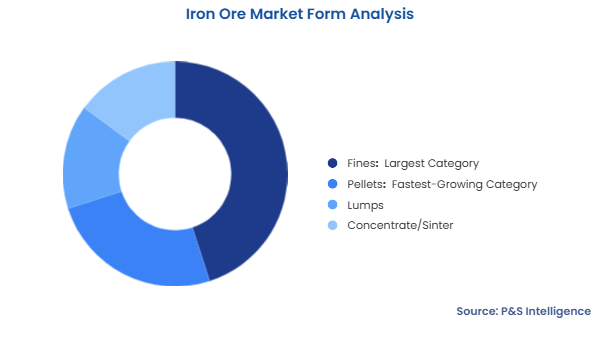
The fines category dominates the market in 2025 with a 45% share, reflecting its essential role in sintering processes that prepare iron ore for blast furnace charging. Iron ore fines, typically sized below 6 mm, undergo agglomeration through sintering to create porous masses suitable for efficient reduction in traditional steelmaking operations. The abundance of fines production from mining operations and their cost-effectiveness compared to lump ore result in their position as the primary feedstock for integrated steel mills globally.
The pellets category exhibits the highest growth potential, through 2032, driven by increasing adoption in direct reduction processes and environmental benefits. Iron ore pellets offer superior metallurgical properties, including uniform size distribution, high iron content after beneficiation, and excellent reducibility, which enhance blast furnace productivity and reduce coke consumption. The expansion of pelletizing capacity in major producing regions responds to growing demand from steel producers seeking to improve operational efficiency and reduce carbon emissions through optimized raw material inputs.
These forms are covered:
Fines (Largest Category)
Pellets (Fastest-Growing Category)
Lumps
Concentrate/Sinter
End-Use Analysis
The steel production category maintains overwhelming dominance with an 45% market share in 2025, reflecting iron ore's fundamental role as the primary raw material for global steelmaking operations. Almost all (98%) iron ore is used in steelmaking, with integrated steel mills and direct reduction facilities consuming vast quantities to meet global steel demand across construction, automotive, and manufacturing sectors. The ongoing modernization of steel production facilities and adoption of more efficient technologies continue to drive iron ore consumption despite improvements in scrap steel utilization rates.
The construction sector represents the fastest-growing end-use category, during the forecast period, propelled by massive infrastructure investments and urban development projects worldwide. Steel-intensive construction activities, including high-rise buildings, bridges, transportation infrastructure, and industrial facilities require substantial iron ore inputs through the steel supply chain. Government stimulus programs focusing on infrastructure development and the global transition toward sustainable construction practices that incorporate high-strength steel solutions further accelerate demand growth in this category.
These end-use categories are covered:
Steel Production (Largest Category)
Construction (Fastest-Growing Category)
Automotive
Others
Drive strategic growth with comprehensive market analysis
Iron Ore Market Geographical Analysis
Asia-Pacific Iron Ore Market Size
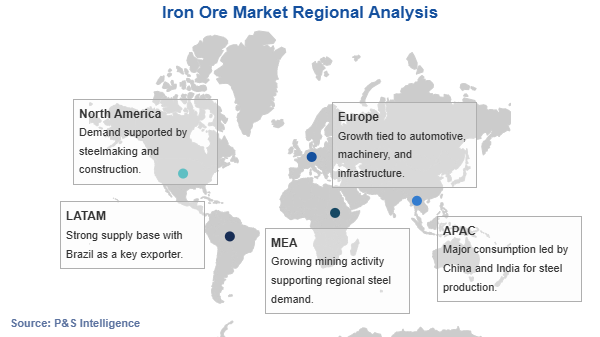
Asia-Pacific dominates the global iron ore market with 40% share in 2025, driven by the region's massive steel production capacity and ongoing industrialization across major economies. China's position as both the world's largest iron ore importer and steel producer anchors regional demand, with the country's steel mills consuming over half of globally traded iron ore to support domestic construction and manufacturing activities. The region's iron ore consumption patterns reflect diverse economic development stages, from China's maturing steel demand to India's rapidly expanding production capacity addressing infrastructure modernization needs.
Regional steel production continues expanding despite global headwinds, with India expected to maintain its strong momentum with robust growth in steel demand projected for both 2024 and 2025. India's emergence as a major steel producer and consumer, driven by government infrastructure programs and industrial expansion, diversifies regional demand sources beyond China's dominant position. Southeast Asian nations, including Vietnam, Indonesia, and Thailand, contribute to regional growth through steel-intensive industrialization strategies and infrastructure development initiatives.
Australia Iron Ore Market Size
Australia produced approximately 960 million metric tons of iron ore in 2023, making it by far the world's largest iron ore mining country. Australia's strategic position as the primary supplier to Asian steel mills, combined with its high-quality hematite ore deposits and efficient logistics infrastructure connecting mines to ports, reinforces the Asia-Pacific region's central role in global iron ore trade flows. The development of new mining projects and expansion of existing operations in Western Australia's Pilbara region ensures continued supply availability to meet regional demand growth.
North America Iron Ore Market Outlook
North America represents the fastest-growing regional market with a projected CAGR of approx. 4.5% during 2026–2032, driven by reshoring initiatives, infrastructure modernization programs, and green steel investments. The region's steel industry transformation toward electric arc furnace production and hydrogen-based technologies creates demand for high-quality iron ore products, particularly pellets and direct reduction-grade materials. The selected projects are expected to eliminate approximately 14 million metric tons of carbon emissions annually through advanced steel production technologies, demonstrating North America's commitment to sustainable steel manufacturing.
U.S. Iron Ore Market Outlook
The United States leads regional consumption through its integrated steel mills and growing network of mini-mills utilizing direct reduced iron and scrap steel combinations. Federal infrastructure spending programs allocating hundreds of billions toward transportation, energy, and water infrastructure projects provide multi-year demand visibility for steel products and, consequently, iron ore inputs. The development of domestic iron ore resources, particularly in Minnesota's Mesabi Range and Michigan's Marquette Range, reduces import dependence while supporting regional steel production competitiveness.
The regions and countries analyzed in this report are:
North America (Fastest-Growing Regional Market)
U.S. (Larger Country Market)
Canada (Faster-Growing Country Market)
Europe
Germany (Largest Country Market)
U.K. (Fastest-Growing Country Market)
France
Italy
Spain
Rest of Europe
Asia-Pacific (Largest Regional Market)
Japan
China (Largest Country Market)
India (Fastest-Growing Country Market)
South Korea
Australia
Rest of APAC
Latin America
Brazil (Largest Country Market)
Mexico (Fastest-Growing Country Market)
Rest of LATAM
Middle East and Africa
Saudi Arabia (Largest Country Market)
South Africa
U.A.E. (Fastest-Growing Country Market)
Rest of MEA
Iron Ore Market Share
The global iron ore market exhibits a highly consolidated structure, this concentration reflects the capital-intensive nature of iron ore mining operations, requiring billions in investment for mine development, processing facilities, and logistics infrastructure. The market's consolidated nature provides major producers with significant pricing influence, though competition remains intense as companies vie for long-term supply contracts with steel producers and position themselves for the transition toward green steel production.
Market dynamics favor established players with extensive ore reserves, integrated logistics networks, and financial resources to invest in technology upgrades and capacity expansions. Barriers to entry remain substantial, including lengthy permitting processes, environmental compliance requirements, and the need for rail and port infrastructure to transport ore to global markets. The industry's shift toward producing higher-grade ores suitable for low-carbon steelmaking further advantages major producers with the technical expertise and capital to upgrade processing facilities.
Competitive strategies increasingly emphasize product differentiation through ore quality, with producers developing specialized products for specific steel applications and emerging green steel technologies. Companies invest heavily in beneficiation technologies to upgrade ore quality, reduce impurities, and create value-added products commanding premium prices. Strategic partnerships with steel producers and technology providers facilitate the development of iron ore products optimized for hydrogen-based direct reduction and other low-carbon steelmaking processes.
The competitive landscape continues evolving as Chinese mining companies expand international operations and junior miners develop niche high-grade deposits. Technology adoption, including autonomous mining equipment, artificial intelligence for ore body modeling, and blockchain for supply chain transparency, creates competitive advantages for early adopters while potentially disrupting traditional operational models.
Key Iron Ore Companies:
Rio Tinto Group
Vale S.A.
BHP Group Limited
Fortescue Metals Group Ltd
Anglo American plc
ArcelorMittal S.A.
Cleveland-Cliffs Inc.
National Mineral Development Corporation Limited
Companhia Sider
Metinvest B.V.
Luossavaara-Kiirunavaara Aktiebolag
Kumba Iron Ore Limited
Champion Iron Limited
Ferrexpo plc
Mineral Resources Limited
Iron Ore Market News
In August 2025, Rio Tinto Group of Companies announced a significant restructuring of its operating model, simplifying its organizational structure into three core product groups: Iron Ore, Aluminium & Lithium, and Copper. This strategic move is designed to streamline operations, enhance accountability, and unlock long-term shareholder value.
In November 2024, Cleveland-Cliffs Inc. announced the acquisition of Canadian steelmaker Stelco Holdings for USD 2.8 billion (CAD 3.85 billion). The strategic acquisition aims to expand Cleveland-Cliffs’ steel production capacity and enhance its position in the North American steel market.
In September 2024, BHP Group Limited partnered with a major Japanese steel producer to develop iron ore products optimized for hydrogen-based direct reduction, including joint research on ore specifications and processing technologies.
In June 2024, Fortescue Ltd. launched its green iron ore project combining renewable energy-powered processing with high-grade ore production, targeting carbon-neutral mining operations by 2030.
Want a report tailored exactly to your business need?
Leading companies across industries trust us to deliver data-driven insights and innovative solutions for their most critical decisions. From data-driven strategies to actionable insights, we empower the decision-makers who shape industries and define the future. From Fortune 500 companies to innovative startups, we are proud to partner with organisations that drive progress in their industries.
Client Testimonials
Working with P&S Intelligence and their team was an absolute pleasure – their awareness of timelines and commitment to value greatly contributed to our project's success. Eagerly anticipating future collaborations.
McKinsey & Company
India
Unmatched Standards
Our insights into the minutest levels of the markets, including the latest trends and competitive landscape, give you all the answers you need to take your business to new heights
Complete Data Security
We take a cautious approach to protecting your personal and confidential information. Trust is the strongest bond that connects us and our clients, and trust we build by complying with all international and domestic data protection and privacy laws