Key Highlights
| Study Period | 2019 - 2032 |
| Market Size in 2025 | USD 124.2 Billion |
| Market Size in 2026 | USD 130.9 Billion |
| Market Size by 2032 | USD 188.3 Billion |
| Projected CAGR | 6.4% |
| Largest Region | APAC |
| Fastest Growing Region | APAC |
| Market Structure | Fragmented |

| Study Period | 2019 - 2032 |
| Market Size in 2025 | USD 124.2 Billion |
| Market Size in 2026 | USD 130.9 Billion |
| Market Size by 2032 | USD 188.3 Billion |
| Projected CAGR | 6.4% |
| Largest Region | APAC |
| Fastest Growing Region | APAC |
| Market Structure | Fragmented |
Explore the market potential with our data-driven report
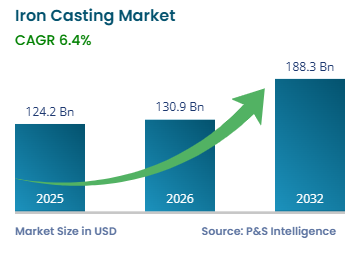
The iron casting market size was USD 124.2 billion in 2025, which is predicted to reach USD 188.3 billion by 2032, growing at a CAGR of 6.4% during 2026–2032.
The market growth is driven by rising investments in railway infrastructure development worldwide, expanding automotive production, particularly in electric vehicles, and increasing demand from industrial machinery and construction sectors.
Iron casting continues to demonstrate its critical importance in modern manufacturing through its versatility in producing complex geometries with exceptional mechanical properties at competitive costs. The material's inherent characteristics, including excellent machinability, superior vibration damping capabilities, and high compressive strength, make it indispensable across diverse industrial applications ranging from automotive engine blocks to heavy machinery components. The growing emphasis on infrastructure development in emerging economies, coupled with the global transition toward sustainable transportation systems, is creating substantial opportunities for iron casting manufacturers to expand their production capacities and develop innovative casting solutions.
The railway sector's transformation represents a particularly significant growth catalyst, with governments worldwide investing heavily in rail network modernization and expansion. In total, 205 rail construction projects broke ground in 2024, with a combined capital investment of almost USD 390 billion, demonstrating the sector's robust demand for high-quality iron castings used in critical components such as brake systems, couplings, and bogie frames. Furthermore, the automotive industry's evolution toward electric vehicles is reshaping demand patterns, with global electric car sales surpassing 17 million units in 2024, creating new requirements for specialized iron casting components in battery housings, motor casings, and structural parts.
The gray category dominated the iron casting market in 2025, accounting for 40% of the total market share, and is expected to maintain its lead throughout the forecast period. This dominance is primarily attributed to gray cast iron's exceptional machinability, cost-effectiveness, and versatile application range across multiple industries. The material's graphite flake microstructure provides superior vibration damping characteristics, making it particularly valuable in automotive engine blocks, machine tool bases, and industrial equipment where noise reduction and operational stability are critical requirements. The widespread availability of raw materials and well-established production processes further contribute to gray cast iron's market lead.
Ductile cast iron represents the fastest-growing category during 2026–2032. This robust growth is driven by the material's unique combination of high strength, ductility, and impact resistance, which enables its use in demanding applications previously reserved for steel forgings. The spheroidal graphite structure in ductile iron provides mechanical properties that bridge the gap between traditional cast iron and steel, offering manufacturers a cost-effective solution for components requiring both strength and toughness. The expanding wind energy sector particularly favors ductile iron for turbine components, while the automotive industry increasingly specifies it for safety-critical parts such as steering knuckles and suspension components.
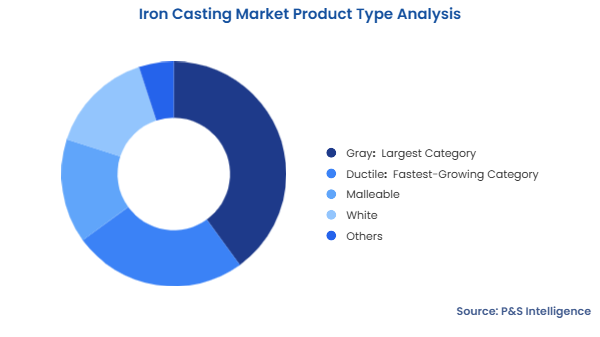
These product types are covered:
Sand-casting dominated the process category in 2025, holding 40% of the market share, and continues to lead due to its versatility, cost-effectiveness, and ability to produce large, complex components. This traditional yet continuously evolving process offers unmatched flexibility in terms of part size, ranging from small precision components to massive industrial castings weighing several tons. The method's adaptability to various iron grades and its capability to accommodate design changes quickly make it ideal for both high-volume production and custom manufacturing. Recent innovations in sand binder systems and 3D-printed sand molds are enhancing the process's precision and reducing environmental impact.
Die-casting emerges as the fastest-growing process category during the forecast period. This growth is fueled by increasing demand for high-precision, thin-walled components with excellent surface finish, particularly from the automotive and consumer goods sectors. Die casting's ability to maintain tight dimensional tolerances and produce near-net-shape parts with minimal machining requirements makes it increasingly attractive for manufacturers seeking to reduce production costs and improve efficiency. The process's high production rates and consistency are particularly valuable in automotive applications where large volumes of identical components are required.
These processes are covered:
The automotive category commands the largest iron casting market share in 2025, of 30%, driven by the industry's extensive use of cast components in powertrains, chassis, and braking systems. Despite the ongoing transition toward electric vehicles and lightweight materials, iron castings remain indispensable for numerous automotive applications where their combination of strength, durability, and cost-effectiveness cannot be matched. The material's excellent thermal management properties make it particularly suitable for brake discs and drums, while its vibration damping characteristics are valued in engine blocks and transmission housings. The growing production of commercial vehicles and the expansion of automotive manufacturing in emerging markets continue to support robust demand from this category.
The railway sector emerges as the fastest-growing application category, during 2026–2032. This exceptional growth is underpinned by massive global investments in railway infrastructure modernization and expansion. These transformative projects are creating the largest boom in rail construction, putting hundreds of thousands of skilled laborers to work, illustrating the sector's expansion beyond traditional markets. Iron castings are essential for manufacturing bogies, brake systems, couplers, and various track components that must withstand extreme loads and environmental conditions, while maintaining safety and reliability over decades of service.
These applications are covered:
Drive strategic growth with comprehensive market analysis
Asia-Pacific dominated the global iron casting market in 2025, commanding 40% share, with the market expected to grow at the highest CAGR, of approx. 6.5%, through 2032. This regional dominance is underpinned by the concentration of global manufacturing activities, rapid industrialization, and massive infrastructure development programs across major economies. China alone accounts for a substantial portion of both production capacity and consumption, leveraging its integrated supply chain, cost advantages, and technological capabilities to serve both domestic and export markets. The region's automotive industry, which represents the world's largest vehicle production hub, generates enormous demand for iron castings across passenger and commercial vehicle segments.
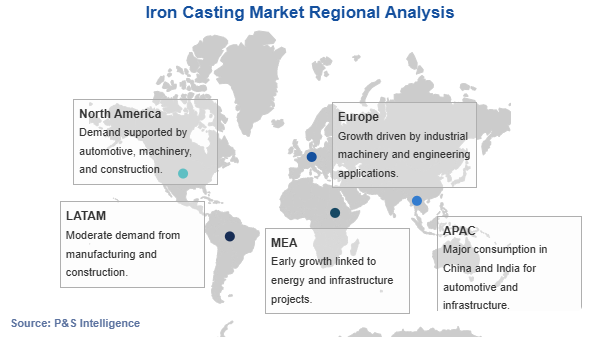
The region's commitment to railway infrastructure development particularly stands out as a growth catalyst. Chinese railway expansion projects, including extensive high-speed rail networks and urban metro systems, require vast quantities of iron castings for rolling stock and infrastructure components. India's ambitious railway modernization program, coupled with its growing automotive and industrial machinery sectors, contributes significantly to regional demand.
In India, the Eastern Dedicated Freight Corridor (EDFC) project led to the construction of 1,337 km of newly built tracks, from 2014 to 2023, exemplifying the scale of infrastructure development driving casting demand. In the Union Budget 2025–26, Indian Railways received a capital outlay of INR 2.52 lakh crore, with a major focus on capacity expansion, safety, and modernization. Key projects include the Mumbai–Ahmedabad bullet train (with an undersea tunnel), Western Dedicated Freight Corridor, and multiple multitracking works in Maharashtra and MP.
The government also plans to produce 200 Vande Bharat trains, 100 Amrit Bharat trains, and expand Kavach (train protection system) coverage. Over 1,300 stations are being redeveloped, and large-scale electrification and signaling upgrades are underway. These efforts aim to enhance connectivity, safety, freight efficiency, and passenger experience across India’s railway network.
North America represents the second-largest regional market, holding 20% of the global iron casting market share in 2025. The region's mature industrial base, technological leadership, and ongoing infrastructure renewal programs drive steady demand for high-quality iron castings. The U.S. dominates the regional market, with its extensive automotive manufacturing presence in Michigan, Ohio, and Pennsylvania. This is why these states serve as primary demand centers for cast iron products. The implementation of stringent quality standards and environmental regulations has prompted North American foundries to invest in advanced technologies and sustainable production practices.
The region's focus on high-value, precision castings for aerospace, defense, and specialized industrial applications differentiates it from cost-focused markets. Advanced manufacturing techniques, including automated molding lines and real-time quality control systems, enable North American foundries to compete on quality and innovation rather than price alone. The growing emphasis on sustainable manufacturing and circular economy principles is driving investments in recycling technologies and energy-efficient production processes.
The regions and countries analyzed in this report are:
The global iron casting market is fragmented, with numerous regional and local foundries alongside several large multinational corporations. This is driven by low barriers to entry for basic casting and the need for proximity to end-users for cost efficiency and customization. Thousands of small to medium-sized foundries serve local markets, while larger players leverage economies of scale and advanced technology to serve global industries. The top 10 players account for around 35% of the market, differentiating themselves through technological innovation, quality certifications, and the ability to produce complex, high-precision castings. Sustainability practices, including reduced emissions and energy-efficient operations, are becoming increasingly important.
Strategic partnerships with end users, particularly in the automotive and railway sectors, support a stable demand and collaborative product development. Companies are heavily investing in automation, digitalization, specialized alloys, and advanced casting techniques, while offering comprehensive solutions such as design assistance, rapid prototyping, and just-in-time delivery to maintain a competitive edge.
Want a report tailored exactly to your business need?
Request CustomizationLeading companies across industries trust us to deliver data-driven insights and innovative solutions for their most critical decisions. From data-driven strategies to actionable insights, we empower the decision-makers who shape industries and define the future. From Fortune 500 companies to innovative startups, we are proud to partner with organisations that drive progress in their industries.

Working with P&S Intelligence and their team was an absolute pleasure – their awareness of timelines and commitment to value greatly contributed to our project's success. Eagerly anticipating future collaborations.
McKinsey & Company
India
Our insights into the minutest levels of the markets, including the latest trends and competitive landscape, give you all the answers you need to take your business to new heights

We take a cautious approach to protecting your personal and confidential information. Trust is the strongest bond that connects us and our clients, and trust we build by complying with all international and domestic data protection and privacy laws


Customize the Report to Align with Your Business Objectives

Request the Free Sample Pages