This Report Provides In-Depth Analysis of the IoT MVNO market Report Prepared by P&S Intelligence, Segmented by Service (Connectivity Services, Managed & Value-Added Services), Enterprise Size (Large Enterprises, Small & Medium Enterprises), Industry (Manufacturing & Industrial, Smart Cities & Infrastructure, Automotive & Transportation, Energy & Utilities, Healthcare, Retail, Agriculture, Logistics & Supply Chain), Business Model (Full MVNO, Service MVNO, Reseller MVNO), and Geographical Outlook for the Period of 2021 to 2032
Explore the market potential with our data-driven report
IoT MVNO Market Future Prospects
IoT MVNO Market Key Insights
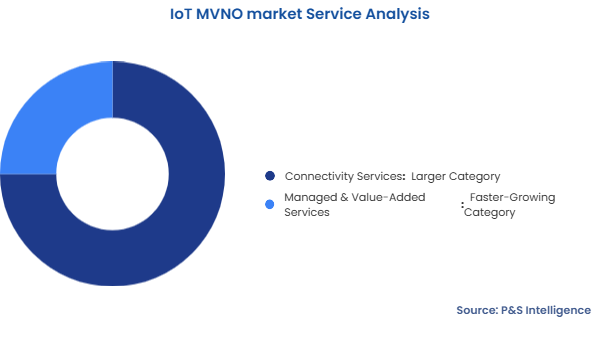
Connectivity services are the largest service, holding a market share of 75%, because they form the essential foundational layer for IoT deployments, prioritising reliable data access across international borders.
Managed & value-added services are the fastest-growing service, registering a CAGR of approximately 18.8%, driven by the increasing demand for complete solutions like device management, data monitoring, and security.
Manufacturing & industrial is the largest industry, holding a market share of 25%, as this sector deploys virtual cellular networks for automation, predictive maintenance, and remote equipment monitoring.
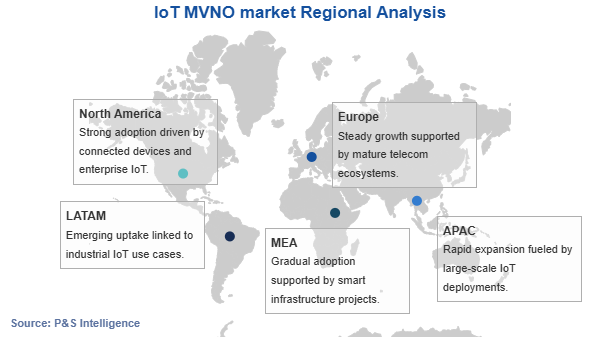
North America holds the largest share of 40% in the IoT MVNO market, driven by a well-established IoT ecosystem and high enterprise adoption across sectors like automotive and healthcare.
China dominates the Asia-Pacific market, holding a significant share, due to the continuous expansion of manufacturing bases and strategic government funding programs focusing on integrating smart factories.
IoT MVNO Market Analysis
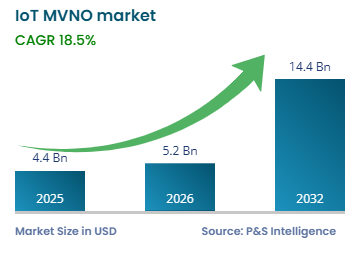
The IoT MVNO market size was USD 4.4 billion for 2025, and it will grow by 18.5% during 2026–2032, to reach USD 14.4 billion by 2032.
The market is expanding as enterprises increasingly rely on flexible cellular connectivity to manage vast fleets of smart devices, without the need for dedicated telecom infrastructure. According to the Department of Telecommunications, India recorded over 1.2 billion wireless subscribers in 2024, demonstrating the vast scale of cellular infrastructure supporting large-scale IoT deployments. This extensive subscriber base supports widespread deployment of connected devices across sectors such as utilities, logistics, and smart infrastructure, reinforcing the need for flexible connectivity models. This trend drives companies to adopt virtual network operator models, ensuring reliable, scalable, and cost-efficient deployments across borders.
IoT MVNO Market Trends and Drivers
Shift towards Platform-Based Connectivity and Global IoT Management Is Major Trend
The market is shifting towards full-service platforms as enterprises increasingly demand integrated solutions that combine advanced analytics and remote management to oversee large-scale device fleets centrally. This transition is directly driven by the rapid growth in global cellular IoT connections, which, according to Ericsson, will reach 4.5 billion by the end of 2025. To support this expansion, telecom providers are rolling out global eSIM offerings, ensuring seamless, cross-border operations without the need for physical network switching.
These trends are transforming basic connectivity providers into comprehensive IoT solution enablers, as the industry is evolving towards platform-based, enterprise-driven connectivity ecosystems. Ultimately, the shift towards integrated platforms is becoming a critical enabler of the enterprise IoT landscape.
Rising Need for Cost-Efficient and Scalable IoT Connectivity Drives Market
The market is expanding rapidly because enterprises increasingly require cost-effective virtual connectivity solutions to manage massive device fleets without the significant investment in building proprietary telecom infrastructure. Establishing independent networks remains prohibitively expensive and complex, which drives the demand for virtual network operators offering flexible pricing and simplified global scaling.
According to the ITU, global mobile data consumption reached 1.3 zettabytes in 2024. This escalating volume of data and the growing density of connected devices emphasise the urgent need for affordable, ready-to-deploy solutions that can facilitate seamless, end-to-end digitisation across industries. Consequently, virtual operators are poised to play a pivotal role in enabling broad digital transformation and operational efficiency across multiple sectors.
Dependence on MNOs and Limited Control over Service Quality Hamper Market Growth
The market faces significant challenges to expansion because virtual network operators are entirely dependent on existing telecommunication companies for physical network access and geographical coverage. These virtual providers do not own the underlying infrastructure, meaning they lack direct control over network outages and must navigate complex agreements across fragmented regional carriers. This dependence limits their ability to ensure high service reliability. As ITU highlights, global 5G network coverage reached 51% of the world’s population in 2024, demonstrating the strict boundaries set by host networks. Consequently, this reliance restricts virtual operators from delivering the consistent, high-quality connectivity required for mission-critical global enterprise applications.
Industry-Specific IoT Solutions and Emerging Markets Offer Opportunities
The market holds immense growth potential because virtual network operators have the ability to deploy tailored connectivity solutions for specialised industries and emerging regions. Sectors such as agriculture, healthcare, and logistics require highly customised device management, while developing nations continue to expand their foundational digital infrastructure. This expansion is validated by the fact that ITU reports global internet users reached 5.5 billion in 2024. Additionally, Ericsson forecasts that massive cellular IoT connections will reach 4.1 billion globally in 2024. Consequently, the convergence of specialised industrial demand with expanding network access creates significant opportunities for operators to capture early market share and establish long-term relationships with enterprises.
IoT MVNO Market Segmentation Analysis
Service Analysis
Connectivity services are the largest category, holding a market share of 75%, because they form the essential foundational layer for any IoT deployment. Enterprises consistently prioritise basic data access before integrating advanced features, requiring flexible SIM or eSIM architectures that scale seamlessly across international borders. Demonstrating this massive baseline requirement for reliable data access, there were about 95 mobile-broadband subscriptions per 100 inhabitants globally in 2024, equivalent to roughly 7.7 billion subscriptions, according to the ITU. Consequently, this continuous operational necessity ensures that fundamental network connectivity remains the dominant and most requested service segment across all enterprise applications.
Managed & value-added services are the fastest-growing category, registering a CAGR of approximately 18.8%, as businesses are moving beyond basic connectivity and looking for complete solutions. They want tools for device management, data monitoring, and security in one place. Handling large IoT deployments without support is difficult; so, companies are adopting managed services to reduce operational burden. As IoT use becomes more complex, demand for these added capabilities is rising quickly.
Large enterprises are the largest category, holding a market share of 75%, because they deploy IoT at a much bigger scale across multiple locations. These organisations have higher budgets and stronger digital strategies, allowing them to invest in advanced connectivity solutions. They also manage large fleets of devices, which increases the need for reliable MVNO services. Their early adoption of IoT technologies keeps them ahead and maintains their leading position in the market.
Small and medium enterprises are the fastest-growing category, registering a CAGR of approximately 18.9%, as they require lighter billing, charging, and customer-support stacks. Virtualised delivery reduces implementation cost and helps smaller firms launch services without owning complex telecom infrastructure. In 2024, newly registered limited-liability companies reached 4.3 per 1,000 working-age adults globally, according to the World Bank Group’s Entrepreneurship Database. This rising formal business creation expands the addressable base for scalable, cloud-based IoT connectivity and MVNO solutions.
The enterprise sizes analysed in this report are:
Large Enterprises (Larger Category)
Small & Medium Enterprises (SMEs) (Faster-Growing Category)
Industry Analysis
Manufacturing & industrial is the largest category, because this sector systematically deploys virtual cellular networks for automation, remote equipment monitoring, and predictive maintenance. Large-scale factories require continuous, uninterrupted data flows between autonomous machines and centralised control systems to maximise productivity and eliminate costly operational downtime. Highlighting this massive scale of interconnected industrial infrastructure, the global operational stock of industrial robots reached 4.6 million units in 2024, according to the International Federation of Robotics. Consequently, this intense reliance on synchronised machinery cements the manufacturing sector as the primary consumer of robust, enterprise-grade connectivity services.
Smart cities & infrastructure is the fastest-growing category, as governments and urban planners are investing in connected solutions for traffic management, energy use, and public safety. Cities are adopting sensors and smart systems to improve daily operations and citizen services. These projects require scalable and flexible connectivity across wide areas. As more regions focus on urban digital transformation, demand in this segment is rising rapidly.
Full MVNO is the largest category, holding a market share of 60%, because it offers greater control over services, pricing, and customer management. These providers handle core network elements, allowing them to deliver customised solutions to clients. Businesses prefer full MVNOs when they need higher flexibility and better service integration. This level of control and capability helps them maintain a strong position in the market.
Reseller MVNOs are the fastest-growing category, registering a significant CAGR due to their ability to enable new telecom players to enter the market with minimal capital investment. These agile providers focus solely on delivering connectivity services, bypassing the financial and technical complexities of maintaining physical network infrastructure. The scale of the existing global mobile networks they leverage is vast, with mobile-cellular subscriptions reaching 9.1 billion in 2024, according to the ITU. As a result, enterprises are increasingly adopting this cost-effective operational model to speed up deployments, roll out scalable IoT solutions, and seize emerging market opportunities with agility.
The business models analysed in this report are:
Full MVNO (Largest Category)
Reseller MVNO (Fastest-Growing Category)
Service MVNO
Drive strategic growth with comprehensive market analysis
IoT MVNO Market Geographical Analysis
North America IoT MVNO Market Analysis
North America holds the largest share, of 40%, because the region has a well-established IoT ecosystem with strong enterprise adoption across sectors like automotive, logistics, and healthcare. Companies here focus on large-scale deployments that need stable and secure connectivity. Telecom partnerships are more structured, allowing MVNOs to offer reliable multi-network services. The presence of advanced regulatory frameworks also supports smoother operations. In addition, early use of technologies like eSIM and private networks helps businesses manage connected devices more efficiently, strengthening the region’s leading position.
U.S. IoT MVNO Market Analysis
The United States leads the North American market because large enterprises rapidly deploy advanced virtual networks across complex operational sectors. Companies require secure, compliant, and wide-reaching connectivity to continuously manage critical applications like remote asset tracking, healthcare monitoring, and autonomous manufacturing. Demonstrating this massive industrial automation scale, 34,200 industrial robots were installed in the United States in 2024, according to the International Federation of Robotics. Moreover, over 1.5 million electric vehicles were sold nationwide in 2024, according to Argonne National Laboratory. Consequently, virtual network operators strategically partner with major telecom providers to deliver the tailored, high-reliability coverage necessary to support these expanding enterprise ecosystems.
Canada IoT MVNO Market Analysis
Canada experiences accelerated market growth because enterprises continuously expand virtual network deployments across the energy, mining, and remote asset management sectors. The country's massive geographic footprint necessitates highly reliable, flexible cellular coverage to connect critical operational infrastructure deployed in isolated, less-populated regions. Demonstrating the immense scale of this industrial output and expanding network reach, Canadian crude oil production reached 298.8 million cubic metres in 2024, according to Statistics Canada.
Asia-Pacific IoT MVNO Market Analysis
Asia-Pacific has the highest CAGR, of approximately 19.4%, because the region is rapidly expanding its digital and industrial base with strong government-backed initiatives. Countries here are investing in smart cities, connected transport, and large-scale industrial IoT projects. Many businesses are adopting IoT for the first time, creating fresh demand for flexible connectivity models. The telecom landscape is also evolving quickly, allowing MVNOs to enter and scale services. Rising startup activity and manufacturing growth further support the increasing need for IoT connectivity solutions.
China IoT MVNO Market Analysis
China dominates the Asia-Pacific market because enterprises continuously expand their massive manufacturing bases and heavily prioritise industrial automation. The national government actively accelerates this deployment through strategic funding programs focused on integrating smart factories and modernising public infrastructure. Demonstrating the immense physical scale of this foundational network capacity, China deployed over 3.8 million 5G base stations by 2024, according to the State Council of the People's Republic of China. Consequently, virtual network operators leverage this expanding infrastructure to deliver specialised industrial solutions that continuously strengthen the country's dominant market position.
India IoT MVNO Market Analysis
India is the fastest-growing country, because enterprises rapidly increase digital adoption across core industries to continuously optimise operations. Businesses systematically deploy virtual connectivity to manage complex, geographically dispersed applications like logistics tracking, agriculture monitoring, and large-scale smart utilities. Demonstrating the massive scale of this ongoing utility digitisation, over 45.5 million smart meters had been installed under the RDSS as of early 2026, according to the Press Information Bureau. Consequently, as the government continues to fund foundational digital infrastructure, virtual network operators aggressively expand their specialised services to capture this escalating nationwide demand.
Europe IoT MVNO Market Analysis
Europe shows steady development in the IoT MVNO market, supported by strict data protection rules and cross-border connectivity needs. Businesses operating across multiple countries require seamless network access, which increases reliance on MVNO solutions. The region also focuses on industrial automation and smart infrastructure projects, especially in manufacturing-driven economies. Telecom operators often collaborate with MVNOs to expand IoT services. In addition, regulatory alignment across countries encourages standardised deployments, making it easier for enterprises to manage connected devices across different locations.
The regions and countries analysed in this report are:
North America (Largest Regional Market)
U.S. (Larger Country)
Canada (Faster-Growing Country)
Europe
Germany (Largest Country)
U.K. (Fastest-Growing Country)
France
Italy
Spain
Rest of Europe
Asia-Pacific (Fastest-Growing Regional Market)
China (Largest Country)
India (Fastest-Growing Country)
Japan
South Korea
Australia
Rest of APAC
Latin America
Brazil (Largest Country)
Mexico (Fastest-Growing Country)
Rest of LATAM
Middle East and Africa
Saudi Arabia
South Africa (Largest Country)
U.A.E. (Fastest-Growing Country)
Rest of MEA
IoT MVNO Market Share Analysis
The market is fragmented, as it includes a large number of global and regional players offering varied IoT connectivity solutions. No single company has full control because services differ based on industry focus, geographic coverage, and technology capabilities. Many MVNOs target niche use cases such as automotive, healthcare, or logistics, which spreads the competition. Also, new entrants can join through reseller models with lower investment, increasing the number of participants. This mix of specialised providers and easy entry keeps the market highly competitive and distributed.
Leading Companies in the IoT MVNO market:
Vodafone Group Plc
Telefonica S.A.
Deutsche Telekom AG
Orange S.A.
AT&T Inc.
Verizon Communications Inc.
T Mobile US Inc.
China Mobile Limited
China Telecom Corporation Limited
China Unicom Hong Kong Limited
KDDI Corporation
SoftBank Group Corporation
Nippon Telegraph and Telephone Corporation
Sierra Wireless Inc.
1NCE GmbH
IoT MVNO Market News
In April 2026, Telenor IoT made its SGP.32 SIM cards available for delivery after opening orders through its managed connectivity service. The release moved the new SIM standard into customer ordering, with support for new global IoT deployments. It gave Telenor IoT a live product update tied to SIM profile management and deployment workflows.
In January 2026, 1NCE GmbH launched 1NCE Insights, a data program for its IoT software and connectivity platform. The program gives customers access to anonymised network-wide information for comparing device behaviour and setup choices. The launch added a new software layer to 1NCE’s platform without changing the company’s core connectivity service.
In October 2025, NuvoLinQ launched LinQ1Zero, an eUICC SIM solution for IoT deployments. The company said the service was in market with customers already operational. The launch used Kigen and BICS technology behind the SIM and covered device onboarding, profile handling, and connectivity lifecycle management across networks and regions.
In September 2025, Pelion unveiled Consumer eSIM for IoT, a connectivity service for eSIM-only and enterprise devices. The company described it as an addition to its existing IoT SIM options, not a replacement. The launch gave Pelion a product for central activation and management of commercial devices using consumer eSIM technology.
In April 2025, BICS launched eSIM Hub, an orchestration platform for enterprise IoT deployments using eSIM connectivity. The platform works with BICS’ SIM for Things service to provision, manage, and switch eSIM connectivity. The launch placed BICS in the eSIM orchestration role ahead of wider use of the new IoT remote provisioning standard.
Frequently Asked Questions About This Report
What is an IoT MVNO and how does it work?+
An IoT MVNO delivers connectivity by leasing network capacity from mobile operators and provides customized solutions for managing connected devices without owning telecom infrastructure.
Why are IoT MVNOs important for enterprise connectivity solutions?+
They provide scalable and flexible connectivity across regions allowing enterprises to deploy and manage IoT devices globally without building complex telecom infrastructure.
What are the main benefits of using IoT MVNO services?+
They offer cost efficiency global coverage flexible pricing simplified management and faster deployment which helps enterprises efficiently manage large IoT device networks.
How do IoT MVNOs differ from traditional telecom operators?+
They do not own network infrastructure and instead focus on service flexibility customization and customer-centric solutions while relying on telecom operators for connectivity.
What industries commonly use IoT MVNO connectivity services today?+
Industries such as manufacturing logistics healthcare automotive and smart cities use IoT MVNOs for real time monitoring automation and efficient device connectivity.
Want a report tailored exactly to your business need?
Leading companies across industries trust us to deliver data-driven insights and innovative solutions for their most critical decisions. From data-driven strategies to actionable insights, we empower the decision-makers who shape industries and define the future. From Fortune 500 companies to innovative startups, we are proud to partner with organisations that drive progress in their industries.
Client Testimonials
Working with P&S Intelligence and their team was an absolute pleasure – their awareness of timelines and commitment to value greatly contributed to our project's success. Eagerly anticipating future collaborations.
McKinsey & Company
India
Unmatched Standards
Our insights into the minutest levels of the markets, including the latest trends and competitive landscape, give you all the answers you need to take your business to new heights
Complete Data Security
We take a cautious approach to protecting your personal and confidential information. Trust is the strongest bond that connects us and our clients, and trust we build by complying with all international and domestic data protection and privacy laws