This Report Provides In-Depth Analysis of the IoT Analytics Market Report Prepared by P&S Intelligence, Segmented by Component (Solutions, Services), Deployment (On-Premises, Cloud), Analytics Type (Descriptive Analytics, Diagnostic Analytics, Predictive Analytics, Prescriptive Analytics), Organization Size (Large Enterprises, SMEs), Application (Predictive Maintenance, Asset Management, Energy Management, Inventory Management, Remote Monitoring), End Use Industry (Manufacturing, Energy & Utilities, Transportation & Logistics, IT & Telecommunications, Retail & E-commerce, Healthcare & Life Sciences), and Geographical Outlook for the Period of 2021 to 2032
Explore the market potential with our data-driven report
IoT Analytics Market Overview
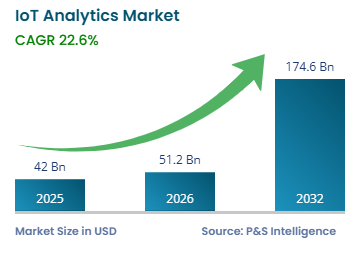
The IoT analytics market size was USD 42.0 billion for 2025, and it will grow by 22.6% during 2026–2032, to reach USD 174.6 billion by 2032.
The market growth is driven by the accelerating deployment of connected sensors, actuators, and industrial control systems across manufacturing, energy, transportation, and healthcare. The maturation of edge-to-cloud analytics architectures is transforming raw device telemetry into descriptive, predictive, and prescriptive insights for real-time operational decision-making.
The expansion of connected infrastructure that generates continuous data streams underscores the scale of this opportunity. According to the International Energy Agency (IEA), the global stock of energy-related connected devices with automated controls and sensors reached approximately 13 billion in 2023 and is projected to exceed 25 billion by 2030. This device growth is increasing the volume of data that IoT analytics platforms must ingest, process, and analyze in near real time. The U.S. Department of Energy (DOE) highlights that transitioning from reactive maintenance to condition-based monitoring enables operators to identify performance degradation before equipment failure occurs, supporting predictive maintenance strategies and reinforcing IoT analytics platforms as essential components of modern asset management and operational optimization.
Key Market Insights
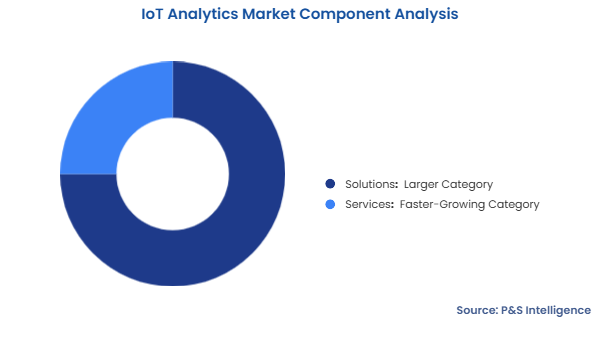
The solutions category holds the larger market share of 75% in 2025, driven by their role as the foundational software layer supporting data ingestion, storage, and analytics in IoT deployments.
The cloud category holds the larger market share of 80% in 2025, and it will have the higher CAGR of approximately 22.9%, driven by scalable computing resources, flexible storage, and lower upfront infrastructure costs offered by cloud platforms.
The manufacturing category holds the largest market share of 35% in 2025, driven by extensive deployment of connected industrial equipment.
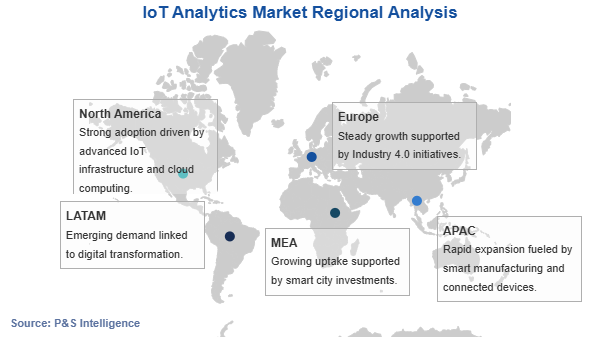
North America holds the largest market share of 40% in 2025, driven by advanced cloud infrastructure, strong enterprise digital transformation investments, and widespread IoT adoption across key industries.
Asia-Pacific will have the highest CAGR of approximately 23.5%, driven by rapid industrial digitalization and expanding IoT adoption across China, India, Japan, and South Korea.
IoT Analytics Market Trends and Drivers
Edge-to-Cloud Analytics Architectures Are Key Trends
A defining trend reshaping the IoT analytics market is the shift from centralized, cloud-only processing toward hybrid edge-to-cloud analytics architectures. Enterprises are increasingly deploying analytics workloads closer to the point of data generation, on gateways, industrial controllers, and edge servers, rather than transmitting all raw sensor data to centralized cloud environments. The growing volume and velocity of data generated by connected sensors are driving this transition, making cloud-centric architectures less suitable for latency-sensitive applications such as predictive maintenance, industrial automation, and safety monitoring.
The U.S. National Institute of Standards and Technology (NIST) identifies fog computing as a distributed computing model that brings data processing and analytics closer to connected devices. This model improves responsiveness while reducing latency and bandwidth requirements. A 2025 NIST assessment estimated that federal investments in IoT technology infrastructure could generate a 10- to 20-fold economic return. This projected return highlights the increasing importance of advanced IoT infrastructure. Reflecting this trend, Microsoft Corporation introduced OPC Write capability in Azure IoT Operations in November 2025, enabling bidirectional edge-to-cloud data exchange for predictive maintenance and AI-driven industrial automation. Consequently, vendors are embedding AI and machine learning inference capabilities into edge devices to enable real-time anomaly detection and faster operational decisions. Cloud platforms are increasingly used for long-term data storage, AI model training, and enterprise-wide analytics.
5G Network Expansion and Connectivity Investment Are Biggest Drivers
Expanding 5G network coverage is a key growth driver accelerating enterprise adoption of IoT analytics platforms. The higher bandwidth, lower latency, and greater device connectivity enabled by 5G generate larger volumes of real-time IoT data, increasing the need for advanced analytics to derive actionable insights. According to the International Telecommunication Union (ITU), 5G network coverage reached 51% of the world's population in 2024. This coverage has increased steadily since commercial deployment began in 2019. Coverage reached 84% of the population in high-income economies, compared with only 4% in low-income economies. This gap highlights the expansion of advanced connectivity in regions leading industrial digitalization, enabling the low-latency, high-bandwidth data transmission required for real-time IoT analytics applications, including predictive maintenance, remote asset monitoring, autonomous operations, and AI-enabled quality inspection.
As 5G infrastructure continues to mature, enterprises are expanding IoT deployments from pilot projects to organization-wide implementations across factories, logistics networks, utilities, and smart campuses. The growing availability of private 5G networks, edge computing, and integrated connectivity services is simplifying large-scale IoT deployments while enabling faster data processing and real-time analytics. Reflecting this momentum, in July 2025, Nokia announced the deployment of a private 5G network for Memphis Light, Gas and Water to support grid modernization through secure, real-time connectivity for smart utility operations. Expanding 5G coverage across industrial and underserved regions is expected to further reduce connectivity constraints, accelerating the adoption of IoT analytics solutions throughout the forecast period.
Data Privacy and Cybersecurity Requirements Are Key Restraints
Data privacy regulations and cybersecurity concerns remain barriers to enterprise IoT analytics adoption. The U.S. National Institute of Standards and Technology (NIST) recommends that IoT product manufacturers incorporate cybersecurity capabilities throughout the product lifecycle and provide customers with the information needed to securely configure, operate, and maintain connected devices. These guidelines highlight the importance of security-by-design in reducing cyber risks across IoT ecosystems that generate data for analytics platforms.
Security and compliance requirements often limit the scope of IoT analytics deployments in regulated industries such as healthcare, critical infrastructure, energy, and financial services. Organizations in these industries implement additional controls such as network segmentation, encryption, identity management, and continuous monitoring before connecting operational assets to analytics platforms. Cross-border data governance and data localization requirements also increase deployment complexity for multinational enterprises by limiting centralized data processing, prompting vendors to increasingly integrate zero-trust security architectures, encryption, and compliance-ready capabilities into IoT analytics platforms to support secure enterprise adoption.
Small and Medium Enterprise Digitalization Gaps Are Biggest Opportunities
An opportunity for IoT analytics providers lies in the digitalization gap among small and medium-sized enterprises (SMEs). According to Eurostat, 74% of all EU businesses reached at least a basic level of digital intensity in 2024, while the share for SMEs was 73%. This SME figure remains around 20 percentage points below the European Union's 2030 Digital Decade target, highlighting untapped potential for IoT analytics adoption as SMEs continue their digital transformation journey.
The high implementation cost and technical complexity of enterprise IoT analytics platforms continue to limit adoption among SMEs. Vendors are increasingly addressing this challenge through cloud-based, subscription-driven solutions with preconfigured dashboards and integrated analytics. These solutions are reducing upfront investment and deployment complexity, enabling wider SME adoption of IoT analytics solutions and creating significant growth opportunities for market participants.
IoT Analytics Market Segmentation Analysis
Component Analysis
The solutions category holds the larger market share of 75% in 2025, driven by their role as the foundational software layer that every IoT analytics deployment requires before any downstream service can be layered on top, covering data ingestion, storage, and analytics engines. This foundational role gives the category first-mover economics within customer budgets. According to the European Commission's Digital Decade report, 55% of EU enterprises adopted artificial intelligence (AI), cloud computing, or data analytics in 2023, reflecting the growing digital infrastructure and data-driven capabilities that support the deployment of IoT analytics solutions.
The services category will have the higher CAGR of approximately 22.8%, driven by the widening gap between IoT analytics platform capability and enterprise implementation maturity, which creates sustained demand for consulting, system integration, and managed analytics operations. Eurostat data indicates that 26.08% of enterprises used cloud Platform-as-a-Service offerings for application development, testing, or deployment, pointing to substantial reliance on external service layers.
The components analyzed in this report are:
Solutions (Larger Category)
Services (Faster-Growing Category)
Deployment Analysis
The cloud category holds the larger market share of 80% in 2025, and it will have the higher CAGR, driven by scalable computing resources, flexible storage, and lower upfront infrastructure costs offered by cloud platforms. According to Eurostat, 52.7% of EU enterprises purchased cloud computing services in 2025, up from 45.2% in 2023, reflecting the accelerating adoption of cloud-based infrastructure that supports IoT analytics deployments. This increasing adoption of cloud services enables organizations to process and analyze large volumes of IoT data more efficiently, accelerating the deployment of real-time analytics, predictive maintenance, and asset optimization solutions across industries.
The deployments analyzed in this report are:
On-Premises
Cloud (Larger and Faster-Growing Category)
Analytic Type Analysis
The descriptive analytics category holds the largest market share of 45% in 2025, driven by its role as the foundational layer of any analytics stack that summarizes historical data through dashboards, reports, and data visualization. This foundational role makes it the first capability enterprises deploy before investing in predictive or prescriptive analytics. According to Eurostat, 33.0% of EU enterprises performed data analytics using their own employees in 2025, reflecting the growing adoption of foundational data analytics capabilities that support descriptive analytics across enterprise IoT deployments.
The prescriptive analytics category will have the highest CAGR, driven by accelerating enterprise adoption of artificial intelligence (AI), enabling organizations to move beyond analyzing historical performance toward recommending optimal actions and automating decision-making. The Federal Reserve Bank of Minneapolis, citing the U.S. Census Bureau's April 2025 AI supplement, reported that approximately 20% of healthcare businesses and 12% of manufacturing businesses used AI in their business functions, highlighting expanding enterprise capabilities that support advanced AI-driven prescriptive analytics.
The analytic types analyzed in this report are:
Descriptive Analytics (Largest Category)
Diagnostic Analytics
Predictive Analytics
Prescriptive Analytics (Fastest-Growing Category)
Organization Size Analysis
The large enterprises category holds the larger market share in 2025, driven by dedicated IT budgets, in-house data science expertise, and complex multi-site operations that justify comprehensive investments in IoT analytics platforms. Their scale also enables implementation costs to be distributed across larger data volumes, connected assets, and business operations. According to Eurostat, 78.84% of large EU enterprises performed data analytics using their own employees in 2025, compared with 27.86% of small enterprises, highlighting the stronger analytical capabilities and digital maturity of large organizations that support enterprise-wide IoT analytics deployments.
The SMEs category will have the higher CAGR of approximately 23.0%, driven by the proliferation of simplified, subscription-based analytics packages that lower the technical and financial barriers previously limiting smaller organizations' adoption. According to Eurostat, small enterprises' use of paid cloud computing services rose 7.48 percentage points to 49.3% between 2023 and 2025. This gain represents the fastest relative increase of any enterprise size class.
The organization sizes analyzed in this report are:
Large Enterprises (Larger Category)
SMEs (Faster-Growing Category)
Application Analysis
The predictive maintenance category holds the largest market share of 35% in 2025, driven by its ability to deliver among the clearest and most measurable returns on investment by reducing unplanned equipment downtime, maintenance costs, and operational disruptions. According to the International Energy Agency (IEA), around 320 million distribution sensors have been deployed globally across power grids. This sensor base reflects the extensive condition-monitoring infrastructure that supports predictive maintenance through continuous asset monitoring and real-time analytics.
The asset management category will have the highest CAGR, driven by organizations increasingly leveraging IoT analytics to optimize asset utilization, lifecycle management, and operational performance across geographically distributed infrastructure. The rapid expansion of connected assets across manufacturing, energy, transportation, and utilities is increasing demand for centralized asset monitoring, performance optimization, and lifecycle management, making asset management one of the fastest-growing applications for IoT analytics solutions.
The applications analyzed in this report are:
Predictive Maintenance (Largest Category)
Asset Management (Fastest-Growing Category)
Energy Management
Inventory Management
Remote Monitoring
Others
End Use Industry Analysis
The manufacturing category holds the largest market share in 2025, driven by the extensive deployment of connected machinery, industrial sensors, robotics, and automated production systems that continuously generate operational data for analytics. Manufacturing's focus on predictive maintenance, quality control, and production optimization has made it the leading adopter of IoT analytics solutions. According to the U.S. Census Bureau, the use of artificial intelligence (AI) in producing goods or services more than doubled in the manufacturing sector between 2023 and 2025. This growth reflects the digital transformation of manufacturing operations and increasing demand for advanced analytics technologies that complement Industrial IoT deployments.
The energy & utilities category will have the highest CAGR of approximately 23.2%, driven by accelerating grid modernization, renewable energy integration, and the need for real-time monitoring of increasingly complex electricity networks. According to the International Energy Agency (IEA), annual global investment in electricity grids needs to more than double from around USD 330 billion to USD 750 billion by 2030. Approximately 75% of this investment is directed toward distribution grids to expand, strengthen, and digitalize electricity networks. This accelerating investment in digital grid infrastructure is expected to drive broader adoption of IoT analytics solutions for asset management, predictive maintenance, and grid optimization.
The end use industries analyzed in this report are:
Manufacturing (Largest Category)
Energy & Utilities (Fastest-Growing Category)
Transportation & Logistics
IT & Telecommunications
Retail & E-commerce
Healthcare & Life Sciences
Others
Drive strategic growth with comprehensive market analysis
IoT Analytics Market Regional Outlook
North America IoT Analytics Market Size
North America holds the largest market share of 40% in 2025, driven by extensive cloud infrastructure, high enterprise spending on digital transformation, and the widespread deployment of connected devices across manufacturing, energy, transportation, and healthcare. The presence of leading cloud service providers, IoT platform vendors, systems integrators, and data analytics specialists enables organizations to efficiently collect, process, and analyze IoT-generated data. Well-established data governance frameworks and continued investments in industrial digitalization strengthen enterprise adoption of IoT analytics solutions for predictive maintenance, asset optimization, and operational intelligence.
According to the U.S. Census Bureau, the use of artificial intelligence in producing goods or services within the manufacturing sector more than doubled between 2023 and 2025, reflecting growing enterprise investment in advanced digital technologies that complement IoT analytics and industrial automation initiatives. A Federal Reserve analysis based on U.S. Census Bureau survey data reported that approximately 18% of U.S. businesses had adopted AI by the end of 2025, indicating increasing organizational readiness to deploy data-driven operational platforms, including IoT analytics solutions.
U.S. IoT Analytics Market Size
The U.S. is both the largest and fastest-growing country market within North America, supported by the concentration of major cloud and analytics platform vendors and one of the world's largest industrial IoT deployment bases across manufacturing, energy, and transportation. Enterprise technology adoption continues to accelerate the integration of AI, cloud computing, and advanced analytics into production environments, with large manufacturers investing in end-to-end sensor-to-insight ecosystems to lead this shift. Continued reshoring initiatives and federal support for advanced manufacturing are reinforcing domestic demand for predictive maintenance, asset performance management, and operational intelligence platforms.
The National Institute of Standards and Technology (NIST) supports the adoption of smart manufacturing through its Smart Infrastructure and Manufacturing Program, which advances interoperable industrial systems, connected sensors, digital measurement science, and real-time data integration to improve manufacturing efficiency and resilience. These initiatives strengthen the deployment of IoT-enabled industrial environments and increase demand for IoT analytics platforms that convert connected-device data into actionable operational insights.
Asia-Pacific IoT Analytics Market Size
Asia-Pacific will have the highest CAGR of approximately 23.5%, driven by large-scale government-backed industrial digitalization programs across China, India, Japan, and South Korea. Manufacturing is transitioning toward Industry 4.0 across the region, and expanding 5G and edge AI infrastructure is reinforcing this shift. Government initiatives promoting smart manufacturing, smart cities, and digital transformation are accelerating the deployment of connected sensors and IoT devices. This deployment is creating an expanding data ecosystem that fuels demand for advanced IoT analytics platforms.
According to the China Internet Network Information Center (CNNIC), China's telecommunications enterprises had developed approximately 2.642 billion cellular IoT end-user connections by the end of 2024. These connections accounted for 59.6% of all mobile network connections in the country, generating massive volumes of real-time data that are driving the adoption of IoT analytics solutions for predictive maintenance, operational optimization, and intelligent decision-making. National Bureau of Statistics of China data shows that the value added of China's core digital economy industries accounted for 10.5% of GDP in 2024. This share reflects the country's expanding digital economy and technology ecosystem that supports enterprise investment in connected technologies and IoT analytics solutions.
India IoT Analytics Market Size
India is the fastest-growing country market in Asia Pacific during the forecast period, supported by accelerating digital transformation across manufacturing, utilities, transportation, agriculture, and smart cities. Government initiatives supporting Industry 4.0 and digital infrastructure, along with rising investments in 5G, edge computingv, cloud services, and industrial automation, are reinforcing this trajectory by accelerating the generation of connected-device data. This growth in data generation is creating demand for IoT analytics platforms that enable predictive maintenance, operational optimization, and real-time decision-making.
According to the Department of Telecommunications (DoT), the Telecommunication Engineering Centre (TEC) continues to develop national standards, technical specifications, and security frameworks for machine-to-machine communications and the IoT. TEC is also promoting interoperability and IoT adoption across smart cities, Industry 4.0, and connected infrastructure applications. These initiatives are strengthening India's IoT ecosystem and supporting wider deployment of IoT analytics solutions. The Digital Bharat Nidhi reported that 24,784 mobile towers had been commissioned, 35,022 villages had been covered, and more than 241,900 FTTH connections had been enabled under the BharatNet programme as of June 2026, expanding broadband connectivity and the digital infrastructure required for large-scale IoT deployments and analytics-driven applications.
The geographical breakdown of the market is as follows:
North America (Largest Regional Market)
U.S. (Larger and Faster-Growing Country)
Canada
Europe
Germany (Largest and Fastest-Growing Country)
U.K.
France
Italy
Spain
Rest of Europe
Asia-Pacific (Fastest-Growing Regional Market)
China (Largest Country)
India (Fastest-Growing Country)
Japan
South Korea
Australia
Rest of APAC
Latin America
Brazil (Largest Country)
Mexico (Fastest-Growing Country)
Rest of LATAM
Middle East & Africa
Saudi Arabia (Largest Country)
South Africa
U.A.E. (Fastest-Growing Country)
Rest of MEA
IoT Analytics Market Competitive Landscape
The market is fragmented due to the presence of numerous global cloud providers, enterprise software companies, industrial automation firms, telecommunications providers, and specialized IoT analytics vendors serving diverse industries and applications. The market encompasses manufacturing, healthcare, energy, transportation, agriculture, retail, and smart cities, each requiring industry-specific analytics capabilities, deployment models, and integration with existing operational technologies. Enterprises commonly deploy multi-vendor ecosystems by combining cloud infrastructure, IoT platforms, edge computing solutions, and analytics software from different providers to meet their operational requirements.
Key companies such as Microsoft Corporation, Amazon Web Services, Inc., Google LLC, IBM Corporation, SAP SE, Oracle Corporation, Cisco Systems, Inc., Siemens AG, and PTC Inc. compete by expanding AI-powered analytics capabilities, edge computing solutions, and industry-specific IoT platforms through product innovation, strategic partnerships, and acquisitions. The presence of numerous established technology companies alongside emerging niche vendors, coupled with continuous advancements in artificial intelligence, edge analytics, predictive maintenance, and digital twin technologies, prevents a small group of companies from dominating the market.
Key Players in the IoT Analytics Market:
Microsoft Corporation
Amazon Web Services, Inc.
IBM Corporation
Google LLC
Oracle Corporation
SAP SE
Cisco Systems, Inc.
Dell Technologies Inc.
Hewlett Packard Enterprise Company
PTC Inc.
Hitachi, Ltd.
Teradata Corporation
SAS Institute Inc.
Siemens AG
Software AG
IoT Analytics Market News
In June 2026, Hitachi, Ltd. expanded its partnership with OpenAI to accelerate AI-driven modernization and cybersecurity, building on an October 2025 memorandum of understanding. The collaboration enhances Hitachi's Lumada solutions, including HMAX, by applying OpenAI's Codex agent to analyze mission-critical legacy system source code.
In January 2026, Teradata Corporation announced that it completed more than 150 enterprise AI engagements in 2025 across industries. This milestone demonstrates growing enterprise adoption of its AI and data analytics platform. The company highlighted its AI Factory and Teradata Enterprise Vector Store capabilities, which enable organizations to operationalize AI at scale and generate real-time insights from complex enterprise data. These capabilities are supporting advanced analytics and decision-making across business operations.
In November 2025, PTC Inc. entered a definitive agreement for TPG to acquire its Kepware industrial connectivity and ThingWorx IoT businesses, with the transaction expected to close in the first half of 2026. The divestiture allows PTC to sharpen its focus on its core CAD, PLM, ALM, and SLM product lines while providing the IoT businesses additional capital for standalone growth.
In November 2025, Cisco Systems, Inc. launched its Unified Edge platform alongside an Agile Services Networking architecture designed to process AI workloads directly at the network edge. The launch targets industrial, retail, and healthcare customers processing the estimated 75% of enterprise data now generated outside traditional data centers.
In July 2025, Siemens AG entered a collaboration agreement with Microsoft Corporation to enable interoperability between its Building X digital building platform and Azure IoT Operations, with availability beginning in the second half of 2025. The partnership targets sustainable, autonomous building operations by unifying IoT data access across Siemens Xcelerator and Microsoft's cloud infrastructure.
Frequently Asked Questions About This Report
What is driving the growth of the IoT Analytics Market?+
The market is driven by the rapid adoption of connected IoT devices, increasing demand for real-time data analytics, advancements in AI and machine learning, expansion of Industrial IoT (IIoT), and the growing need for predictive maintenance and operational efficiency.
Which deployment model is witnessing higher adoption in the IoT Analytics Market?+
Cloud deployment is witnessing higher adoption due to its scalability, cost-effectiveness, remote accessibility, seamless software updates, and ability to process large volumes of IoT-generated data in real time.
Which industries are the primary users of IoT analytics solutions?+
Manufacturing, healthcare, transportation and logistics, energy and utilities, retail, and smart cities are the primary users, leveraging IoT analytics to improve asset performance, optimize operations, reduce costs, and enhance decision-making.
What are the major challenges in the IoT Analytics Market?+
Major challenges include data privacy and cybersecurity concerns, integration with legacy systems, interoperability among diverse IoT devices, poor data quality, and the shortage of skilled professionals capable of managing advanced analytics platforms.
Which technologies are transforming the IoT Analytics Market?+
Artificial intelligence (AI), machine learning (ML), edge computing, 5G connectivity, digital twins, big data analytics, and cloud computing are transforming the market by enabling faster, more accurate, and real-time analysis of IoT-generated data.
Want a report tailored exactly to your business need?
Leading companies across industries trust us to deliver data-driven insights and innovative solutions for their most critical decisions. From data-driven strategies to actionable insights, we empower the decision-makers who shape industries and define the future. From Fortune 500 companies to innovative startups, we are proud to partner with organisations that drive progress in their industries.
Client Testimonials
Working with P&S Intelligence and their team was an absolute pleasure – their awareness of timelines and commitment to value greatly contributed to our project's success. Eagerly anticipating future collaborations.
McKinsey & Company
India
Unmatched Standards
Our insights into the minutest levels of the markets, including the latest trends and competitive landscape, give you all the answers you need to take your business to new heights
Complete Data Security
We take a cautious approach to protecting your personal and confidential information. Trust is the strongest bond that connects us and our clients, and trust we build by complying with all international and domestic data protection and privacy laws