This Report Provides In-Depth Analysis of the Intralogistics Market Report Prepared by P&S Intelligence, Segmented by Component (Hardware, Software, Services), Automation Level (Semi-Automated, Fully Automated, Manual), Industry (Retail & E-Commerce, Logistics & Warehousing, Automotive, Food & Beverages, Industrial Manufacturing, Airports, Chemicals), and Geographical Outlook for the Period of 2021 to 2032
Explore the market potential with our data-driven report
Intralogistics Market Future Outlook
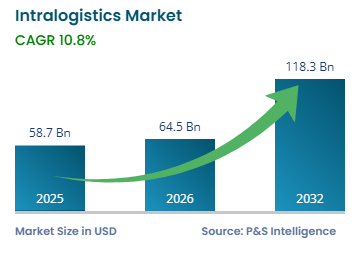
The global intralogistics market size stood at USD 58.7 billion in 2025, and it is projected to reach USD 118.3 billion by 2032, expanding at a CAGR of 10.8% over 2026–2032.
Accelerating deployment of warehouse automation technologies is reshaping operational requirements across the sector. Automated storage and retrieval systems (ASRS), autonomous mobile robots (AMRs), automated guided vehicles (AGVs), and conveyor systems are now standard infrastructure investments for high-throughput distribution operators. The rapid digitalization of supply chain and distribution operations is reinforcing this shift at a structural level. The International Federation of Robotics (IFR) highlights in its World Robotics 2025 report that 542,000 industrial robots were installed globally in 2024, more than double the number installed a decade ago, with Asia accounting for 74% of new deployments.
Key Market Insights
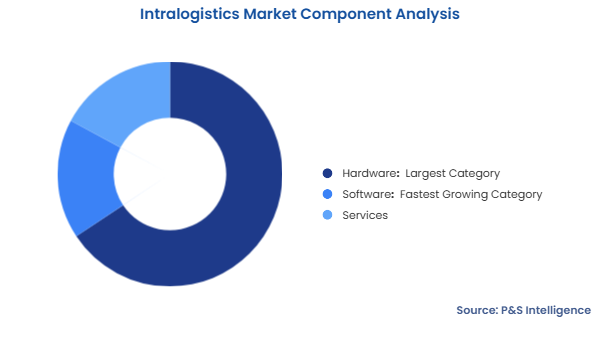
Hardware commanded the largest share, of 65%, in 2025.
Fully automated solutions are the fastest-growing category over 2026–2032, at 11.0% CAGR.
The logistics & warehousing category accounted for the largest share in 2025, of 30%.
North America held the largest share, of 45%, in 2025.
Asia-Pacific is the fastest-growing region with 11.5% CAGR.
The expanding scale of global e-commerce is a primary structural force reshaping intralogistics requirements. The U.S. Census Bureau reports that U.S. retail e-commerce sales exceeded USD 1.19 trillion in 2024, reflecting an 8.1% year-over-year increase. Throughput pressures of this scale are compelling operators to invest in high-speed order fulfillment infrastructure. The integration of warehouse management systems (WMS) and AI-driven predictive analytics is shifting the competitive axis from hardware deployment toward intelligent orchestration. Cloud-based platforms are enabling real-time inventory visibility and workflow optimization, with adaptive resource allocation across distribution networks emerging as a defining operational capability.
Intralogistics Market Trends & Drivers
AI Integration and Software-Defined Logistics Are Trending
A defining trend reshaping the intralogistics landscape is the accelerating shift from hardware-centric automation toward intelligent, software-orchestrated operations. The global digital logistics market is projected to grow from USD 40.5 billion in 2025 to USD 130.8 billion by 2032. Early-generation intralogistics systems were characterized by fixed conveyors, ASRS units, and AGVs operating on predetermined routes within rigid workflows. The current generation is defined by dynamic orchestration through AI-powered WMS, warehouse execution systems (WES), digital twins, and machine learning algorithms. These systems optimize picking routes and predict maintenance needs while balancing load across robotic fleets and adapting to real-time demand fluctuations without manual intervention.
The rapid proliferation of collaborative robots and autonomous mobile robots (AMRs) reflects the sector's transition toward flexible, reprogrammable automation architectures.
This trend is compressing the software segment's share of total intralogistics spending at an accelerating rate. Cloud-based WMS platforms, robotics-as-a-service (RaaS) subscription models, and AI-driven analytics tools have become standard components of modern fulfillment infrastructure. As AI capabilities mature and integration costs decline, software-defined logistics will increasingly differentiate competitive operators from those still reliant on static automation configurations.
Surging E-Commerce and Omnichannel Fulfillment Demand Drive Market
The exponential expansion of global e-commerce is the most consequential structural driver reshaping intralogistics demand. As online retail penetrates a growing share of total retail sales worldwide, distribution center operators face escalating throughput requirements and compressed delivery windows. Order profiles have grown increasingly complex, with high SKU diversity, small-batch picking, and same-day or next-day fulfillment expectations now standard across major e-commerce verticals.
These operational pressures cannot be resolved through labor scaling alone. Investment in high-speed sortation systems and robotic picking stations has become a baseline requirement, with automated conveyor networks and AI-integrated warehouse management systems (WMS) providing the orchestration layer that sustains throughput at scale. The global warehouse management system market is projected to grow from about USD 4,127.3 million in 2024 to USD 10,279.3 million by 2030.
The U.S. Bureau of Labor Statistics (BLS) projects that warehousing firms are increasingly implementing automation solutions, including WMS, AGVs, robots, and AI-based systems, to manage e-commerce-driven volume growth, with productivity gains from these technologies expected to accelerate through 2034. As e-commerce penetration deepens across Asia-Pacific, Latin America, and the Middle East, where online retail share remains well below mature economy levels, the volume of new intralogistics infrastructure required will expand commensurately. Demand for automated material handling solutions is sustained through the forecast period by this structural gap between current penetration rates and mature-market benchmarks.
High Capital Intensity and Integration Complexity Constrain Market Growth
The high upfront investment required to deploy enterprise-grade intralogistics automation represents a persistent structural barrier, particularly for small and medium-sized enterprises and operators in emerging markets. Medium-scale ASRS installations typically require USD 2–5 million in capital expenditure, while fully robotic fulfillment hubs can demand USD 10–20 million or more. Outlays at this level are prohibitive for mid-market operators managing thin margins and limited access to long-tenor financing.
Beyond hardware, network infrastructure upgrades alone can cost USD 30,000–150,000 per facility, and these prerequisites are frequently omitted from vendor quotes, inflating realized deployment costs well above initial projections. Extended implementation timelines further compound the burden, with capital tied up for up to 30 months before breakeven in many ASRS deployments.
These barriers are compounded by the complexity of integrating new automation platforms with legacy warehouse management systems, enterprise resource planning (ERP) infrastructure, and existing conveyor or storage configurations. The National Institute of Standards and Technology (NIST), through its Manufacturing Extension Partnership (MEP), documents that many companies face significant difficulty harmonizing new automation technologies with existing legacy infrastructure. Integration challenges of this kind frequently delay implementation and increase costs beyond initial projections, widening the gap between vendor-quoted and realized deployment expenditure.
This restraint disproportionately affects mid-sized 3PL operators, regional retailers, and manufacturers in Latin America, Southeast Asia, and Africa. These geographies represent substantial long-run growth potential, yet automation penetration remains low precisely because of capital access constraints. While modular and RaaS deployment models are beginning to erode this barrier, the pace of adoption among sub-enterprise operators remains slower than market-level growth figures suggest, moderating the overall addressable market in the near term.
Intralogistics Market Segmentation Analysis
Component Analysis
Hardware commanded the largest share, of 65%, in 2025. Physical equipment forms the foundational layer of any intralogistics installation, and no software layer substitutes for it. Conveyors, ASRS units, AMRs, AGVs, robotic picking arms, and sortation systems constitute the essential infrastructure that automated material handling operations require. The capital-intensive nature of facility upgrades, particularly in high-throughput e-commerce and automotive distribution, sustains strong hardware demand regardless of economic cycles. The global automated storage and retrieval system market is projected to reach USD 17.0 billion by 2032 from USD 9.8 billion in 2024, while the autonomous mobile robots market will reach USD 12.5 billion by 2032 from USD 5.6 billion in 2024.
This installation volume sustains demand for intralogistics hardware integration across the sectors driving deployment growth. The U.S. Bureau of Labor Statistics (BLS) notes that warehousing firms are increasingly implementing automation technologies, including AGVs, robots, and control hardware, to manage throughput demands. E-commerce expansion is the primary volume driver behind this accelerating implementation trend.
Software is the fastest-growing category over 2026–2032. Surging adoption of WMS and AI-powered analytics platforms is expanding the segment's revenue base, with WES and cloud-based orchestration tools adding recurring contract value on top of hardware deployments. As hardware installations mature across major markets, the competitive advantage increasingly shifts toward intelligent software layers that optimize fleet coordination and predict maintenance needs. Real-time inventory visibility has emerged as a commercially differentiating capability, generating recurring revenue streams and deepening customer lock-in across the operator base.
The market segments into the following components:
Hardware (Largest Category)
Software (Fastest Growing Category)
Services
Automation Level Analysis
Semi-automated solutions accounted for the largest share of the global intralogistics market in 2025, of 55%. The pragmatic deployment reality across most operator segments underpins this position. Pick-to-light systems, conveyor-assisted workflows, automated forklifts, RFID tracking, and barcode-integrated inventory systems enable facilities to achieve efficiency gains without the full capital commitment and integration complexity of end-to-end automation. For mid-sized enterprises, 3PL operators, and facilities operating across diverse product categories, semi-automated systems offer a commercially viable and operationally flexible entry point.
The National Institute of Standards and Technology (NIST) acknowledges that many companies face significant difficulty harmonizing new automation technologies with existing legacy infrastructure. This integration barrier reinforces the preference for semi-automated transitional architectures among operators upgrading incrementally.
Fully automated solutions are the fastest-growing category over 2026–2032. Declining system costs have lowered the capital threshold for full deployment, while improving AI-navigation capabilities in AMRs are expanding the range of facility types where end-to-end automation is operationally viable. Growing operator confidence following first-generation automation deployments is further accelerating adoption timelines. As robotics-as-a-service models lower upfront capital barriers and integration expertise becomes more widely available, the addressable market for full automation is expanding beyond large enterprises into mid-market operators. The global automated material handling equipment size will reach USD 68.4 billion by 2032, growing at a CAGR of 10.6 % from 2025 to 2032.
The market segments into the following automation levels:
Semi-Automated (Largest Category)
Fully Automated (Fastest Growing Category)
Manual
Industry Analysis
The logistics & warehousing category accounted for the largest share in the global intralogistics market in 2025, of 30%. Concentration of automation investment within dedicated distribution centers, third-party logistics hubs, and fulfillment facilities underpins this position. These environments demand throughput performance and operational uptime at a level that justifies intensive capital deployment. Error tolerance requirements in high-velocity fulfillment operations reinforce the case for ASRS, sorting, and robotic picking systems over manual alternatives.
The scale and standardization of dedicated logistics facilities also enable faster ROI on automation investments relative to more operationally complex end-user environments such as manufacturing or chemicals. The BLS projects that the transportation and warehousing sector will add 198,800 jobs through 2034, with growth increasingly concentrated in freight arrangement and logistics automation. This employment trajectory validates sustained capital flow into the logistics & warehousing end-use segment through the forecast period.
Retail & e-commerce is the fastest-growing category over 2026–2032. The relentless expansion of online order volumes is the primary demand driver, with the proliferation of omnichannel fulfillment models adding structural complexity that manual operations cannot absorb. Increasing deployment of micro-fulfillment centers embedded within urban retail locations is further compressing fulfillment timelines and raising the automation threshold for competitive operators.
E-commerce operators require dynamic, high-velocity automation capable of handling extreme SKU diversity and variable order batches. This demand profile is accelerating the adoption of AMRs and AI-powered sortation, with advanced WMS platforms providing the orchestration layer that makes fleet-level coordination viable at scale. The U.S. Census Bureau confirms that U.S. retail e-commerce sales grew 8.1% year-on-year to exceed USD 1.19 trillion in 2024. Throughput pressure of this magnitude translates directly into intralogistics investment across the retail and e-commerce operator base.
The market segments into the following industries:
Logistics & Warehousing (Largest Category)
Retail & E-Commerce (Fastest Growing Category)
Automotive
Food & Beverages
Industrial Manufacturing
Airports
Chemicals
Others
Drive strategic growth with comprehensive market analysis
Intralogistics Market Geographical Analysis
North America Intralogistics Market Outlook
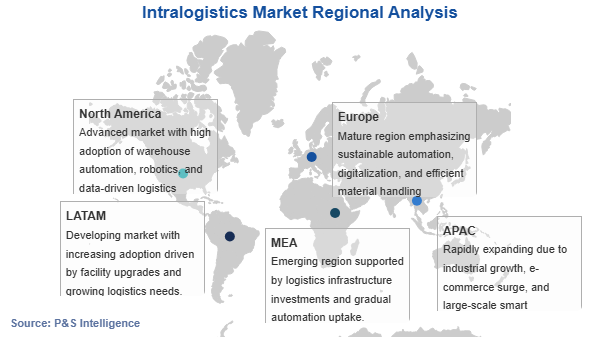
North America held the largest share, of 45%, of the global intralogistics market revenue in 2025. This is due to the decades of investment in automated distribution infrastructure, a highly developed third-party logistics (3PL) ecosystem, and the concentrated presence of leading solution integrators. Federal programs, such as the U.S. Manufacturing Extension Partnership (MEP), administered through the National Institute of Standards and Technology (NIST), have incentivized the modernization of manufacturing and logistics processes through automation and smart systems, directly accelerating intralogistics adoption across mid-sized enterprises.
The National Institute of Standards and Technology (NIST) notes that many U.S. companies face significant complexity in integrating new intralogistics technologies with legacy infrastructure This integration complexity is driving demand for modular, scalable deployment models across the operator base. The IFR reports that robot installations in the Americas exceeded 50,000 units for the fourth consecutive year in 2024, with the United States accounting for 68% of regional deployments.
North America's trajectory remains strongly positive. Continued e-commerce expansion is sustaining throughput investment across distribution infrastructure, while the reshoring of manufacturing activity is generating new automation demand in industrial facilities. Growing adoption of AI-integrated WMS platforms is deepening the technology layer across existing deployments. Canada is advancing as the fastest-growing country market within the region, with increasing investments in automated cold-chain and food logistics infrastructure.
United States Intralogistics Market Analysis
The United States is the largest individual country market for intralogistics globally. Its huge e-commerce retail sector is the primary volume driver, with extensive omnichannel fulfillment requirements compelling investment in high-velocity automated infrastructure. Deep penetration of robotic picking and sortation systems across distribution centers reflects the maturity of automation adoption within the country's logistics sector. Major retailers, e-commerce platforms, and 3PL operators are investing heavily in next-generation automated fulfillment hubs. The chemical and pharmaceutical sectors add additional demand vectors, requiring specialized ASRS and hazardous material handling solutions compliant with stringent safety regulations.
The U.S. Census Bureau reports that U.S. retail e-commerce sales reached USD 1.19 trillion in 2024, a year-over-year increase of 8.1%. Persistent volume pressure of this scale is compounding investment requirements across fulfillment infrastructure nationwide. The U.S. BLS reports that wage and salary costs for transportation and warehousing workers rose 7.1% in the 12 months to December 2023. The outlook for the United States remains robust, with AI-powered warehouse automation, micro-fulfillment center proliferation, and robot-as-a-service (RaaS) deployment models expanding access to automation beyond large enterprises.
Europe Intralogistics Market Trends
Europe represents the second-largest intralogistics market globally, with Germany being the largest robot market in Europe and the fifth-largest in the world. The region's emphasis on Industry 4.0 integration has positioned European manufacturers and logistics operators at the forefront of intelligent intralogistics deployment. IoT sensors, edge computing, and digital twins are now embedded components of warehouse operations across the continent's most advanced facilities. The nearshoring trend, accelerated by post-pandemic supply chain restructuring, is driving additional investment in automated logistics infrastructure across Germany, France, and Poland.
The IFR reports that industrial robot installations in Europe totaled 85,000 units in 2024, the second-highest figure on record, with 80% concentrated in the European Union. The European Commission's Horizon Europe framework supports digitalization of logistics through research funding targeting smart warehousing, autonomous systems, and sustainable intralogistics solutions.
Germany's trajectory remains dominant within Europe, sustained by its automotive and electronics manufacturing base. The United Kingdom, despite a post-2023 normalization in robot installations following the expiry of the super-deduction tax credit, is recovering as investment cycles resume, positioning it as the fastest-growing country within the region.
Asia-Pacific Intralogistics Market Growth
Asia-Pacific is the fastest-growing region in the global intralogistics market, with 11.5% CAGR. An unprecedented concentration of manufacturing output is the structural foundation, with e-commerce volume and government-backed smart logistics investment accelerating deployment across the region's major economies. China is the dominant country market, accounting for 54% of global industrial robot deployments in 2024 and operating the world's most extensive automated warehouse ecosystem. Chinese suppliers now command 57% of the domestic robotics market, up from 28% a decade ago, as domestic manufacturers have rapidly displaced international competitors across the mid-market.
The IFR notes that Asia accounted for 74% of global industrial robot installations in 2024. It also notes that China installed 295,000 industrial robots in 2024, the highest annual total on record. he region's concentration of new deployments reflects an accelerating push toward fully automated factory and warehouse environments across its manufacturing base. Demand from e-commerce, manufacturing, and logistics sectors drove this installation volume across the country's expanding automated warehouse ecosystem.
India is the fastest-growing country market within Asia-Pacific, recording a 7% increase in industrial robot installations to a record 9,100 units in 2024 per IFR data, with automotive and e-commerce fulfillment as the primary demand drivers. The region's trajectory is strongly positive, with South Korea, Japan, and Australia contributing incremental demand through semiconductor logistics, precision manufacturing automation, and cold-chain expansion, respectively.
China Intralogistics Market Drivers
China's intralogistics market is shaped by the scale and sophistication of its manufacturing and e-commerce sectors. The country's online retail ecosystem generates parcel volumes that rank among the highest recorded globally, pushing logistics operators and retailers to continuously improve warehouse efficiency and order fulfillment speed. Robotic picking systems and automated sorting lines have seen widespread adoption as a direct response to this throughput pressure, with advanced warehouse management platforms providing the orchestration layer that sustains operational accuracy at scale. Distribution center operators are prioritizing solutions that improve throughput and operational flexibility as order complexity increases.
Manufacturing clusters across coastal and inland provinces are increasingly modernizing internal factory logistics to streamline production flows and reduce operational inefficiencies. Rising labor costs in warehouse operations have strengthened the economic case for automated material-handling systems, while workforce shortages are compressing the timeline within which operators can defer that investment. Intelligent logistics technologies are absorbing demand from both pressures simultaneously.
Government initiatives supporting industrial upgrading and smart logistics infrastructure reinforce demand at a structural level. Cold chain logistics and cross-border e-commerce are expanding the range of facility types requiring advanced intralogistics systems, while large-scale logistics park development is concentrating capital deployment into high-specification automated environments. These converging forces position China as one of the most technologically mature intralogistics markets globally.
India Intralogistics Market Trends
India's intralogistics market is expanding as supply chains modernize to support rapid growth in consumption, organized retail, and digital commerce. The rise of e-commerce and quick-commerce platforms has increased order volumes and compressed delivery expectations, creating strong demand for efficient warehouse operations. Automated storage and sorting systems are being deployed to improve order processing speed, with inventory management platforms enabling accuracy at the shipment volumes these channels generate.
Expanding domestic manufacturing is reinforcing intralogistics demand from the supply side. Policy frameworks targeting stronger domestic production and improved logistics infrastructure are encouraging companies to upgrade internal material-handling systems within factories and distribution centers. Supply chain consolidation is producing larger, centralized warehouses and logistics hubs, raising the automation threshold required to operate them competitively.
Technology adoption is gradually accelerating across the sector. Companies are integrating robotics and IoT-enabled tracking alongside advanced warehouse management systems as operational complexity increases. Energy-efficient logistics infrastructure is emerging as an additional consideration shaping procurement decisions, reflecting sustainability commitments that are beginning to influence capital allocation across India's intralogistics market.
The regions and countries analyzed in this report include:
North America (Largest Region)
U.S. (Largest Country Market)
Canada (Fastest-Growing Country Market)
Europe
Germany (Largest Country Market)
U.K. (Fastest-Growing Country Market)
France
Italy
Spain
Rest of Europe
Asia-Pacific (Fastest-Growing Region)
China (Largest Country Market)
India (Fastest-Growing Country Market)
Japan
South Korea
Australia
Rest of Asia-Pacific
Latin America
Brazil (Largest Country Market)
Mexico (Fastest-Growing Country Market)
Rest of Latin America
Middle East & Africa
Saudi Arabia (Largest Country Market)
U.A.E. (Fastest-Growing Country Market)
South Africa
Rest of Middle East & Africa
Intralogistics Market Share Analysis
The global intralogistics market exhibits a moderately consolidated competitive structure, shaped by the capital intensity of developing, integrating, and servicing complex automated material handling systems at scale. Building and sustaining a credible intralogistics portfolio requires substantial investment across hardware engineering, software development, and global service networks. Systems integration capabilities add a further structural barrier that favors large, established industrial automation groups over newer or narrowly focused entrants. Leading competitors offer solutions across the breadth of the market and boast significant geographic and vertical diversity. This ensures that no single player achieves dominance across all dimensions.
The competitive landscape is evolving as software capabilities and AI integration increasingly determine differentiation. Players investing in proprietary WMS, robotics orchestration platforms, and real-time analytics are building sustainable competitive advantages that complement hardware strengths. Selective consolidation is advancing in parallel, as established groups acquire specialist robotics and software firms to accelerate capability development.
Intralogistics Solution Producers:
Daifuku Co. Ltd.
KION Group AG
Dematic
SSI SCH
Vanderlande Industries B.V.
Swisslog Holding AG
Jungheinrich AG
BEUMER Group GmbH & Co. KG
Honeywell Intelligrated
Toyota Industries Corporation
Murata Machinery Ltd.
Interroll Holding AG
KNAPP AG
TGW Logistics Group
WITRON Group
Körber Supply Chain
Mecalux S.A.
Abb Ltd.
Robert Bosch GmbH
Intralogistics Market News & Updates
In November 2025, Jungheinrich AG acquired Invar, an Atlanta-based U.S. warehouse automation system integrator and specialist in mobile ASRS, through its subsidiary Storage Solutions. The acquisition adds proprietary WES capabilities, data analytics, and simulation expertise to its U.S. portfolio.
In September 2025, Daifuku Co. Ltd. completed the expansion of its Daifuku Intralogistics America Corporation manufacturing plant in Hobart, Indiana, doubling the facility's production capacity for conveyors, sorters, and ASRS systems.
In March 2025, Toyota Industries Corporation announced the intended reorganization of its warehouse automation business in Europe and the United States, merging Vanderlande's warehousing operations, viastore, and Bastian Solutions into a unified group structure.
In January 2024, Honeywell International Inc. acquired Transnorm, a German manufacturer of conveyor and sortation systems, to strengthen its warehouse automation capabilities in Europe and expand its intralogistics hardware portfolio for high-throughput distribution and e-commerce fulfillment applications.
In March 2024, Dematic, a subsidiary of KION Group AG, acquired Digital Applications International (DAI), a U.K.-based provider of advanced robotics and warehouse management software, to integrate AI-driven picking and sortation capabilities into its high-throughput distribution center solutions. The acquisition accelerates Dematic's software-defined automation strategy and deepens its presence in the U.K. and European intralogistics markets.
Frequently Asked Questions About This Report
What will be the intralogistics market 2032 size?+
In 2032, the market for intralogistics will value USD 118.3 billion.
Which component leads the intralogistics industry?+
Hardware dominates the intralogistics industry with 65% revenue.
Which is the largest region in the intralogistics market?+
North America is the largest market for intralogistics, with 45% share.
What are the key intralogistics industry drivers?+
The global intralogistics industry is driven by rapid expansion of e-commerce, rising demand for warehouse automation to improve efficiency and accuracy, increasing labor costs and shortages, and growing investments in modern logistics and distribution infrastructure.
What is the intralogistics market nature?+
The market for intralogistics is moderately consolidated.
Want a report tailored exactly to your business need?
Leading companies across industries trust us to deliver data-driven insights and innovative solutions for their most critical decisions. From data-driven strategies to actionable insights, we empower the decision-makers who shape industries and define the future. From Fortune 500 companies to innovative startups, we are proud to partner with organisations that drive progress in their industries.
Client Testimonials
Working with P&S Intelligence and their team was an absolute pleasure – their awareness of timelines and commitment to value greatly contributed to our project's success. Eagerly anticipating future collaborations.
McKinsey & Company
India
Unmatched Standards
Our insights into the minutest levels of the markets, including the latest trends and competitive landscape, give you all the answers you need to take your business to new heights
Complete Data Security
We take a cautious approach to protecting your personal and confidential information. Trust is the strongest bond that connects us and our clients, and trust we build by complying with all international and domestic data protection and privacy laws