Intelligent Traffic Management System Market Size & Opportunities Analysis - Growth Strategies, Competitiveness, and Forecasts (2026 - 2032)
This Report Provides In-Depth Analysis of the Intelligent Traffic Management System Market Report Prepared by P&S Intelligence, Segmented by System Type (Traffic Monitoring System, Traffic Signal Control System, Adaptive Traffic Control System, Incident Detection and Management System, Intelligent Driver Information System, Integrated Corridor Management), Component (Hardware, Software, Services), Application (Urban Traffic Management, Highway Management, Tunnel Management, Bridge Management, Parking Management), and Geographical Outlook for the Period of 2019 to 2032
Intelligent Traffic Management System Market Revenue Scope
Key Highlights
Study Period
2019 - 2032
Market Size in 2025
USD 15.3 Billion
Market Size in 2026
USD 17.1 Billion
Market Size by 2032
USD 35.0 Billion
Projected CAGR
12.8%
Largest Region
North America
Fastest Growing Region
APAC
Market Structure
Consolidated
Market Size
Explore the market potential with our data-driven report
Intelligent Traffic Management System Market Outlook
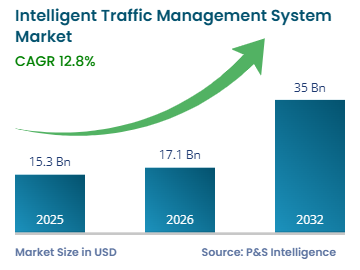
The intelligent traffic management system market size is estimated at USD 15.3 billion in 2025, which is predicted to reach USD 35.0 billion by 2032, growing at a CAGR of 12.8% during 2026–2032.
The major factors responsible for the growth of the market include rapid urbanization, increasing vehicle density on roads, rising government investments in smart city infrastructure, and growing demand for real-time traffic data analytics to reduce congestion and improve road safety.
The surging urban population is creating unprecedented pressure on existing transportation infrastructure worldwide. According to the UN Department of Economic and Social Affairs, 55% of the world's population lives in urban areas, a proportion that is expected to increase to 68% by 2050. This urbanization trend, coupled with increasing vehicle ownership rates, has led to severe traffic congestion in major cities globally, necessitating the deployment of advanced traffic management solutions. Intelligent traffic management systems are becoming essential for cities to optimize traffic flow, reduce travel time, and minimize vehicle emissions through adaptive signal control and real-time monitoring capabilities.
Furthermore, road safety concerns continue to drive ITMS adoption as governments seek to reduce traffic-related fatalities and injuries. According to the WHO, approximately 1.19 million people die each year as a result of road traffic crashes, with road traffic injuries being the leading cause of death for children and young adults aged 5–29 years. Advanced incident detection systems, automated enforcement technologies, and intelligent driver information systems are being deployed to enhance road safety and enable rapid emergency response. The integration of artificial intelligence and machine learning algorithms in traffic management systems is enabling predictive analytics that can anticipate traffic patterns and prevent potential accidents before they occur.
Intelligent Traffic Management System Market Growth Factors
Integration of AI and IoT Technologies Is a Key Trend
AI and IoT integration enable real-time data collection and analysis from traffic sensors, cameras, and connected vehicles.
These technologies improve traffic flow prediction by analyzing patterns using machine learning algorithms.
Smart traffic lights use AI and IoT to dynamically adjust signal timings based on real-time congestion levels.
In India, the Greater Noida Industrial Development Authority (GNIDA) is investing USD 27–30 million (INR 227 crore) in a smart traffic system featuring 2,700+ cameras at 115 junctions, a central command center, emergency call boxes, and traffic violation detection.
The project uses AI and IoT to enhance traffic flow, safety, and enforcement.
AI-powered surveillance systems enhance traffic rule enforcement and accident detection through video analytics.
IoT devices, such as connected road infrastructure and vehicles, facilitate vehicle-to-infrastructure (V2I) communication for better coordination.
Predictive analytics driven by AI help in proactive traffic congestion management and incident response.
Integration supports intelligent route planning and navigation systems that adapt to changing traffic conditions.
Data from IoT devices is used by AI systems to optimize public transportation scheduling and reduce delays.
The EU’s Horizon Europe program has allocated around EUR 290 million for 2023–2024 to support R&D in AI-powered data operations, industrial IoT platforms, and edge computing.
This funding targets innovations in smart cities and transportation, aiming to improve digital infrastructure, interoperability, and sustainability.
The combined use of AI and IoT enhances emergency response by identifying incidents faster and optimizing rescue routes.
These technologies support the development of autonomous and semi-autonomous traffic systems in smart cities.
Growing Smart City Initiatives Are Accelerating Market Growth
Governments worldwide are investing heavily in smart city projects, driving demand for intelligent traffic solutions.
Smart cities prioritize efficient urban mobility, boosting the adoption of advanced traffic management systems.
In July 2025, Hitachi announced pilot projects in Tokyo using 5G-enabled smart traffic systems to optimize signal control and reduce wait times at intersections.
Additionally, NEC Corporation deployed AI-powered video analytics in Osaka for automated traffic violation detection.
Integration of intelligent traffic systems supports smart city goals like sustainability, safety, and reduced emissions.
These initiatives often include funding for infrastructure upgrades, making it easier to deploy smart traffic technologies.
The government has been investing heavily in smart city infrastructure, with plans to create about 500 smart cities by 2024.
Smart city frameworks promote the use of data-driven decision-making, aligning with intelligent traffic system capabilities.
Urbanization and population growth in smart cities increase traffic volumes, necessitating more efficient traffic control.
Intelligent traffic systems are key components in smart city ecosystems, connecting with utilities, emergency services, and public transport.
Collaboration between public and private sectors in smart cities accelerates innovation in traffic management technologies.
Smart cities act as testbeds for new traffic technologies, speeding up market readiness and global adoption.
Growing environmental regulations in smart cities encourage the use of traffic systems that reduce fuel consumption and emissions.
Intelligent Traffic Management System Market Segmentation Analysis
System Type Analysis
The traffic monitoring system segment holds the largest share in the intelligent traffic management system market in 2025, of approximately 35%, and it is expected to maintain its dominance throughout the forecast period. This is primarily due to the critical role of real-time traffic surveillance in enabling all other ITMS functions, from adaptive signal control to incident detection. Traffic monitoring systems form the foundational layer of intelligent transportation infrastructure, providing the continuous data streams necessary for analysis, optimization, and response. Cities are deploying advanced video analytics, radar sensors, and inductive loop detectors to achieve comprehensive coverage of their road networks, enabling them to identify congestion patterns, detect incidents immediately, and measure the effectiveness of traffic management interventions.
The adaptive traffic control system segment is experiencing the fastest growth with a CAGR, during the forecast period, driven by its proven ability to reduce travel times and vehicle emissions through dynamic signal optimization. These systems use real-time traffic data to continuously adjust signal timing plans, responding to actual traffic demand rather than operating on fixed schedules. The integration of connected vehicle technology is further enhancing adaptive control capabilities, as vehicles can communicate their speed and destination directly to traffic signals, enabling more precise optimization. Cities implementing adaptive traffic control report average travel time reductions of 15–25% and significant decreases in vehicle idling at intersections.
These system types are covered:
Traffic Monitoring System (Largest Category)
Traffic Signal Control System
Adaptive Traffic Control System (Fastest-Growing Category)
Incident Detection and Management System
Intelligent Driver Information System
Integrated Corridor Management
Others
Component Analysis
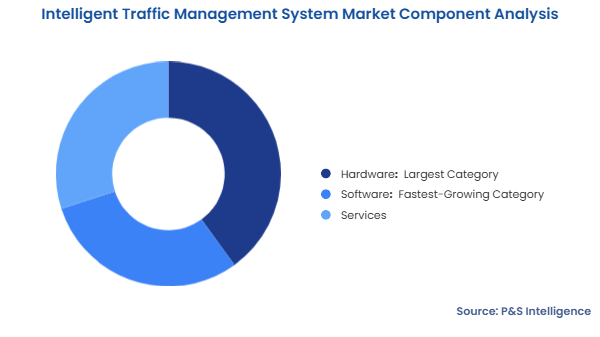
The hardware segment dominates the ITMS market in 2025 with a market share of 40%, driven by the extensive deployment of physical infrastructure required for comprehensive traffic management. This includes surveillance cameras, traffic controllers, various types of sensors, communication equipment, and data servers that form the backbone of ITMS networks. The ongoing transition to high-definition and thermal imaging cameras, along with the deployment of edge computing devices for local data processing, continues to drive hardware investments. Cities are also upgrading legacy traffic signal controllers to support adaptive control algorithms and vehicle-to-infrastructure communication protocols.
Software solutions represent the fastest-growing segment, through 2032. The rapid growth in software adoption reflects the increasing sophistication of traffic management applications, from AI-powered analytics platforms to cloud-based management systems. Modern ITMS software incorporates advanced features, including predictive modeling, automated incident detection, multi-modal optimization, and integration with third-party applications. The shift toward software-as-a-service delivery models is making advanced traffic management capabilities accessible to smaller cities that previously could not afford comprehensive ITMS deployments.
These components are covered:
Hardware (Largest Category)
Surveillance Cameras
Traffic Controllers and Signals
Sensors and Detectors
Communication Equipment
Servers and Storage
Others
Software (Fastest-Growing Category)
Traffic Analytics Software
Signal Control Software
Data Management Software
Simulation and Modeling Software
Others
Services
Consulting Services
Deployment and Integration
Support and Maintenance
Others
Application Analysis
Urban traffic management represents the largest application segment, accounting for 45% of the ITMS market in 2025, reflecting the concentration of traffic congestion challenges in city environments. Urban areas face unique traffic management complexities, including high vehicle density, multiple transportation modes, frequent intersections, and competing demands for limited road space. Cities are implementing comprehensive ITMS solutions that integrate arterial management, transit signal priority, pedestrian safety systems, and parking guidance to address these multifaceted challenges. The focus on creating livable, sustainable urban environments is driving investment in intelligent systems that can balance mobility needs with environmental and quality of life considerations.
Highway management applications have the highest CAGR, driven by increasing inter-city travel and the need to maximize existing highway capacity. Intelligent highway management systems employ variable speed limits, ramp metering, dynamic lane management, and traveler information systems to optimize traffic flow and enhance safety on high-speed roadways. The deployment of connected and autonomous vehicle technologies is particularly relevant for highway applications, where consistent speeds and limited access points create ideal conditions for vehicle automation. Transportation agencies are investing in smart highway infrastructure to prepare for the transition to connected and autonomous vehicles while addressing current congestion and safety challenges.
These applications are covered:
Urban Traffic Management (Largest Category)
Highway Management (Fastest-Growing Category)
Tunnel Management
Bridge Management
Parking Management
Drive strategic growth with comprehensive market analysis
Intelligent Traffic Management System Market Geographical Outlook
North America Intelligent Traffic Management System Market Size
North America holds the largest share of the global intelligent traffic management system market in 2025, of approximately 40%, and is expected to maintain its leadership position throughout the forecast period. The region's dominance is primarily attributed to substantial government funding for transportation infrastructure modernization, early adoption of smart city technologies, and the presence of leading ITMS technology providers. The United States Department of Transportation has allocated significant resources through programs like the Intelligent Transportation Systems Joint Program Office, which coordinates federal ITS investments and promotes the deployment of advanced traffic management technologies across the country.
The maturity of North America's technology ecosystem, combined with high vehicle ownership rates and extensive highway networks, creates strong demand for sophisticated traffic management solutions. Cities across the region are implementing next-generation ITMS platforms that leverage cloud computing, artificial intelligence, and connected vehicle technologies to address growing congestion challenges. The region's focus on public-private partnerships for infrastructure development is accelerating ITMS deployment, as technology companies collaborate with government agencies to design, build, and operate advanced traffic management systems. Additionally, the push toward sustainable transportation and carbon emission reduction targets is driving investment in intelligent systems that can optimize traffic flow and support alternative transportation modes.
Asia-Pacific Intelligent Traffic Management System Market Growth
Asia-Pacific is emerging as the fastest-growing market for intelligent traffic management systems, with an expected CAGR of approx. 13.5% during 2026-2032. The region's rapid growth is fueled by massive urbanization, increasing vehicle ownership in developing economies, and substantial government investments in smart city infrastructure. According to UN projections, India will add 416 million urban dwellers by 2050, while China will add 255 million, creating unprecedented demand for intelligent transportation solutions to manage growing urban populations and vehicle traffic.
China's ambitious smart city program, covering over 500 cities, represents one of the largest ITMS deployment initiatives globally. The country is leveraging its advanced digital infrastructure and technology capabilities to implement AI-powered traffic management systems that can process millions of data points in real-time. India's Smart Cities Mission, covering 100 cities, similarly prioritizes intelligent transportation as a key component of urban transformation. Japan and South Korea are leading in next-generation ITMS deployment, integrating 5G connectivity, edge computing, and advanced sensor technologies to create highly responsive traffic management systems that can support connected and autonomous vehicles.
Europe Intelligent Traffic Management System Market Share
Europe commands approximately 20% of the global ITMS market share in 2025, driven by stringent environmental regulations, mature transportation infrastructure, and strong commitment to sustainable mobility. The European Union's Green Deal and commitment to carbon neutrality by 2050 are compelling cities to adopt intelligent traffic management systems that can reduce vehicle emissions through optimized traffic flow and support for alternative transportation modes. The region's emphasis on multimodal transportation integration is driving the deployment of comprehensive ITMS platforms that coordinate between private vehicles, public transit, cycling infrastructure, and pedestrian systems.
The regions and countries analyzed in this report are:
North America (Largest Regional Market)
U.S. (Larger Country Market)
Canada (Faster-Growing Country Market)
Europe
Germany (Largest Country Market)
U.K. (Fastest-Growing Country Market)
France
Italy
Spain
Rest of Europe
Asia-Pacific (Fastest-Growing Regional Market)
Japan
China (Largest Country Market)
India (Fastest-Growing Country Market)
South Korea
Australia
Rest of APAC
Latin America
Brazil (Largest Country Market)
Mexico (Fastest-Growing Country Market)
Rest of LATAM
Middle East and Africa
Saudi Arabia (Largest Country Market)
South Africa
U.A.E. (Fastest-Growing Country Market)
Rest of MEA
Intelligent Traffic Management System Market Share
The global intelligent traffic management system market exhibits a consolidated structure. It is characterized by the presence of established technology conglomerates, specialized ITS solution providers, and emerging software companies offering innovative traffic management applications. Competition is intensifying as traditional infrastructure companies partner with technology firms to deliver integrated ITMS solutions that combine hardware, software, and services. The market dynamics are shaped by technological innovation, with companies investing heavily in artificial intelligence, cloud computing, and IoT capabilities to differentiate their offerings.
Leading players maintain their market position through comprehensive product portfolios that address the entire ITMS value chain, from sensors and controllers to analytics software and management platforms. These companies leverage their global presence, established customer relationships, and technical expertise to secure large-scale smart city contracts. The competitive landscape is evolving as new entrants introduce disruptive technologies such as AI-powered optimization algorithms and cloud-native traffic management platforms. Strategic partnerships between ITMS vendors and telecommunications companies are becoming increasingly important as 5G deployment enables new connected vehicle and smart infrastructure applications.
Key Intelligent Traffic Management System Companies:
Siemens AG
Kapsch TrafficCom AG
Cubic Corporation
Thales Group
SWARCO AG
IBM Corporation
Cisco Systems, Inc.
Huawei Technologies Co., Ltd.
Iteris, Inc.
Q?Free ASA
TransCore (Roper Technologies)
Econolite Group, Inc.
FLIR Systems, Inc.
Jenoptik AG
PTV Group
Intelligent Traffic Management System Market News
In July 2025, Cubic Corporation secured USD 275 million in new liquidity through a recapitalization deal with existing sponsors and lenders. The move includes USD 170 million in equity, a USD 370 million debt reduction, and over USD 200 million in projected interest savings over three years.
In April 2025, Madrid awarded Kapsch TrafficCom a EUR 5.6-million contract to deploy its EcoTrafiX and Mobility Data Platform to modernize traffic and intersection management across 3,000 intersections, including hardware provision and maintenance of the traffic control center.
In April 2025, Kapsch TrafficCom launched a tunnel management system for the Greater Florianópolis Ring Road in Brazil, equipping four tunnels with ITS control systems to ensure safety, regulated traffic flow, and automated operations.
In March 2025, Huawei Technologies Co. Ltd. unveiled a suite of seven smart transportation solutions under the theme Accelerate Transportation Digital Intelligence. The aim is to provide smart/digital upgrades across multiple transportation sectors: rail, aviation, road transportation, and seaports.
Want a report tailored exactly to your business need?
Leading companies across industries trust us to deliver data-driven insights and innovative solutions for their most critical decisions. From data-driven strategies to actionable insights, we empower the decision-makers who shape industries and define the future. From Fortune 500 companies to innovative startups, we are proud to partner with organisations that drive progress in their industries.
Client Testimonials
Working with P&S Intelligence and their team was an absolute pleasure – their awareness of timelines and commitment to value greatly contributed to our project's success. Eagerly anticipating future collaborations.
McKinsey & Company
India
Unmatched Standards
Our insights into the minutest levels of the markets, including the latest trends and competitive landscape, give you all the answers you need to take your business to new heights
Complete Data Security
We take a cautious approach to protecting your personal and confidential information. Trust is the strongest bond that connects us and our clients, and trust we build by complying with all international and domestic data protection and privacy laws