This Report Provides In-Depth Analysis of the Infrared Detector Market Report Prepared by P&S Intelligence, Segmented by Type (Mercury, Indium, Pyroelectric, Thermopile, Microbolometer, PIR Motion Sensor, IR Photodiode Sensor, IR Imaging Sensor), Technology (Uncooled, Cooled), Wavelength (Short-Wave, Mid-Wave, Long-Wave), Application (People & Motion Sensing, Temperature Measurement, Security & Surveillance, Gas & Fire Detection, Spectroscopy & Biomedical Imaging), Vertical (Automotive, Aerospace, Semiconductor & Electronics, Oil & Gas, Military & Defense, Residential & Commercial, Medical, Scientific Research), and Geographical Outlook for the Period of 2021 to 2032
Explore the market potential with our data-driven report
Infrared Detector Market Overview
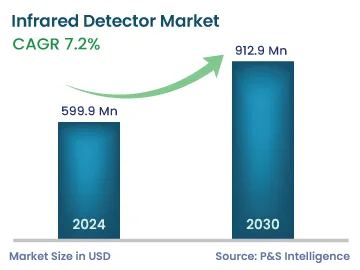
The infrared detector market size was USD 637.1 million for 2025, and it will grow by 7.3% during 2026–2032, to reach USD 1,041.3 million by 2032.
This is due to the rising need for industrial automation, manufacturing processes, safety and surveillance applications such as fire detection at public places, temperature measurement, consumer electronics such as smartphones, smart-watches & tablets, healthcare solutions, scientific research, and diverse industrial applications. Moreover, due to growing industrialization and urbanization, the demand for consumer electronics, smart homes, and safety and surveillance systems has increased enormously. In addition, industries including energy and manufacturing greatly benefit from the precise measurement of temperature, accomplished without physical contact. This confirms quality assurance, effective process control, and enhanced safety measures. Thus, these factors drive the market growth.
Furthermore, the need for infrared detectors is experiencing rapid growth in a variety of applications, such as fire detection and non-contact temperature measurement. They can accurately measure surface temperatures without direct contact, making them valuable in various applications. In fire detection, infrared detectors sense the infrared radiation emitted by flames, providing early warning and enabling effective risk mitigation and quick response. Also, the rising acceptance of infrared detectors can be accredited to their non-contact measurement capabilities, exceptional accuracy, and significant safety advantages in industries, public spaces, and safety systems, and continuous technological developments. In April 2026, the European Commission announced EUR 1.07 billion in funding for 57 collaborative defense projects under the 2025 European Defence Fund calls, supporting advanced sensors, drones, AI, cyber defense, and space technologies. This investment is expected to support demand for advanced sensing and electro-optical/infrared technologies used in defense and surveillance applications.
Key Market Insights
Indium–Gallium Arsenide (InGaAs) held a 30% market share in 2025, driven by its high quantum efficiency and low dark current for SWIR applications.
The cooled category is expected to grow at a higher CAGR of 7.6%, driven by demand for high-sensitivity infrared sensing in defense, aerospace, surveillance, and scientific applications.
The long-wave category held the largest market share at 60% in 2025, driven by its widespread use in thermal imaging, security, industrial monitoring, and Earth observation.
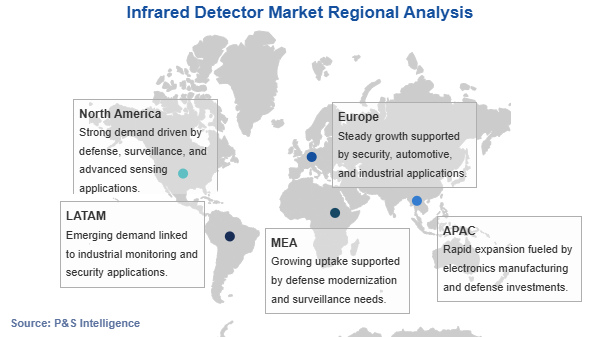
North America held the largest market share at 40% in 2025, driven by key players, technological advancements, and strong demand across major industries.
Asia-Pacific is expected to record the highest CAGR of approximately 8.2%, driven by government support, industrialization, urbanization, and growing demand across key end-use sectors.
Infrared Detector Market Trends and Drivers
Cost-Reduction Packaging Innovations Is Key Trend
A defining trend reshaping the infrared detector market is the shift toward wafer-level vacuum packaging for uncooled microbolometer arrays, which is helping reduce packaging costs, package size, and manufacturing complexity. Research identifies vacuum packaging as a major cost driver for uncooled infrared focal-plane arrays and highlights wafer-level packaging as an important approach for cost reduction. Pixel-level packaging provides a further pathway by integrating infrared-transparent microcaps directly over individual bolometer pixels, reducing additional bonding requirements.
Recent research further demonstrates the advancement of this technology, with an 8-inch wafer-level packaging approach achieving approximately 80% infrared transmission and vacuum pressures as low as 0.13 Pa with getter integration. These developments are supporting the commercialization of smaller and lower-cost uncooled infrared detectors for applications such as security, automotive, IoT, robotics, and other mass-market sensing applications.
Methane Leak Detection Regulations Is Biggest Driver
Tightening regulations on methane and volatile organic compound emissions are increasing demand for advanced leak-detection technologies, including optical gas imaging (OGI) systems that use infrared sensing to visualize otherwise invisible gas leaks. The U.S. Environmental Protection Agency's final methane rule includes semiannual OGI monitoring for certain multi-wellhead well sites and requires repairs within 30 days after detection. The EPA estimates that the rule will prevent approximately 58 million tons of methane emissions between 2024 and 2038, highlighting the scale of regulatory efforts to improve methane monitoring.
The regulatory push is encouraging oil and gas operators to adopt OGI cameras, aerial monitoring, continuous monitoring systems, and other advanced methane-detection technologies, creating opportunities for infrared detector suppliers serving gas-leak detection applications. EPA has also supported methane-reduction technologies through approximately USD 850 million for 43 projects announced in December 2024 to help operators reduce, monitor, measure, and quantify methane emissions. Consequently, increasing regulatory emphasis on methane monitoring is expected to support demand for cooled and uncooled infrared detectors used in gas-imaging and leak-detection systems.
Export Control Classification Complexity Is Key Restraint
Export licensing complexity for infrared detection technologies represents a persistent restraint on cross-border market development, particularly for advanced focal-plane arrays, thermal imaging cameras, and related components used in defense and other dual-use applications. Classification and licensing requirements can vary according to the technical characteristics of the detector or camera, destination, end user, and intended application, increasing compliance requirements for suppliers seeking to access international markets.
The U.S. Bureau of Industry and Security (BIS) controls certain infrared focal-plane arrays under ECCN 6A002 and thermal imaging cameras under ECCN 6A003, with controls based on characteristics such as wavelength response, detector-element count, detector pitch, frame rate, and other technical parameters. BIS also imposes additional restrictions on certain infrared and thermal-imaging products intended for military end users. These classification requirements can increase compliance costs and extend transaction timelines for suppliers of higher-performance infrared detection technologies, particularly in defense and sensitive end-use markets.
Biomedical Thermal Screening Applications Is Biggest Opportunity
The expanding use of infrared thermography in healthcare is creating new opportunities for infrared detector suppliers, particularly in non-contact temperature measurement, patient monitoring, screening, and assessment of inflammation and microcirculatory changes. Infrared thermography provides non-contact and non-ionizing measurement of surface temperature, making it suitable for applications where repeated or remote thermal assessment is required. A 2024 systematic review identified 30 studies evaluating infrared thermography in acute-care settings, including emergency departments and intensive care units, for diagnosis, monitoring, and risk stratification across various conditions.
The broader medical evidence base is also expanding. A scoping review identified 72 studies involving 17,314 participants across 38 health conditions and 13 therapeutic areas, covering screening, diagnosis, and disease monitoring applications. Earlier CDC research involving 2,873 patients found that two infrared thermal detection systems achieved 91% and 90% sensitivity for fever detection at their optimal thresholds, although the study also highlighted variability between systems and limitations in applying the results to airport or border screening. These developments are expected to support continued demand for high-sensitivity, calibration-stable infrared detectors and thermal imaging systems in healthcare and biomedical applications.
Infrared Detector Market Segmentation Analysis
Type Analysis
The indium-gallium arsenide category holds the largest market share, of 30%, in 2025, reflecting the material's superior quantum efficiency and low dark-current performance across the short-wave infrared band, which has made it the widely used choice for machine-vision, spectroscopy, and telecommunications-adjacent sensing applications requiring room-temperature operation without the fabrication complexity of mercury-cadmium telluride.
The microbolometer detectors category will have the highest CAGR, of approximately 7.9%, supported by continued advances in uncooled detector manufacturing, miniaturization, and cost reduction. These developments are expanding the use of microbolometer-based thermal imaging across automotive, security, industrial, consumer, and other commercial applications.
The types analyzed in this report are:
Mercury–Cadmium Telluride (MCT)
Indium–Gallium Arsenide (InGaAs)
Pyroelectric
Thermopile
Microbolometer
PIR Motion Sensor
IR Photodiode Sensor
IR Imaging Sensor
Technology Analysis
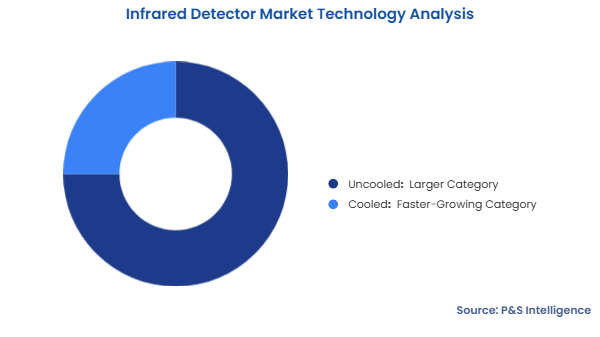
The uncooled category holds the larger market share, of 75%, in 2025, supported by its lower size, weight, power consumption, and cost compared with cooled alternatives. These characteristics have made uncooled detectors widely suitable for security, automotive, industrial monitoring, and other applications where compactness, affordability, and ease of integration are important.
The cooled category will have the higher CAGR, of approximately 7.6%, supported by increasing demand for high-performance infrared sensing in defense, aerospace, long-range surveillance, scientific research, and other applications requiring high sensitivity, enhanced signal-to-noise ratio, and superior detection performance. According to SIPRI, global military expenditure reached USD 2,887 billion in 2025, increasing by 2.9% in real terms, while military spending rose by 14% in Europe and 8.1% in Asia and Oceania. This increasing defense spending is supporting investments in high-performance sensing, surveillance, and targeting systems, thereby driving demand for cooled infrared detectors.
The technologies analyzed in this report are:
Uncooled (Larger Category)
Cooled (Faster-Growing Category)
Wavelength Analysis
The long-wave category holds the largest market share, of 60%, in 2025, supported by its extensive use in thermal imaging, security, industrial monitoring, and Earth-observation applications. Their ability to detect thermal radiation at longer infrared wavelengths makes them particularly suitable for applications requiring temperature-based imaging and detection. Government-operated Earth-observation missions demonstrate the established application base for thermal-infrared sensing. NASA and the U.S. Geological Survey report that Landsat data generated an estimated USD 25.6 billion in economic value for the U.S. economy in 2023, reflecting the extensive use of Landsat imagery for agriculture, water-resource management, wildfire monitoring, land management, and other applications.
The short-wave category will have the highest CAGR, supported by increasing adoption in machine vision, semiconductor inspection, spectroscopy, and advanced imaging. SWIR's ability to provide information beyond the visible spectrum and its transmission characteristics for certain semiconductor materials make it valuable for applications such as wafer inspection and defect detection.
The wavelengths analyzed in this report are:
Short-Wave (Fastest-Growing Category)
Mid-Wave
Long-Wave (Largest Category)
Application Analysis
The security & surveillance category holds the largest market share, of 40%, in 2025, reflecting continued deployment of thermal cameras for critical-infrastructure protection, perimeter monitoring, security, and law-enforcement applications. Infrared sensing enables detection in low-light or complete-darkness and can provide thermal information that complements conventional visible-spectrum cameras, supporting surveillance across a wide range of environments.
The gas & fire detection category will have the highest CAGR, supported by increasing demand for methane leak detection, fire monitoring, and industrial safety systems. The European Union's Regulation (EU) 2024/1787 establishes methane leak detection and repair requirements for the energy sector and includes stringent monitoring requirements for methane-emitting sources. Recent research on optical gas imaging highlights the use of high-sensitivity infrared cameras for detecting and visualizing methane emissions, supporting the adoption of infrared gas-imaging technologies in oil and gas and other industrial applications.
The applications analyzed in this report are:
People & Motion Sensing
Temperature Measurement
Security & Surveillance (Largest Category)
Gas & Fire Detection (Fastest-Growing Category)
Spectroscopy & Biomedical Imaging
Vertical Analysis
The military & defense category holds the largest market share in 2025, sustained by long-standing demand for infrared sensing technologies in targeting, surveillance, reconnaissance, thermal imaging, and night-vision systems, where high sensitivity and reliable performance are critical.
The automotive category will have the highest CAGR, of approximately 7.7%, supported by increasing integration of advanced driver-assistance and safety systems, growing demand for nighttime pedestrian detection, and the development of thermal and infrared sensing technologies for enhanced vehicle perception. Increasing vehicle safety requirements and investment in advanced sensing technologies are encouraging automakers and technology suppliers to deploy thermal and infrared sensing solutions for enhanced pedestrian detection, nighttime perception, and vehicle safety.
The verticals analyzed in this report are:
Automotive (Fastest-Growing Category)
Aerospace
Semiconductor & Electronics
Oil & Gas
Military & Defense (Largest Category)
Residential & Commercial
Medical
Scientific Research
Drive strategic growth with comprehensive market analysis
Infrared Detector Market Geographical Analysis
North America Infrared Detector Market Size
North America holds the largest market share, of 40%, in 2025, due to the presence of key players, technological advancements, and high demand from industries such as aerospace, military & defense, healthcare, industrial manufacturing, and automotive, in the region. The region's strong adoption of thermal imaging and infrared sensing technologies across defense, security, industrial, and commercial applications further supports market growth.
The U.S. Department of Defense's FY2025 budget request allocated USD 143.2 billion to Research, Development, Test, and Evaluation (RDT&E) and USD 167.5 billion to Procurement, totaling USD 310.7 billion in FY2025 investment funding. Defense budget documents also identify investments in advanced infrared detectors, thermal imaging, infrared search-and-track, and electro-optical/infrared sensor systems, supporting demand for infrared detection technologies.
Asia-Pacific Infrared Detector Market Size
Asia-Pacific will have the highest CAGR, of approximately 8.2%. This can be ascribed to the strong governmental support, a thriving consumer electronics demand, expanding industrialization and urbanization, and the growing end-use sectors such as military & defense, safety & surveillance, healthcare, automotive, and aerospace, in the region. In APAC, Japan, China, India, and Taiwan are key markets. Japan, in particular, has a significant manufacturing base for infrared detectors, which are exported worldwide. Japan's Ministry of Defense has also supported research on high-sensitivity, broadband infrared detector elements for advanced sensing and space-domain applications, highlighting the country's continued investment in infrared detection technologies.
Moreover, the decreasing cost of infrared detectors is expected to boost their utilization in various applications within the region. Additionally, there is a growing emphasis on enhancing surveillance and security systems in APAC. Infrared detectors play a vital role in security cameras, access control systems, and intrusion detection systems by detecting motion, monitoring activities, and ensuring safety. Thus, the increasing need for improved security measures in commercial establishments, residential areas, and public spaces is boosting the need for infrared detectors in the region.
India Infrared Detector Market Size
India is also expected to witness strong growth in the infrared detector market, supported by increasing defense modernization, electronics manufacturing, and demand for thermal imaging and surveillance systems. The India Semiconductor Mission has an approved outlay of INR 76,000 crore for developing the semiconductor and display ecosystem, including support for compound semiconductor, silicon photonics, sensor fabs, and semiconductor packaging. The scheme provides fiscal support of up to 50% of capital expenditure for eligible compound semiconductor and sensor fabs.
The regions and countries analyzed in this report are:
North America (Largest Regional Market)
U.S. (Larger and Faster-Growing Country)
Canada
Europe
Germany (Largest Country)
U.K. (Fastest-Growing Country)
France
Italy
Spain
Rest of Europe
Asia-Pacific (Fastest-Growing Regional Market)
China (Largest Country)
India (Fastest-Growing Country)
Japan
South Korea
Australia
Taiwan
Rest of APAC
Latin America
Brazil (Largest and Fastest-Growing Country)
Mexico
Rest of LATAM
Middle East and Africa
Saudi Arabia (Largest and Fastest-Growing Country)
South Africa
U.A.E.
Rest of MEA
Infrared Detector Market Competitive Landscape
The market is semi-consolidated because it includes a group of well-established global companies that hold significant market positions, alongside numerous specialized and regional manufacturers. Leading players such as Teledyne FLIR, Lynred, Hamamatsu Photonics, Excelitas Technologies, Honeywell, and InfraTec have strong capabilities in detector design, manufacturing, thermal imaging, and infrared sensing technologies. These companies benefit from established customer relationships, proprietary technologies, extensive product portfolios, and significant R&D capabilities. However, the market is not fully consolidated because several smaller and regional companies compete across specific detector types, wavelengths, technologies, and end-use applications, including defense, aerospace, industrial, automotive, healthcare, and security. In addition, technological diversity across cooled and uncooled detectors, MCT, InGaAs, microbolometers, thermopiles, and pyroelectric detectors creates opportunities for specialized manufacturers.
Leading Companies in the Infrared Detector Market:
Teledyne FLIR LLC
Lynred S.A.S.
VIGO Photonics S.A.
Excelitas Technologies Corp.
Honeywell International Inc.
Murata Manufacturing Co., Ltd.
Texas Instruments Incorporated
Omron Corporation
TE Connectivity Ltd.
InfraTec GmbH
Nippon Ceramic Co., Ltd.
Leonardo DRS
Infrared Detector Market Developments
In June 2026, Teledyne FLIR OEM launched the Boson SX8, an uncooled long-wave infrared thermal camera module combining SXGA (1280×1024) resolution with an 8-micron pixel pitch, delivering four times the detail of standard high-volume VGA thermal modules without increasing size or weight. The launch, debuted at the Eurosatory defense exhibition in Paris, extends the company's vertically integrated microbolometer portfolio into higher-resolution defense and industrial applications.
In March 2026, VIGO Photonics S.A. acquired InfraRed Associates, a Florida-based specialist in liquid-nitrogen-cooled mercury-cadmium telluride detector technology, for approximately USD 8.4 million. The acquisition, supported by Poland's Foreign Expansion Fund, establishes VIGO's first U.S. manufacturing footprint and extends its reach into the defense, industrial, medical, and scientific markets served by InfraRed Associates since the 1970s.
In January 2026, Lynred S.A.S. launched Sirocco SW, a new extended short-wave infrared (eSWIR) detector built on space-proven technology for high-impact industrial and environmental applications, including soil, material, and gas analysis. The launch positions Lynred to address growing demand for spectroscopic sensing tied to critical-raw-material access, food security, and climate-monitoring priorities.
Frequently Asked Questions About This Report
What factors affect the cost of infrared detectors?+
The cost of infrared detectors is influenced by detector material, wavelength range, cooling requirements, sensitivity, resolution, pixel size, packaging, manufacturing complexity, and application requirements.
What are the major challenges in manufacturing infrared detectors?+
Key manufacturing challenges include achieving high detector sensitivity, controlling noise, producing uniform detector arrays, managing specialized semiconductor materials, maintaining precise packaging, and meeting stringent performance requirements for advanced imaging applications.
What factors determine the selection of an infrared detector?+
Detector selection depends on the required wavelength range, sensitivity, detectivity, response time, operating temperature, spectral resolution, size, power consumption, environmental conditions, and overall system cost.
How is artificial intelligence influencing infrared detector demand?+
AI is supporting demand for advanced infrared sensing in defense, surveillance, sensors, drones, and electro-optical/infrared systems.
What role does infrared detection play in industrial automation?+
Infrared detectors enable non-contact temperature measurement, equipment monitoring, quality inspection, fault detection, and predictive maintenance.
Want a report tailored exactly to your business need?
Leading companies across industries trust us to deliver data-driven insights and innovative solutions for their most critical decisions. From data-driven strategies to actionable insights, we empower the decision-makers who shape industries and define the future. From Fortune 500 companies to innovative startups, we are proud to partner with organisations that drive progress in their industries.
Client Testimonials
Working with P&S Intelligence and their team was an absolute pleasure – their awareness of timelines and commitment to value greatly contributed to our project's success. Eagerly anticipating future collaborations.
McKinsey & Company
India
Unmatched Standards
Our insights into the minutest levels of the markets, including the latest trends and competitive landscape, give you all the answers you need to take your business to new heights
Complete Data Security
We take a cautious approach to protecting your personal and confidential information. Trust is the strongest bond that connects us and our clients, and trust we build by complying with all international and domestic data protection and privacy laws