Inertial Navigation System Market Size & Share Analysis - Emerging Trends, Growth Opportunities, Competitive Landscape, and Forecasts (2025 - 2032)
This Report Provides In-Depth Analysis of the Inertial Navigation System Market Report Prepared by P&S Intelligence, Segmented by Platform (Solution, Service, Platform), Application (Real-Time Collaboration, Enterprise Infrastructure Management, Streaming Analytics, Security, Data Management, Remote Monitoring, Network Management, Mobile Workforce Management), End User (Manufacturing, BFSI, Healthcare and Life Sciences, Retail and E-commerce, Telecommunication and IT, Government, Energy and Utilities, Media and Enterprises), and Geographical Outlook for the Period of 2019 to 2032
Explore the market potential with our data-driven report
Inertial Navigation System Market Analysis
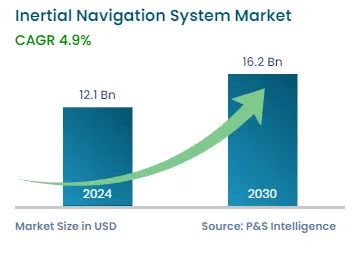
The global inertial navigation system market was valued at USD 12.1 billion in 2024 and is projected to reach USD 17.5 billion by 2032, growing at a CAGR of 4.9% during the forecast period (2025–2032). The market's robust growth is driven by the increasing demand for highly accurate navigation solutions in defense applications, rising adoption of autonomous systems, and advancements in MEMS technology that enhance system performance while reducing size and cost.
The growing deployment of unmanned systems across military and commercial sectors is creating substantial opportunities for inertial navigation technologies. According to the Space Foundation, the number of successful space launches reached 212 in 2023, representing an 18% year-over-year growth, which directly drives the demand for precision navigation systems. The military sector's continuous modernization efforts, particularly in GPS-denied environments, further accelerate market expansion as defense organizations seek reliable positioning solutions for missiles, aircraft, and autonomous vehicles.
Rising geopolitical tensions and electronic warfare capabilities, including GPS jamming and spoofing, have intensified the need for assured positioning, navigation, and timing solutions. The White House Office of Science and Technology added PNT to its 2024 list of Critical and Emerging Technologies, highlighting the strategic importance of inertial navigation systems in national security applications. Additionally, advancements in fiber optic gyroscope technology and MEMS-based sensors are enabling more compact, cost-effective, and accurate navigation solutions for emerging applications in autonomous vehicles and industrial automation.
Inertial Navigation System Market Dynamics
Advancements in MEMS Technology Are Major Market Trends
Significant technological improvements in microelectromechanical systems have revolutionized the inertial navigation landscape by delivering higher accuracy, improved reliability, and reduced size, weight, power, and cost profiles. Modern MEMS gyroscopes and accelerometers achieve performance levels previously reserved for much larger and more expensive ring laser gyro systems.
These technological advances have expanded the addressable market beyond traditional aerospace and defense applications into automotive, industrial, and consumer sectors. The automotive industry's transition toward autonomous driving systems requires precise positioning capabilities that can function reliably in urban canyons, tunnels, and other GPS-challenging environments. Industrial robotics, precision agriculture, and mobile mapping applications increasingly rely on MEMS-based inertial navigation systems for accurate positioning and orientation data, creating new revenue streams for market participants.
Growing Electronic Warfare Threats Are Driving Market Demand
The escalating electronic warfare capabilities, including GPS jamming and spoofing technologies, represent a primary driver for the inertial navigation system market. Modern military conflicts have demonstrated the vulnerability of satellite-based navigation systems, with adversaries deploying sophisticated jamming devices that can disrupt GPS signals over extended distances. According to the U.S. Department of Defense, GPS-guided weapons equipped with inertial navigation system backups maintain operational effectiveness even when primary satellite signals are compromised. This growing threat landscape has prompted defense organizations worldwide to invest heavily in assured positioning, navigation, and timing solutions.
The Russia–Ukraine conflict has particularly highlighted the importance of GPS-independent navigation systems, as both sides employ electronic warfare tactics to disrupt enemy positioning capabilities. Military strategists recognize that inertial navigation systems provide critical redundancy for precision-guided munitions, autonomous vehicles, and aircraft operations in contested environments. As low-cost jamming technologies become increasingly accessible to both state and non-state actors, the demand for robust inertial navigation solutions continues to accelerate across defense applications.
Electronic warfare (EW) has played a significant role in modern conflicts. In Ukraine, Russia's use of systems like Krasukha-4 has disrupted GPS, drone, and communications systems, while Ukraine has responded with captured and improvised EW tools. The U.S. and UK, through exercises like Project Flytrap 4.0, are deploying portable jamming devices and AI-enhanced sensors against drones. Israel used EW to blind Syrian radars in 2007, and Turkey's KORAL system has been employed in Syria, Libya, and Cyprus.
The U.S. is the leading investor in EW, spending USD 5 billion in 2024 with projections of USD 7.5 billion by 2033, according to TheDefensePost. Global EW market size is expected to reach USD 29 billion by 2032 (Navistra Analytics), with airborne systems leading and space-based EW growing fastest. Russia and China combined spent around USD 2.5 billion in 2024, while India is investing heavily in indigenous systems like Himshakti, backed by an INR 3,000-crore commitment.
Operational Downtime and Maintenance Issues Are Key Challenges
Operational downtime and maintenance challenges remain significant restraints on the inertial navigation system market—particularly when deployed within Automated Material Handling (AMH) systems. Unplanned downtime in manufacturing and warehouse operations can be extremely costly; the average cost of unexpected production halts can reach up to USD 125,000 per hour, while in the automotive sector, it may exceed USD 22,000 per minute. Globally, unplanned downtime results in nearly USD 1 trillion in lost productivity annually, with average production losses of 20–30% per incident.
Even brief outages lasting only a few hours can cost companies around USD 2 million. While predictive maintenance can help reduce downtime by up to 35%, implementing such programs involves significant costs and operational complexity. For small and medium-sized users, these additional expenses—though essential to mitigate risk and avoid customer dissatisfaction—can create financial burdens that hinder adoption. As a result, operational and maintenance concerns act as a serious market challenge for the broader adoption of these systems.
Inertial Navigation System Market Segmentation Analysis
Technology Insights
The MEMS category dominated the inertial navigation system market in 2024 with 35% share, driven by its superior cost-effectiveness, compact form factor, and rapidly improving performance characteristics. MEMS-based systems offer significant advantages in size, weight, and power consumption compared to traditional mechanical gyroscopes, making them ideal for unmanned systems, automotive applications, and portable devices. The category's growth is supported by continuous technological improvements that enable MEMS sensors to achieve tactical-grade performance levels at substantially lower costs than fiber optic or ring laser alternatives.
Fiber-optic gyroscopes represent the fastest-growing category, with a projected CAGR of 5.1% during 2025–2032, reflecting increasing demand for high-precision navigation in critical applications. FOG technology offers superior performance characteristics, including excellent bias stability, low noise levels, and immunity to electromagnetic interference. According to Advanced Navigation, FOG systems can achieve north-seeking capabilities by precisely measuring Earth's rotation rate, providing autonomous heading determination within minutes without external references. This technology is particularly valuable for subsea operations, aerospace applications, and military systems requiring navigation in GPS-denied environments.
These technologies are covered:
MEMS (Largest Category)
Fiber-Optic Gyroscopes (Fastest-Growing Category)
Ring-Laser Gyroscopes
Mechanical Gyroscopes
Others
Component Analysis
The gyroscopes category held the largest market share in 2024, of 50%, attributed to their fundamental role in measuring angular velocity and providing orientation data essential for navigation calculations. Gyroscopes serve as the primary sensing elements that enable inertial navigation systems to detect rotational motion across three axes, making them indispensable components for accurate positioning and attitude determination. The category benefits from continuous technological advances in both MEMS and fiber optic gyroscope technologies that deliver improved accuracy, enhanced reliability, and reduced power consumption.
The accelerometers category is projected to experience the fastest growth, with a CAGR of 5.2% through 2032, driven by expanding applications in autonomous vehicles, unmanned systems, and industrial automation. Modern accelerometers provide precise linear acceleration measurements that, when integrated with gyroscope data, enable comprehensive motion tracking and positioning calculations. According to the International Trade Commission, accelerometer applications span from smartphone motion sensing to precision-guided munitions, creating diverse revenue opportunities across multiple market segments.
These component types are covered:
Gyroscopes (Largest Category)
Accelerometers (Fastest-Growing Category)
Magnetometers
Algorithms & Processors
Application Analysis
The aviation category held the largest market share in 2024, of approximately 35%, reflecting the critical importance of inertial navigation systems in commercial and military aircraft operations. Aviation applications require highly reliable navigation solutions that maintain accuracy during GPS outages, electromagnetic interference, or polar region operations where satellite coverage is limited. The segment benefits from increasing aircraft production, expanding fleet modernization programs, and stringent safety requirements that mandate redundant navigation capabilities for critical flight operations.
Airbus provided 766 aircraft in 2024 and currently holds a backlog of roughly 8,617 as of 2025. Boeing supplied 348 aircraft in 2024 and maintains a backlog of about 6,527 as of 2025. Moreover, as per estimates, 6,000 to 8,000 orders for military aircraft from around the world are pending for delivery.
The missiles category will demonstrate the highest growth rate, of 5.4%, during the forecast period, driven by rising geopolitical tensions and increasing investments in precision-guided munitions worldwide. According to Honeywell International, their Embedded Global Positioning System/inertial navigation system equipped with M-Code capabilities completed successful testing for missile guidance applications, demonstrating the critical role of inertial navigation in modern warfare. The segment growth is supported by defense modernization programs and the need for accurate targeting systems that can operate effectively in GPS-denied environments.
These application types are covered:
Aviation (Largest Category)
Missiles (Fastest-Growing Category)
Marine
Space Launch Vehicles
End User Analysis
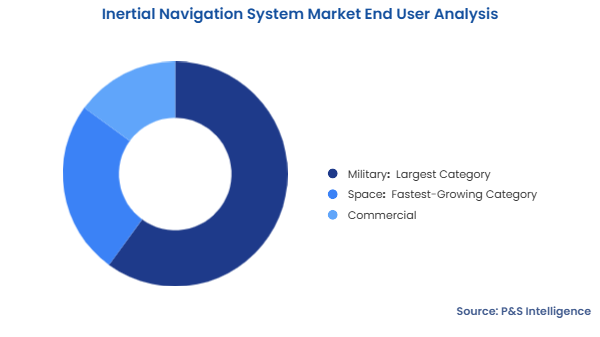
The military category accounts for the largest market share in 2024, of approximately 60%, driven by substantial defense spending on navigation systems for various military platforms, including aircraft, naval vessels, ground vehicles, and weapons systems. Military applications demand the highest levels of accuracy, reliability, and resistance to electronic warfare threats, requiring advanced inertial navigation solutions that can operate independently of external references. The segment benefits from ongoing modernization programs worldwide and increasing investments in autonomous military systems that rely heavily on precision navigation capabilities.
The latest estimate of global defense spending according to the Stockholm International Peace Research Institute (SIPRI) is USD 2,718 billion in 2024. This marks a 9.4% increase in real terms compared to 2023 and represents the steepest annual surge since the end of the Cold War.
The space category is projected to experience the fastest growth, with a CAGR of 5.3% through 2032, supported by expanding commercial space activities, satellite constellation deployments, and ambitious exploration missions. According to the Space Foundation, the space economy continues to grow rapidly with increasing launches and satellite deployments requiring sophisticated navigation systems. Private space companies and national space agencies demand strategic-grade inertial navigation systems capable of operating in extreme space environments while maintaining exceptional accuracy for mission-critical operations. Total government investment in space programs—both civil and defense—reached approximately USD 135 billion in 2024, marking a 10% increase from 2023.
These end user types are covered:
Military (Largest Category)
Space (Fastest-Growing Category)
Commercial
Drive strategic growth with comprehensive market analysis
Inertial Navigation System Market Regional Market Performance
North America Market Share
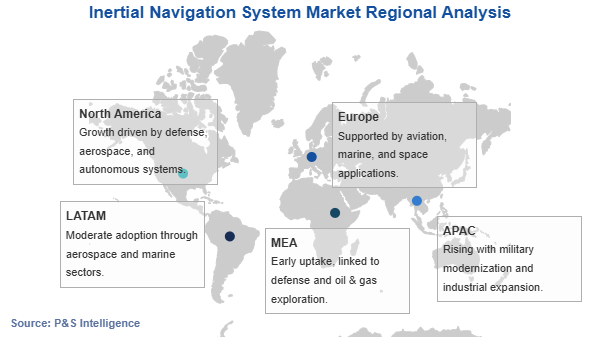
North America dominates the global inertial navigation system market with approximately 40% market share in 2024, supported by the presence of leading manufacturers, substantial defense spending, and advanced technology development capabilities. The region's market leadership stems from major aerospace and defense companies, including Honeywell International, Northrop Grumman, and Collins Aerospace, that maintain significant research and development investments in inertial navigation technologies. The U.S. Department of Defense's Next Generation Air Dominance program and other modernization initiatives drive sustained demand for advanced navigation systems across military platforms.
The region benefits from a robust ecosystem of technology suppliers, system integrators, and end-users that accelerates innovation and market adoption. According to the U.S. Navy, contracts awarded to companies like Honeywell for ring laser gyros and Northrop Grumman for inertial sensor modules demonstrate the military's commitment to maintaining technological superiority in navigation systems. Commercial aerospace growth, expanding UAV applications, and emerging autonomous vehicle programs further strengthen North America's market position.
Asia-Pacific Market Share
Asia-Pacific represents the fastest-growing regional market with a projected CAGR of 5.9% during 2025–2032, driven by rapidly increasing defense budgets, expanding aerospace industries, and growing autonomous systems adoption. China, India, Japan, and South Korea are making substantial investments in sovereign navigation capabilities and military modernization programs that require advanced inertial navigation systems. China's BeiDou constellation development and India's NavIC program represent multi-billion-dollar investments in positioning technologies that incorporate sophisticated inertial navigation components.
The region's industrial base expansion, particularly in automotive and robotics sectors, creates new application areas for inertial navigation systems beyond traditional defense uses. According to the Japan Aerospace Exploration Agency, Japan's QZSS satellite navigation system integration with ground-based inertial sensors provides enhanced positioning accuracy for civilian and commercial applications. Rising urbanization and smart city initiatives across Asia-Pacific drive demand for precision navigation solutions in transportation, logistics, and infrastructure management applications.
Based on geography, the market has the following categories:
North America (Largest Regional Market)
U.S. (Larger and Faster-Growing Country Market)
Canada
Europe
Germany (Largest Country Market)
U.K.
France
Italy
Spain
Israel (Fastest-Growing Country Market)
Rest of Europe
Asia-Pacific (Fastest-Growing Regional Market)
Japan
China (Largest and Fastest-Growing Country Market)
India
South Korea
Australia
Rest of APAC
Latin America
Brazil (Largest and Fastest-Growing Country Market)
Mexico
Rest of LATAM
Middle East and Africa
Saudi Arabia (Largest Country Market)
South Africa
U.A.E. (Fastest-Growing Country Market)
Rest of MEA
Inertial Navigation System Market Competitive Landscape
The global inertial navigation system market exhibits a consolidated structure with the top 5 key players controlling 70% of total market share, indicating significant barriers to entry and established competitive advantages among leading manufacturers.
The market concentration reflects the technical complexity, substantial research and development investments, and stringent qualification requirements necessary for success in aerospace and defense applications.
Major players leverage their extensive intellectual property portfolios, manufacturing capabilities, and customer relationships to maintain competitive positions across multiple market segments.
Leading companies pursue growth strategies centered on technological innovation, strategic acquisitions, and expanding application areas beyond traditional defense markets.
Product development focuses on improving size-weight-power-cost characteristics while enhancing accuracy and reliability for emerging applications in autonomous systems and commercial markets.
Companies invest heavily in MEMS technology advancement, AI-powered sensor fusion algorithms, and miniaturization capabilities to address evolving customer requirements across diverse industries.
Strategic partnerships and collaboration agreements enable market participants to access new technologies, expand geographic reach, and enter adjacent market segments.
For instance, Advanced Navigation's agreements with Hanwha and Rheinmetall demonstrate how specialized inertial navigation suppliers partner with major defense contractors to integrate advanced systems into next-generation military platforms.
Vertical integration strategies help companies control critical supply chain elements and maintain technological differentiation in competitive markets.
The competitive landscape includes both established aerospace and defense giants with diversified portfolios and specialized inertial navigation companies focused on specific technology segments or applications.
Market leaders maintain significant advantages through scale economies, established customer relationships, and comprehensive product portfolios spanning multiple performance grades and applications.
However, emerging companies with innovative technologies or niche capabilities can capture market share by addressing specific customer needs or pioneering new application areas.
Key Inertial Navigation System Companies:
Honeywell International Inc.
Northrop Grumman Corporation
Safran Electronics & Defense
Thales Group
Collins Aerospace
L3Harris Technologies Inc.
iXblue
KVH Industries Inc.
VectorNav Technologies
Trimble Inc.
Safran Electronics & Defense
Raytheon Technologies Corporation
Inertial Navigation System Market News
In February 2025, Safran S.A. secured a contract with the Finnish Defense Forces to supply advanced Geonyx Inertial Navigation Systems for Finland's artillery systems, spanning from 2024 to 2031 and highlighting long-term defense modernization commitments.
In December 2024, VIAVI Solutions Inc. agreed to acquire Inertial Labs Inc. for USD 325 million to enhance its product offerings and strengthen its position in the defense, aerospace, and industrial sectors.
In December 2024, Advanced Navigation Pty. Ltd. completed a multi-million-dollar agreement with Rheinmetall AG to supply fiber-optic gyroscope inertial navigation systems for integration into Boxer Combat Reconnaissance Vehicles currently operational with the Australian Army.
In September 2024, Advanced Navigation Pty. Ltd. finalized agreements with South Korean conglomerate Hanwha Group to supply distinctive inertial guidance systems for various weapons platforms, demonstrating expansion into Asian defense markets.
In June 2024, BAE Systems plc unveiled NavStorm-M, a gun-hardened integrated anti-jamming GPS receiver for artillery rounds, bombs, missiles, and unmanned systems, incorporating next-generation assured-positioning, navigation, and timing device capabilities with M-Code GPS technology.
In March 2024, Huntington Ingalls Industries Inc. launched the REMUS 130 unmanned underwater vehicle, featuring enhanced payload integration; a compact, two-person, portable design; and extended 10-hour battery capability, for offshore oil and gas exploration and mine countermeasure operations.
In March 2024, Exail Holding launched the Phins 9 Compact, a high-performance inertial navigation system for unmanned underwater vehicles, featuring advanced fiber-optic gyroscope technology and compact form factor optimization.
Want a report tailored exactly to your business need?
Leading companies across industries trust us to deliver data-driven insights and innovative solutions for their most critical decisions. From data-driven strategies to actionable insights, we empower the decision-makers who shape industries and define the future. From Fortune 500 companies to innovative startups, we are proud to partner with organisations that drive progress in their industries.
Client Testimonials
Working with P&S Intelligence and their team was an absolute pleasure – their awareness of timelines and commitment to value greatly contributed to our project's success. Eagerly anticipating future collaborations.
McKinsey & Company
India
Unmatched Standards
Our insights into the minutest levels of the markets, including the latest trends and competitive landscape, give you all the answers you need to take your business to new heights
Complete Data Security
We take a cautious approach to protecting your personal and confidential information. Trust is the strongest bond that connects us and our clients, and trust we build by complying with all international and domestic data protection and privacy laws