This Report Provides In-Depth Analysis of the Industrial Vending Machine Market Report Prepared by P&S Intelligence, Segmented by Type (Carousel Vending Machine, Coil Vending Machine, Cabinet Vending Machine), Product (MRO Tools, PPE), End User (Manufacturing, Oil & Gas, Construction, Aerospace, Other), and Geographical Outlook for the Period of 2019 to 2032
Explore the market potential with our data-driven report
Industrial Vending Machine Market Overview
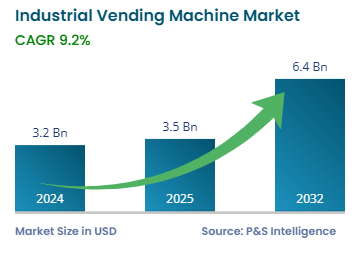
The global industrial vending machine market will generate an estimated revenue of USD 3.2 billion in 2024, which is expected to witness a CAGR of 9.2% during 2025–2032, to reach USD 6.4 billion by 2032.
The market is propelled by the increasing demand for efficient inventory management, enhanced automation in industrial processes, and the growing need for safety and productivity in workplaces. Industrial vending machines offer convenient solutions for providing employees with tools, personal protective equipment (PPE), and other essential items in a timely manner, thereby reducing downtime and improving operational efficiency.
Additionally, the ongoing advancements in machine technology, integration with cloud-based systems for real-time tracking, and the expansion of smart manufacturing facilities further drive the adoption of these vending solutions across industries. As manufacturers focus on streamlining operations and optimizing cost-efficiency, the market for industrial vending machines is expected to witness sustained demand and innovation in the coming years.
Industrial Vending Machine Market Dynamics
Rising Adoption of Industry 4.0 Technologies Is a Key Driver
The rising adoption of Industry 4.0 technologies is a key trend in the market.
As per studies, worldwide spending on industrial control and factory automation technology will grow from USD 166.1 billion in 2024 to USD 339.5 billion by 2032.
Industry 4.0, characterized by the integration of smart technologies such as IoT, AI, and automation, is revolutionizing manufacturing and industrial operations.
These technologies enhance connectivity, data analytics, and process optimization, creating an ideal environment for the deployment of industrial vending machines.
Industrial vending machines equipped with IoT sensors can seamlessly integrate with existing systems, enabling real-time monitoring of inventory levels, usage patterns, and equipment status.
This allows for predictive maintenance and ensures that necessary tools, spare parts, and personal protective equipment are readily available, reducing downtime and improving overall operational efficiency.
Moreover, with AI-driven analytics, these vending machines can optimize inventory management, automatically reorder items based on usage trends, and provide insights into worker behavior and asset utilization.
Increasing Emphasis on Access Control in Data Centers Is Key Opportunity
One of the key drivers for the global industrial vending machine market is the growing emphasis on access control in data centers.
As data centers continue to handle critical and sensitive information, maintaining a secure and controlled environment is becoming increasingly important.
Industrial vending machines play a vital role in supporting this need by providing secure, automated access to tools, parts, and equipment necessary for operations and maintenance within these facilities.
These machines can be equipped with advanced access control systems, such as biometric authentication, RFID, or PIN codes, ensuring that only authorized personnel can access specific items.
The integration of access control features in vending machines aligns with the broader trend of enhancing security and operational efficiency in data centers.
By automating the distribution of items, industrial vending machines minimize human error, reduce the risk of theft or misuse, and ensure that the right tools are available to the right personnel at the right time.
Global data center capacity is rapidly expanding, with approximately 10 GW of hyperscale and colocation sites breaking ground in 2025, and another 7 GW completing construction.
This boom is supported by nearly USD 170 billion in development financing, marking record investment levels to meet soaring demand for AI and cloud infrastructure.
Challenges Related to Data Synchronization and System Compatibility
A key challenge in the global industrial vending machine market is data synchronization and system compatibility.
As industrial vending machines increasingly integrate with enterprise-level systems such as inventory management, enterprise resource planning (ERP), and maintenance tracking platforms, ensuring seamless data flow across these various systems becomes crucial.
However, many businesses use legacy systems or software that may not be easily compatible with newer vending machine technologies, leading to difficulties in data synchronization.
Inconsistent or delayed data transfer can result in inventory inaccuracies, operational inefficiencies, and potential disruptions in manufacturing processes.
Moreover, integrating vending machines with multiple types of equipment and systems requires complex customization and continuous updates to keep pace with technological advancements.
In some cases, data incompatibility can lead to integration failures, causing inventory shortages or overstocking, both of which can negatively impact.
Industrial Vending Machine Market Segmentation and Category Analysis
Type Insights
The coil vending machine type category is projected to grow at the highest CAGR, of approx. 9.5%, during 2025–2032, after holding the largest market share, of 60%, in 2024. This is due to its flexibility, cost-effectiveness, and ability to serve a wide range of products. Coil vending machines are widely favored in industrial environments because they can handle diverse items, such as tools, parts, personal protective equipment (PPE), and consumables, with minimal complexity.
The coil system allows for easy adjustment to accommodate different sizes and shapes of products, making these machines versatile and efficient in storing and dispensing items across various industries, including manufacturing, automotive, and logistics. Additionally, coil vending machines are relatively low-cost compared to other types, such as carousel or robotic systems, which makes them particularly appealing for businesses looking to implement vending solutions on a budget.
The simple mechanism behind coil machines also contributes to their reliability, reducing the risk of mechanical failures and increasing operational efficiency.
During the study, we have analyzed the following types in the report:
Carousel Vending Machine
Coil Vending Machine (Largest and Faster-Growing Category)
Cabinet Vending Machine
Others
Product Analysis
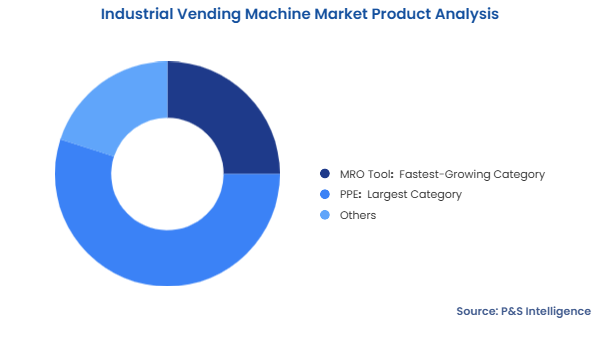
The PPE category holds the largest market share, of 55%, in 2024. This is due to the critical role of PPE in ensuring workplace safety and compliance with increasingly stringent health and safety regulations. Across industries such as manufacturing, construction, automotive, and energy, the need for quick, reliable access to safety gear like helmets, gloves, goggles, and masks is paramount.
Industrial vending machines are becoming a preferred solution for delivering PPE, as they provide a secure and efficient way to dispense these essential items to workers on-demand, minimizing downtime and enhancing overall productivity. The growing emphasis on worker safety, coupled with regulatory requirements for the provision of adequate PPE, further drives demand in this segment.
Studied predict global cleanroom consumable spending to grow from USD 10.1 billion in 2024 to USD 17.2 billion by the year 2032, led by the sale of apparel, especially PPE.
MRO tools are the fastest-growing category, with approx. 10.5% CAGR, as industries are seeking better inventory control and reduced downtime. Automated dispensing ensures critical tools are available on demand, minimizes tool loss, and enhances accountability—especially in manufacturing, energy, and heavy engineering sectors where precision and uptime are vital. As per estimates, MRO accounts for up to 20% of the operational expenses in industries.
Equipment failures due to poor maintenance cause manufacturers to lose an average of 5–20% of productive capacity, according to the U.S. Department of Energy. Inefficient MRO practices can lead to excess inventory costs rising by 10–15%, or stockouts causing production delays. Unplanned downtime costs industrial manufacturers an estimated $50 billion annually in the U.S. alone.
Below are the products analyzed:
MRO Tools (Fastest-Growing Category)
PPE (Largest Category)
Others
End User Insights
The manufacturing category accounts for the largest share, of 40%, in 2024. This is primarily due to its high demand for efficient tools, parts, and PPE to ensure smooth and safe operations. In manufacturing environments, downtime can significantly impact productivity, making it crucial for workers to have quick and easy access to the necessary resources. Moreover, manufacturing facilities often operate around the clock, requiring continuous availability of materials and equipment.
Vending machines help companies maintain optimal inventory levels, streamline supply chain processes, and minimize human error in inventory management. Additionally, the growing focus on workplace safety and compliance with regulations further drives the adoption of vending machines for PPE distribution. The ability to track usage and monitor stock levels in real time adds an extra layer of control, ensuring that essential items are always available when needed.
The aerospace category has the highest CAGR in the market. The aerospace industry demands flawless inventory precision, making industrial vending machines essential for managing tools, PPE, and spare parts. Stockouts can trigger aircraft on ground (AOG) events costing an average of USD 10,000 per hour, while excess inventory incurs carrying costs of up to 30% of inventory value. One aerospace manufacturer reduced inventory by 45% and consistently fulfilled critical parts demands on time through optimized inventory processes. With production delays costing hundreds of millions annually in disruptions and contract penalties, automated vending systems improve accountability, ensure parts availability, and mitigate the financial and operational risks associated with poor inventory management.
The following end users are included in the report:
Manufacturing (Largest Category)
Oil & Gas
Construction
Aerospace (Faster-Growing Category)
Other
Drive strategic growth with comprehensive market analysis
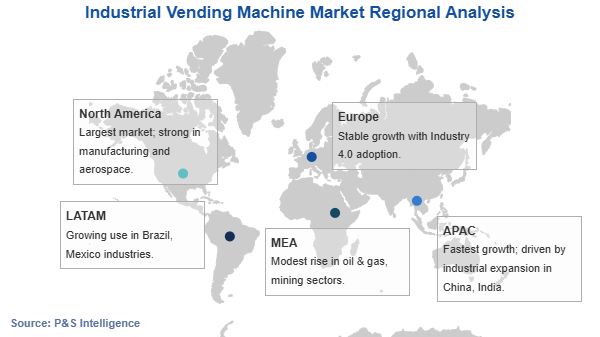
North America holds the largest market share, of 35%, in 2024. This is driven by several key factors, including advanced industrial infrastructure, high adoption of automation technologies, and stringent workplace safety regulations. The region's well-established manufacturing and industrial sectors, particularly in the United States and Canada, have seen a growing need for efficient inventory management and secure access to tools, parts, and personal protective equipment (PPE).
Furthermore, North American companies are increasingly adopting Industry 4.0 technologies, which are driving the demand for smart and integrated vending solutions. Additionally, the emphasis on workplace safety and compliance with Occupational Safety and Health Administration (OSHA) regulations further contributes to the growing adoption of PPE vending machines in the region.
APAC is the fastest-growing region, with a CAGR of approx. 9.5% during the forecast period, owing to the booming manufacturing, automotive, aerospace, and electronics sectors. China leads with over 30% of the global manufacturing output, while India’s manufacturing sector has expanded at around 7% annually. The automotive industry is shifting to electric vehicles, with Asia accounting for over 50% of global EV production. Aerospace is growing at about 6% annually, driven by rising domestic air travel. Electronics manufacturing in countries like South Korea and Japan is notable for precision and scale. These expanding industries increase demand for automated inventory solutions, enhancing operational efficiency and minimizing costly production delays across the region.
Further, regions and countries analyzed for this report include:
Brazil (Largest and Fastest-Growing Country Market)
Mexico
Rest of LATAM
Middle East and Africa (MEA)
Saudi Arabia (Largest Country Market)
South Africa
U.A.E. (Fastest-Growing Country Market)
Rest of MEA
Industrial Vending Machine Market Share
The market is fragmented, with a diverse range of players offering various types of vending solutions across different industries. This can be attributed to the wide variety of industrial applications and the customization required to meet specific operational needs. Different vending machine types, such as coil, carousel, and robotic systems, cater to various sectors like manufacturing, automotive, construction, and logistics, further contributing to a diverse market landscape. Additionally, companies offering industrial vending solutions often provide tailored features, such as advanced tracking, real-time inventory management, and integration with enterprise resource planning (ERP) systems, to address the unique requirements of their customers.
This fragmentation is also influenced by the presence of both established, large-scale players and smaller, specialized vendors that focus on niche markets or regional needs. The growing demand for automation, efficiency, and workplace safety has led to an influx of new market entrants, intensifying competition and preventing consolidation. While a few dominant players control a significant share of the market, such as companies offering comprehensive integrated vending solutions, the overall market remains highly competitive and diverse.
Key Industrial Vending Machine Companies:
Fastenal Company
Air Liquide S.A.
Rubix Group
MSC Industrial Direct Co. Inc.
W.W. Grainger Inc.
Turtle & Hughes Inc.
Apex Industrial Technologies LLC
AutoCrib Inc.
IMC Group
IVM Inc.
Stanley Black & Decker Inc.
SecuraStock
Industrial Vending Machine Market News
In October 2024, Amazon Business introduced Amazon Business Restock, featuring the Managed Inventory and Vending replenishment services. The Managed Inventory service enables Amazon Business technicians to automatically replenish one or more stockrooms or similar areas at a workplace, ensuring that supplies are consistently available. The Vending service allows vendors to oversee product distribution through Amazon Business Restock vending machines. Account administrators have the ability to set product quantities and spending limits, while employees can access authorized items by entering a code or scanning an ID. Notifications are sent to the Amazon Business team and administrators when stock levels are low, facilitating automatic reordering. This vending solution is anticipated to launch in early 2025.
In September 2023, Turtle & Hughes Inc. entered into a partnership with MRO Integrated Supply to develop a guiding framework for the selection process, encompassing areas central to the needs of the organization.
In August 2022, MSC Industrial Direct Co. Inc. completed the acquisition of Tower Fasteners, a value-added distributor of OEM components and fasteners, to broaden its market presence.
Want a report tailored exactly to your business need?
Leading companies across industries trust us to deliver data-driven insights and innovative solutions for their most critical decisions. From data-driven strategies to actionable insights, we empower the decision-makers who shape industries and define the future. From Fortune 500 companies to innovative startups, we are proud to partner with organisations that drive progress in their industries.
Client Testimonials
Working with P&S Intelligence and their team was an absolute pleasure – their awareness of timelines and commitment to value greatly contributed to our project's success. Eagerly anticipating future collaborations.
McKinsey & Company
India
Unmatched Standards
Our insights into the minutest levels of the markets, including the latest trends and competitive landscape, give you all the answers you need to take your business to new heights
Complete Data Security
We take a cautious approach to protecting your personal and confidential information. Trust is the strongest bond that connects us and our clients, and trust we build by complying with all international and domestic data protection and privacy laws