This Report Provides In-Depth Analysis of the Industrial Safety Glove Market Report Prepared by P&S Intelligence, Segmented by Product Type (Reusable, Disposable), Material (Latex/Natural Rubber, Nitrile, HPPE, Neoprene, Vinyl), Functionality (Cut-Resistant, Heat & Flame-Resistant, Chemical-Resistant, General-Purpose), End Use (Automotive, Pharmaceutical, Construction, Oil & Gas, Food & Beverage, Manufacturing, Mining), and Geographical Outlook for the Period of 2021 to 2032
Explore the market potential with our data-driven report
Industrial Safety Glove Market Overview
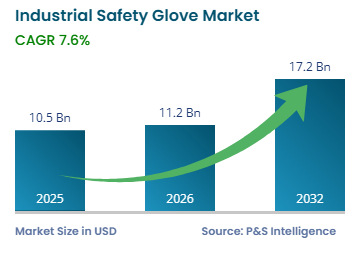
The global industrial safety gloves market size was USD 10.5 billion in 2025, and it is anticipated to expand at a CAGR of 7.6% during 2026–2032, reaching USD 17.2 billion by 2032. This growth is driven by the increasing stringency of the occupational health and safety mandates across the manufacturing, construction, oil & gas, and pharmaceutical industries. This is compelling enterprises worldwide to invest in certified hand protection as a non-negotiable compliance requirement rather than a discretionary spend.
Key Market Insights
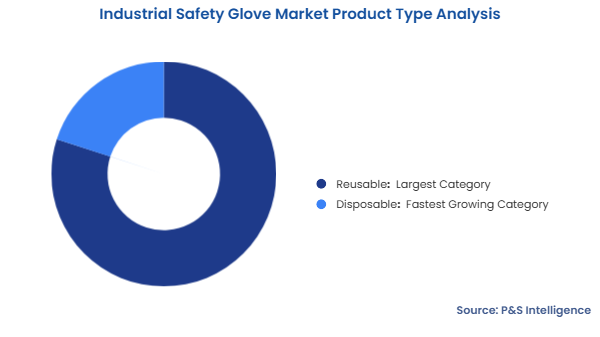
Reusable gloves commanded the largest share in 2025, of 80%.
HPPE is anticipated to exhibit the highest growth rate through 2032, of 7.9%.
Cut-resistant gloves accounted for the largest share in 2025, of 45%.
The pharmaceutical category has the highest growth rate, of 8.2%.
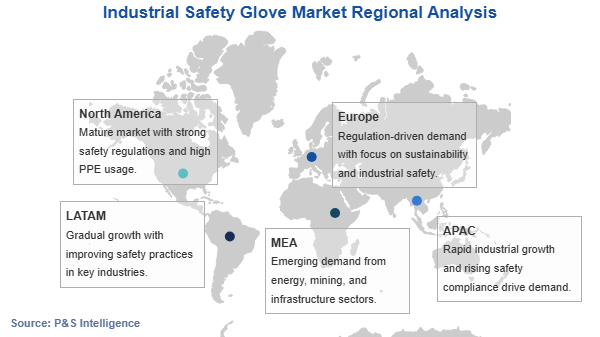
North America held the largest share in 2025, of 40%.
Asia-Pacific is the fastest-growing region with 8.5% CAGR during 2026–2032.
The stricter standards on personal protective equipment (PPE) are compelling industrial operators to transition from general-purpose gloves toward specialized variants offering cut resistance, chemical protection, and thermal barrier. The U.S. Bureau of Labor Statistics (BLS) reports 2.5 million nonfatal workplace injuries and illnesses in private industry in 2024. This persistent occupational exposure risk sustains the demand for hand protection in high-hazard sectors. The International Labour Organization (ILO) estimates that work-related diseases and injuries in Asia and the Pacific alone account for at least 1.2 million deaths annually. This reinforces the policy urgency for systematic PPE deployment across developing industrial economies.
Industrial Safety Glove Market Emerging Trends
Advancing Material Science and Ergonomic Engineering Are Major Trends
The evolving glove material composition and design architecture are the biggest trends in this market. The integration of high-performance polyethylene (HPPE) fibers into cut-resistant constructions has enabled gloves with EN ISO 13997 cut resistance levels, which are attainable only with heavier, less dexterous materials. Simultaneously, nitrile compound formulations are evolving toward ultra-thin, textured configurations, which maintain chemical barrier integrity, while delivering tactile sensitivity for pharmaceutical manufacturing and electronics assembly.
Nanotechnology-enhanced coatings are enabling surfaces with simultaneous hydrophobic, antimicrobial, and anti-static properties a multi-hazard functionality that was structurally impossible with conventional rubber or fabric constructions a decade ago. Sensor-embedded smart gloves, integrating real-time grip force, temperature, and hand movement monitoring, are advancing from prototype to commercial deployment in automated industrial zones. Facilities that previously purchased commodity latex or cotton gloves are transitioning to technically specified, albeit expensive, alternatives.
The tightening of occupational health and safety legislation across major industrial economies is the prominent driver for the market. The U.S. Occupational Safety and Health Administration (OSHA), the European Agency for Safety and Health at Work, and equivalent national authorities in Asia are raising compliance thresholds, expanding inspection frequency, and broadening the categories of workers legally required to wear certified hand protection. OSHA's 29 CFR 1910.138 mandates that employers conduct formal hazard assessments and provide appropriate gloves wherever contact with harmful substances or objects creates hand injury risk. This obligation applies across the manufacturing, construction, chemicals, oil & gas, and healthcare industries.
The ILO reports that more than 317 million nonfatal workplace accidents occur each year. This creates an undeniable policy imperative for comprehensive PPE deployment. OSHA's 2024 shift toward predictive compliance requires employers to proactively identify and mitigate hazards before incidents occur. This has converted glove procurement from a reactive compliance exercise into a continuous, planned investment cycle.
Rampant Industrialization across Emerging Economies Creates Opportunities
The rapid industrialization across emerging economies is significantly expanding the industrial workforce and increasing the demand for workplace safety equipment. The ILO estimates that nearly 3 million people die each year from work-related accidents and diseases globally, highlighting the scale of workplace safety challenges. Agriculture, construction, forestry & fishing, and manufacturing account for 63% of the fatal occupational injuries worldwide. This indicates that the industries experiencing the fastest employment growth across emerging markets are also those with the highest exposure to workplace hazards.
Governments across Asia and the Middle East are investing heavily in manufacturing infrastructure, industrial corridors, and investment programs to strengthen domestic production and attract global supply chains. As industrial employment expands and occupational safety regulations become more formalized, the number of workers required to use certified personal protective equipment will increase.
The Make in India initiative aims to develop manufacturing capabilities across 27 priority sectors. According to the Annual Survey of Industries (ASI) published by India’s Ministry of Statistics and Programme Implementation, employment in the registered manufacturing sector reached 19.5 million workers in FY2024, representing a 5.9% yearly increase. The ministry also reports that manufacturing gross value added (GVA) grew by 11–12% in FY2024, driven by automotive manufacturing, chemicals, metals, pharmaceuticals, and electronics.
The Production Linked Incentive (PLI) scheme offers USD 24 billion to stimulate domestic manufacturing and strengthen export competitiveness across 14 strategic sectors. According to the Press Information Bureau and the Ministry of Commerce and Industry, the scheme has already generated over INR 1.76 lakh crore (USD 21 billion) in committed investments and more than 1.2 million jobs, while catalyzing industrial production exceeding INR 16 lakh crore.
The PLI scheme for automobiles and auto components has attracted INR 29,500 crore in investment and generated around 45,000 jobs. Similarly, the PLI scheme for electronics components is expected to generate INR 59,350 crore in investment and over 91,000 direct jobs over six years. In addition, the India Semiconductor Mission initially committed INR 76,000 crore to build domestic semiconductor manufacturing capabilities. The Union Budget 2026 allocated INR 1.25 lakh crore more to an expanded India Semiconductor Mission 2.0.
The National Industrial Corridor Development Programme (NICDP) is developing 11 industrial corridors and manufacturing zones with logistics networks, ports, and industrial cities with investment exceeding INR 1.2 lakh crore. The 2,500-kilometer East Coast Economic Corridor along India’s eastern coastline aims to strengthen supply chain connectivity with East and Southeast Asian manufacturing hubs. The Make in Odisha initiative has secured investment commitments exceeding INR 2.03 lakh crore (USD 30 billion) across the metallurgy, petrochemicals, chemicals, and advanced manufacturing sectors. Similarly, Uttar Pradesh has implemented the Electronics Manufacturing and EV Manufacturing & Mobility policies. The state currently accounts for more than 50% of India’s mobile phone and smartphone production.
According to the National Bureau of Statistics of China, manufacturing value added reached RMB 34.7 trillion in 2025, accounting for roughly 25% of the national GDP. Moreover, industrial activity contributed around 35% of the overall economic growth that year. China’s manufacturing sector continues to employ over 120 million workers, representing roughly one-fifth of the country’s workforce. The Made in China 2025 and subsequent Five-Year Plans focus on upgrading industrial capacity through automation, robotics, advanced materials, and semiconductor production. As per reports, high-tech and equipment manufacturing output expanded by more than 9% year-on-year in 2025.
According to the United Nations Conference on Trade and Development (UNCTAD) World Investment Report, the rapidly rising manufacturing foreign direct investment in Southeast Asia is driven by electronics assembly, automotive components, and consumer goods production.
Vietnam wants industry to account for more than 40% of its GDP by 2030, with manufacturing and processing industries contributing around 30%. The country’s industrial development strategy also aims for industrial value-added growth exceeding 8.5% annually. Manufacturing employment reached nearly 12 million workers in 2023, while the sector contributes roughly 17% of the national GDP, supported by strong growth in electronics, textiles, and furniture manufacturing.
The Making Indonesia 4.0 strategy prioritizes the electronics, automotive manufacturing, chemicals, textiles, and food processing sectors. The country’s manufacturing sector employs 19 million workers and contributes roughly 20% of the GDP. In Thailand, manufacturing accounts for 27% of the GDP, supported by the established automotive, electronics, and petrochemical clusters. Thailand 4.0 and the Eastern Economic Corridor (EEC) initiatives aim to upgrade manufacturing toward higher-value sectors, including robotics, electric vehicles, and advanced electronics.
The industrial sector is a core pillar of Saudi Arabia’s Vision 2030 economic transformation agenda. Manufacturing contributes 10–14% of the GDP and employs more than 1.1 million workers. The government has committed over SAR 1.2 trillion (USD 320 billion) to industrial development projects and identified more than 800 manufacturing investment opportunities, valued at USD 273 billion. The National Industrial Development and Logistics Program (NIDLP) and the National Industrial Strategy aim to expand the number of factories from around 10,000 currently to 36,000 by 2035. The UAE has launched Operation 300bn to increase manufacturing’s contribution to GDP from USD 36 billion to USD 82 billion by 2031, while accelerating the adoption of advanced manufacturing technologies, such as Industry 4.0.
Reusable gloves commanded the largest share in 2025, of 80%, due to the lower total cost of ownership compared to single-use alternatives across high-hazard operations. Additionally, multi-layered gloves offer the superior mechanical performance in applications needing sustained grip strength and chemical barrier integrity. Additionally, enterprise procurement policies in capital-intensive sectors, such as oil & gas, automotive assembly, and chemical processing, favor durability. Manufacturing and industrial workers account for a high incidence of repeat-exposure hand injuries. This reinforces the preference for reusable gloves that maintain consistent protective performance across multiple shifts. Worker ergonomics programs further require correctly fitted, well-maintained gloves, which is more achievable with reusable products accommodating individual sizes.
Disposable gloves are projected to register the highest CAGR during 2026–2032. This is driven by the accelerating adoption across pharmaceutical, food processing, and electronics factories, where contamination control requirements prohibit the cross-use of protective equipment. FDA Current Good Manufacturing Practice (cGMP) regulations under 21 CFR Part 211 mandate that personnel handling active pharmaceutical ingredients wear appropriate protection in aseptic and controlled environments. This creates a non-discretionary demand for certified disposable gloves, which is expanding proportionally with the global pharmaceutical production capacity.
The market segments into the following product types:
Reusable (Largest Category)
Disposable (Fastest Growing Category)
Material Analysis
Latex/natural rubber held the largest share in 2025, of 35%, due to its elasticity, tactile sensitivity, and biological hazard resistance. These properties are critical in the healthcare, automotive, and food processing sectors, where dexterity requirements preclude heavier synthetic alternatives. Its extensive global supply infrastructure maintains cost competitiveness across the price-sensitive emerging markets in Latin America and Southeast Asia. OSHA's 29 CFR 1910.138 requires employers to select gloves providing hazard-appropriate material protection, based on performance testing. This compliance framework consistently validates latex for biological and low-chemical-exposure environments across general industry.
HPPE is anticipated to exhibit the highest growth rate through 2032. It is propelled by the accelerating adoption in the cut-resistant gloves worn during automotive stamping, metal fabrication, glass handling, and electronics assembly. The WHO/ILO Joint Estimates confirm that occupational injuries account for over 360,000 work-related deaths annually, with hand lacerations being prominent. This regulatory and liability context drives enterprise migration from commodity cotton and leather toward certified HPPE wearables achieving EN ISO 13997 and ANSI/ISEA A4–A9 cut resistance ratings.
The market segments into the following materials:
Latex/Natural Rubber (Largest Category)
Nitrile
HPPE (Fastest Growing Category)
Neoprene
Vinyl
Others
Functionality Analysis
Cut-resistant gloves accounted for the largest share in 2025, of 45%. This is credited to the pervasiveness of laceration hazards across a wide range of industrial applications — from automotive stamping and metal fabrication to glass handling, food processing, and electronics assembly. Employers operating under OSHA 29 CFR 1910.138 compliance obligations are shifting toward technically certified products incorporating HPPE, Dyneema, and Kevlar engineered yarns. These products are replacing general-purpose fabric gloves that provide inadequate protection against EN ISO 13997-rated blade contact. Contact with objects and equipment is a major cause of nonfatal occupational injuries, which propels the demand for gloves that prevent cuts, lacerations, and punctures.
Heat & flame-resistant gloves are projected to demonstrate the highest CAGR during 2026–2032, supported by the strict regulations on the metal manufacturing, welding, and chemical processing sectors. Further, the rapid expansion of electric vehicle battery manufacturing facilities drives this category, as cell assembly and formation processes generate extreme thermal hazards. The ILO identifies thermal and chemical energy exposures as priority occupational hazards in manufacturing sectors across emerging economies. Here, expanding industrial infrastructure is creating large new workforces requiring certified thermal protection for the first time.
The market segments into the following functionality categories:
Cut Resistant (Largest Category)
Heat & Flame Resistant (Fastest Growing Category)
Chemical Resistant
General Purpose
End Use Analysis
The automotive sector held the largest share in 2025, of 30%. Automotive stamping, welding, painting, final assembly, and parts handling generate pervasive hand hazard exposure, necessitating certified gloves across the production floor. The sector's organized procurement environment is driven by Tier 1 supplier and OEM safety compliance requirements, which cascade through supply chains. This produces large structured purchasing programs that sustain demand irrespective of production cycles.
According to the BLS’s 2023 Survey of Occupational Injuries and Illnesses, automobile and light-duty motor vehicle manufacturing reported approximately 6.2 nonfatal injury cases per 100 full-time workers. Specifically, motor vehicle parts manufacturing experienced 3.0 cases per 100 workers due to exposure to machinery, sharp edges, and repetitive assembly hazards. The Safe in India Foundation documented 1,256 injured workers in automotive factories in 2024, representing an annual 35% increase. Of these injuries, 875 were classified as crush injuries to fingers caused by power presses and machinery.
The pharmaceutical category is expected to register the highest growth rate during 2026–2032, driven by regulatory compliance expansion and global production capacity growth. The FDA’s cGMP regulations under 21 CFR Part 211 mandate contamination control, necessitating certified glove use across aseptic processing, API handling, and final packaging operations. This compliance burden is worsening with the expanding pharmaceutical production in India, China, and Southeast Asia.
Pharmaceutical manufacturing faces both worker safety and product contamination risks. The BLS reports nonfatal injury rates of 4.8 per 100 workers in pharmaceutical and medicine manufacturing and 3.2 per 100 in pharmaceutical preparations. This is because workers handle hazardous chemicals and machinery. On the other hand, product contamination drives regulatory recalls, averaging 330 annually, affecting roughly 400,000 units per recall. Sterility failures are the most common cause, highlighting the importance of PPE, hygiene, and quality systems.
In October 2025, a facility in Indore, India, was temporarily shut down after inspectors from the Central Drugs Standard Control Organisation and the state FDA found 216 deficiencies in production and quality processes. That year, the Indian government also revoked the license of a company whose contaminated cough syrup was linked to multiple child fatalities, requiring plants to upgrade to WHO-compliant standards.
Between 2023 and 2025, the FDA issued several warning letters to pharmaceutical manufacturers, citing inadequate procedures to prevent microbial contamination and poor aseptic practices that could compromise product safety. Earlier, a National Institutes of Health pharmaceutical facility was temporarily closed after fungal contamination was detected in manufactured vials, with operations resuming only after thorough remediation.
The market segments into the following end uses:
Automotive (Largest Category)
Pharmaceutical (Fastest Growing Category)
Construction
Oil & Gas
Food & Beverage
Manufacturing
Mining
Others
Drive strategic growth with comprehensive market analysis
Industrial Safety Glove Market Regional Outlook
North America Industrial Safety Gloves Market Overview
North America held the largest share in 2025, of 40%, underpinned by a mature occupational safety ecosystem. OSHA's 29 CFR 1910.138 mandates employer-funded hand protection assessments across all general industry sectors, creating a continuous, legally obligated procurement cycle that insulates demand from discretionary budget pressures. Canada’s market is driven by expanding oil sands, mining, and construction activity, alongside federal OHS regulatory alignment with U.S. standards. The automotive, construction, and manufacturing sectors anchor regional demand, with pharmaceutical and food processing emerging as growing contributors.
U.S. Industrial Safety Gloves Market Analysis
The U.S. is the largest market in North America and the World. OSHA's enforcement infrastructure creates a compliance-driven procurement baseline, which functions independently of industrial output cycles. Automotive manufacturing remains the largest end-use sector, with stamping, welding, and assembly operations mandating certified multi-hazard hand protection for personnel. Pharmaceutical manufacturing is the fastest-growing end use, propelled by the FDA’s cGMP compliance obligations, which mandate certified gloves during aseptic processing and API handling. The 2024 OSHA shift toward predictive compliance frameworks requires proactive hazard identification rather than reactive incident response, expanding glove usage in SMEs.
Asia-Pacific is the fastest-growing region with 8.5% CAGR during 2026–2032, driven by the industrial expansion across China, India, and Southeast Asia. The ILO estimates that the Asia and Pacific region accounts for 63% of the global occupational mortality, while the World Bank had projected East Asia and Pacific economic growth at 4.8% in 2025. This reflects the scale of the region's industrial workforce, urgency of PPE deployment, and expansion of the addressable workforce for certified hand protection.
China Industrial Safety Gloves Market Forecast
China is the largest industrial economy not only in the Asia‑Pacific region, but the entire world. Government initiatives prioritize automation, advanced manufacturing, and worker safety modernization across the automotive, electronics, chemicals, and metal fabrication sectors. As industrial activity expands into high‑tech and capital‑intensive production, enterprises increasingly adopt formal occupational health and safety standards, cleanroom operations, and stricter workplace controls. This drives the demand for certified protective gloves to mitigate the risks from contact with machinery, sharp materials, chemicals, and particulate contamination, while supporting compliance with evolving domestic and international OHS expectations.
India Industrial Safety Gloves Market Dynamics
India is the fastest-growing market in Asia-Pacific due to the expanding workforce in its pharmaceutical, automotive, chemical, and electronics assembly sectors. The Factories Act 1948 mandates employers to provide appropriate protective equipment to workers exposed to occupational hazards. India's emergence as a global pharmaceutical export hub generates non-discretionary PPE demand, as the FDA and EU mandate certified glove use across active pharmaceutical ingredient manufacturing and packaging operations. The ILO supports the strengthening of India's occupational safety and health governance frameworks, reinforcing mandatory PPE compliance across formal industrial employment.
The market covers the following regions and countries:
North America (Largest Region)
U.S. (Largest Country Market)
Canada (Fastest-Growing Country Market)
Europe
Germany (Largest Country Market)
U.K.
France
Italy
Spain (Fastest-Growing Country Market)
Rest of Europe
Asia-Pacific (Fastest-Growing Region)
China (Largest Country Market)
India (Fastest-Growing Country Market)
Japan
South Korea
Australia
Rest of Asia-Pacific
Latin America
Brazil (Largest Country Market)
Mexico (Fastest-Growing Country Market)
Rest of Latin America
Middle East & Africa
Saudi Arabia (Largest Country Market)
U.A.E. (Fastest-Growing Country Market)
South Africa
Rest of Middle East & Africa
Industrial Safety Glove Market Share Analysis
The global industrial safety gloves market is fragmented, due to the diverse end-use industries, protection categories, and geographic demand patterns, which no single manufacturer can serve comprehensively. Fragmentation is sustained by the technical segmentation of demand across mechanically distinct categories, each requiring different manufacturing processes, materials, and certifications. The geographically dispersed customer base rewards regional supply chain proximity and local regulatory expertise. The low entry barriers in commodity latex and nitrile gloves enable domestic producers across Asia to profit. The competitive landscape is evolving as sustainability requirements and smart glove technology reshape differentiation criteria. Manufacturers are demonstrating recycled material content, reduced chemical accelerator formulations, and sensor integration for emerging specification requirements in Europe and North America.
Key Industrial Safety Glove Companies:
Ansell Limited
Honeywell International Inc.
3M Company
Top Glove Corporation Berhad
Hartalega Holdings Berhad
Kossan Rubber Industries Bhd
SHOWA Group
Supermax Corporation Berhad
MCR Safety
Protective Industrial Products Inc.
Uvex Group
Superior Glove Works Ltd.
Mechanix Wear Inc.
Portwest Ltd.
Delta Plus Group
Globus Group
Magid Glove & Safety Manufacturing Company LLC
Ironclad Performance Wear Inc.
HexArmor Inc.
Industrial Safety Glove Market News
In November 2024, Honeywell International Inc. agreed to divest its PPE business to Protective Industrial Products Inc. for USD 1.3 billion. The business comprised the Fendall, Fibre-Metal, Howard Leight, and KCL brands across 5,000 employees and 20 manufacturing facilities in the U.S., Mexico, Europe, North Africa, and Asia-Pacific.
In October 2024, Showa Glove Co. Ltd. commenced nitrile rubber glove production at the Sakaide Plant in Kagawa Prefecture, Japan. The JPY 15 billion (USD 100 million) factory boasts fully automated production-to-packaging lines and a combined daily capacity of 3.6 million gloves across five production lines spanning 17,000 square meters.
In October 2024, Ansell Limited introduced the AlphaTec 53-002 and 53-003 chemical-resistant gloves for the pharmaceutical, laboratory, and chemical sectors. They feature advanced rubber polymer coating and plastic laminate technology, providing EN 374 Type A chemical protection and ANSI/ISEA 105-2024 abrasion compliance.
In July 2024, Ansell Limited completed the acquisition of Kimberly-Clark Corporation's PPE business for USD 640 million. Ansell acquired the Kimtech brand for the scientific and cleanroom markets, KleenGuard brand for industrial environments, RightCycle end-of-life PPE recycling program, and APEX cleanroom contamination control service. The acquisition consolidates Ansell's life sciences and North American industrial distribution presence, while extending its sustainability service portfolio.
In April 2024, Honeywell International Inc. opened the automated electrical safety glove production Line 6 at its Clover, South Carolina, manufacturing facility. The line uses robotic dipping to reduce process dipping cycles by 15–20% and increase production yield by 35%, supporting the output of more than 2,000 finished gloves per week from the single line.
Frequently Asked Questions About This Report
What will be the industrial safety glove market 2032 size?+
In 2032, the market for industrial safety gloves will value USD 17.2 million.
Which product type leads the industrial safety glove industry?+
Reusable gloves dominate the industrial safety glove industry with 80% revenue.
Which is the largest region in the industrial safety glove market?+
North America is the largest market for industrial safety gloves, with 40% share.
What are the key industrial safety glove industry drivers?+
The industrial safety glove industry is driven by increasing stringency of the occupational health and safety mandates across the manufacturing, construction, oil & gas, and pharmaceutical industries.
What is the industrial safety glove market nature?+
The market for industrial safety gloves is severely fragmented.
Want a report tailored exactly to your business need?
Leading companies across industries trust us to deliver data-driven insights and innovative solutions for their most critical decisions. From data-driven strategies to actionable insights, we empower the decision-makers who shape industries and define the future. From Fortune 500 companies to innovative startups, we are proud to partner with organisations that drive progress in their industries.
Client Testimonials
Working with P&S Intelligence and their team was an absolute pleasure – their awareness of timelines and commitment to value greatly contributed to our project's success. Eagerly anticipating future collaborations.
McKinsey & Company
India
Unmatched Standards
Our insights into the minutest levels of the markets, including the latest trends and competitive landscape, give you all the answers you need to take your business to new heights
Complete Data Security
We take a cautious approach to protecting your personal and confidential information. Trust is the strongest bond that connects us and our clients, and trust we build by complying with all international and domestic data protection and privacy laws