Industrial Refrigeration Oil Management Systems Market Statistics
Key Highlights
Study Period
2022 - 2033
Market Size in 2026
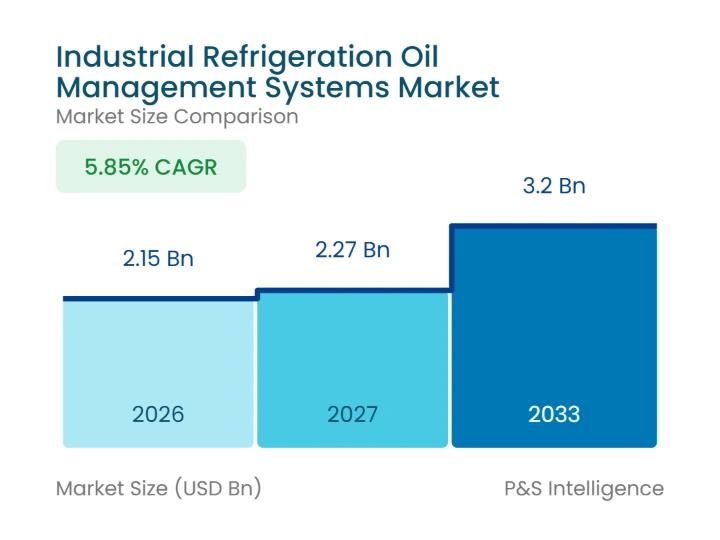
USD 2.15 Billion
Market Size in 2027
USD 2.27 Billion
Market Size by 2033
USD 3.20 Billion
Projected CAGR
5.85%
Largest Region
Asia-Pacific
Fastest Growing Region
Asia-Pacific
Market Structure
Moderately Fragmented
Market Size
Explore the market potential with our data-driven report
Industrial Refrigeration Oil Management Systems Market Outlook
The global industrial refrigeration oil management systems market size is estimated at USD 2.15 Billion in 2026 and is projected to reach USD 2.27 Billion in 2027. Revenue is projected to climb to USD 3.20 Billion by 2033, a CAGR of 5.85% during 2027-2033. Food processors, cold storage operators, and chemical plants buy separators, reservoirs, filters, and level controls because a screw compressor that loses lubricant risks rotor and bearing damage, and oil left in evaporators cuts cooling capacity across the plant. Most purchases arrive with new compressor packages or during scheduled engine-room maintenance.
Cold storage developers and food processors commissioning new ammonia and CO2 engine rooms generate a large part of equipment demand, since every compressor package they install comes with its own oil separation and return circuit. China's total cold storage capacity reached 277 million cubic meters in 2025, according to the China Federation of Logistics and Purchasing. That figure measures warehouse space and does not count oil components. Each added warehouse does, however, extend the population of compressors that need filter, strainer, and coalescing-element changes over their working life, giving separator and filter makers a replacement-parts stream after the initial sale.
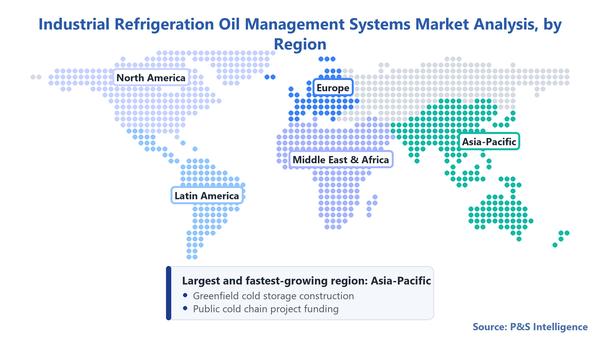
Asia-Pacific accounts for the largest share of industrial refrigeration oil management systems market revenue in 2026 and is also expected to grow fastest, as China and India keep adding processing plants and refrigerated warehouses. North America and Europe follow, where spending depends more on refrigerant conversions and on electronic control retrofits in existing ammonia and CO2 plants. Component makers therefore work two distinct sales cycles, project-led in Asia-Pacific and upgrade-led in the mature regions, with different lead times, pricing, and service expectations.
Key market insights
By component type, oil separators (coalescent, conventional, helical) account for 38.5% in 2026, while oil level controls & electronic regulators are projected to grow fastest during 2027-2033.
By refrigerant type, ammonia (R-717) accounts for 42.0% in 2026, while carbon dioxide (CO2 / R-744) is projected to post the quickest expansion during 2027-2033.
By system type and compressor integration, screw compressor systems (twin & single screw) account for 52.0% in 2026.
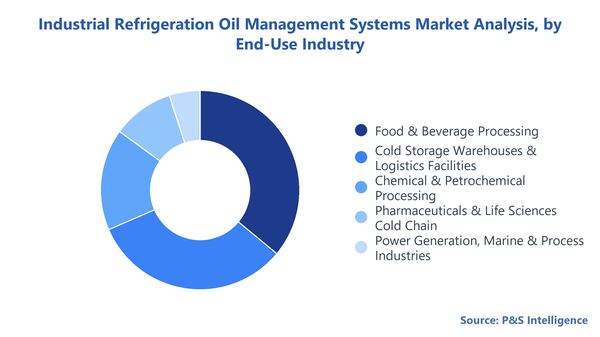
By end-use industry, food & beverage processing (dairy, meat, seafood, bakery, beverages) accounts for 36.0% in 2026.
By geography, Asia-Pacific accounts for 38.0% in 2026 and is also projected to record the fastest growth during 2027-2033.
Industrial Refrigeration Oil Management Systems Market Drivers & Opportunities
Electronic oil level regulation is redefining compressor protection on industrial racks
Plant operators are replacing mechanical float valves on compressor crankcases with electronic regulators that read oil level continuously, top it up through a solenoid valve, and trip an alarm before a compressor runs short. The shift matters most on parallel racks, where a single sticking float can starve one machine while its neighbor floods. Each retrofit turns a low-cost mechanical part into a powered device with a sensor, wiring, and a controller link, which raises spending per compressor without any new plant being built.
As per Copeland's product listing, its TraxOil OM5 regulator was developed specifically for transcritical CO2 applications and uses a Hall sensor for level detection, so electronic level control is already on sale for the highest-pressure duty in a refrigeration plant. Alarm histories from these devices can also point to compressors that carry over excess oil, evidence plant engineers can use to justify separator upgrades. Makers of level switches and regulators that connect directly to rack controllers stand to capture a larger share of each retrofit order.
Natural refrigerant conversions are driving demand for active oil return equipment
Food processors and cold storage operators moving industrial plants from HFCs to CO2 meet an oil problem that ammonia engine rooms rarely present. Oil in an ammonia system sinks and can be drained from low points, while oil in a CO2 system dissolves into the refrigerant and travels wherever the liquid goes. Each CO2 conversion therefore needs high-pressure separators, reservoirs sized for changing oil carry-over, and controlled return paths, so every converted plant becomes an order for oil-management equipment rated for CO2 duty.
A 2022 technical paper published by the International Institute of All-Natural Refrigeration observes that, unlike ammonia systems, oil in CO2 systems is typically miscible, and that the extensively branched piping common in industrial applications has to be designed to return that oil. The design burden is likely heavier in a multi-zone freezing plant than on a compact rack. Vessel and controls makers with separators certified for transcritical pressures gain an opening, because contractors converting these plants need components rated well above ammonia working pressures.
Ammonia charge limits are opening a market for packaged oil management skids
Owners of large U.S. ammonia plants take on process-safety obligations once a single system holds more refrigerant than the federal threshold, which encourages some new projects to adopt low-charge packaged units and distributed systems. Those packages typically leave the factory with the compressor's oil separator and oil cooling already mounted on the skid. In these projects, purchasing of oil-management components shifts from site contractors toward equipment manufacturers, who buy separators and level controls in repeatable volumes and specify them once for each product family.
Under the Occupational Safety and Health Administration's Process Safety Management standard, the threshold quantity for anhydrous ammonia is 10,000 pounds, a quantity that a central engine room serving a large freezer warehouse can exceed. Packaged low-charge designs that keep each system below that line can ease the compliance burden for operators, and EVAPCO is one of the makers selling such units, with a three-stage oil separator built into the package. Separator and controls suppliers that win a position on these platforms gain repeat orders with every unit shipped, a steadier pattern than one-off engineered projects.
Deferred refrigerant deadlines are limiting the pace of retrofit-driven orders
Part of North American demand for new separators and electronic regulators depends on refrigerant changeover timing, because operators often replace oil-management hardware when they rebuild a plant around a new refrigerant. When regulators push back deadlines, owners of HFC cold storage plants can run existing equipment longer and defer the separator, reservoir, and control purchases that a conversion would bring. Oil-free compressor designs add a narrower limit, since they remove the lubricant circuit altogether in the chiller duties where they compete.
The U.S. Environmental Protection Agency finalized a reconsideration rule in May 2026 that extended compliance deadlines and raised interim global warming potential limits for several subsectors, with cold storage warehouses among those covered. The change eases near-term pressure on HFC plant owners and is likely to spread conversion orders over a longer period. Separator and regulator makers have meanwhile widened their CO2-rated ranges, which gives plants that convert ahead of the deadlines a broader choice of proven components.
Segmentation Outlook
Component Type
Oil separators account for 38.5% of industrial refrigeration oil management systems market revenue in 2026, the largest component share. Every screw compressor discharges a mixture of gas and oil that has to be split before it reaches the condenser, so a separator is specified on each package whatever the refrigerant. Coalescing vessels for CO2 and high-pressure ammonia also carry pressure-vessel certification and replaceable elements, which keeps unit prices above those of simpler parts. Separator makers earn on the original package and again whenever plants change elements during scheduled maintenance.
Oil level controls and electronic regulators are expected to post the fastest growth during 2027-2033. Optoelectronic and microprocessor-controlled regulators are displacing mechanical float switches, and each swap adds a sensor, a valve, and an alarm output to what used to be a simple mechanical fitting. CO2 conversions add to this demand because oil that dissolves in the refrigerant can be harder to hold at the right crankcase level with floats alone. Controls specialists benefit from this shift, since the purchase decision moves from the pipefitter toward the plant's controls engineer.
Refrigerant Type
Ammonia (R-717) accounts for 42.0% of 2026 revenue. Meat, dairy, and frozen-food processors and large public refrigerated warehouses have long run ammonia engine rooms, and those plants rely on oil-injected screw compressors. Because oil and ammonia do not mix, the oil settles at low points and must be separated, collected, and drained or returned, which calls for heavy separators, oil pots, and return controls in these plants. Per Johnson Controls, its Frick business has supplied ammonia refrigeration compressors to food and beverage processors for decades, a sign of how deep and long-lived this installed base is.
Carbon dioxide (CO2 / R-744) is projected to record the quickest expansion during 2027-2033. Cold storage owners leaving HFCs often choose transcritical CO2 for mid-sized sites and CO2 and ammonia cascades for larger ones, and the cascade layout adds a second compressor stage with its own oil circuit. Transcritical plants also run at far higher pressures than ammonia, which narrows the field to separators and reservoirs certified for that duty. Vessel makers with certified high-pressure designs are better positioned to win these orders as conversions accelerate.
System Type and Compressor Integration
Screw compressor systems, both twin and single screw, account for 52.0% of 2026 revenue. Screw machines inject oil into the rotor housing for sealing and cooling, so they discharge far more oil than reciprocating units and need a complete separator, oil cooler, and filter train on each package. They are also the usual choice in the large engine rooms of processing plants and distribution warehouses, where one package may run continuously across all shifts. The result is a high oil-component value per installation and a regular schedule of filter and element changes.
Reciprocating compressor systems take 31.0% of 2026 revenue and depend less on large separators than on keeping oil balanced across several machines that share one suction line. Parallel racks of reciprocating compressors use oil reservoirs, equalizing headers, and an individual level regulator on each crankcase, which makes this group a core outlet for optoelectronic regulators. Makers of regulators and reservoirs sell more units per rack in this segment, even though each part is worth less than a screw-package separator. New multi-cylinder CO2 reciprocating models are widening the duty range these racks can cover.
End-use Industry
Food and beverage processing accounts for 36.0% of 2026 revenue. Dairy, meat, seafood, bakery, and beverage plants run chillers, blast freezers, and process cooling around the clock, and processors want no oil carried into process evaporators. Many processors also run several temperature levels on one site, which multiplies compressors and oil circuits. Because a stopped compressor can halt a production line, plant engineers often specify higher-grade separation and electronic monitoring than the minimum a storage-only site would accept.
Cold storage warehouses and logistics facilities generate 32.5% of 2026 revenue. Third-party logistics operators building automated high-bay freezer warehouses buy central ammonia or CO2 systems sized for large frozen volumes, and each new building adds compressor packages with full oil-management trains. Warehouse operators also tend to standardize one engineering design across a network of sites, which favors suppliers able to deliver the same separator and control package to multiple locations on a predictable schedule. That repeat specification gives qualified suppliers a pipeline of orders tied to each operator's expansion plans.
The following segments are analysed in this report.
Copyright P&S Intelligence. Reuse requires attribution under CC BY 4.0.
Geographical Outlook
Asia-Pacific industrial refrigeration oil management systems market outlook
Asia-Pacific accounts for 38.0% of 2026 revenue, the largest regional share, and is also expected to grow fastest during 2027-2033. China is the region's largest market, where food processors and logistics groups keep adding refrigerated warehouses and processing lines, and local compressor production lets package builders supply oil systems at lower cost. Much of this is greenfield construction, so separators, reservoirs, and level controls arrive inside new engine-room packages, which makes project pipelines and contractor relationships the main route to orders.
India adds a second, policy-backed source of growth, with public grants supporting post-harvest cold chain projects. Ministry of Food Processing Industries data show that, as of June 2025, 395 integrated cold chain projects had been approved under its scheme since 2008, of which 291 were complete and operational, adding 2.55 million tonnes of annual preservation capacity. Approved projects still under construction represent future compressor and oil-system purchases, so their timing depends on commissioning. Vessel and controls makers with local fabrication and service teams in India are better positioned for these mid-sized ammonia and CO2 builds.
Japan, South Korea, and Australia behave more like the mature Western markets, with spending tied to refrigerant conversions and control upgrades in existing plants, while Indonesia and Vietnam are at an earlier stage of building processing and storage capacity. The region's share of the industrial refrigeration oil management systems market is likely to keep rising through 2033 because greenfield construction continues in China, India, and Southeast Asia. Local fabricators can compete on price for standard separators, which leaves certified high-pressure CO2 equipment as the area where international suppliers stand apart.
Copyright P&S Intelligence. Reuse requires attribution under CC BY 4.0.
North America market analysis
North America trails Asia-Pacific in revenue, with demand built on a deep installed base of industrial ammonia plants and a growing number of transcritical CO2 sites in food processing and cold storage. Spending leans toward retrofits, because operators rebuilding older engine rooms replace mechanical floats with electronic regulators and add coalescing stages when they overhaul compressor packages. Refrigerant rules also shape the timing of these upgrades, as plant owners tend to group oil-system work into larger conversion projects when they can.
Figures from the U.S. Department of Agriculture's National Agricultural Statistics Service put gross refrigerated warehouse capacity at 3.99 billion cubic feet across 931 warehouses on October 1, 2025. The survey counts storage space, so it says nothing direct about oil-component spending. It does indicate how large the U.S. engine-room base is, and that base needs filter changes, element replacements, and control upgrades on a recurring schedule. Component makers with distributor networks and field service across the U.S. and Canada hold an advantage in the maintenance business this base produces.
Europe market analysis
Europe's demand is shaped more by refrigerant regulation than by new floor space. Processors and warehouse operators in Germany, the Netherlands, France, and the Nordics moved early to ammonia and CO2, and their engineers routinely specify high-efficiency coalescing separators and electronic level controls on natural refrigerant plants. Conversions of the remaining HFC systems add a further layer of orders as owners plan around a shrinking supply of those gases, which keeps European demand weighted toward replacement packages in existing buildings.
Regulation (EU) 2024/573, which has applied since March 11, 2024, sets an EU-wide HFC phase-out by 2050, as the European Commission confirms. The regulation does not prescribe a replacement refrigerant, yet it gives plant owners a fixed horizon for retiring HFC equipment, and owners who move to CO2 or ammonia buy oil components rated for those refrigerants. Component makers whose separators and reservoirs already carry EU pressure equipment conformity can move faster in these conversions, because uncertified vessels need assessment before they can be placed on the EU market.
Middle East & Africa market analysis
The Middle East and Africa holds a smaller share of revenue, with demand concentrated in Gulf food-import hubs and large processing plants in Saudi Arabia, the U.A.E., Qatar, and South Africa. High ambient temperatures raise condensing pressures and discharge temperatures, which puts more thermal load on compressor oil and makes oil cooling and high-capacity separation more important than in temperate plants. Logistics hubs built to hold imported frozen food rely on central systems with full oil-management trains, so project timing follows port and logistics-zone investment.
The Brazilian Animal Protein Association (ABPA) recorded 479,900 tonnes of Brazilian chicken exports to the U.A.E. and 397,200 tonnes to Saudi Arabia in 2025, placing them first and third among destinations. Those volumes measure meat trade only. Imported frozen poultry on that scale still needs cold storage at Gulf ports and distribution centers, which is where central refrigeration plants with full oil circuits are built. Makers of oil coolers and separators rated for high condensing temperatures, backed by regional service partners, are suited to this climate-driven specification.
Latin America market analysis
Latin America trails the other regions in revenue, though its meat, poultry, and seafood export industries make industrial ammonia refrigeration a core part of processing investment in Brazil, Mexico, Chile, and Argentina. Export plants must hold product at stable frozen temperatures to meet buyer specifications, and they typically choose central ammonia systems with automated oil return loops. Expansion of slaughter and freezing capacity therefore carries oil-management purchases with it, mainly through engineering contractors and compressor package suppliers.
The Brazilian Beef Exporters Association (ABIEC) estimates that Brazil shipped about 3.5 million tonnes of beef to 177 countries in 2025, a record volume for the country. Those tonnages measure exports only. Shipping on that scale still requires freezing, chilling, and storage capacity at plants and ports. Mexico follows a different pattern, with refrigerated distribution tied to cross-border food trade with the U.S. Because these plants buy mainly through engineering contractors, component makers already written into those contractors' standard ammonia designs are better positioned as export capacity grows.
The following geographies are analysed in this report.
Asia-Pacific
China
India
Japan
South Korea
Australia
Indonesia
Vietnam
Rest of Asia-Pacific
Europe
Germany
France
U.K.
Italy
Netherlands
Nordics
Rest of Europe
Latin America
Brazil
Mexico
Chile
Argentina
Colombia
Rest of Latin America
Middle East & Africa
Saudi Arabia
U.A.E.
Qatar
South Africa
Egypt
Rest of Middle East & Africa
North America
U.S.
Canada
Industrial Refrigeration Oil Management Systems Market Competitive Landscape
Competition in the industrial refrigeration oil management systems market is spread across three supplier groups that reach the plant through different routes, and no single group supplies every component in a typical engine room. Compressor package builders fit separators, oil coolers, and filters at the factory, so the compressor purchase often decides the oil-system brand. Controls companies sell level regulators, valves, and sensors through refrigeration distributors and contractors. Vessel fabricators compete on pressure ratings, code certification, and lead times. Switching is costly once a design is approved, because a new separator or regulator needs re-engineering and pressure-code paperwork.
Among package builders, BITZER, GEA, and Johnson Controls through its Frick brand integrate oil separation and return into their screw and reciprocating packages, which links later element and filter purchases to the original package supplier. Danfoss, Copeland, CAREL, and the Sporlan division of Parker Hannifin compete in controls, where electronic regulators, sensors, and rack controllers favor suppliers whose products connect to plant monitoring. Temprite, Westermeyer Industries, and Henry Group Industries specialize in separator and reservoir vessels, selling both to package builders and to contractors who design site-built systems.
The shift to CO2 is blurring the lines between these groups. Danfoss now sells CO2 oil separators alongside its valves and controls, and specialists such as Temprite list level controls next to their separators, so each group competes on more of the oil circuit than before. Buyers gain more sourcing options for CO2 projects as a result, while plants that standardize on one supplier's separator and regulator set can simplify spare parts and service.
Major Companies in Industrial Refrigeration Oil Management Systems Market:
Danfoss A/S
Copeland LP
Parker Hannifin Corporation (Sporlan Division)
BITZER SE
Johnson Controls International plc (Frick)
GEA Group AG
Temprite Company
Westermeyer Industries Inc.
Henry Group Industries (Aspen Pumps Group)
CAREL Industries S.p.A.
HB Products A/S
EVAPCO Inc.
Industrial Refrigeration Oil Management Systems Market News
In October 2026, BITZER SE unveiled new six-cylinder ECOLINE reciprocating compressors for transcritical CO2 at Chillventa 2026 in Nuremberg, extending its ECOLINE CO2 range to two- through eight-cylinder models for industrial refrigeration and heat pumps. Larger CO2 machines can let industrial racks run fewer compressors, each needing higher-capacity oil balancing and level control.
In May 2026, Danfoss A/S introduced its OUB range of oil separators and receivers for transcritical CO2 systems in commercial and industrial plants, rated for operating pressures up to 140 bar, with three-stage coalescing filtration on serviceable models and more than 3,300 square centimeters of filtration area. Contractors converting plants to CO2 can now source separators from the same supplier as their valves and controls.
In December 2025, GEA Group AG launched the Grasso L XHP screw compressor series for ammonia heat pumps and high-pressure duty, offering three sizes with swept volumes of 1,990 to 2,748 cubic meters per hour, a 70 bar(g) design pressure, and heating capacities of 2 to 11 MW per compressor. Higher-pressure ammonia screw packages need oil separation and cooling rated for hotter discharge conditions, widening the duty range oil-system suppliers must cover.
Last Updated: October 2026
Frequently Asked Questions About This Report
How big is the industrial refrigeration oil management systems market?+
The global industrial refrigeration oil management systems market size is estimated at USD 2.15 Billion in 2026 and is projected to reach USD 2.27 Billion in 2027.
Why do screw compressors need an oil separator?+
Every screw compressor discharges a mixture of gas and oil that has to be split before it reaches the condenser, so a separator is specified on each package whatever the refrigerant.
How is oil management different in CO2 and ammonia refrigeration systems?+
Oil in an ammonia system sinks and can be drained from low points, while oil in a CO2 system dissolves into the refrigerant and travels wherever the liquid goes.
Why are electronic oil level regulators replacing mechanical float controls?+
Plant operators are replacing mechanical float valves on compressor crankcases with electronic regulators that read oil level continuously, top it up through a solenoid valve, and trip an alarm before a compressor runs short.
Which refrigerant is most widely used in industrial refrigeration oil management systems?+
Ammonia (R-717) accounts for 42.0% of 2026 revenue. Meat, dairy, and frozen-food processors and large public refrigerated warehouses have long run ammonia engine rooms, and those plants rely on oil-injected screw compressors.
Which region leads the industrial refrigeration oil management systems market?+
Asia-Pacific accounts for 38.0% of 2026 revenue, the largest regional share, and is also expected to grow fastest during 2027-2033.
Who are the key companies in industrial refrigeration oil management?+
Among package builders, BITZER, GEA, and Johnson Controls through its Frick brand integrate oil separation and return into their screw and reciprocating packages, which links later element and filter purchases to the original package supplier.
Want a report tailored exactly to your business need?
Leading companies across industries trust us to deliver data-driven insights and innovative solutions for their most critical decisions. From data-driven strategies to actionable insights, we empower the decision-makers who shape industries and define the future. From Fortune 500 companies to innovative startups, we are proud to partner with organisations that drive progress in their industries.
Client Testimonials
Working with P&S Intelligence and their team was an absolute pleasure – their awareness of timelines and commitment to value greatly contributed to our project's success. Eagerly anticipating future collaborations.
McKinsey & Company
India
Unmatched Standards
Our insights into the minutest levels of the markets, including the latest trends and competitive landscape, give you all the answers you need to take your business to new heights
Complete Data Security
We take a cautious approach to protecting your personal and confidential information. Trust is the strongest bond that connects us and our clients, and trust we build by complying with all international and domestic data protection and privacy laws