Industrial PC Market Size & Opportunities Analysis - Growth Strategies, Competitiveness, and Forecasts (2025 - 2032)
This Report Provides In-Depth Analysis of the Industrial PC Market Report Prepared by P&S Intelligence, Segmented by Type (Panel, Rack-Mounted, DIN Rail IPC, Embedded), Specification (Data Storage Medium, Maximum RAM Capacity, Display Type), Sales Channel (Direct, Indirect), End User (Automotive & Transportation, Manufacturing & Heavy Engineering, Medical Devices & Pharmaceuticals, Healthcare, Aerospace & Defense, Energy & Power, Chemical, Oil & Gas, Food & Beverage, Semiconductors & Electronics), and Geographical Outlook for the Period of 2019 to 2032
Explore the market potential with our data-driven report
Industrial PC Market Outlook
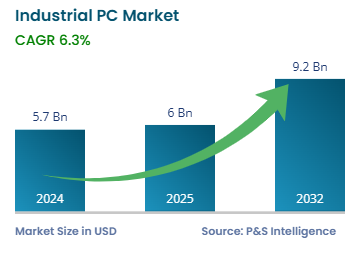
The global industrial PC market will generate an estimated revenue of USD 5.7 billion in 2024, which is expected to witness a CAGR of 6.3% during 2025–2032, to reach USD 9.2 billion by 2032.
This growth can be ascribed to the increasing demand for automation and control systems across various industries, including manufacturing, automotive, energy, and pharmaceuticals. As industries continue to adopt advanced technologies for process optimization, the need for robust, high-performance, and reliable computing solutions like industrial PCs has grown. These systems are critical for handling complex tasks such as data acquisition, real-time monitoring, and machine control, all of which are essential in modern industrial operations.
Additionally, the ongoing trend toward digital transformation and Industry 4.0 is driving the adoption of industrial PCs for seamless integration into automated environments, smart factories, and IoT networks. As industries focus on improving productivity, efficiency, and safety, the global IPC market is well-positioned to experience sustained growth over the forecast period.
The global industrial sector, encompassing manufacturing, mining, and utilities, represents roughly 25–30% of the world’s GDP and values almost USD 14 trillion. Key manufacturing powerhouses include China, the U.S., Germany, Japan, and South Korea. Industrial PCs play a crucial role across these economies, enabling automation, real-time data processing, and improved operational efficiency in factories.
Their rugged design supports harsh industrial environments, while connectivity features drive Industry 4.0 adoption. As manufacturers push for smarter production, demand for industrial PCs grows, particularly in automotive, electronics, and heavy machinery sectors. This integration enhances productivity, quality control, and predictive maintenance, underpinning global industrial competitiveness.
Industrial PC Market Emerging Trends
Shift toward Digitalized, Automated, and Smart Manufacturing Is Key Driver
One of the key drivers propelling the global industrial PC market is the shift of the manufacturing sector toward digitalization.
As industries embrace Industry 4.0, there is a growing demand for advanced computing solutions that can support automated processes, real-time data analysis, and seamless integration with IoT systems.
Industrial PCs are central to this digital transformation, providing the computing power and durability needed to manage complex industrial applications in harsh environments.
By enabling machine-to-machine communication, predictive maintenance, and enhanced process control, IPCs help manufacturers optimize production, reduce downtime, and improve overall operational efficiency.
The integration of digital technologies, such as AI, big data analytics, and cloud computing further drives the need for high-performance IPCs capable of handling vast amounts of data in real time.
A significant market opportunity for the global Industrial PC market lies in the growing deployment of smart manufacturing solutions.
As industries shift toward more automated and interconnected production processes, the demand for advanced computing systems capable of handling the complexities of smart manufacturing has surged.
Smart manufacturing leverages IoT, AI, robotics, and big data analytics to create highly efficient, flexible, and responsive production environments.
Industrial PCs are essential to this transformation, as they provide the computing power and ruggedness required to support these advanced systems in challenging industrial settings.
IPCs serve as the central control unit in smart factories, integrating machinery, sensors, and production systems into a unified network for real-time monitoring and decision-making.
They help manufacturers improve operational efficiency, reduce downtime, optimize energy use, and ensure better product quality.
Additionally, IPCs enable predictive maintenance by collecting and analyzing data from equipment, which can detect potential issues before they lead to costly breakdowns.
Major smart manufacturing initiatives include Germany’s Industry 4.0 with over EUR 200 million funding, the US Advanced Manufacturing Partnership investing USD 1.5 billion, China’s Made in China 2025 with USD 300 billion investment, and India’s Make in India campaign promoting digital manufacturing through government incentives exceeding USD 10 billion (INR 8,000 crore).
Risks associated with integration of industrial PCs Poses Challenge
One of the key challenges in the global Industrial PC market is the risks associated with the integration of these systems into existing industrial environments.
The process of integrating IPCs into legacy systems can be complex and costly, especially in older manufacturing facilities that were not originally designed for advanced automation or digital technologies.
Companies must ensure that new IPCs are compatible with existing hardware and software, which often requires significant modifications or upgrades to the entire production infrastructure.
Moreover, industrial environments are often subject to harsh conditions such as extreme temperatures, vibrations, and dust, which can create additional risks for IPCs when integrating into sensitive systems.
The durability and reliability of the IPC must be thoroughly tested to ensure it can withstand these conditions without compromising performance.
On average, implementing an industrial PC system can cost anywhere from USD 3,000 to USD 15,000 per unit.
Basic setups for simple automation tasks start around USD 3,000–5,000, while advanced systems with rugged designs, high processing power, multiple I/O interfaces, and custom software integration can reach USD 10,000–15,000 or more.
Costs vary widely based on complexity, required certifications, and industry-specific features.
These challenges can delay the adoption of industrial PCs, increase upfront costs, and limit the overall return on investment for companies.
Industrial PC Market Segmentation Analysis
Type Insights
The panel type category held the largest market share, of 40% in 2024. This is due to its versatility and wide range of applications across various industries. Panel PCs combine a high-performance computing system with an integrated touchscreen, making them ideal for human-machine interface (HMI) applications, which are essential in sectors like manufacturing, automation, and logistics.
Their all-in-one design allows for space-saving, ease of installation, and enhanced user interaction, driving their widespread adoption in industries requiring real-time monitoring and control. Moreover, the increasing demand for smart factories and automated production lines is another factor contributing to the dominance of Panel PCs. These systems allow operators to easily interact with machines, monitor processes, and manage data flows, improving efficiency and reducing operational costs.
DIN rail is the fastest-growing category, with 6.5% CAGR, as industries seek compact, durable, and easy-to-install computing solutions for automation and control. Their modular design fits tight spaces, supports harsh environments, and enables real-time data processing, driving adoption in manufacturing, energy, transportation, and smart building applications worldwide.
DIN Rail PCs are mounted on standard DIN rails, commonly used in control panels. They provide reliable processing power close to machinery, enabling real-time monitoring, data analysis, and automation. This local computing reduces latency, minimizes downtime, and improves maintenance, enhancing overall operational efficiency.
During the study, we have analyzed the following types in the report:
Panel (Largest Category)
Rack-Mounted
DIN Rail IPC (Fastest-Growing Category)
Embedded
Specification Analysis
The data storage medium category held the largest market share, of 60%, in 2024. This is primarily due to the increasing need for efficient, reliable, and high-capacity storage solutions in industrial applications. Data storage is a critical component in industrial PCs, as these systems handle vast amounts of real-time data generated by sensors, machinery, and automated processes in sectors like manufacturing, energy, and pharmaceuticals.
The growing adoption of data-driven technologies such as predictive maintenance, machine learning, and big data analytics has further amplified the demand for advanced storage solutions. In industrial environments, where data integrity, speed, and accessibility are essential, solid-state drives (SSDs) and other high-performance storage media are preferred for their durability, fast read/write speeds, and resistance to vibrations and shocks.
Furthermore, with the integration of IoT and connected devices in industrial operations, the need for scalable and secure storage solutions has become even more critical.
The maximum RAM capacity category has the highest CAGR, of 7%, as complex applications like AI, machine learning, and real-time data analytics require higher memory. Industries prioritize these PCs to handle large datasets efficiently, ensure smooth multitasking, and support advanced software, boosting productivity and enabling smarter, faster industrial automation processes.
Below are the specifications analyzed:
Data Storage Medium (Largest Category)
Maximum RAM Capacity (Fastest-Growing Category)
Display Type
Sales Channel Insights
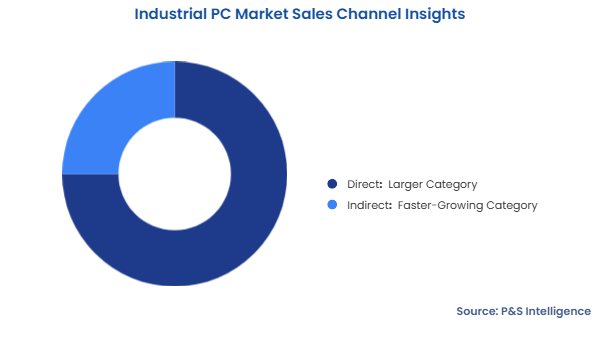
The direct category accounted for the larger share in 2024, of 75%. This is due to the high level of customization, support, and specialized services required by industrial clients. Many organizations prefer purchasing industrial PCs directly from manufacturers or authorized distributors to ensure they receive tailored solutions that meet their specific operational needs.
Direct sales allow customers to work closely with vendors, providing a clear understanding of the product's capabilities, compatibility with existing systems, and necessary configurations, which is particularly important in industries like automation, energy, and aerospace.
Additionally, direct sales offer manufacturers greater control over the entire sales process, enabling them to build stronger customer relationships, provide personalized consultation, and offer better post-sales support, such as technical assistance, installation, and maintenance services.
Indirect sales have the higher CAGR, during the forecast period. Distributors and system integrators provide localized expertise, customized solutions, and faster service, making it easier for industries to adopt complex industrial PC technologies. They also expand reach into emerging markets and small to mid-sized businesses where direct manufacturer presence is limited, driving broader market penetration and sustained growth.
The following sales channels are included in the report:
Direct (Larger Category)
Indirect (Faster-Growing Category)
End User Insights
The manufacturing & heavy engineering category dominated the market in 2024, with a share of 30%, because it includes diverse industries heavily investing in automation and smart manufacturing. Industrial PCs enable real-time monitoring, process control, and predictive maintenance, improving efficiency and reducing downtime. The sector’s scale and ongoing digital transformation ensure sustained high demand for robust, scalable computing solutions.
Use cases include assembly line automation, robotics control, real-time quality inspection, and predictive maintenance. Industrial PCs support harsh environments and integrate with sensors and PLCs to optimize workflows. Manufacturing accounts for over 16% of global GDP, with heavy engineering sectors like automotive driving 30%+ of industrial PC demand worldwide.
The healthcare category is projected to grow at the highest CAGR, during 2025–2032. This is driven by the increasing demand for advanced healthcare technologies and digital transformation in the medical field. Industrial PCs play a crucial role in medical applications, providing reliable, high-performance computing for critical systems like patient monitoring, diagnostic equipment, medical imaging, and telemedicine.
As healthcare facilities increasingly adopt digital tools to improve patient care, efficiency, and operational workflows, the demand for rugged, customizable, and secure IPC solutions continues to rise. Furthermore, the growing trend of remote patient monitoring and the use of IoT-enabled medical devices is expanding the need for industrial PCs that can handle vast amounts of real-time data and provide secure, seamless connectivity.
During the study, we have analyzed the following end user in the report:
Automotive & Transportation
Manufacturing & Heavy Engineering (Largest Category)
Medical Devices & Pharmaceuticals
Healthcare (Fastest-Growing Category)
Aerospace & Defense
Energy & Power
Chemical
Oil & Gas
Food & Beverages
Semiconductors & Electronics
Others
Drive strategic growth with comprehensive market analysis
Industrial PC Market Regional Growth Dynamics
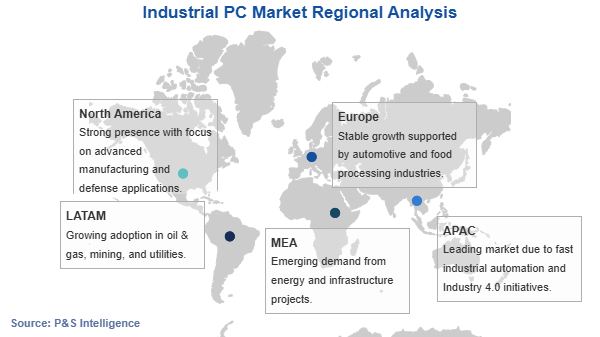
Asia-Pacific leads the market, with 35% share, due to its massive manufacturing base, particularly in China, Japan, South Korea, and India. Rapid industrialization, government initiatives promoting smart factories, and strong electronics and automotive sectors drive demand. The region’s large workforce and expanding infrastructure encourage automation adoption. Additionally, rising investments in energy, semiconductors, and heavy engineering bolster industrial PC usage. Asia-Pacific’s diverse industries and focus on Industry 4.0 transformation make it the largest and most influential market globally, setting trends that other regions follow.
North America has the highest CAGR, due to its strong industrial base, technological advancements, and robust demand for automation across various sectors.
The U.S. is a leader in industrial automation, robotics, and IoT, which require high-performance computing solutions. The region’s well-established manufacturing, aerospace, automotive, and energy industries are major drivers of the demand for industrial PCs, as these sectors require reliable, efficient, and durable computing systems for real-time process control, monitoring, and data processing.
Moreover, North America benefits from significant investments in research and development, allowing manufacturers to develop cutting-edge industrial PC solutions that cater to the needs of diverse industries. Additionally, the U.S.–Mexico–Canada Agreement (USMCA), support regional collaboration, making it easier to scale production and distribution of Industrial PCs.
Further, regions and countries analyzed for this report include:
North America (Fastest-Growing Regional Market)
U.S. (Larger and Faster-Growing Country Market)
Canada
Europe
Germany (Largest Country Market)
UK (Fastest-Growing Country Market)
France
Italy
Spain
Rest of Europe
Asia-Pacific (APAC) (Largest Regional Market)
China (Largest Country Market)
Japan
India (Fastest-Growing Country Market)
South Korea
Australia
Rest of APAC
Latin America (LATAM)
Brazil (Largest and Fastest-Growing Country Market)
Mexico
Rest of LATAM
Middle East and Africa (MEA)
Saudi Arabia (Largest Country Market)
South Africa
U.A.E. (Fastest-Growing Country Market)
Rest of MEA
Industrial PC Market Share
The market is relatively fragmented and characterized by the presence of numerous players ranging from small, specialized companies to large multinational corporations. This is from the wide variety of industries that utilize industrial PCs, including manufacturing, automation, aerospace, automotive, medical, and energy. Each industry has unique requirements for IPCs, such as ruggedness, performance, and customization, leading to a diverse range of product offerings. This diversity allows both small and large players to cater to specific market needs, creating a competitive environment.
Furthermore, the rapid technological advancements in IPCs, including the integration of IoT, AI, and edge computing, have spurred innovation, with many companies focusing on offering specialized solutions to meet the evolving demands of industrial environments. As a result, companies in the market often differentiate themselves through product features, performance, and customer service.
Key Industrial PC Companies:
Rockwell Automation, Inc.
Emerson Electric Co.
ADLINK Technology Inc.
OMRON Corporation
Panasonic Holdings Corporation
Mitsubishi Electric Corporation
NEXCOM International Co. Ltd.
OnLogic Inc.
Schneider Electric SE
Siemens AG
ABB Ltd.
Hitachi Ltd.
Toshiba Corporation
Robert Bosch GmbH
Eaton Corporation plc
Industrial PC Market News
In September 2023, IOTech Systems Limited announced a partnership with Advantech Co. Ltd. to offer advanced edge data processing solutions for industrial automation and smart manufacturing. The companies will offer integrated hardware and software solutions to automate the exchange of data between control systems and equipment and simplify the adoption of AI and machine vision.
In December 2022, Avalue Technology Incorporation introduced two new AI-based industrial box PC models: the EPC-TGU and EMS-TGL. They are powered by the 11th Gen Intel Tiger Lake UP3 microprocessor and consist of a dedicated GPU. The EMS-TGL is designed for AMRs and the EPC-TGU for vision-based solutions.
In November 2022, Beckhoff Automation GmbH & Co. KG unveiled the C6040-0090 model in its C60xx ultra-compact industrial PC series at SPS 2022. It is powered by 12th Generation Intel Core processors and designed for advanced axis control, complex HMI tasks, machine learning, and machine vision.
Want a report tailored exactly to your business need?
Leading companies across industries trust us to deliver data-driven insights and innovative solutions for their most critical decisions. From data-driven strategies to actionable insights, we empower the decision-makers who shape industries and define the future. From Fortune 500 companies to innovative startups, we are proud to partner with organisations that drive progress in their industries.
Client Testimonials
Working with P&S Intelligence and their team was an absolute pleasure – their awareness of timelines and commitment to value greatly contributed to our project's success. Eagerly anticipating future collaborations.
McKinsey & Company
India
Unmatched Standards
Our insights into the minutest levels of the markets, including the latest trends and competitive landscape, give you all the answers you need to take your business to new heights
Complete Data Security
We take a cautious approach to protecting your personal and confidential information. Trust is the strongest bond that connects us and our clients, and trust we build by complying with all international and domestic data protection and privacy laws