This Report Provides In-Depth Analysis of the Industrial Ovens Market Report Prepared by P&S Intelligence, Segmented by Product Type (Curing, Drying, Baking, Reflow), Process Type (Continuous, Batch), End-Use Industry (Automotive, Food & Beverage, Aerospace & Defense, Electronics & Semiconductor, Chemical & Pharmaceutical, Metals & Mining), and Geographical Outlook for the Period of 2019 to 2032
Explore the market potential with our data-driven report
Industrial Ovens Market Future Outlook
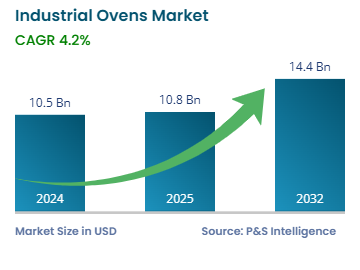
The global industrial ovens market size was USD 10.5 billion in 2024, which is predicted to reach USD 14.4 billion by 2032, growing at a CAGR of 4.2% during 2025–2032.
The significant factors driving market expansion include rapid industrialization in emerging economies, increasing demand for energy-efficient thermal processing equipment, and growing adoption of automation in manufacturing processes across various end-use industries.
The market is experiencing robust growth due to the expanding manufacturing sector's need for precise temperature control and efficient thermal processing solutions. Industrial ovens are essential for processes like adhesive curing, coating, and composite material hardening, which require precise temperature control and consistency. The automotive and aerospace industries remain the largest consumers of industrial ovens, utilizing them extensively for heat treatment, curing, and drying processes that enhance material properties such as strength, durability, and wear resistance. Furthermore, the transition toward energy-efficient manufacturing practices has led to increased investments in advanced oven technologies. Manufacturers can now anticipate energy waste before it occurs by leveraging vast troves of sensor data and machine learning algorithms, enabling more efficient operations and reduced energy consumption.
The replacement of industrial furnaces with ovens in heat treatment operations where temperatures below 1,000°F are required presents substantial growth opportunities. This trend, combined with the development of smart manufacturing capabilities and Industry 4.0 integration, positions the industrial ovens market for sustained expansion throughout the forecast period.
Industrial Ovens Market Growth Factors
Technological Advancements and Industry 4.0 Integration Is a Key Trend
The integration of Industry 4.0 is driving significant transformations in the global industrial ovens market.
In January 2024, Matsui Manufacturing Co. Ltd. introduced the MC6-SP, an enhancement to its MC6 series, reflecting its ongoing efforts to improve product offerings.
The use of smart sensors and AI for predictive maintenance is helping extend the lifespan of equipment and reduce downtime.
In May 2025, Therma-Tron-X Inc. completed the acquisition of Heat Treat Furnaces (HTF), to expand its product offerings by adding high-temperature furnaces.
Industry 4.0 technologies enable remote monitoring and operation, providing businesses with better control over their processes.
The SAMARTH Udyog Bharat 4.0 initiative has received significant investment from the Indian government to promote Industry 4.0 technologies.
The Center for Industry 4.0 (C4i4) in Pune was established with a total project cost of INR 35 crore, which includes a government grant of INR 28 crore and an industry/academia contribution of INR 7 crore.
The ability to collect and analyze vast amounts of data improves performance, energy efficiency, and quality control in industrial oven operations.
The U.S. state of Iowa has invested an additional USD 2 million into the Manufacturing 4.0 Technology Investment Program.
This initiative aims to support manufacturers in adopting smart technologies such as automation, data analytics, and artificial intelligence.
These advancements are fostering innovation in the design and functionality of industrial ovens, meeting the growing needs for customization and precision in industries like automotive, food processing, and electronics.
The European Union's Clean Industrial Deal proposes a substantial investment of 100 billion euros aimed at supporting clean manufacturing across Europe.
This initiative includes measures to lower energy costs, improve sustainability, and promote the adoption of Industry 4.0 technologies.
Growing Demand for Energy-Efficient Manufacturing Solutions Is Driving Market Growth
There is an increasing focus on reducing energy consumption in industrial processes, driving the demand for energy-efficient industrial ovens.
Energy-efficient ovens help companies lower operational costs by minimizing energy usage during heating and drying processes.
The Indian government has launched the Assistance in Deploying Energy Efficient Technologies in Industries and Establishments (ADEETIE) scheme, with a budget of ₹1,000 crore.
Rising environmental concerns and stricter regulations regarding carbon emissions are pushing manufacturers toward more sustainable and energy-saving solutions.
The U.S. Department of Energy's Industrial Efficiency and Decarbonization Office announced USD 38 million in funding for 16 projects aimed at advancing energy-efficient technologies across various industries, including those utilizing industrial ovens.
Industrial ovens with advanced technologies, like heat recovery systems and better insulation, are becoming popular for their ability to reduce energy waste.
In October 2024, DoE selected 16 projects for USD 38.5 million in funding under the Industrial Heat Shot initiative.
This initiative aims to develop cost-competitive industrial heat technologies, including electrification of industrial heat and efficient energy use in industrial systems.
In the same funding opportunity, an additional USD 5.2 million was invested in five projects through a partnership with the Electrified Processes for Industrial Excellence (EPIXC) Institute.
Technological advancements such as IoT and automation allow for more precise control over temperature and energy use, further boosting energy savings in industrial ovens.
Growing sectors like food processing, pharmaceuticals, and automotive, which rely heavily on industrial ovens, are increasingly prioritizing energy efficiency to meet both economic and environmental demands.
The EU’s Ecodesign and Energy Labelling regulations have improved oven efficiency significantly (up to 27% for electric ovens) and are expected to save billions in energy costs and reduce greenhouse gas emissions collectively across member states.
Industrial Ovens Market Segmentation Analysis
Product Type Analysis
The curing category dominated the industrial ovens market in 2024, accounting for 35% of the total market share, primarily due to its extensive application across multiple industries, including automotive, aerospace, electronics, and healthcare. These ovens are essential for processes requiring precise temperature control to achieve optimal material properties, particularly in adhesive bonding, coating applications, and composite material processing. The category's growth is sustained by the increasing demand for high-performance materials in critical applications where product reliability and durability are paramount.
The drying category is expected to witness the fastest CAGR, during 2025–2032, driven by its versatile applications in the chemical, pharmaceutical, and food processing industries. The drying oven category is expected to showcase the highest growth rate, owing to its increased use in various industrial applications. The rising industrial activities, coupled with the need for efficient moisture removal and product stabilization processes, fuel this growth. Innovations aimed at improving energy efficiency and process control in drying ovens, including advanced airflow systems and precision temperature controls, are accelerating adoption across industries.
These product types are covered:
Curing (Largest Category)
Drying (Fastest-Growing Category)
Baking
Reflow
Others
Process Type Analysis
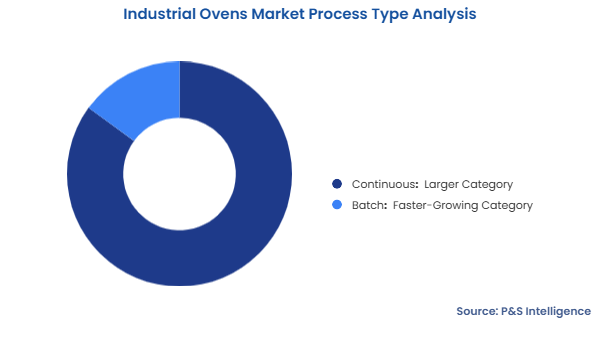
The continuous process category held the dominant position in the industrial ovens market in 2024, capturing 85% share. Continuous ovens offer significant advantages for high-volume production environments by enabling uninterrupted operation and consistent processing conditions. These systems provide superior efficiency and throughput compared to batch processes, making them ideal for automotive, electronics, and food processing applications where production volumes are substantial and consistency is critical.
The batch process is expected to witness the faster growth rate, during 2025–2032, particularly in applications requiring flexibility for smaller production runs and customized processes. Batch ovens are widely utilized in aerospace composites curing, specialized heat treatment operations, and research and development applications where precise control over individual processing cycles is essential. The ability to process different product types with varying thermal requirements makes batch ovens indispensable for job shops and facilities handling diverse product portfolios.
These process types are covered:
Continuous (Larger Category)
Batch (Faster-Growing Category)
End-Use Industry Analysis
The automotive industry emerged as the largest end-user category, accounting for 30% of the industrial ovens market in 2024. The automotive category led the market in 2024, fueled by lightweight vehicle production and rising electric vehicle (EV) adoption. Heat treatment processes in the automotive sector are critical for manufacturing components such as gears, shafts, springs, and bearings that require enhanced mechanical properties. The transition to electric vehicles has further intensified demand, as EV components require specialized thermal processing to ensure performance and safety standards are met. As per OICA, the worldwide automotive production stood at 92,504,338 units in 2024.
The food & beverage category will have the highest CAGR, over the forecast period. Industrial ovens enable precise, large-scale cooking, baking, drying, and roasting processes. They ensure uniform heat distribution, which is vital for product quality, consistency, and food safety. From baked goods to ready-to-eat meals, ovens support mass production while meeting hygiene and regulatory standards. Their energy efficiency, temperature control, and automation capabilities also help reduce operational costs and waste, making them essential for modern food manufacturing and processing. In high-income countries, processed food contributes 45–58% of people’s daily calories.
These end-use industries are covered:
Automotive (Largest Category)
Food & Beverage (Fastest-Growing Category)
Aerospace & Defense
Electronics & Semiconductor
Chemical & Pharmaceutical
Metals & Mining
Others
Drive strategic growth with comprehensive market analysis
Industrial Ovens Market Geographical Analysis
Asia-Pacific Industrial Ovens Market Size
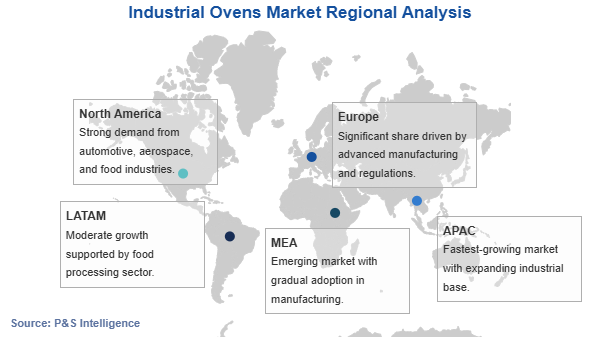
Asia-Pacific dominated the global industrial ovens market with the largest share of 40% in 2024, driven by rapid industrialization, expanding manufacturing capabilities, and substantial investments in automotive and electronics production. The region's manufacturing sector benefits from favorable government policies supporting industrial development, growing foreign direct investment, and the presence of major manufacturing hubs in China, Japan, India, and South Korea. China alone accounts for a significant portion of global manufacturing output, with its industrial ovens market experiencing robust growth due to continuous expansion in automotive production, electronics manufacturing, and food processing industries.
China Industrial Ovens Market Size
China's industrial sector, the world's largest, spans manufacturing, metallurgy, electronics, and automotive industries. As the global manufacturing hub, China's demand for high-precision thermal processing has driven significant growth in the industrial oven market. Industrial ovens are widely used in electronics for PCB curing, in automotive for heat treatment of components, and in food processing for large-scale baking and drying. With ongoing investments in automation and energy-efficient technologies, China is rapidly modernizing its production infrastructure. The government's push for greener manufacturing has also increased the adoption of advanced industrial ovens that support low-emission and high-efficiency thermal operations across industries.
India Industrial Ovens Market Size
India’s industrial sector is diverse and expanding, driven by manufacturing, automotive, food processing, pharmaceuticals, and electronics. The government’s “Make in India” initiative has accelerated industrial growth and modernization, increasing demand for industrial ovens in sectors like metal fabrication, bakery production, and chemical processing. In food and beverage, ovens are essential for mass baking and roasting. In automotive and aerospace, heat treatment ovens are used for metal hardening and component curing. Pharmaceutical manufacturers use precision ovens for sterilization and drying. With growing emphasis on clean energy and efficient manufacturing, India is witnessing rising adoption of smart, energy-efficient industrial oven systems.
North America Industrial Ovens Market Outlook
North America is expected to witness the fastest growth rate with a CAGR of approx. 4.5% during 2025–2032, with the U.S. accounting for the majority of regional demand. The region's well-established automotive and aerospace industries remain primary drivers of market growth, particularly with the ongoing transition toward electric vehicle production and advanced composite manufacturing for aerospace applications.
The implementation of stringent quality standards and regulations, including NADCAP certification requirements for aerospace heat treatment processes, drives the adoption of advanced ovens with superior temperature uniformity and process control capabilities. The region's focus on reshoring manufacturing operations and reducing supply chain dependencies has led to increased investments in domestic production facilities, further boosting demand for industrial ovens.
In April 2025, Wisconsin Oven Corporation announced the shipment of six heavy-duty Walk-In Batch Ovens to an energy industry manufacturer. These ovens include advanced controls, guaranteed temperature uniformity, high-efficiency insulating panel seams, enhanced safety features, and are equipped with Allen-Bradley GuardLogix PLCs and Ethernet communication to enable real-time monitoring.
Europe Industrial Ovens Market Share
Europe accounts for 20% global industrial ovens market revenue, with Germany leading regional demand due to its strong automotive and machinery manufacturing sectors. The market size of the Machinery & Equipment Manufacturing industry in Germany is €315.4bn in 2024. The region's commitment to environmental sustainability and carbon neutrality goals has accelerated the adoption of energy-efficient oven technologies, including systems with advanced heat recovery and reduced emissions.
The European market is characterized by high demand for precision equipment meeting strict quality standards, particularly in automotive, aerospace, and pharmaceutical applications. Countries such as Italy, France, and the United Kingdom contribute significantly to regional market growth through their specialized manufacturing sectors, including luxury automotive production, aerospace component manufacturing, and advanced materials processing.
The regions and countries analyzed in this report are:
North America (Fastest-Growing Regional Market
U.S. (Larger Country Market)
Canada (Faster-Growing Country Market)
Europe
Germany (Largest Country Market)
U.K. (Fastest-Growing Country Market)
France
Italy
Spain
Rest of Europe
Asia-Pacific (Largest Regional Market)
Japan
China (Largest Country Market)
India (Fastest-Growing Country Market)
South Korea
Australia
Rest of APAC
Latin America
Brazil (Largest Country Market)
Mexico (Fastest-Growing Country Market)
Rest of LATAM
Middle East and Africa
Saudi Arabia (Largest Country Market)
South Africa
U.A.E. (Fastest-Growing Country Market)
Rest of MEA
Industrial Ovens Market Share Analysis
The industrial ovens market is generally fragmented in nature. This fragmentation arises from the diverse range of applications across various industries, such as automotive, food processing, pharmaceuticals, electronics, and metalworking, each requiring specialized oven solutions. The presence of many small and medium-sized enterprises (SMEs) further contributes to this fragmentation, as these companies often serve regional markets with customized offerings. Additionally, the market features a wide array of oven types, including batch ovens, conveyor ovens, and rotary ovens, catering to different processes and further intensifying competition. Moreover, the presence of numerous regional players, each with a focus on specific geographic areas or industries, limits the dominance of a few large companies. While larger companies with advanced technologies are gaining traction, particularly in developed markets, the overall market remains fragmented due to the variety of products, regional players, and diverse industry needs.
Key Industrial Ovens Companies:
ASC Process Systems, Inc.
Harper International Corporation
Heatron, Inc.
Eastman Manufacturing Inc.
Rowan Technologies Limited
Wisconsin Oven Corporation
JPW Industrial Ovens & Furnaces
Davron Technologies, Inc.
Grieve Corporation
JLS Ovens
Steelman Industries, Inc.
Despatch Industries
LEWCO Inc.
Thermcraft, Inc.
Precision Quincy
Industrial Ovens Market News & Updates
In March 2025, Wisconsin Oven Corporation dispatched six walk-in batch ovens to a producer of goods for the energy sector. These industrial ovens are intended for the application of glue onto products.
In December 2024, Wisconsin Oven Corporation announced the shipment of a two-zone belt conveyor oven designed for tempering various steel components, featuring advanced temperature control systems achieving ±5°F uniformity across the processing zone.
In July 2024, Menissez Bakery Group completed the acquisition of Jones Village Bakery in Wrexham, including a multi-million-pound investment in new bread production lines and advanced baking oven systems to expand UK production capabilities.
In June 2024, Bühler Group launched its Arrakis advanced roller mill line for snacks and bakery manufacturers. The line features enhanced efficiency, reliability, and simplified operation as core design principles for industrial baking applications.
In February 2024, Schneider Electric SE launched the EcoStruxure Plant Lean Management at Hannover Messe 2024, aiming to boost productivity and digitalization in manufacturing. This initiative focuses on enhancing operational efficiency, which is crucial for industries utilizing industrial ovens.
In February 2024, Middleby Corporation acquired GBT GmbH Bakery Technology, a manufacturer of high-grade industrial baking and bread production lines, strengthening its position in the European bakery equipment market.
Want a report tailored exactly to your business need?
Leading companies across industries trust us to deliver data-driven insights and innovative solutions for their most critical decisions. From data-driven strategies to actionable insights, we empower the decision-makers who shape industries and define the future. From Fortune 500 companies to innovative startups, we are proud to partner with organisations that drive progress in their industries.
Client Testimonials
Working with P&S Intelligence and their team was an absolute pleasure – their awareness of timelines and commitment to value greatly contributed to our project's success. Eagerly anticipating future collaborations.
McKinsey & Company
India
Unmatched Standards
Our insights into the minutest levels of the markets, including the latest trends and competitive landscape, give you all the answers you need to take your business to new heights
Complete Data Security
We take a cautious approach to protecting your personal and confidential information. Trust is the strongest bond that connects us and our clients, and trust we build by complying with all international and domestic data protection and privacy laws