This Report Provides In-Depth Analysis of the Industrial Machine Vision Market Report Prepared by P&S Intelligence, Segmented by Component (Hardware, Software, Services), Product Type (PC-Based Vision Systems, Smart Camera Vision Systems, Hybrid Smart Camera Vision Systems), Imaging Technology (1D Imaging, 2D Imaging, 3D Imaging, Hyperspectral & Multispectral Imaging), Deployment (General, Robotic Cell), End Use Industry (Automotive, Electronics & Semiconductors, Food & Beverage, Healthcare & Pharmaceuticals, Logistics & E-commerce, Aerospace & Defense, Metals & Machinery, Glass, Rubber & Plastics, Printing & Packaging, Mining, Textiles, Wood & Paper, Solar Manufacturing), and Geographical Outlook for the Period of 2021 to 2032
Explore the market potential with our data-driven report
Industrial Machine Vision Market Future Outlook
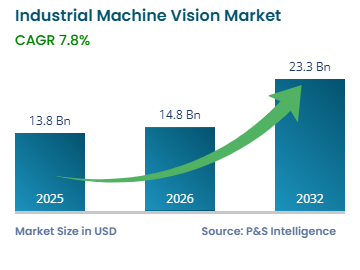
The industrial machine vision market size was USD 13.8 billion for 2025, and it will grow by 7.8% during 2026–2032, to reach USD 23.3 billion by 2032.
The market growth is supported by the accelerating integration of AI-enabled inspection software, high-resolution 2D and 3D imaging hardware, and vision-guided robotic cells across automotive, electronics, and pharmaceutical manufacturing lines. Manufacturers are increasingly deploying machine vision to automate defect detection and product inspection. This shift is reducing reliance on manual quality checks and improving inspection accuracy, production throughput, and traceability across complex manufacturing environments.
The broader industrial automation wave reshaping global manufacturing is reinforcing this demand. According to the International Federation of Robotics (IFR), 542,000 industrial robots were installed worldwide in 2024, with Asia accounting for 74% of new deployments. This expanding installed base is driving demand for integrated machine vision systems that enable vision-guided positioning, part identification, and real-time quality inspection. As robotic cells proliferate across assembly and packaging lines, machine vision increasingly serves as the sensory layer that enables autonomous decision-making and consistent quality validation with minimal human intervention.
Key Market Insights
The hardware category holds the largest market share, of 60%, in 2025, driven by the essential role and higher cost of cameras, optics, lighting, frame grabbers, and processors in every machine vision system.
The smart camera vision systems category will have the highest CAGR, of approximately 8.2%, driven by declining hardware costs, plug-and-play deployment, and increasing adoption in automation and robotic inspection.
The 2D imaging category holds the largest market share, of 45%, in 2025, driven by its cost-effectiveness and widespread use in high-volume manufacturing inspection.
The robotic cell category will have the higher CAGR, of approximately 7.4%, driven by increasing adoption of collaborative and autonomous robots for vision-guided automation and quality inspection.
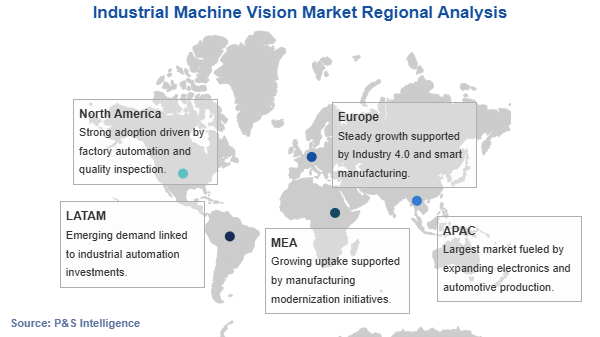
Asia-Pacific holds the largest market share, of 40%, in 2025, and it will have the highest CAGR, of approximately 8.6%, driven by the region's concentrated electronics, semiconductor, and automotive manufacturing base.
Industrial Machine Vision Market Trends and Drivers
AI and Deep Learning Integration Are Key Trends
A structural shift is underway from rule-based image processing toward AI- and deep-learning-driven inspection systems that can generalize across variable defect types without manual reprogramming. This transformation is changing the value proposition of machine vision from simple pass/fail inspection toward adaptive, self-improving quality systems capable of supporting high-mix, low-volume manufacturing environments.
According to the World Economic Forum's Global Lighthouse Network, analytical AI and machine learning account for approximately 62% of AI-enabled Lighthouse use cases in 2025 under its updated classification methodology, demonstrating the growing role of AI in advanced manufacturing. For instance, CITIC Dicastal Morocco achieved a 31.1% reduction in product defects after deploying an AI-enhanced vision inspection system alongside advanced manufacturing technologies. As deep-learning inspection models continue to mature, they are expected to narrow the performance gap between smart camera and PC-based vision systems. This shift is moving competitive differentiation increasingly toward software capabilities, AI algorithms, and training-data quality rather than raw imaging hardware specifications.
Manufacturing Labor Shortages and Automation Are Biggest Drivers
Persistent skilled labor shortages on factory floors are compelling manufacturers to replace manual quality inspection with automated inspection systems. As experienced inspection personnel retire faster than they can be replaced, manufacturers are increasingly deploying industrial machine vision to automate defect detection, dimensional measurement, and part verification. This shift is improving inspection consistency, production throughput, and product quality.
According to the U.S. Bureau of Labor Statistics (BLS), manufacturers are increasingly automating inspection processes by deploying advanced vision inspection systems and three-dimensional (3D) scanners. This automation is enabling inspectors to monitor automated systems while improving productivity and inspection accuracy. Continued innovation from machine vision vendors is reinforcing this driver. For instance, in June 2025, Cognex Corporation introduced OneVision, a cloud-based platform for AI-powered machine vision that enables manufacturers to build, train, and scale deep learning vision applications more efficiently. This platform is accelerating the adoption of automated inspection across production environments.
High Implementation Costs and Integration Complexity Are Key Restraints
While large manufacturers can readily absorb investments in industrial machine vision, high upfront equipment costs and ongoing maintenance expenses continue to limit adoption among small and medium-sized enterprises (SMEs). The costs associated with cameras, sensors, lighting, optics, software, system installation, and employee training often create financial barriers that delay automation investments among resource-constrained manufacturers.
According to the OECD's 2025 D4SME Survey, maintenance costs were identified as the leading barrier to digital technology adoption by 40% of surveyed SMEs, while hardware costs were cited by 32% of respondents. These cost constraints reduce the pace of investment in advanced automation technologies, including industrial machine vision systems, among small and medium-sized manufacturers. Although vendors are increasingly introducing AI-enabled smart cameras, no-code software, and more cost-effective vision solutions, broader SME adoption is expected to remain gradual until implementation and maintenance costs become more affordable.
Semiconductor Fabrication Expansion Is Biggest Opportunity
The global expansion of semiconductor fabrication capacity is creating growing demand for advanced 2D, 3D, and hyperspectral machine vision systems capable of wafer-level and die-level defect detection at increasingly advanced process nodes. Every new semiconductor fabrication, assembly, testing, and packaging facility requires high-precision inspection and metrology equipment to ensure manufacturing accuracy, yield optimization, and process control, making semiconductor investment a primary demand opportunity for industrial machine vision. According to the U.S. Government Accountability Office (GAO), as of July 2025, the U.S. Department of Commerce had awarded USD 30.9 billion in direct CHIPS Act incentives to 19 companies across 40 semiconductor facility construction, expansion, and modernization projects.
Commerce estimates that these investments will increase the U.S. share of global leading-edge logic chip manufacturing from 0% in 2022 to 20% by 2030, with project completion milestones extending through 2033. As these facilities transition from construction to equipment qualification and high-volume manufacturing, demand for industrial machine vision systems is expected to increase through the deployment of advanced inspection, metrology, and process-control solutions. Recurring upgrade and replacement cycles are expected to follow as semiconductor process technologies continue to evolve.
The hardware category holds the largest market share, of 60%, in 2025. This dominance reflects the essential role of cameras, optics, frame grabbers, lighting, and processors as the physical foundation of every machine vision system, together with the higher cost of precision imaging hardware compared with software licenses. In addition, continuous upgrades to high-resolution cameras, smart sensors, advanced optics, and image processors to support AI-enabled inspection and high-speed manufacturing are sustaining hardware demand across industrial applications.
The software category will have the highest CAGR, of approximately 8.0%, driven by the increasing adoption of AI- and deep learning-based inspection algorithms that enhance inspection accuracy and expand system capabilities without requiring hardware replacement. According to the World Economic Forum's Global Lighthouse Network, generative AI represented approximately 23% of AI-related technology solutions implemented across Lighthouse manufacturing sites in 2025. This adoption is accelerating demand for intelligent machine vision software that enables adaptive inspection, defect detection, and process optimization.
The components analyzed in this report are:
Hardware (Largest Category)
Software (Fastest-Growing Category)
Services
Product Type Analysis
The PC-based vision systems category holds the largest market share, of 60%, in 2025, driven by their widespread adoption in complex manufacturing environments requiring multi-camera synchronization, high-speed image processing, custom algorithm development, and seamless integration with factory automation systems. Their superior computing capability and scalability make them the preferred choice for high-precision inspection applications across automotive, electronics, and semiconductor manufacturing.
The smart camera vision systems category will have the highest CAGR, of approximately 8.2%, driven by declining hardware costs, simplified plug-and-play deployment, integrated processing capabilities, and increasing adoption in compact automation and robotic inspection applications. According to the International Federation of Robotics (IFR), the global operational stock of industrial robots reached 4.664 million units in 2024. The continued expansion of industrial robotics is increasing demand for compact, self-contained vision systems that enable real-time inspection, robotic guidance, and quality control directly within automated production lines.
The product types analyzed in this report are:
PC-Based Vision Systems (Largest Category)
Smart Camera Vision Systems (Fastest-Growing Category)
Hybrid Smart Camera Vision Systems
Imaging Technology Analysis
The 2D imaging category holds the largest market share, of 45%, in 2025, driven by its cost-effectiveness and widespread adoption in high-volume manufacturing applications such as barcode reading, label verification, optical character recognition (OCR), and surface defect inspection. Its high inspection speed makes it well-suited to continuous, high-throughput manufacturing processes across industries such as automotive, electronics, food & beverage, and pharmaceuticals. Proven reliability and seamless integration with existing production lines reinforce it as the preferred imaging technology for these environments.
The 3D imaging category will have the highest CAGR, driven by increasing demand for volumetric measurement, robotic guidance, and precision inspection across automotive, electronics, semiconductor, and advanced packaging applications. According to SEMI, global semiconductor test equipment sales are projected to increase by 23.2% in 2025, reaching a record USD 9.3 billion. The growing complexity of semiconductor device architectures and the rising performance requirements of AI and high-bandwidth memory (HBM) semiconductors are driving this increase. Consequently, manufacturers are increasingly adopting 3D machine vision systems for high-precision dimensional inspection, defect detection, and metrology across advanced manufacturing environments.
The imaging technologies analyzed in this report are:
1D Imaging
2D Imaging (Largest Category)
3D Imaging (Fastest-Growing Category)
Hyperspectral & Multispectral Imaging
Deployment Analysis
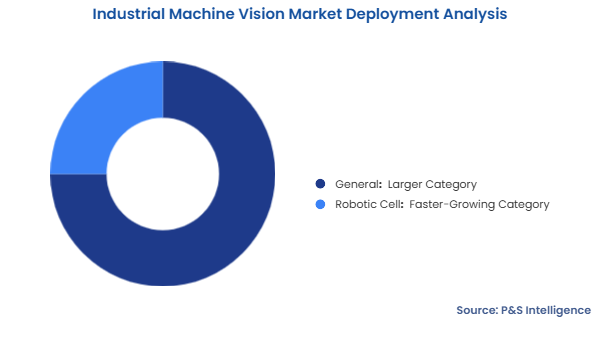
The general category holds the larger market share, of 75%, in 2025, driven by its widespread deployment as fixed-position inspection stations across conventional manufacturing lines, where it supports high-speed product inspection, defect detection, barcode reading, and quality assurance. Its seamless integration with existing production infrastructure reinforces its dominant market position, and its lower implementation complexity compared to robotic cell deployments makes it accessible to a broader range of manufacturers. Its broad applicability across automotive, electronics, food & beverage, pharmaceuticals, and packaging industries further extends this dominance.
The robotic cell category will have the higher CAGR, driven by the increasing adoption of collaborative and autonomous robots that require integrated vision for robotic guidance, part identification, pick-and-place operations, and quality inspection. According to the Association for Advancing Automation (A3), robot orders in North America increased by 4.3% during the first half of 2025 compared with the same period in 2024. Companies ordered 17,635 robots valued at USD 1.094 billion during this period. The continued expansion of industrial robotics is accelerating the integration of machine vision systems into robotic cells to enable real-time inspection, positioning, and automated manufacturing processes.
The deployments analyzed in this report are:
General (Larger Category)
Robotic Cell (Faster-Growing Category)
End Use Industry Analysis
The automotive category holds the largest market share, in 2025, reflecting the sector's long-standing reliance on vision-guided robotics for welding verification, paint inspection, and safety-critical component assembly across high-volume production lines. The International Federation of Robotics notes that the automotive industry operates roughly one-third of all industrial robots installed worldwide, sustaining continuous demand for integrated vision-guided inspection.
The electronics & semiconductors category will have the highest CAGR, of approximately 8.4%, driven by expanding fabrication and packaging capacity requiring precision wafer and chip inspection. SEMI reports that global semiconductor assembly and packaging equipment sales were projected to rise 19.6% in 2025, reflecting capacity expansion that directly requires new inspection tooling.
The end use industries analyzed in this report are:
Asia-Pacific holds the largest market share, of 40%, in 2025, and it will have the highest CAGR, of approximately 8.6%, driven by the region's concentrated electronics, semiconductor, and automotive manufacturing base. Rapid adoption of vision-guided robotic cells is reinforcing this position, and government support for advanced manufacturing across China, Japan, South Korea, and India adds structural momentum. According to the International Federation of Robotics (IFR), Asia's average robot density reached 131 units per 10,000 manufacturing employees in 2024, representing an 11% year-on-year increase.
The continued expansion of industrial automation is accelerating demand for machine vision systems used in robotic guidance, defect detection, and automated quality inspection. SEMI reported that semiconductor equipment spending in 2025 reached USD 49.3 billion in China, USD 31.5 billion in Taiwan, USD 25.8 billion in South Korea, and USD 9.5 billion in Japan. This spending highlights sustained investments in regional semiconductor manufacturing capacity. These investments are driving increased deployment of high-precision industrial machine vision systems for wafer inspection, metrology, and semiconductor production.
China Industrial Machine Vision Market Size
China represents the largest country market within Asia-Pacific, driven by the world's largest installed base of industrial robots, a vast manufacturing sector, and an accelerating transition toward AI-enabled smart manufacturing that is extending the country's automation lead. The country's continued investments in industrial automation, electronics, semiconductor fabrication, and automotive manufacturing are driving widespread adoption of industrial machine vision systems for inspection, robotic guidance, and quality assurance. According to the National Bureau of Statistics of China, industrial robot production increased by 35.6% year-on-year during the first half of 2025, reaching nearly 370,000 units. This growth reflects the country's continued acceleration of manufacturing automation.
Moreover, according to the International Federation of Robotics (IFR), China accounted for 54% of global industrial robot installations in 2024, while its operational robot stock exceeded 2 million units, representing the largest installed base worldwide. This expanding automation footprint continues to drive demand for industrial machine vision systems across manufacturing operations.
India Industrial Machine Vision Market Size
India represents the fastest-growing country market within Asia-Pacific, driven by government initiatives to establish a domestic electronics and semiconductor manufacturing ecosystem that increasingly requires high-precision inspection, metrology, and automation technologies. According to the Ministry of Electronics and Information Technology (MeitY), the Government of India has approved 10 semiconductor projects under the Semicon India Programme with a total investment of approximately INR 1.6 lakh crore.
Electronics manufacturing in India has increased nearly sixfold over the last 11 years, reaching INR 11.32 lakh crore in 2024–25, supported by the Production-Linked Incentive (PLI) schemes and broader electronics manufacturing initiatives. The continued expansion of semiconductor fabrication, assembly, testing, and packaging facilities, together with sustained growth in domestic electronics manufacturing, is expected to drive increasing demand for industrial machine vision systems used in automated inspection, robotic guidance, metrology, and quality assurance.
North America Industrial Machine Vision Market Size
North America accounted for a significant share of the industrial machine vision market revenue in 2025, driven by a mature manufacturing base across the automotive, aerospace, and electronics industries and the early adoption of AI-enabled inspection systems to meet stringent quality, safety, and regulatory requirements. The region's extensive installed base of automated production lines continues to expand, reinforcing demand for integrated vision-guided positioning and defect-detection systems across manufacturing operations.
According to the International Federation of Robotics (IFR), North America reached a robot density of 204 units per 10,000 manufacturing employees in 2024, representing a 4% year-on-year increase. The continued adoption of industrial robots is driving demand for machine vision systems that support automated inspection, robotic guidance, and real-time quality assurance.
These regions and countries are analysed:
North America
U.S. (Larger and Faster-Growing Country)
Canada
Europe
Germany (Largest Country)
U.K.
France
Italy
Spain (Fastest-Growing Country)
Rest of Europe
Asia-Pacific (Largest and Fastest-Growing Region Market)
The industrial machine vision market is semi-consolidated, with a limited number of established global players holding leading market positions alongside numerous regional and niche vendors specializing in cameras, sensors, optics, AI software, and system integration. High entry barriers, including extensive R&D investments, proprietary imaging algorithms, deep-learning capabilities, precision optical engineering, and advanced sensor manufacturing expertise, favor companies with established technological capabilities and global distribution networks. Leading vendors such as Cognex, KEYENCE, OMRON, Teledyne, and Basler continuously strengthen their market presence through AI-enabled vision innovations, product portfolio expansion, strategic partnerships, and acquisitions. Meanwhile, smaller companies primarily compete in specialized applications, component manufacturing, or regional markets. Established incumbent players and high technological barriers continue to shape the competitive landscape, while continuous innovation reinforces the market structure.
Key Players in the Industrial Machine Vision Market:
Cognex Corporation
Keyence Corporation
Teledyne Technologies Incorporated
Omron Corporation
Basler AG
SICK AG
Hikrobot Co., Ltd.
Zebra Technologies Corporation
Allied Vision Technologies GmbH
Datalogic S.p.A.
IDS Imaging Development Systems GmbH
Baumer Group
Industrial Machine Vision Market Developments
In May 2026, Cognex Corporation launched the In-Sight 3900 Vision System, an embedded AI vision system powered by Qualcomm Dragonwing platforms delivering up to 4x faster processing and support for up to 25-megapixel imaging in a PC-free configuration. The launch extends Cognex's embedded AI portfolio toward high-speed, high-accuracy inspection for automotive, electronics, and consumer goods production lines without sacrificing line speed.
In March 2026, Basler AG and Orbbec Inc. announced a strategic partnership to co-develop industrial 3D vision solutions, with the first result being the Basler Stereo mini 3D camera targeted at logistics and factory automation applications. The partnership expands Basler's 3D portfolio to address autonomous mobile robot and AGV guidance use cases ahead of a planned LogiMAT 2026 debut.
In September 2025, OMRON Corporation launched its DX1 Data Flow Controller globally, an edge controller that collects, analyzes, and visualizes operational data from factory sensors and controllers without requiring specialized programming. The launch targets manufacturers seeking to accelerate on-site data utilization and digital transformation while reducing GHG emissions across production sites.
Frequently Asked Questions About This Report
What are the primary drivers of growth in the industrial machine vision market?+
The market is driven by increasing factory automation, rising adoption of Industry 4.0, growing deployment of AI-powered vision systems, expanding semiconductor and electronics manufacturing, and the need for high-precision quality inspection across industries.
Which region is expected to witness the highest demand for industrial machine vision systems?+
Asia-Pacific is expected to witness the highest demand due to rapid industrial automation, expanding electronics and semiconductor manufacturing, strong automotive production, and government initiatives supporting smart manufacturing in countries such as China, Japan, South Korea, and India.
How is artificial intelligence transforming industrial machine vision?+
Artificial intelligence enables machine vision systems to perform complex defect detection, pattern recognition, object classification, predictive quality control, and adaptive inspection with higher accuracy than traditional rule-based vision systems.
What are the major challenges facing the industrial machine vision market?+
High initial implementation costs, integration complexity with legacy production systems, the need for skilled personnel, cybersecurity concerns in connected factories, and varying lighting or environmental conditions remain key challenges.
What are the main components of an industrial machine vision system?+
A typical system consists of industrial cameras, lenses and optics, lighting systems, image acquisition hardware (frame grabbers), processors or controllers, communication interfaces, and machine vision software for image analysis and decision-making.
Want a report tailored exactly to your business need?
Leading companies across industries trust us to deliver data-driven insights and innovative solutions for their most critical decisions. From data-driven strategies to actionable insights, we empower the decision-makers who shape industries and define the future. From Fortune 500 companies to innovative startups, we are proud to partner with organisations that drive progress in their industries.
Client Testimonials
Working with P&S Intelligence and their team was an absolute pleasure – their awareness of timelines and commitment to value greatly contributed to our project's success. Eagerly anticipating future collaborations.
McKinsey & Company
India
Unmatched Standards
Our insights into the minutest levels of the markets, including the latest trends and competitive landscape, give you all the answers you need to take your business to new heights
Complete Data Security
We take a cautious approach to protecting your personal and confidential information. Trust is the strongest bond that connects us and our clients, and trust we build by complying with all international and domestic data protection and privacy laws