This Report Provides In-Depth Analysis of the Industrial Hose Market Report Prepared by P&S Intelligence, Segmented by Material Type (Rubber, Polyvinyl Chloride (PVC), Polyurethane (PU / TPU), Fluoropolymers & Silicone, Metal & Composite), Media Type (Oil & Petroleum, Water & Wastewater, Air & Gas, Chemical & Corrosive Fluids, Food & Beverage / Agricultural Fluids), End-Use Industry (Construction & Mining (Infrastructure), Automotive & Transportation, Oil & Gas / Petrochemicals, Chemicals & Pharmaceuticals, Agriculture & Irrigation, Food & Beverage Processing), Pressure Design / Working Pressure Tier (Medium-Pressure Hoses (300 to 3,000 psi), Low-Pressure Hoses (< 300 psi), High & Ultra-High Pressure Hoses (> 3,000 psi)), and Geographical Outlook for the Period of 2022 to 2033
Explore the market potential with our data-driven report
Industrial Hose Market Overview
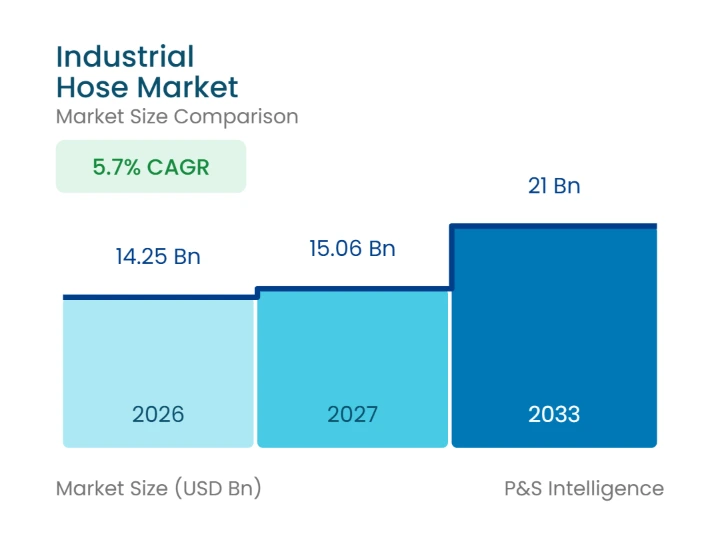
The global industrial hose market size is estimated at USD 14.25 Billion in 2026 and is projected to reach USD 15.06 Billion in 2027. Revenue is projected to climb to USD 21.00 Billion by 2033, advancing at a 5.7% CAGR during 2027-2033 as equipment fleets, process plants, and vehicle platforms renew their hose. Contractors, mine operators, refineries, and food plants buy hose as a wear part that cracks, abrades, or fails a pressure check and must be replaced. Much of the revenue therefore comes from machines and plants already in service, with new equipment and plant projects adding further orders.
Automakers moving to battery-electric platforms are opening the newest stream of hose orders, since battery packs and power electronics need liquid cooling loops of their own. According to the International Energy Agency, electric car sales exceeded 20 million in 2025, one-quarter of all new cars sold worldwide. Vehicle sales size the platform base, not hose content, yet each new cooling circuit is a design-in decision where lightweight thermoplastic lines compete with rubber. Each sourcing round favors hose makers already qualified with automakers' thermal-system engineers.
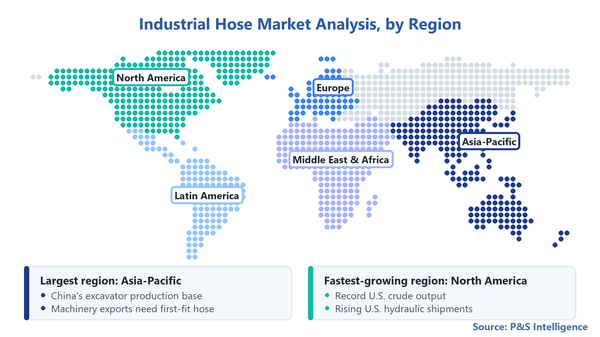
Asia-Pacific accounts for 37.4% of revenue in 2026, led by China's machinery, chemical, and vehicle output, with Japan, South Korea, and India adding equipment exports and infrastructure work. North America is set to grow fastest, at a 6.5% CAGR during 2027-2033, as U.S. oil and gas production and Canadian mining and energy projects keep fuel, hydraulic, and transfer hose in heavy use. Asia-Pacific rewards low-cost local production, while North American industrial hose market demand leans on fast assembly and field replacement service.
Key market insights
By material type, rubber accounts for 39.2% of revenue in 2026, while polyurethane (PU / TPU) is projected to post a 7.4% CAGR during 2027-2033.
By media type, oil & petroleum holds 27.5% in 2026, while air & gas is expected to advance at a 6.8% CAGR during 2027-2033.
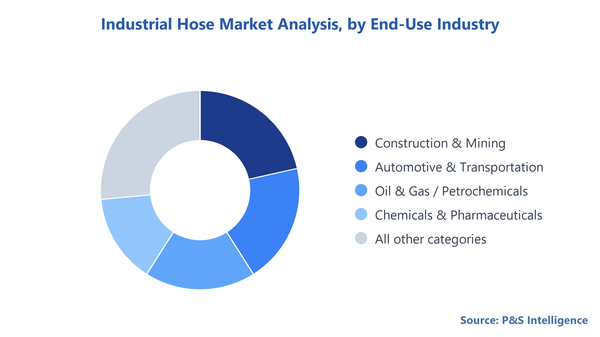
By end-use industry, construction & mining (infrastructure) represents 21.5% in 2026, while automotive & transportation is set to expand at a 6.9% CAGR during 2027-2033.
By pressure design, medium-pressure hoses (300 to 3,000 psi) account for 46.0% in 2026, while high & ultra-high pressure hoses (> 3,000 psi) are forecast to rise at a 7.2% CAGR during 2027-2033.
By geography, Asia-Pacific accounts for 37.4% in 2026, while North America is projected to record a 6.5% CAGR during 2027-2033.
Industrial Hose Market Drivers & Opportunities
Traceable, factory-built assemblies are reshaping how plants buy replacement hose
Maintenance teams at plants, mines, and equipment dealers increasingly buy finished hose assemblies, cut, fitted, crimped, and tested to a recorded specification, instead of bulk hose and loose couplings. A burst hydraulic line on a loader or a leaking chemical hose halts work and can injure staff, so plant engineers want every replacement to match the original build. Value moves from the hose itself toward fittings, crimping, testing, and delivery speed, which raises revenue per assembly for suppliers with fabrication capacity.
NAHAD, the Association for Hose and Accessories Distribution, launched its Hose Safety Institute in 1995, and the institute's handbook and fabrication guides set performance recommendations for how hose assemblies are specified, designed, and fabricated. Its designated locations include distributors, manufacturers, and suppliers, and its STAMPED checklist gives buyers and fabricators a common set of seven details to specify. Hose makers typically qualify their hose with their own couplings and crimp settings, so distributors that crimp one brand's system tend to stay with it, which rewards manufacturers with broad matched ranges and assembly tooling.
Compact constant-pressure specifications are driving higher-value hose into mobile machinery
Builders of excavators, loaders, tractors, and mining trucks are packing more hydraulic functions into tighter booms and engine bays, which pushes them toward compact, higher-rated hose. A hose rated at one working pressure across every bore size within its class lets an engineer route a whole circuit with a single product family, cutting part numbers and bend space. Each such switch replaces a lower-cost braided line with a spiral or compact construction that sells at a higher price per meter.
Under ISO 18752, hydraulic hoses fall into four grades, A to D, by impulse resistance, with the top grade tested to one million pressure cycles, and maximum working pressure is held constant across sizes in each pressure class. Equipment makers that specify the higher grades also fix the replacement part, because dealers and fleet owners usually replace a hose with one of equal rating. Suppliers carrying complete constant-pressure ranges with matched couplings are better positioned in OEM nominations, and the specification is likely to spread further into mid-size machines.
Liquefied gas bunkering is opening a market for cryogenic transfer hose
Shipowners ordering dual-fuel vessels need bunker barges and terminal connections that move LNG at about minus 162°C between ships, and much of that transfer runs through composite or metal hose strings. These hoses carry higher prices than standard oil-transfer hose because of multilayer construction, cryogenic testing, and type approval. Each new bunker vessel needs a working set plus spares, and operators replace hoses on inspection cycles, so every delivery adds recurring demand.
SEA-LNG's 2026 mid-year review counts 67 LNG bunker vessels in operation and 42 more on order. Vessel counts measure transfer points, not hose spending, but each added bunker vessel creates a buyer for cryogenic hose that did not exist before. Suppliers with qualified composite and hose-in-hose ranges could win repeat business as more ports add bunkering services, while makers without cryogenic test capability have little access to these orders.
Proposed curbs on fluorinated polymers are constraining planning for chemical and pharmaceutical hose
Chemical plants, pharmaceutical producers, and semiconductor fabs rely on PTFE, PFA, and FEP liners for aggressive and high-purity fluids, and these fluoropolymers fall within the European Union's proposed universal PFAS restriction. Hose makers do not yet know which uses will keep a derogation or for how long, which can delay investment in new fluoropolymer lines and lead some buyers to test alternative liners early. The uncertainty weighs most on suppliers whose chemical hose ranges depend heavily on PTFE.
The European Chemicals Agency confirms that its risk assessment committee adopted a final opinion on March 2, 2026, and that its socio-economic committee agreed a draft on March 10 backing a broad restriction with targeted derogations, with a final opinion expected by the end of 2026 before the European Commission decides. Suppliers able to offer non-fluorinated liners, such as UHMWPE, give European buyers a fallback, although these materials may not match PTFE in every chemical service. Clearer derogation terms would let hose makers restart investment planning.
Segmentation Analysis
Material Type
Rubber hoses account for 39.2% of industrial hose market revenue in 2026, led by hydraulic, steam, and heavy suction hoses that need an elastomer able to bond with reinforcement and resist heat and oil. Different compounds cover different fluids, so one compounding plant can serve many end uses. Figures from the International Rubber Study Group put world rubber consumption at 15,819 thousand tonnes in the first half of 2025, and nine-month consumption still ran 0.6% above the prior-year period despite a weaker third quarter. Tires take most of that volume, yet the scale keeps compound supply broad for hose makers.
Polyurethane (PU / TPU) hoses are projected to post the quickest gains, at a 7.4% CAGR during 2027-2033. Plants conveying grain, plastic pellets, sand, and wood chips choose polyurethane because its abrasion resistance extends service life in suction and pneumatic conveying lines, and its lower weight makes long runs easier to handle. Plastics Europe estimates global plastics production at 430.9 million tonnes in 2024, 4.1% above 2023, and processors move resin pellets between silos, dryers, and molding machines through such lines. Makers with antistatic polyurethane spiral ranges can take share as plants replace heavier rubber material-handling hose.
Media Type
Oil & petroleum transfer accounts for 27.5% of revenue in 2026. Refineries, fuel terminals, tank truck fleets, and offshore platforms use hydrocarbon-resistant hose for loading, unloading, and dispensing, and these lines need electrical continuity against static ignition plus regular pressure testing, so they are retired on fixed inspection schedules. OPEC expects world oil demand of 105.7 million barrels per day in 2026, a volume that passes through flexible hose at many loading and dispensing points. Throughput of that scale, more than new refinery construction, sets the replacement base for fuel and oil-suction hose.
Air & gas hose is expected to expand fastest on this axis, at a 6.8% CAGR during 2027-2033. Compressed air drives tools, actuators, and cleaning in most factories, so each new assembly line, packaging cell, or robot cell adds pneumatic hose runs. Gas service is widening too, as hydrogen dispensers for fuel-cell vehicles operate at a nominal 700 bar and need thermoplastic liners with aramid or steel spiral reinforcement. Specialty gas lines sell at higher prices per meter than air hose, so revenue in this category can rise faster than volume.
End-Use Industry
Construction & mining (infrastructure) accounts for 21.5% of revenue in 2026. Excavators, loaders, drill rigs, and haul trucks each run many hydraulic hoses exposed to abrasion, vibration, and pressure spikes, so fleets replace hoses many times over a machine's life. Mines also buy large-bore rubber hose for slurry and dewatering, and contractors buy it for concrete pumping, both carrying high unit values. Because replacement follows operating hours, spending holds up in years when new equipment sales slow, giving suppliers with field service vans and dealer stocking programs steady volume.
Automotive & transportation is forecast to show the highest growth among end uses, at a 6.9% CAGR during 2027-2033. Battery-electric cars need coolant lines for the battery pack, motor, and power electronics, and these circuits can use lighter thermoplastic vulcanizate or polyamide lines in place of EPDM rubber. ACEA data show battery-electric cars took 17.4% of new EU car registrations in 2025, up from 13.6% in 2024. Registrations measure the vehicle base, not hose content per car, but each platform change opens a sourcing round in which hose makers with thermal-management engineering teams can win multi-year supply contracts.
Copyright P&S Intelligence. Reuse requires attribution under CC BY 4.0.
Pressure Design
Medium-Pressure Hoses (300 to 3,000 psi) account for 46.0% of revenue in 2026. This band covers braided hydraulic hose on tractors, forklifts, and factory presses, plus steam, chemical, and heavy air lines, so it serves the widest spread of machines and plants. Distributors stock it on bulk reels and crimp it to length at the counter, which keeps it the default choice for maintenance replacements. That breadth also makes it the most price-competitive tier, where regional producers in Asia compete directly with global brands on standard SAE and EN constructions.
High & Ultra-High Pressure Hoses (> 3,000 psi) are set to grow at the fastest pace in this dimension, a 7.2% CAGR during 2027-2033. Equipment builders are raising system pressures to get more force from smaller cylinders and pumps, which moves them to four- and six-spiral and compact hose. Waterblasting, descaling, and high-pressure cleaning add further uses well above 3,000 psi. These hoses need impulse-tested couplings matched to the hose, so buyers tend to source hose and fittings as one system, which benefits manufacturers that sell complete assemblies.
The following segments are analyzed in this report:
Material Type
Rubber
Polyvinyl Chloride (PVC)
Polyurethane (PU / TPU)
Fluoropolymers & Silicone
Metal & Composite
Media Type
Oil & Petroleum
Water & Wastewater
Air & Gas
Chemical & Corrosive Fluids
Food & Beverage / Agricultural Fluids
Others / Multipurpose Transfer
End-Use Industry
Construction & Mining (Infrastructure)
Automotive & Transportation
Oil & Gas / Petrochemicals
Chemicals & Pharmaceuticals
Agriculture & Irrigation
Food & Beverage Processing
General Manufacturing & Others
Pressure Design / Working Pressure Tier
Medium-Pressure Hoses (300 to 3,000 psi)
Low-Pressure Hoses (< 300 psi)
High & Ultra-High Pressure Hoses (> 3,000 psi)
Geographical Analysis
Asia-Pacific industrial hose market outlook
Asia-Pacific holds 37.4% of global revenue in 2026. China, the region's largest market, combines high construction machinery output with large chemical, steel, and vehicle industries that consume hydraulic, transfer, and coolant hose in volume. Japan and South Korea add higher-value demand from excavator, vehicle, and shipbuilding exports, while highway, metro, and power projects in India keep earthmoving fleets working long hours. Regional hose makers, from Japanese groups to Indian and Chinese exporters, supply both local plants and machine builders abroad.
As per the China Construction Machinery Association, excavator sales reached 235,257 units in 2025, up 17%, with 118,518 sold in China and 116,739 exported. Excavator sales measure machine output, not hose purchases, but every unit leaves the factory with a full hydraulic hose set, and the domestic half adds replacement demand over its working life. The region's lead looks set to hold through 2033 because machine production and the largest installed fleets are both concentrated there, although competition among local producers is likely to keep average selling prices below North American levels.
North America industrial hose market growth
North America is on course for the quickest expansion of any region, a 6.5% CAGR during 2027-2033. The U.S., the region's fastest-growing market, combines shale oil and gas operations, LNG export terminals, and large construction and farm equipment fleets that wear through fuel, hydraulic, and cryogenic hose. Canada adds oil sands, mining, and forestry machines working in cold and abrasive conditions. Much of the region's spending passes through distributor fabrication shops and mobile service vans that build replacement assemblies on site, which raises revenue per meter compared with bulk hose sales.
The U.S. Energy Information Administration recorded average U.S. crude oil output of 13.6 million barrels per day in 2025, a record above the 13.2 million set in 2024. U.S. hydraulic shipments were 6.3% higher in July 2026 than a year earlier, according to the National Fluid Power Association. Record production keeps wellsite and terminal hose in heavy use, while rising hydraulic shipments point to more first-fit hose on new machinery. Growth therefore draws on both replacement and new equipment, which favors suppliers combining domestic hose plants with field service networks.
Copyright P&S Intelligence. Reuse requires attribution under CC BY 4.0.
Europe market analysis
Europe contributes a mature share of global revenue, with demand centered on replacement in established machinery, chemical, food, and pharmaceutical plants in Germany, Italy, France, and the Nordic countries. Buyers here specify to EN standards, food-contact rules, and ATEX requirements for explosive atmospheres, which favors certified, premium constructions and lifts value per meter more than volume. European hose makers also ship hydraulic and industrial hose to machine builders worldwide, so export orders cushion soft domestic demand.
The Committee for European Construction Equipment puts the 2025 rise in European construction equipment sales at 4.6%, following a 19% fall in 2024, and expects growth of around 2% to 2.5% in 2026. A slow equipment recovery limits first-fit orders from European machine builders, so hose suppliers lean more on aftermarket replacement and higher-specification products. Pending fluoropolymer limits add a further planning risk for chemical hose producers in the region, one that could favor those already testing alternative liners.
Latin America market analysis
Latin America holds a smaller share of global revenue, with hose demand tied to copper mining in Chile, agribusiness and sugar-ethanol processing in Brazil, and oil production in Brazil, Mexico, and Colombia. Mines buy large-bore slurry and dewatering hose, much of it imported, and replace it often because abrasive ore wears through linings. Mexico's export-oriented vehicle and appliance plants add steady orders for coolant, fuel, and pneumatic hose.
Anfavea, the Brazilian vehicle and machinery manufacturers' association, reported that domestic farm machinery sales fell 3.6% in 2025, with combine harvester sales down 22% as crop margins tightened and credit became harder to obtain. Weaker machine sales reduce first-fit hose demand, although older fleets that stay in service longer tend to need more replacement hose through dealers. The region is likely to track the wider market, with mining and oil projects offsetting swings in farm equipment purchases.
Middle East & Africa market analysis
Middle East & Africa contributes a modest share of global revenue, built on oil and gas production, refining, and petrochemicals in Saudi Arabia, the U.A.E., Qatar, and Kuwait, and on mining in South Africa. Hoses in these facilities carry crude, fuel, chemicals, and seawater in heat and sand that shorten service life, and many projects buy through international engineering contractors and specialist distributors. Desalination plants and port expansions add water and marine transfer demand.
Saudi Arabia's Ministry of Industry and Mineral Resources counted 13,870 industrial facilities at the end of May 2026, about 12% more than a year earlier, a total that includes plants still under construction. Each new factory installs compressed air, water, and process hose at start-up and generates replacement orders afterwards. Distributors holding stock in the Gulf and offering local assembly could capture much of this business, since plant operators value short delivery times for maintenance parts.
The following geographies are analyzed in this report:
Asia-Pacific
Japan
South Korea
Taiwan
China
India
Australia
Rest of Asia-Pacific
North America
U.S.
Canada
Europe
Germany
U.K.
France
Italy
Netherlands
Spain
Rest of Europe
Latin America
Brazil
Mexico
Rest of Latin America
Middle East & Africa
Saudi Arabia
U.A.E.
South Africa
Rest of Middle East & Africa
Industrial Hose Market Competitive Landscape
The industrial hose market is moderately fragmented, and entry barriers differ by product layer. Hydraulic hose for mobile machinery is the harder layer to enter, because OEM qualification, impulse testing, and matched coupling systems take years and capital to build, and switching a qualified hose on a production line is costly for an equipment maker. Transfer hose for water, air, food, and chemicals is more open, with regional rubber and thermoplastic producers competing on compound know-how, lead time, and price. Two ownership changes agreed in July 2026 among established producers show the structure is still shifting.
Parker Hannifin, Gates, Danfoss Power Solutions, and Bridgestone compete in hydraulic and high-pressure hose through OEM nominations, constant-pressure ranges, and distributor and mobile service networks that crimp assemblies on demand. Continental's ContiTech, Trelleborg, Semperit, and Saint-Gobain cover industrial, chemical, food, and fluoropolymer transfer hose, where compound formulation and sanitary or chemical certifications decide which suppliers make a plant's approved list. Kuriyama and Polyhose occupy narrower positions in thermoplastic and cost-competitive export hose, where delivery speed and price in standard sizes count for more than OEM approvals.
For buyers, standardizing on one hydraulic hose brand lowers fitting errors and stocking costs but ties future purchases to that brand's couplings and crimp settings. Distributors also shape brand share, because the fabricator who crimps a replacement often decides which brand goes back on the machine. Transfer hose purchases stay more open to competitive bids, since plants can qualify a second source by fluid and temperature rating without retooling assembly equipment, and smaller producers compete most effectively there.
Major Companies in Industrial Hose Market:
Parker-Hannifin Corporation
Gates Industrial Corporation Ltd.
Continental AG
Danfoss Power Solutions (Danfoss A/S)
Semperit AG Holding
Trelleborg AB
Bridgestone Corporation
Kuriyama Holdings Corporation
Alfa Gomma S.p.A. (Alfagomma Group)
Saint-Gobain (Compagnie de Saint-Gobain S.A.)
NORRES Schlauchtechnik GmbH
Polyhose India Private Limited
Industrial Hose Market News
In August 2026, Parker-Hannifin Corporation partnered with GF to pair Parker’s E-Z Form hose, crimped to one half of GF’s Quick Connect Valve 700 coupling, as a pre-assembled plug-and-play unit for direct liquid cooling links from data center distribution headers to IT racks. The factory-tested set can replace preformed hoses and bent metal tube assemblies in high-density AI computing halls.
In July 2026, Danfoss A/S signed a definitive agreement to acquire Alfagomma, an Italian hose and fittings maker with 28 production and assembly sites, about 4,500 employees, and annual sales of about USD 673.00 Million (EUR 600 Million), with completion expected by the fourth quarter of 2026. The deal would fold Alfagomma's sites into the Fluid Conveyance division of Danfoss Power Solutions, enlarging the group's hose and fittings manufacturing footprint.
In July 2026, Continental AG agreed to sell its ContiTech group sector to Lone Star Funds at an enterprise value of USD 4.49 Billion (EUR 4 Billion), with closing possible by the end of 2026, subject to antitrust clearance. ContiTech earns about 80% of its sales from industrial customers, so the sale would move a major hose, belting, and fluid-handling producer under private equity ownership.
In May 2026, Gates Industrial Corporation Ltd. added 3-inch and 4-inch inner-diameter versions of its Data Master MegaFlex hose, built with a zinc-free, peroxide-cured EPDM tube, for coolant distribution units and technology cooling loops in AI, hyperscale, and high-performance computing data centers. Larger bores carry the higher coolant flows that racks drawing 150 kW and more require.
In February 2026, Semperit AG Holding introduced its Flexline X-Compact hydraulic hose in DN10 to DN31 sizes, citing up to 40% lower bending force and up to 40% less weight, plus a bend radius up to 50% smaller than SAE 100 R13 and R15 hoses. Tighter routing suits machine builders fitting more hydraulics into compact equipment.
Last Updated: October 2026
Frequently Asked Questions About This Report
How big is the industrial hose market?+
The global industrial hose market size is estimated at USD 14.25 Billion in 2026 and is projected to reach USD 15.06 Billion in 2027.
What is the growth rate of the industrial hose market?+
Revenue is projected to climb to USD 21.00 Billion by 2033, advancing at a 5.7% CAGR during 2027-2033 as equipment fleets, process plants, and vehicle platforms renew their hose.
Which region holds the largest share of the industrial hose market?+
Asia-Pacific accounts for 37.4% of revenue in 2026, led by China's machinery, chemical, and vehicle output, with Japan, South Korea, and India adding equipment exports and infrastructure work.
Which region is growing fastest in the industrial hose market?+
North America is set to grow fastest, at a 6.5% CAGR during 2027-2033, as U.S. oil and gas production and Canadian mining and energy projects keep fuel, hydraulic, and transfer hose in heavy use.
Which material is most used in industrial hoses?+
Rubber hoses account for 39.2% of industrial hose market revenue in 2026, led by hydraulic, steam, and heavy suction hoses that need an elastomer able to bond with reinforcement and resist heat and oil.
Who are the top industrial hose manufacturers?+
Parker Hannifin, Gates, Danfoss Power Solutions, and Bridgestone compete in hydraulic and high-pressure hose through OEM nominations, constant-pressure ranges, and distributor and mobile service networks that crimp assemblies on demand.
How are electric vehicles affecting demand for industrial hose?+
Automakers moving to battery-electric platforms are opening the newest stream of hose orders, since battery packs and power electronics need liquid cooling loops of their own.
Want a report tailored exactly to your business need?
Leading companies across industries trust us to deliver data-driven insights and innovative solutions for their most critical decisions. From data-driven strategies to actionable insights, we empower the decision-makers who shape industries and define the future. From Fortune 500 companies to innovative startups, we are proud to partner with organisations that drive progress in their industries.
Client Testimonials
Working with P&S Intelligence and their team was an absolute pleasure – their awareness of timelines and commitment to value greatly contributed to our project's success. Eagerly anticipating future collaborations.
McKinsey & Company
India
Unmatched Standards
Our insights into the minutest levels of the markets, including the latest trends and competitive landscape, give you all the answers you need to take your business to new heights
Complete Data Security
We take a cautious approach to protecting your personal and confidential information. Trust is the strongest bond that connects us and our clients, and trust we build by complying with all international and domestic data protection and privacy laws