This Report Provides In-Depth Analysis of the Industrial Heat Battery Market Report Prepared by P&S Intelligence, Segmented by Storage medium (Solid sensible media, Molten salt and liquid media, Phase-change media, Thermochemical and sorption media, Steam and pressurized-water storage), Heat output temperature (Low-temperature below 200°C, Medium-temperature 200°C to below 600°C, High-temperature 600°C to below 1,200°C, Ultra-high-temperature 1,200°C and above), Charging source (Grid electricity, Co-located renewable electricity, Recovered industrial waste heat, Hybrid multi-source charging), End-use industry (Chemicals and refining, Food and beverage, Pulp, paper and textiles, Cement, glass and ceramics, Metals and mining, Other manufacturing), Business model (Equipment sale with EPC integration, Heat-as-a-service or energy-service contract, Retrofit module and controls package, Demonstration and pilot project), and Geographical Outlook for the Period of 2021 to 2032
Explore the market potential with our data-driven report
Industrial Heat Battery Market Overview
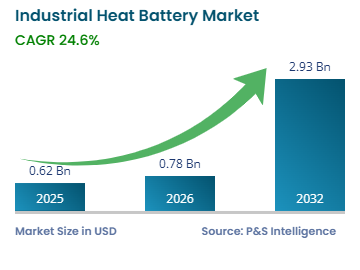
The global Industrial Heat Battery Market size was USD 0.62 billion in 2025 and is projected to reach USD 0.78 billion in 2026 and USD 2.93 billion by 2032, advancing at a CAGR of 24.6% from 2026 to 2032. Procurement decisions center on whether stored heat can meet a facility's operating schedule while allowing electricity purchases to move into affordable charging periods.
Continuous steam and process-heat requirements create a commercial opening for storage integrated with industrial heating equipment. Heat accounted for almost half of global final energy consumption and 37% of energy-related carbon dioxide emissions in 2024, according to the International Energy Agency's Renewables 2025 report. These totals describe the wider heat sector, providing demand context rather than a measure of heat-battery adoption.
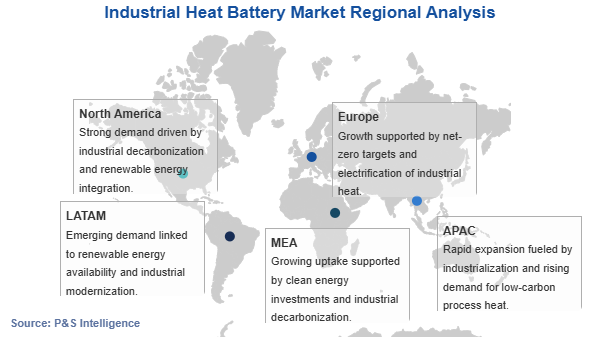
Europe held the largest global Industrial Heat Battery Market share, at 38.0% in 2025. Asia-Pacific is projected to record the fastest regional CAGR, at 28.0% from 2026 to 2032. European project development and Asian industrial heat requirements provide different routes to procurement, with delivery schedules, power access, and financing shaping the conversion of projects into commercial revenue.
Key Market Insights
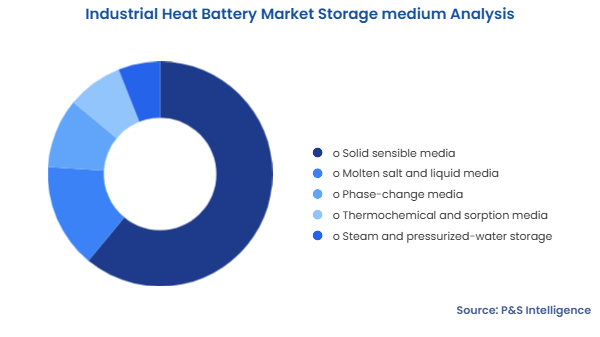
By storage medium, solid sensible media held 61.0% in 2025, while thermochemical and sorption media are projected to grow at a CAGR of 31.5% from 2026 to 2032.
By heat output temperature, medium-temperature (200°C to below 600°C) held 43.0% in 2025, while ultra-high-temperature (1,200°C and above) is projected to grow at a CAGR of 32.0% from 2026 to 2032.
By charging source, grid electricity held 46.0% in 2025, while co-located renewable electricity is projected to grow at a CAGR of 29.0% from 2026 to 2032.
By end-use industry, chemicals and refining held 27.0% in 2025, while cement, glass and ceramics are projected to grow at a CAGR of 30.0% from 2026 to 2032.
By business model, equipment sale with EPC integration held 52.0% in 2025, while heat-as-a-service or energy-service contract is projected to grow at a CAGR of 33.0% from 2026 to 2032.
By geography, Europe held 38.0% in 2025, while Asia-Pacific is projected to grow at a CAGR of 28.0% from 2026 to 2032.
Industrial Heat Battery Market Trends and Growth Drivers
Affordable Charging Windows for Continuous Process Heat
Access to affordable electricity during selected charging periods supports global Industrial Heat Battery Market growth by giving industrial buyers a way to separate power purchasing from heat delivery. Industrial heat demand is projected to increase 14% globally during 2025–2030, according to the International Energy Agency's Renewables 2025 report. The expanding requirement creates additional demand for heat supply, although only part is addressable by storage.
A buyer operating a continuous steam process can evaluate charging flexibility alongside the cost of replacing combustion heat. Storage is commercially useful when its charging rate, retained energy, and discharge capability fit the plant's load. The comparison must include electricity delivery charges and integration costs. More affordable power windows can strengthen procurement economics, but a plant with limited connection capacity may be unable to capture them.
Contracted Heat Supply and Project Financing
Financed heat delivery creates an opportunity for the global industrial heat battery industry among customers seeking an alternative to direct storage-asset procurement. Industrial energy supplied to the Big Stone City bioprocessing facility is covered by a long-term heat offtake agreement and project-level financing, according to POET's May 2026 commissioning release.
The arrangement connects equipment deployment with a contracted industrial customer. A heat buyer can assess the price, availability commitments, and operating responsibilities of the supplied energy instead of organizing every element of asset financing internally. Suppliers and project investors consequently need to demonstrate dependable delivery as well as technical storage performance.
Contract-based expansion depends on repeatable financing and credible operating obligations. A signed heat agreement provides a commercial structure, while equipment availability, power procurement, and contractual risk allocation determine whether a similar structure can be used at another site.
Direct Hot-Gas Delivery for Furnaces and Kilns
Direct hot-gas interfaces are shaping global industrial heat battery industry trends by extending system design toward furnaces, boilers, and kilns. The San Antonio system stores 20 MWh of heat and delivers it through a process-gas stream, according to Southwest Research Institute's March 2026 account.
Delivering heat through a process-gas stream gives engineers an interface to assess against existing equipment. Temperature stability, gas compatibility, flow control, and heat delivery rate become central selection criteria. A high storage temperature alone cannot establish suitability for a production process.
Further deployment depends on validating the complete interface under the customer's operating conditions. Suppliers able to connect storage discharge with usable process heat can address a wider set of applications, while projects requiring substantial furnace changes face a longer integration path.
Electricity Tariffs and Grid Connection Constraints
Electricity delivery costs and connection availability can restrain industrial heat-battery deployment even where the storage technology meets the required duty. Unfavorable electricity-to-gas price ratios, long grid connection lead times, and unclear policy frameworks have limited industrial heat electrification, according to the International Energy Agency's Renewables for Industry report.
A storage project needs sufficient power access during its intended charging hours. Network charges, contracted capacity, and the applicable industrial tariff can reduce the benefit of buying electricity when wholesale prices are low. Procurement economics also depend on the heat displaced and the cost of installing the equipment.
Industrial customers therefore need to evaluate the charging schedule against the actual power contract before committing to deployment. A connection delay can postpone commercial heat delivery, while an unsuitable tariff can weaken the case for replacing existing fuel-based supply. Accessible power and a workable delivered-energy cost remain conditions for project replication.
Solid sensible media held the largest share, at 61.0% in 2025. Commercial-scale deployment provides an operating precedent for this category. A thermal battery project with 5 GWh capacity began delivering industrial energy in South Dakota by May 2026, according to POET. Full operation remained planned for later in 2026. Initial delivery provides a deployment precedent without establishing equivalent performance across solid-media designs.
Thermochemical and sorption media are projected to grow fastest, at a CAGR of 31.5% from 2026 to 2032. Material qualification and reactor development provide a distinct pathway for these systems. Industrial process applications and pressure-dependent heat upgrading are under investigation at the German Aerospace Center. Commercial expansion will depend on translating reaction behavior into controllable heat delivery and durable equipment.
Heat output temperature
Medium-temperature (200°C to below 600°C), held the largest share, at 43.0% in 2025. Existing electric steam equipment provides an integration route within this band. Electric boilers can generate steam up to 350°C and pressures of around 70 bar, according to the International Energy Agency's Renewables for Industry report. Storage can complement such steam systems where charging flexibility improves the delivered-energy economics.
Ultra-high-temperature (1,200°C and above), is projected to grow fastest, at a CAGR of 32.0% from 2026 to 2032. Direct hot-gas delivery offers a development route into demanding furnace and kiln applications. The growth case requires verified discharge conditions at the process interface. Peak storage temperature, delivered gas temperature, and the customer's usable heat requirement must remain separate when assessing a project.
Charging source
Grid electricity held the largest share, at 46.0% in 2025. Variation in wholesale prices creates an incentive to examine flexible charging. Germany recorded 573 hours of negative wholesale electricity prices in 2025, compared with 457 in 2024, according to Bundesnetzagentur. The global Industrial Heat Battery Market analysis must distinguish that opportunity from the customer's all-in electricity bill, which also reflects network and contractual charges.
Co-located renewable electricity is projected to grow fastest, at a CAGR of 29.0% from 2026 to 2032. On-site generation can align charging with a dedicated power source and reduce reliance on continuously available grid electricity. Expansion depends on matching renewable output, storage capacity, and industrial heat demand without assuming that every renewable installation has a suitable industrial buyer.
End-use industry
Chemicals and refining held the largest share, at 27.0% in 2025. Steam integration offers a concrete use case for storage within this category. A planned heat battery at the Brunsbüttel chemical site is expected to supply 10% of its steam requirement, according to Covestro's January 2026 project update. The expected contribution is site-specific and remains dependent on commissioning.
Cement, glass and ceramics are projected to grow fastest, at a CAGR of 30.0% from 2026 to 2032. High-temperature fuel substitution creates a different engineering requirement from steam-network integration. The European Commission's industrial heat auction includes high-temperature applications, giving qualifying projects a potential funding route. Storage suppliers must still demonstrate suitable hot-gas output, process compatibility, and installation economics before that support can translate into equipment demand.
Business model
Equipment sale with EPC integration held the largest share, at 52.0% in 2025. Commercial-scale systems require coordinated equipment and site work. The 20 MWh San Antonio installation involved support-system design, utility integration, and construction oversight, according to Southwest Research Institute's March 2026 account. Those requirements explain the role of integrated delivery without treating demonstration capacity as equipment-sale revenue.
Heat-as-a-service or energy-service contract is projected to grow fastest, at a CAGR of 33.0% from 2026 to 2032. Project financing linked to long-term heat offtake offers customers a separate procurement route. The forward opportunity depends on dependable heat supply and financeable operating commitments. Suppliers using service contracts must manage equipment performance and power sourcing over the delivery period, while customers evaluate the supplied-heat terms against their production needs.
The complete segmentation hierarchy is as follows.:
Storage medium
Solid sensible media
Molten salt and liquid media
Phase-change media
Thermochemical and sorption media
Steam and pressurized-water storage
Heat output temperature
Low-temperature (below 200°C)
Medium-temperature (200°C to below 600°C)
High-temperature (600°C to below 1,200°C)
Ultra-high-temperature (1,200°C and above)
Charging source
Grid electricity
Co-located renewable electricity
Recovered industrial waste heat
Hybrid multi-source charging
End-use industry
Chemicals and refining
Food and beverage
Pulp, paper and textiles
Cement, glass and ceramics
Metals and mining
Other manufacturing
Business model
Equipment sale with EPC integration
Heat-as-a-service or energy-service contract
Retrofit module and controls package
Demonstration and pilot project
Drive strategic growth with comprehensive market analysis
Industrial Heat Battery Market Regional Analysis
Europe held the largest regional share, at 38.0% in 2025. Industrial heat funding offers a route for qualifying projects to address the cost of fuel substitution. The European Commission selected 65 projects for grant-agreement preparation under its Innovation Fund 2025 Heat Auction, according to the program's May 2026 results. Selection covers broader industrial heat technologies and does not mean that all projects use heat batteries or have signed grants.
Output-linked support can help a qualifying project connect public funding with delivered clean heat. For storage suppliers, that structure makes heat production and project execution commercially relevant alongside equipment specifications. European deployment can develop through repeat installations where buyers have suitable power access and industrial heating interfaces. The EU program supports this pathway within part of Europe, without measuring the entire regional opportunity. Grant signing, commissioning, and subsequent customer procurement will determine how much project development converts into sustained deployment.
Asia-Pacific is projected to record the fastest global Industrial Heat Battery Market growth, at a CAGR of 28.0% from 2026 to 2032. Expanding industrial heat requirements create a different demand setting from replacement-led projects. China and India together are expected to account for more than half of global industrial heat-demand growth during 2025–2030, according to the International Energy Agency's Renewables 2025 report. Their contribution supports regional demand context without establishing a region-wide heat-battery adoption rate.
Power sourcing is an important condition for accessing that demand. Steam electrification using captive renewable generators could cost around USD 50/MWh, compared with USD 70–100/MWh for grid-connected supply in the Chinese provinces examined by the International Energy Agency's Renewables for Industry report. These estimates are provincial scenarios for steam electrification, rather than regional heat-battery prices. Co-located power and storage could offer a procurement route where continuous industrial heat demand aligns with renewable supply. Replication will depend on accessible power arrangements, process integration, and customer financing. Growth could slow where factories cannot secure suitable charging capacity or commercially workable electricity terms.
Germany accounted for 26.0% of Europe's market in 2025. Renewable generation and industrial steam integration provide complementary conditions for project development. Renewables represented 58.8% of Germany's net electricity generation into the public network in 2025, according to Bundesnetzagentur. The figure excludes private industrial networks and does not measure renewable electricity contracted to heat batteries.
At Brunsbüttel, a planned industrial installation illustrates how storage can be evaluated against an existing chemical-site steam network. Commissioning of the 100 MWh heat battery was scheduled for the end of 2026 in Covestro's January project update. Deployment beyond the initial project will depend on proving the required steam delivery and maintaining workable power costs. Germany's position could strengthen if operating experience supports additional chemical-site installations. Connection delays, unsuitable tariffs, or commissioning slippage would weaken that replication pathway, even with a substantial renewable generation base.
India's Industrial Heat Battery Market is projected to grow at a CAGR of 31.0% from 2026 to 2032. An expanding renewable power base offers potential charging supply for industrial storage where buyers can access it. India’s renewable energy capacity reached a combined 222.73 GW as of July 31, 2026, driven by 164.59 GW of installed solar and 58.14 GW of wind power, according to the Ministry of New and Renewable Energy. Installed capacity does not establish the amount of electricity available to industrial heat-battery projects.
A facility able to connect suitable renewable supply with its steam or process-heat schedule can evaluate storage as part of an electrification investment. Customer access to power, the terms of renewable procurement, and the cost of site integration will shape that decision. Suppliers face a practical requirement to match equipment delivery with an affordable charging arrangement. India's growth trajectory can strengthen where financing and industrial power access allow repeat procurement. High delivered electricity costs or insufficient connection capacity would reduce the benefit of the expanding renewable fleet for individual heat buyers.
The global industrial heat battery industry is fragmented, with competing storage architectures and heat-delivery interfaces addressing different industrial requirements. Commercial solid-media installations coexist with less mature reaction-based approaches. Competition centers on the usable heat delivered to a customer's process, the charging arrangement, and the extent of site integration.
Suppliers delivering steam compete for integration with industrial heat networks, while systems delivering hot gas must meet furnace or kiln conditions. Providers offering heat and power face a further discharge-interface requirement. These differences limit the usefulness of comparing storage capacity alone. A buyer needs to evaluate temperature, delivery rate, controllability, and power access against the intended production duty.
Engineering and project delivery create barriers beyond the storage material. Utility integration, gas handling, controls, and commissioning require capabilities that connect the thermal system with existing operations. Equipment developers, integration providers, and project financiers consequently contribute different parts of the commercial offering. New entrants need a credible route from component performance to dependable industrial heat delivery.
Competition can evolve toward repeatable installations and financeable customer contracts as operating experience develops. Direct equipment procurement and contracted heat supply place different responsibilities on the customer and supplier, which changes how buyers compare offers. Providers with suitable process interfaces and workable power arrangements have a clearer basis for replication. Demonstration success remains a limited reference until the system meets the operating and commercial conditions of the next customer.
Key Players in the Industrial Heat Battery Market:
Rondo Energy Inc.
Antora Energy Inc.
Electrified Thermal Solutions Inc.
Brenmiller Energy Ltd.
Kraftblock GmbH
EnergyNest AS
Kyoto Group AS
MGA Thermal Pty Ltd
Caldera Heat Batteries Ltd.
Polar Night Energy Oy
Malta Inc.
Fourth Power Inc.
Industrial Heat Battery Market Developments
In May 2026, POET LLC announced commissioning of a 5 GWh thermal battery project at its Big Stone City, South Dakota facility, where energy delivery had begun. Full operation remained planned for later in 2026, distinguishing initial delivery from completion of the entire project.
In February 2026, Southwest Research Institute hosted the commissioning of a commercial-ready thermal battery at its San Antonio campus. The 20 MWh installation provides a full-scale setting for evaluating industrial heat delivery and process integration, with operating assessment continuing beyond the commissioning event.
In January 2026, Covestro AG held a groundbreaking for a 100 MWh industrial heat battery at its Brunsbüttel site in Germany. Commissioning was planned for the end of 2026, establishing a project milestone while leaving operating steam delivery dependent on completion.
Frequently Asked Questions About This Report
What was the global industrial heat battery market size in 2025?+
The global industrial heat battery market size was USD 0.62 billion in 2025.
Which region held the largest industrial heat battery market share?+
Europe held the largest global industrial heat battery market share, at 38.0% in 2025. Asia-Pacific is projected to record the fastest regional CAGR, at 28.0% from 2026 to 2032.
What limits industrial heat-battery deployment?+
Electricity delivery costs and connection availability can restrain industrial heat-battery deployment even where the storage technology meets the required duty.
Which storage medium held the largest share?+
Solid sensible media held the largest share, at 61.0% in 2025. Commercial-scale deployment provides an operating precedent for this category.
Want a report tailored exactly to your business need?
Leading companies across industries trust us to deliver data-driven insights and innovative solutions for their most critical decisions. From data-driven strategies to actionable insights, we empower the decision-makers who shape industries and define the future. From Fortune 500 companies to innovative startups, we are proud to partner with organisations that drive progress in their industries.
Client Testimonials
Working with P&S Intelligence and their team was an absolute pleasure – their awareness of timelines and commitment to value greatly contributed to our project's success. Eagerly anticipating future collaborations.
McKinsey & Company
India
Unmatched Standards
Our insights into the minutest levels of the markets, including the latest trends and competitive landscape, give you all the answers you need to take your business to new heights
Complete Data Security
We take a cautious approach to protecting your personal and confidential information. Trust is the strongest bond that connects us and our clients, and trust we build by complying with all international and domestic data protection and privacy laws