Industrial Edge AI Gateway Market Size & Share Analysis - Trends, Drivers, Competitive Landscape, and Forecasts (2026 - 2032)
This Report Provides In-Depth Analysis of the Industrial Edge AI Gateway Market Report Prepared by P&S Intelligence, Segmented by Component (Hardware, Software and Platforms, Services), Connectivity (Wired Ethernet and Fieldbus, Cellular (4G/5G), Wi-Fi and Short-range), AI Processor (CPU-based, GPU and SoC, NPU, ASIC and FPGA), End-Use Industry (Discrete Manufacturing, Process Industries, Energy and Utilities, Transportation and Logistics), and Geographical Outlook for the Period of 2021 to 2032
Explore the market potential with our data-driven report
Industrial Edge AI Gateway Market Overview
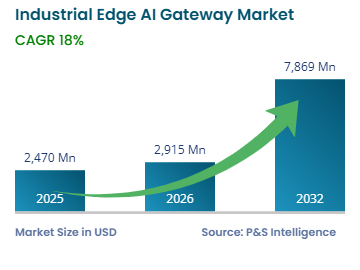
The industrial edge AI gateway market size reached USD 2,470.0 million in 2025 and is estimated at USD 2,915.0 million in 2026. Revenue is forecast to climb to USD 7,869.0 million by 2032, a CAGR of 18.0% from 2026 to 2032.
Most of that spending still buys rugged devices mounted beside machines, in cabinets, and at remote sites. The faster-growing value comes from what runs on them after installation, from model updates to security patches and fleet management, which turns the cost of a gateway into a multi-year commitment instead of a one-time equipment price.
AI use is highest among the large organizations that run industrial assets. In 2025, 20.0% of EU enterprises with 10 or more employees used AI technologies, up from 13.5% a year earlier, and the share among large enterprises reached 55.03%, Eurostat data shows. U.S. firms show the same size gradient. Overall business use ranged from 17% to 20% between December 2025 and May 2026, against 37% for firms with at least 250 employees, according to the Census Bureau's Business Trends and Outlook Survey. Because adoption is concentrated in large organizations, the first volume buyers of on-site inference hardware are likely to be large multi-site operators.
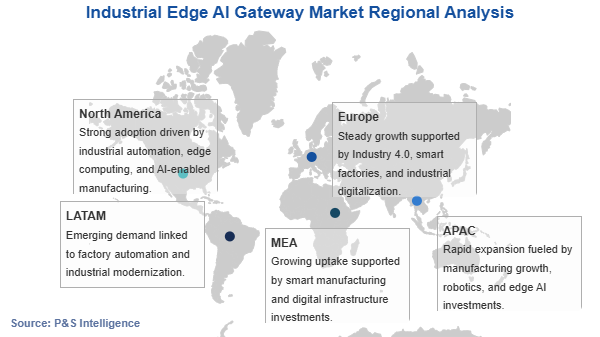
North America holds the largest industrial edge AI gateway market share at 36% in 2025. Asia-Pacific is the fastest-growing region, with a projected CAGR of 21.5% from 2026 to 2032, so the global market for industrial edge AI gateways is expected to tilt gradually toward Asian production bases as that growth gap compounds.
Key Market Insights
By component, hardware accounted for 77% of revenue in 2025, while software and platforms is projected to post the fastest CAGR of 24.0% from 2026 to 2032.
By connectivity, wired Ethernet and fieldbus held a 60% share in 2025, and cellular (4G/5G) links are expected to record the fastest CAGR of 24.5% from 2026 to 2032.
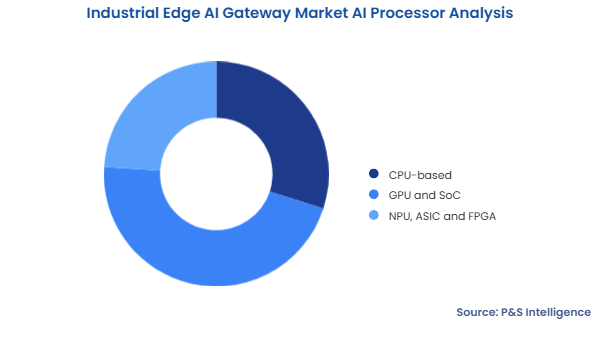
By AI processor, GPU and SoC designs captured 46% of 2025 revenue, whereas NPU, ASIC and FPGA designs are forecast to grow at the fastest CAGR of 26.0% from 2026 to 2032.
By end-use industry, discrete manufacturing represented a 35% share in 2025, and transportation and logistics is set to expand at the fastest CAGR of 21.0% from 2026 to 2032.
By geography, North America held a 36% share in 2025, and Asia-Pacific is projected to grow at the fastest CAGR of 21.5% from 2026 to 2032.
Industrial Edge AI Gateway Market Trends and Growth Drivers
AI Workloads Are Moving Into Production Processes
Industrial edge AI gateway market growth depends on AI leaving back-office tasks and entering the production process, and larger firms are already making that move. Among EU enterprises that used AI in 2025, 33.46% of large ones applied it to production processes compared with 19.02% of small ones, and 47.51% of large users deployed it for ICT security, Eurostat figures show.
Production use changes the hardware question. A model that inspects parts, predicts a bearing failure, or flags an intrusion has to return its result within the machine cycle. It may also be required to run on a plant network deliberately isolated from the internet. Sending every frame to a remote data center adds delay and exposes the control network, which makes a gateway beside the line the practical place for inference. Each production use case then becomes a device purchase, a site integration, and a multi-year software commitment. Gateway demand therefore follows production deployments more directly than headline AI adoption rates.
Grid Investment Opens a Utility Channel
Power networks give the industrial edge AI gateway industry a large opportunity outside the factory. Global grid investment rose by USD 45 billion in 2025 to nearly USD 450 billion and is projected to grow a further 17% in 2026, according to the International Energy Agency's World Energy Investment 2026 report. The same report estimates that digital technologies improving maintenance, asset lifetimes, and utilization could defer USD 1.8 trillion of grid investment globally to 2050. Part of the recent increase comes from inflation in transformers, cables, and overhead lines, not only from more delivered infrastructure.
The deferral estimate is where gateways earn their place. A utility that keeps a transformer or feeder in service longer needs condition data analyzed close to the asset, and inference at the substation turns raw sensor streams into maintenance decisions without backhauling every reading. Suppliers able to meet utility cybersecurity and lifecycle requirements gain access to a buyer group whose capital budgets are rising and under price pressure at the same time.
Safety Law Now Reaches Machine-Learning Functions
Among industrial edge AI gateway industry trends, the regulation of learning systems carries the firmest dates. The EU Machinery Regulation, which applies from January 20, 2027, lists safety components and embedded systems with fully or partially self-evolving behavior using machine-learning approaches in the part of its Annex I that requires third-party conformity assessment.
The rule separates two kinds of edge AI. A gateway running a fixed, validated model for inspection or condition monitoring stays outside that category, whereas a learning model that performs a safety function brings a notified body into the design cycle. Machine builders selling into Europe therefore have a reason to keep adaptive models away from safety functions, or to choose gateway platforms whose model versioning and audit records can support certification.
Cyber Rules Raise the Cost of Selling Gateways
Compliance cost is a direct brake on supply. Since September 11, 2026, the EU Cyber Resilience Act has required manufacturers of products with digital elements to send an early warning of an actively exploited vulnerability within 24 hours. A fuller notification must follow within 72 hours, and a final report within 14 days after a corrective measure is available. The duty covers products already on the market, and the Act's main provisions apply from December 11, 2027.
For gateway vendors, vulnerability handling becomes a standing operating expense. A supplier with a long tail of installed models must monitor, triage, and report on each one still in the field, and buyers can be expected to ask for evidence of that capability before approving a device. Suppliers with established security teams absorb the cost more easily, so the rule may narrow the range of smaller specialists that European buyers can choose from.
Industrial Edge AI Gateway Market Segmentation Analysis
Component
Hardware leads this industrial edge AI gateway market analysis, with 77% of revenue in 2025. In the most advanced deployments nearly every machine is connected, and each connection needs a physical device. The 100 benchmark 5G factories selected by China's Ministry of Industry and Information Technology report equipment connectivity above 97.7% and network coverage above 99.3%. At that density, the gateway count scales with the machine count and keeps hardware the largest cost line.
Software and platforms is projected to grow at a CAGR of 24.0% from 2026 to 2032. The EU Cyber Resilience Act requires manufacturers to set a support period for each product, generally at least five years, and to handle vulnerabilities effectively throughout it. Patching, model management, and remote fleet control thus become recurring deliverables that outlast the original hardware sale.
Connectivity
Wired Ethernet and fieldbus held 60% of 2025 revenue, because industrial machines already exchange data over wired networks at very large scale. PROFINET reached an installed base of 89.2 million nodes after 10.4 million were added in 2025, and PROFIBUS devices in service totaled 71 million, according to PROFIBUS & PROFINET International. A gateway that plugs into that base reads existing controller data without new radio planning, and that convenience keeps wired designs the default in brownfield plants.
Cellular (4G/5G) connectivity is expected to expand at a CAGR of 24.5% from 2026 to 2032. Pipelines, wind farms, rail corridors, and water networks lie outside plant cabling, and 5G networks covered 55% of the world's population in 2025, including 84% of people in high-income countries, International Telecommunication Union estimates show. Coverage in low-income countries was only 4%, a gap that limits the cellular case in those markets.
AI Processor
GPU and SoC designs held 46% of 2025 revenue, as large vision models need parallel compute that general-purpose processors cannot supply at line speed. A peer-reviewed benchmark published in Scientific Reports in March 2026 found CPU-only execution of large object detectors on an edge board impractical, with latency of several seconds per frame. GPU acceleration on an embedded module gave the strongest deployment path. None of the large-model configurations tested reached the 25 frames-per-second real-time target for a full video pipeline, which keeps demand for compute headroom high.
NPU, ASIC and FPGA designs are forecast to grow at a CAGR of 26.0% from 2026 to 2032. Sealed, fanless enclosures cap the power a gateway can dissipate. In a 2025 study in the journal Systems, NPU-based platforms matched or exceeded GPU throughput in many inference tasks while drawing 35% to 70% less power, a result measured on server hardware, not on gateways. For a DIN-rail unit with a fixed thermal limit, that gap helps determine how many camera streams or sensor models one box can carry.
End-Use Industry
Discrete manufacturing held 35% of 2025 revenue, anchored by the automated cells where machine vision and robot monitoring run. The operational stock of industrial robots reached 4,664,000 units in 2024, up 9% on the previous year, after 542,000 new installations, International Federation of Robotics statistics show. Each cell produces the vision, vibration, and torque data that gateways analyze, so the robot fleet supplies a large and growing pool of equipment to instrument.
Transportation and logistics is projected to grow at a CAGR of 21.0% from 2026 to 2032 as rail operators add AI analytics to stations and track. India's Ministry of Railways reports AI-based video analytics at 1,731 stations and an AI-enabled intrusion detection system operating over 141 route kilometers, with tenders awarded for another 981. In the EU, 32 projects in 11 Member States were selected in July 2025 for Connecting Europe Facility grants to install the European Rail Traffic Management System on trains and tracks, the European Commission announced.
The complete segmentation hierarchy is as follows:
Component
Hardware
Fanless Edge Gateways
DIN-rail Gateways
Edge AI Accelerator-equipped Gateways
Software and Platforms
Edge Orchestration Platforms
AI Model Runtime and Management
Services
Integration and Deployment
Managed Edge Services
Connectivity
Wired Ethernet and Fieldbus
Cellular (4G/5G)
4G LTE
5G
Wi-Fi and Short-range
AI Processor
CPU-based
GPU and SoC
NPU, ASIC and FPGA
End-Use Industry
Discrete Manufacturing
Process Industries
Chemicals
Oil and Gas
Food and Beverage
Pharmaceuticals
Energy and Utilities
Transportation and Logistics
Others
Drive strategic growth with comprehensive market analysis
Industrial Edge AI Gateway Market Geographical Analysis
North America held 36% of global revenue in 2025, the largest regional share, and its position comes from factories already built and running. The region's growth outlook of 15.5% a year from 2026 to 2032 depends on equipping that installed base more than on new plants. U.S. manufacturing construction spending ran at a seasonally adjusted annual rate of USD 169,795 million in July 2026, 21.2% below July 2025, Census Bureau data shows. With fewer greenfield sites breaking ground, gateway demand in the region is likely to come mainly from retrofitting existing lines and replacing older connected devices. The lead would narrow faster if factory construction keeps falling while Asian capacity additions continue.
Industrial edge AI gateway market growth is fastest in Asia-Pacific, which held 29% of 2025 revenue and is projected to expand at a CAGR of 21.5% from 2026 to 2032. Automation capacity is being installed there faster than anywhere else, and new lines can specify connectivity and inference at commissioning instead of adding them later. Asia accounted for 74% of the 542,000 industrial robots installed worldwide in 2024, against 16% for Europe and 9% for the Americas, International Federation of Robotics data shows. A sustained slowdown in regional robot installations or export-oriented factory investment would pull this growth rate down.
China accounted for 12.5% of global revenue in 2025, and state-directed network build-out gives its plants dense connectivity to build on. The country had 5.154 million 5G base stations at the end of July 2026, equal to 39.4% of all mobile base stations, and 2.993 billion mobile IoT terminal connections, Ministry of Industry and Information Technology figures show. Policy now targets the next layer. The State Council's August 2025 opinion on the AI Plus initiative sets a goal for next-generation intelligent terminals and agents to exceed 70% penetration by 2027 and 90% by 2030. If factories stop at connectivity projects without adding on-site inference, China's share would stall even as its networks keep expanding.
India is projected to be the fastest-growing country, with a CAGR of 26.0% from 2026 to 2032, and its demand comes from new electronics capacity rather than an established automation base. Electronics production rose from ₹1.90 lakh crore in 2014-15 to an estimated ₹13.11 lakh crore in 2025-26, according to the Ministry of Electronics and Information Technology. Telecom operators had installed 5.18 lakh 5G base transceiver stations by December 31, 2025, with 5G available in 99.9% of districts, the Department of Telecommunications reported. Growth at that pace depends on new plants building automated inspection in from launch. If output stays concentrated in manual final assembly, India's gateway demand would lag its production growth.
The regions and countries in scope are listed below.
North America
U.S.
Canada
Europe
Germany
U.K.
France
Italy
Rest of Europe
Asia-Pacific
China
India
Japan
South Korea
Taiwan
Australia
Rest of Asia-Pacific
Latin America
Mexico
Brazil
Rest of Latin America
Middle East and Africa
Saudi Arabia
U.A.E.
South Africa
Rest of Middle East and Africa
Industrial Edge AI Gateway Market Competitive Landscape
The industrial edge AI gateway industry is fragmented. A working deployment combines a rugged computer, an AI accelerator, industrial protocols, wired or cellular connectivity, and lifecycle software. Different supplier groups control each of those layers, so no single type of company sets terms across the value chain.
Diversified automation groups sell gateways as extensions of their controller and software platforms, which gives them access to installed customers but ties their devices to their own engineering tools. Industrial computing specialists build accelerator-equipped units on processors from several chip suppliers and compete on form factor, temperature rating, and long product availability. Networking and enterprise IT vendors enter from the plant network and the data center, bundling edge compute with switching, routing, and security. Connectivity specialists concentrate on cellular routers and device management for remote assets. Beneath all of them, a small number of accelerator designers supply the compute modules that many hardware makers build on, which gives those designers influence over product cycles without direct control of the gateway sale.
Entry barriers are rising mainly in certification and support. Component security certification to IEC 62443-4-2, multi-year support commitments, and vulnerability reporting duties favor suppliers with established engineering and security teams. At the same time, hardware makers are extending into model deployment and fleet-management software, which moves competition toward lifecycle platforms.
For buyers, fragmentation keeps hardware pricing competitive but raises integration risk. Plants that standardize on one software layer across several hardware suppliers keep negotiating power, while those that buy a single vendor's full stack gain simpler support at the cost of switching flexibility.
Key Players in the Industrial Edge AI Gateway Market:
Siemens AG
Advantech Co. Ltd.
Moxa Inc.
Cisco Systems Inc.
Dell Technologies Inc.
Hewlett Packard Enterprise Company
Schneider Electric SE
Lantronix Inc.
Teltonika Networks (UAB)
ADLINK Technology Inc.
Kontron AG
NVIDIA Corporation
Eurotech S.p.A.
Digi International Inc.
Industrial Edge AI Gateway Market Developments
In September 2026, Advantech extended its edge AI software architecture and container catalog to processor platforms from three chip vendors, covering x86 and Arm designs for its edge computers. The move widens processor choice for its customers but does not show a change in buyer preference.
In June 2026, Schneider Electric signed a definitive agreement to acquire an industrial data and AI software company for USD 3.1 billion in cash. The target's 2025 revenue exceeded USD 170 million. Pending completion, the deal would add a plant data layer to the group's software business.
In April 2026, Siemens made its industrial AI software suite, which runs on its edge computing platform and manages models across sites, generally available alongside a decentralized SCADA application. The release adds a vendor-supported route to scale AI models across plants but proves no adoption level.
In January 2026, Digi International acquired an edge application infrastructure company for USD 50 million in cash, adding a subscription business with about USD 20 million in annual recurring revenue. The purchase raises the recurring software share of its IoT revenue base.
In January 2026, NVIDIA announced an industrial edge AI platform combining high-performance AI computing, enterprise software support, and functional safety, with availability scheduled for later that month. The launch gives gateway builders a safety-oriented compute option, although announced availability does not confirm shipments.
Frequently Asked Questions About This Report
What is the size of the industrial edge AI gateway market?+
The industrial edge AI gateway market size reached USD 2,470.0 million in 2025 and is estimated at USD 2,915.0 million in 2026.
What is driving demand for industrial edge AI gateways?+
Industrial edge AI gateway market growth depends on AI leaving back-office tasks and entering the production process, and larger firms are already making that move.
Which component segment leads the market?+
Hardware leads this industrial edge AI gateway market analysis, with 77% of revenue in 2025. In the most advanced deployments nearly every machine is connected, and each connection needs a physical device.
Which region holds the largest share?+
North America held 36% of global revenue in 2025, the largest regional share, and its position comes from factories already built and running.
Which region is growing fastest?+
Industrial edge AI gateway market growth is fastest in Asia-Pacific, which held 29% of 2025 revenue and is projected to expand at a CAGR of 21.5% from 2026 to 2032.
Which country is expected to grow fastest?+
India is projected to be the fastest-growing country, with a CAGR of 26.0% from 2026 to 2032, and its demand comes from new electronics capacity rather than an established automation base.
How competitive is the industrial edge AI gateway industry?+
The industrial edge AI gateway industry is fragmented. A working deployment combines a rugged computer, an AI accelerator, industrial protocols, wired or cellular connectivity, and lifecycle software.
Want a report tailored exactly to your business need?
Leading companies across industries trust us to deliver data-driven insights and innovative solutions for their most critical decisions. From data-driven strategies to actionable insights, we empower the decision-makers who shape industries and define the future. From Fortune 500 companies to innovative startups, we are proud to partner with organisations that drive progress in their industries.
Client Testimonials
Working with P&S Intelligence and their team was an absolute pleasure – their awareness of timelines and commitment to value greatly contributed to our project's success. Eagerly anticipating future collaborations.
McKinsey & Company
India
Unmatched Standards
Our insights into the minutest levels of the markets, including the latest trends and competitive landscape, give you all the answers you need to take your business to new heights
Complete Data Security
We take a cautious approach to protecting your personal and confidential information. Trust is the strongest bond that connects us and our clients, and trust we build by complying with all international and domestic data protection and privacy laws