Industrial Air Cooler Market Size & Share Analysis - Emerging Trends, Growth Opportunities, Competitive Landscape, and Forecasts (2025 - 2032)
This Report Provides In-Depth Analysis of the Industrial Air Cooler Market Report Prepared by P&S Intelligence, Segmented by Type (Direct, Indirect, Two-Stage), Application (Manufacturing Plants, Warehouses & Distribution Centers, Commercial Buildings, Power Plants, Agricultural Facilities), Capacity (Below 1, cfm, 1,-25, cfm, 25,-5, cfm, Above 5, cfm), and Geographical Outlook for the Period of 2019 to 2032
Explore the market potential with our data-driven report
Industrial Air Cooler Market Overview
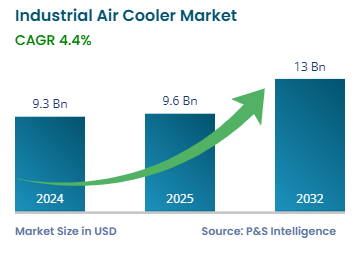
The global industrial air cooler market size was USD 9.3 billion in 2024, which is predicted to reach USD 13.0 billion by 2032, growing at a CAGR of 4.4% during 2025–2032.
The market growth is primarily driven by the increasing demand for energy-efficient cooling solutions across manufacturing facilities, rising awareness about environmental sustainability, and stringent regulations limiting the use of chemical refrigerants in industrial cooling systems.
Industrial air coolers are gaining significant traction as cost-effective alternatives to traditional air conditioning systems, particularly in regions with hot and dry climates. These systems consume approximately 75% less energy compared to conventional refrigeration-based cooling systems while providing effective temperature control for large industrial spaces. The technology's ability to maintain optimal working conditions while reducing operational costs has made it increasingly attractive for industries seeking to minimize their carbon footprint and comply with environmental regulations.
The manufacturing sector's rapid expansion in emerging economies, coupled with growing investments in warehouse infrastructure for e-commerce operations, has created substantial demand for industrial cooling solutions.
Industrial Air Cooler Market Growth Factors
Technological Advancements and Smart Cooling Solutions Is a Key Trend
The integration of IoT-enabled air coolers allows remote operation, real-time monitoring, and predictive maintenance, improving operational control and uptime.
Smart cooling systems use sensors to adjust fan speed and water flow based on temperature and humidity, ensuring optimal performance and energy efficiency.
A World Bank study highlights a potential USD 1.6-trillion investment opportunity by 2040 in energy-efficient cooling technologies across India, encompassing innovative alternatives that align with evaporative or smart cooling—underscoring the scale of possible mobilization.
The deployment of AI-based algorithms in cooling units enables automatic adjustments to varying environmental conditions, reducing manual intervention.
Advanced control panels with touchscreen interfaces and mobile app connectivity offer enhanced user convenience and system diagnostics.
Hybrid air coolers, which combine evaporative and mechanical cooling technologies, are gaining traction due to their adaptability across diverse climate zones.
The government of the Indian state Madhya Pradesh has struck a strategic agreement with Submer Technologies (Spain) to develop AI‑ready, energy‑efficient data centers.
The partnership promises up to 45% energy savings and 90% water conservation via advanced liquid cooling infrastructure—demonstrating investments in smart, efficient cooling at a state level.
Variable-frequency drives (VFDs) in motorized fans allow dynamic control of airflow, reducing power consumption during low-load conditions.
Manufacturers are focusing on low-noise, eco-friendly models that comply with global energy efficiency and emission standards.
TVA EnergyRight provides USD 100 per horsepower, while DCSEU offers USD 150 per horsepower for 2–15 hp units, with custom incentives for larger capacities.
These utility-driven programs reflect strong public policy support for low-energy technologies.
Rising Energy Costs and Sustainability Initiatives Are Driving Market Expansion
Escalating global electricity prices are encouraging industries to shift to low-energy cooling alternatives, to cut operational expenses.
Industrial air coolers consume significantly less power than conventional air conditioning systems.
Through 2032, U.S. taxpayers can claim credits of up to USD 3,200 for qualified residential energy-efficient improvements, including HVAC upgrades and heat pumps.
These incentives help promote efficient cooling technology adoption them a preferred solution for cost-conscious enterprises.
Increasing adoption of evaporative cooling systems, which use water instead of refrigerants, aligns with eco-friendly practices and reduces carbon footprint.
Cornell University’s lake-source cooling system (a type of district cooling) was established at a cost of USD 55–60 million, delivering sustainable campus-wide cooling.
Governments and regulatory bodies are introducing policies and incentives promoting energy-efficient equipment across industrial applications.
The Weatherization Assistance Program (WAP) offers federally funded services to reduce energy costs through efficiency improvements.
On average, participating households save over USD 372 per year.
Though focused on residences, such programs support a broader culture of efficient cooling.
Sustainability-focused industries are incorporating green technologies like air coolers to meet their carbon neutrality and ESG compliance goals.
The use of solar-powered and hybrid cooling systems is rising in regions with high sunlight exposure, contributing to reduced reliance on fossil fuels.
In India, GIFT City (Gujarat) has implemented a district cooling system with an approximately 10,000-TR capacity, upgradeable to 50,000 TR.
Industrial Air Cooler Market Segmentation Analysis
Type Analysis
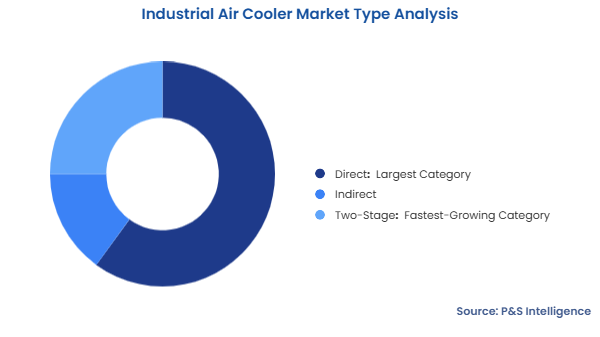
The direct evaporative coolers category held the largest share in the industrial air cooler market in 2024, of 60%, primarily due to their simplicity, cost-effectiveness, and proven performance in hot, dry climates. These systems operate by drawing warm air through water-saturated cooling pads, where evaporation naturally reduces air temperature by 15–40 °F, depending on ambient conditions. The widespread adoption of direct evaporative coolers stems from their minimal maintenance requirements, absence of compressors or refrigerants, and ability to provide 100% fresh air ventilation while cooling, making them ideal for industrial applications requiring high air change rates for worker health and safety.
The two-stage evaporative coolers category is expected to witness the highest CAGR, during 2025–2032, driven by their ability to achieve lower temperatures and operate effectively in moderately humid conditions where single-stage systems lose efficiency. These advanced systems combine indirect and direct cooling stages, pre-cooling incoming air through a heat exchanger before passing it through traditional evaporative media. This dual-stage approach enables temperature reductions of up to 30% greater than direct systems alone, expanding the geographic and climatic applicability of evaporative cooling technology to regions previously considered unsuitable for this cooling method.
These types are covered:
Direct (Largest Category)
Indirect
Two-Stage (Fastest-Growing Category)
Application Analysis
The manufacturing plants category dominated the industrial air cooler market in 2024 with 35% share. This is due to the critical need for temperature control in production environments where heat-generating equipment and processes create challenging thermal conditions. Manufacturing facilities, particularly those in metalworking, plastics processing, and textile production, generate substantial process heat that must be effectively managed to maintain product quality, equipment reliability, and worker productivity.
Industrial air coolers provide targeted cooling zones around workstations and equipment while maintaining the high ventilation rates necessary to remove airborne contaminants and process emissions. As per studies, the global GVA of the manufacturing and industrial sector stood at more than USD 15 trillion in 2022.
Warehouses & distribution centers will have the highest CAGR during the forecast period, due to increasing logistics activity, e-commerce growth, and stringent worker safety regulations. These facilities require consistent temperature control to protect both workers and temperature-sensitive goods. Industrial air coolers offer energy-efficient, scalable solutions for large, open spaces where traditional HVAC systems may be cost-prohibitive. In hot climates or during peak summer months, they help maintain operational efficiency and prevent equipment overheating.
Additionally, sustainability goals are pushing companies to adopt eco-friendly cooling technologies, further boosting demand for high-performance, low-energy air cooling systems in industrial environments. As per the International Trade Administration, B2C e-commerce order value will reach USD 5.5 trillion by 2027 globally.
These applications are covered:
Manufacturing Plants (Largest Category)
Warehouses & Distribution Centers (Fastest-Growing Category)
Commercial Buildings
Power Plants
Agricultural Facilities
Others
Capacity Analysis
The 10,000–25,000 cfm capacity category dominated the market in 2024 with 45% share, representing the sweet spot for industrial applications that require substantial cooling coverage without excessive capital investment. This capacity range effectively serves mod-sized-to-large industrial spaces ranging from 5,000 to 15,000 square feet, providing adequate air circulation and temperature reduction for most manufacturing and warehouse applications. The popularity of this category stems from its versatility in addressing diverse cooling needs while offering favorable economics in terms of initial investment, operating costs, and maintenance requirements.
The above 50,000 cfm category is projected to grow at the highest CAGR, during 2025–2032, driven by the construction of mega-warehouses and large-scale manufacturing facilities requiring comprehensive cooling solutions. These high-capacity systems are increasingly deployed in facilities exceeding 100,000 square feet, where multiple units work in concert to maintain uniform temperatures across vast operational areas. The growth in this category reflects the trend toward larger, more consolidated industrial facilities that benefit from economies of scale in both operations and cooling infrastructure.
These capacities are covered:
Below 10,000 cfm
10,000–25,000 cfm (Largest Category)
25,000–50,000 cfm
Above 50,000 cfm (Fastest-Growing Category)
Drive strategic growth with comprehensive market analysis
Industrial Air Cooler Market Regional Outlook
Asia-Pacific Industrial Air Cooler Market Share
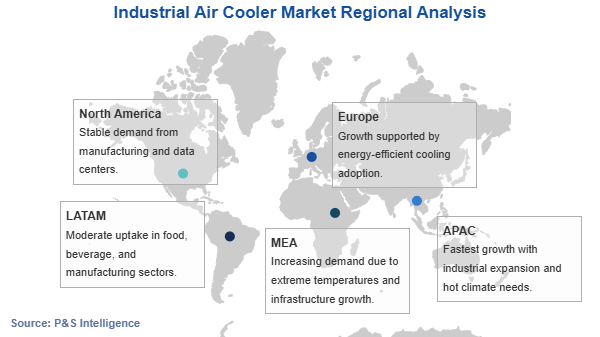
Asia-Pacific dominated the global industrial air cooler market in 2024, accounting for 40% of the global share. This is ascribed to the rapid industrialization, favorable climatic conditions, and the region's position as the global manufacturing hub. The region's hot and dry climate zones, particularly in India, parts of China, and Southeast Asia, create ideal conditions for evaporative cooling technology, which performs optimally in low-humidity environments. The massive expansion of manufacturing capacity across the region, combined with increasing awareness of energy conservation and environmental sustainability, has positioned Asia-Pacific as the largest and most dynamic market for industrial cooling solutions.
India Industrial Air Cooler Market Share
India, the fastest-growing country market within Asia-Pacific, has witnessed substantial growth in industrial cooling demand, supported by government initiatives such as Make in India and the expansion of manufacturing capacity across multiple sectors. In April 2025, the Manufacturing Purchasing Managers' Index (PMI) in India stood at 58.2, indicating robust industrial activity that drives demand for cooling solutions. The country's hot and dry climate, particularly in industrial hubs like Gujarat, Maharashtra, and Tamil Nadu, creates optimal conditions for evaporative cooling technology, which can reduce temperatures by up to 40°F while consuming minimal electricity compared to conventional air conditioning systems.
China Industrial Air Cooler Market Share
China's position as the world's factory continues to drive significant demand for industrial air coolers, particularly in the southern manufacturing regions where high temperatures and humidity challenge traditional cooling approaches. The country's focus on energy efficiency and environmental protection, combined with stringent regulations on industrial energy consumption, has accelerated the adoption of evaporative cooling technology in factories producing electronics, textiles, and consumer goods. Chinese manufacturers have also emerged as major suppliers of industrial air-cooling equipment, leveraging economies of scale and technological innovation to offer competitive products for both domestic and export markets.
North America Industrial Air Cooler Market Value
North America is experiencing the fastest regional growth, with a CAGR of approx. 5.0% during 2025–2032, This growth is primarily driven by the rising demand for energy-efficient and environmentally sustainable cooling solutions across various industrial sectors, including manufacturing, warehousing, food processing, and data centers. Increasing awareness about climate change and carbon emissions is pushing industries in the U.S. and Canada to adopt evaporative and hybrid cooling technologies that consume significantly less electricity compared to conventional air conditioning systems.
Additionally, government incentives promoting green building infrastructure and the integration of smart energy management systems are further accelerating the adoption of industrial air coolers in the region. The strong focus on ESG (Environmental, Social, and Governance) compliance among large enterprises and the expanding presence of temperature-sensitive industries—such as pharmaceuticals and electronics—are also contributing to the region’s robust market expansion.
The regions and countries analyzed in this report are:
North America (Fastest-Growing Regional Market)
U.S. (Larger Country Market)
Canada (Faster-Growing Country Market)
Europe
Germany (Largest Country Market)
U.K. (Fastest-Growing Country Market)
France
Italy
Spain
Rest of Europe
Asia-Pacific (Largest Regional Market)
Japan
China (Largest Country Market)
India (Fastest-Growing Country Market)
South Korea
Australia
Rest of APAC
Latin America
Brazil (Largest Country Market)
Mexico (Fastest-Growing Country Market)
Rest of LATAM
Middle East and Africa
Saudi Arabia (Largest Country Market)
South Africa
U.A.E. (Fastest-Growing Country Market)
Rest of MEA
Industrial Air Cooler Market Share Analysis
The global industrial air cooler market exhibits a fragmented competitive landscape characterized by the presence of numerous regional manufacturers alongside established international players. The market structure reflects the technology's relatively simple design and manufacturing requirements, which have enabled local companies in various regions to develop competitive products tailored to specific climatic conditions and industrial applications. This fragmentation has intensified competition, driving innovation in areas such as cooling pad materials, water distribution systems, and control technologies while keeping prices competitive for end users.
Regional manufacturers, particularly those based in Asia-Pacific and the Middle East, have gained substantial market presence by offering cost-effective solutions optimized for local climate conditions and industrial requirements. These companies leverage their understanding of regional market dynamics, established distribution networks, and ability to provide rapid after-sales support to compete effectively against larger international brands.
Leading companies in the market maintain their competitive positions through continuous product innovation, particularly in developing hybrid cooling systems that combine evaporative and refrigeration technologies for enhanced performance in varying humidity conditions. Market leaders are investing in research and development to improve cooling pad efficiency, reduce water consumption, and integrate IoT-enabled monitoring and control systems that allow remote management of multiple cooling units across large industrial facilities. Strategic partnerships with industrial facility developers and engineering, procurement, and construction (EPC) contractors have become crucial for securing large-scale project orders.
Key Industrial Air Cooler Companies:
Atlas Copco AB
Ingersoll Rand Inc.
Kaeser Kompressoren SE
Sullair LLC
Gardner Denver Holdings Inc.
Siemens Energy AG
Bauer Kompressoren GmbH
Doosan Portable Power
ELGi Equipments Ltd.
Quincy Compressor LLC
Kobe Steel Ltd.
Hanwha Power Systems
BOGE Kompressoren Otto Boge GmbH & Co. KG
Aerzen Maschinenfabrik GmbH
Mitsubishi Heavy Industries Ltd.
Industrial Air Cooler Market News
In August 2025, Seeley International Pty. Ltd. showcased its Breezair and Climate Wizard lines at HVACR World / BIG5 Dubai. This advanced adiabatic cooling technology delivers energy savings and sustainability—even under extreme environmental conditions.
In July 2025, Symphony Limited launched the HiFlo 27 Advantage for compact, energy-efficient cooling, low power consumption, and eco-friendly design.
In February 2025, SPX Cooling Tech LLC unveiled the Marley OlympusV Adiabatic Fluid Coolers, a new series combining energy-efficient water use with operational flexibility across industrial, commercial HVAC, and data center cooling applications.
In January 2025, Baltimore Aircoil Company launched the TrilliumSeries Dry Cooler, expanding its product portfolio in energy-efficient coolers.
In November 2024, Kelvion Holding GmbH officially launched the GB 790, a high-efficiency cooler designed for use with natural refrigerants such as COâ‚‚, ammonia, and propane. The product is engineered to deliver appreciable energy performance and operational efficiency in data centers, heat pumps, food processing, and industrial refrigeration.
Want a report tailored exactly to your business need?
Leading companies across industries trust us to deliver data-driven insights and innovative solutions for their most critical decisions. From data-driven strategies to actionable insights, we empower the decision-makers who shape industries and define the future. From Fortune 500 companies to innovative startups, we are proud to partner with organisations that drive progress in their industries.
Client Testimonials
Working with P&S Intelligence and their team was an absolute pleasure – their awareness of timelines and commitment to value greatly contributed to our project's success. Eagerly anticipating future collaborations.
McKinsey & Company
India
Unmatched Standards
Our insights into the minutest levels of the markets, including the latest trends and competitive landscape, give you all the answers you need to take your business to new heights
Complete Data Security
We take a cautious approach to protecting your personal and confidential information. Trust is the strongest bond that connects us and our clients, and trust we build by complying with all international and domestic data protection and privacy laws