This Report Provides In-Depth Analysis of the Indoor 5G Market Report Prepared by P&S Intelligence, Segmented by Component (Infrastructure & Solutions, Services), Deployment Environment (Commercial Buildings, Industrial Facilities, Public Venues, Institutional Buildings), Organization Size (Large Enterprises, Small and Medium Enterprises), and Geographical Outlook for the Period of 2021 to 2032
Explore the market potential with our data-driven report
Indoor 5G Market Key Insights
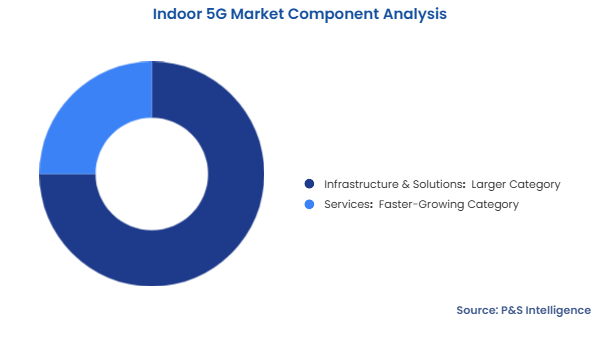
Infrastructure & solutions are the larger component, holding a market share of 75%, due to enterprises requiring reliable indoor network coverage and robust connectivity.
Services are the faster-growing component, registering a CAGR of approximately 21.0%, as organisations increasingly adopt professional deployment, integration, and managed services.
Commercial Buildings is the largest deployment environment, holding a market share of 45%, driven by high device density and multi-floor enterprise campuses.
Industrial Facilities is the fastest-growing deployment environment, registering a CAGR of approximately 21.1%, because smart factories and IoT-enabled operations demand low-latency connectivity.
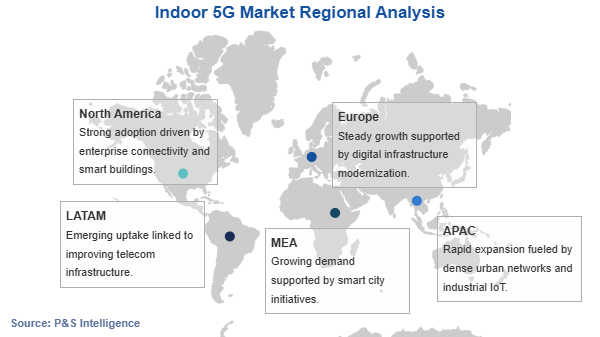
North America holds the largest regional share of 40%, supported by mature telecom infrastructure, high enterprise IT investment, and early private network adoption.
Indoor 5G Market Future Outlook
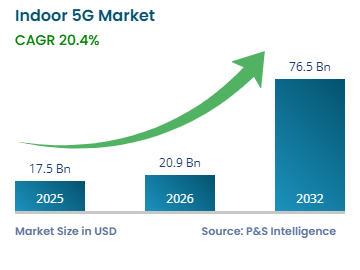
The indoor 5G market size was USD 17.5 billion for 2025, and it will grow by 20.4% during 2026–2032, to reach USD 76.5 billion by 2032.
The market is expanding because businesses increasingly require highly reliable wireless networks to operate a growing number of smart devices within commercial buildings. Enterprises also demand low-latency connectivity to support real-time applications such as industrial automation, smart building management, and connected workplace systems. According to Ericsson, over 80% of global mobile data traffic is consumed indoors, highlighting the critical importance of robust in-building connectivity. As the number of enterprises' IoT devices continues to rise, organisations are actively upgrading to indoor 5G networks to ensure stable connectivity and consistent operational performance in complex indoor environments.
Indoor 5G Market Trends and Drivers
Rising Adoption of Private and Enterprise 5G Networks Is Major Trend
Enterprise organisations increasingly utilise private indoor 5G networks to meet escalating global bandwidth demands. Global 5G subscriptions reached approximately 3 billion in 2025, according to the International Telecommunication Union, reflecting the broader adoption of next-generation connectivity worldwide. These modern network architectures provide ultra-low latency connections to support complex enterprise IoT ecosystems. Consequently, technology vendors actively develop integrated solutions combining specialised small cells and distributed antenna systems, enabling enterprises to deploy high-performance indoor networks across hospitals, corporate campuses, and smart manufacturing facilities. According to the International Federation of Robotics, global industrial robot installations reached 542,000 units in 2024, reflecting increased adoption of automation in manufacturing environments, which is driving demand for reliable, high-capacity connectivity.
Need for Faster and More Reliable Indoor Connectivity Drives Market
Organisations generate massive volumes of data, which increasingly strain legacy network infrastructure across commercial and industrial environments. This pressure continues to grow as enterprises rely on cloud computing, real-time analytics, and high-definition communication tools for daily operations. Mobile networks carried approximately 200 exabytes of data traffic per month in 2025, according to Ericsson, reflecting the rapid escalation in overall global data consumption. As data-intensive applications expand across enterprise environments, organisations increasingly adopt indoor 5G networks to ensure low latency, high bandwidth, and reliable connectivity for uninterrupted digital operations.
High Deployment Costs and Complex Integration Challenges
High equipment and complex installation costs significantly hinder the widespread implementation of indoor 5G networks. Integrating these advanced systems into existing legacy infrastructure requires substantial time and specialised effort. Consequently, small businesses often hesitate to adopt this modern technology due to limited budgets and operational constraints. Ultimately, organisations strongly delay full-scale deployments until they confirm both operational feasibility and financial returns.
Expansion of Smart Buildings and Industrial Automation
Advanced 5G technology provides reliable connectivity to support intelligent workplaces and highly automated industrial campuses across multiple industries. Organisations increasingly deploy indoor 5G networks to operate connected devices, enable AI-driven controls, and perform real-time monitoring in complex commercial and manufacturing environments. As the number of connected enterprise devices continues to grow, the demand for stable and high-capacity indoor connectivity also increases. According to Ericsson, global cellular IoT connections reached approximately 4.5 billion by the end of 2025, highlighting the rapid adoption of connected technologies across industries. As enterprises continue to modernise legacy infrastructure, indoor 5G creates significant opportunities to support next-generation automation and smart building applications.
Indoor 5G Market Segmentation Analysis
Component Analysis
Infrastructure & solutions are the larger category, holding a market share of 75%, due to the growing demand for reliable indoor wireless connectivity across enterprise environments. Organisations increasingly deploy advanced small cells, distributed antenna systems, and radio access network infrastructure to support high-volume data usage and ensure consistent network performance inside complex commercial buildings. The rising number of connected users and devices continues to increase pressure on existing wireless systems. According to the International Telecommunication Union, active global mobile-broadband subscriptions reached approximately 7.4 billion in 2024, reflecting the rapid expansion of overall digital connectivity worldwide. As data consumption continues to grow, enterprises increasingly invest in modern indoor network infrastructure to maintain stable and high-speed connectivity.
Services are the faster-growing category, registering a CAGR of approximately 21.0%, due to the increasing adoption of professional deployment, integration, and managed services. Enterprises upgrading their networks rely on external expertise to plan, install, optimise, and maintain systems. The need for network reliability and performance fuels continued growth in these service offerings.
The components analysed in this report are:
Infrastructure & Solutions (Larger Category)
Distributed Antenna Systems
Small Cells
Radio Access Network Equipment
Core Network Integration
Network Management and Optimisation Platforms
Services (Faster-Growing Category)
Network Planning and Design
Deployment and Installation
Integration and Testing
Managed Services and Maintenance
Network Optimisation and Support
Deployment Environment Analysis
Commercial buildings are the largest category, holding a market share of 45%, due to the high number of offices, retail stores, and campus environments that create the strongest demand for indoor 5G networks. These spaces typically host large numbers of users and devices simultaneously, requiring seamless connectivity and making them the primary target for indoor 5G deployment. According to Ericsson, global broadband IoT connections reached approximately 2.6 billion in 2025.
Industrial facilities represent the fastest-growing category, due to the rapid adoption of smart factory technologies and industrial IoT solutions across manufacturing industries. Large production facilities increasingly require ultra-low latency and high-speed connectivity to support automated production systems, machine-to-machine communication, and real-time monitoring of industrial operations. As manufacturers continue to integrate connected devices into production environments, the demand for reliable indoor 5G connectivity continues to grow significantly.
The global IoT in manufacturing market was valued at USD 87.9 billion in 2024 and is projected to reach USD 194.9 billion by 2030, highlighting the rapid expansion of connected industrial devices worldwide. As industrial automation continues to accelerate, enterprises increasingly deploy indoor 5G networks to ensure stable connectivity and efficient production performance.
The deployment environments analysed in this report are:
Commercial Buildings (Largest Category)
Industrial Facilities (Fastest-Growing Category)
Public Venues
Institutional Buildings
Organisation Size Analysis
Large enterprise organisations are the largest category, holding a dominant share of global indoor 5G deployments, because they operate expansive multi-storied commercial facilities with dense internal wireless environments that demand continuous connectivity for thousands of smart devices simultaneously. Global cellular IoT connections reached 4 billion by the end of 2024, highlighting the scale of enterprise network demand according to Ericsson. Consequently, these companies invest substantially in specialised physical infrastructure to guarantee seamless network performance. In addition to hardware, they procure professional integration services to deploy advanced indoor 5G systems. These strategic infrastructure investments directly enable enterprises to execute critical daily operations across highly complex corporate environments.
Small and medium enterprises are the fastest-growing category, registering a CAGR of approximately 20.7%, because they are increasingly digitising operations and adopting smart tools. Rising IoT usage, cloud adoption, and the need for reliable internal networks drive this growth, as SMEs invest in compact, cost-effective indoor 5G solutions.
The organisation sizes analysed in this report are:
Large Enterprises (Larger Category)
Small and Medium Enterprises (Faster-Growing Category)
Drive strategic growth with comprehensive market analysis
Indoor 5G Market Regional Outlook
North America Indoor 5G Market Analysis
North America has the largest market share, of 40%, due to its superior telecommunications infrastructure, high levels of business IT investment, and well-established regulatory framework. These factors create an ideal environment for deploying private indoor 5G networks. Demand is further fuelled by major service providers and early enterprise adoption of private wireless systems. Businesses increasingly seek reliable networks with low latency capable of supporting high device densities across office buildings, campus locations, and industrial sites.
U.S. Indoor 5G Market Analysis
The United States holds the largest share of the indoor 5G market due to its advanced telecommunications infrastructure and strong enterprise technology investments. Large organisations across the country increasingly deploy private 5G networks in corporate offices, university campuses, and healthcare facilities to ensure reliable indoor connectivity. According to the CTIA, wireless data traffic in the United States reached approximately 130 trillion megabytes in 2024, highlighting the extremely high demand for high-capacity network infrastructure.
Furthermore, 5G networks covered more than 330 million Americans in 2024, according to CTIA, reflecting the extensive nationwide availability of 5G infrastructure. As data usage and digital services continue to expand rapidly, enterprises across the country increasingly invest in advanced indoor 5G infrastructure to maintain stable and high-speed connectivity.
Canada Indoor 5G Market Analysis
The Canadian indoor 5G market continues to expand due to the growing adoption of digital technologies across enterprise and commercial sectors. Organisations increasingly require reliable indoor connectivity to support smart building systems, automated workflows, and cloud-based operations. As connectivity infrastructure remains highly developed across the country, enterprises increasingly adopt advanced indoor 5G solutions to enhance network reliability and support high-capacity digital operations.
Asia-Pacific Indoor 5G Market Analysis
Asia-Pacific has the highest CAGR, of approximately 21.3%, due to the growing industrialisation and Smart Factory initiatives, as well as government-driven digital transformation programs. These factors are accelerating indoor 5G network deployment. Manufacturing hubs, logistics centres, and large public venues are driving increased demand for indoor 5G networks. Investments are focused on building high-capacity networks capable of reliably supporting IoT applications, AI applications, and real-time monitoring across diverse commercial and industrial environments.
China Indoor 5G Market Analysis
China represents one of the fastest-growing markets for indoor 5G due to the rapid expansion of smart city initiatives and large-scale industrial automation. Massive commercial complexes and manufacturing hubs increasingly require high-capacity indoor wireless infrastructure to support connected devices and automated production systems. Regional telecom operators actively collaborate with domestic technology vendors to deploy customised indoor connectivity solutions across factories, transportation hubs, and commercial buildings.
According to the State Council of the People's Republic of China, the number of active 5G base stations in the country reached approximately 4.8 million in 2025, highlighting the extensive scale of national network infrastructure. As 5G deployment continues to accelerate, enterprises increasingly adopt indoor 5G solutions to support smart manufacturing and large-scale digital operations.
India Indoor 5G Market Analysis
India is emerging as a rapidly expanding market for indoor 5G due to increasing enterprise digitalisation and large-scale telecommunications infrastructure investments. Manufacturing facilities, logistics hubs, and commercial buildings increasingly deploy advanced wireless networks to improve operational efficiency and support connected industrial systems. The national government and telecom operators continue to expand next-generation network infrastructure to accelerate industrial IoT adoption and enterprise connectivity. According to PIB, the number of active 5G base stations in India reached approximately 518,854 in 2025, reflecting the rapid expansion of national 5G infrastructure. As network deployment continues to accelerate across the country, enterprises increasingly adopt indoor 5G solutions to enable smart manufacturing, logistics automation, and advanced digital services.
Europe Indoor 5G Market Analysis
Europe is growing steadily, supported by structured 5G rollout programs and strong regulatory oversight across multiple countries. Enterprises are focusing on upgrading indoor networks within hospitals, universities, and industrial sites where reliable connectivity is essential. The region places emphasis on energy-efficient systems and secure data handling, which influences how indoor 5G solutions are designed and deployed. Adoption is also shaped by collaboration between telecom operators and local industries, especially in manufacturing-driven economies. However, varied spectrum policies and cautious enterprise spending create a more measured pace of deployment compared to faster-moving regions like Asia-Pacific.
The regions and countries analysed in this report are:
North America (Largest Regional Market)
U.S. (Larger Country)
Canada (Faster-Growing Country)
Europe
Germany (Fastest-Growing Country)
U.K. (Largest Country)
France
Italy
Spain
Rest of Europe
Asia-Pacific (Fastest-Growing Regional Market)
China (Largest Country)
India (Fastest-Growing Country)
Japan
South Korea
Australia
Rest of APAC
Latin America
Brazil (Largest Country)
Mexico (Fastest-Growing Country)
Rest of LATAM
Middle East and Africa
Saudi Arabia (Fastest-Growing Country)
U.A.E. (Largest Country)
South Africa
Rest of MEA
Indoor 5G Market Share Analysis
The indoor 5G market is fragmented, as no single company controls a dominant share. Multiple global and regional players provide infrastructure, small cells, DAS, and services, competing across enterprise, industrial, and public venue segments. Continuous innovation, specialised deployments, and regional variations keep market influence widely distributed. Strategic collaborations, partnerships, and niche solutions are common, while competition encourages diverse technology offerings. This fragmentation reflects the complex requirements of indoor environments, where customised network setups and varied deployment scales prevent consolidation and support a broad, dynamic ecosystem of players.
Leading Companies in the Indoor 5G Market:
Telefonaktiebolaget LM Ericsson
Nokia Corporation
Huawei Technologies Co., Ltd.
ZTE Corporation
Samsung Electronics Co., Ltd.
Cisco Systems, Inc.
Qualcomm Incorporated
Intel Corporation
CommScope Holding Company, Inc.
Corning Incorporated
Airspan Networks Holdings Inc.
Mavenir Systems, Inc.
Parallel Wireless, Inc.
Radisys Corporation
Fujitsu Limited
Indoor 5G Market Developments
In January 2026, Telefonaktiebolaget LM Ericsson launched its 5G Advanced location services suite for commercial 5G SA networks, enabling precise indoor and outdoor positioning capabilities.
In September 2024, Huawei Technologies Co., Ltd. and du commercially deployed the first indoor 5G-Advanced network in the Middle East using Huawei’s LampSite X digital indoor solution.
Frequently Asked Questions About This Report
What is indoor 5G and how does it improve connectivity+
Indoor 5G uses small cells and antenna systems inside buildings to deliver stronger signals, ensuring faster speeds, better coverage, and reliable connectivity where outdoor networks struggle.
Why is indoor 5G necessary for modern enterprise environments today+
Most mobile data is used indoors, and enterprises need stable, high-speed connectivity to support applications like IoT, automation, and real-time communication across complex indoor spaces.
How does indoor 5G differ from traditional outdoor network coverage+
Outdoor networks struggle to penetrate walls, while indoor 5G deploys dedicated infrastructure inside buildings, ensuring consistent signal strength, lower latency, and better user experience indoors.
What technologies are commonly used to enable indoor 5G networks+
Indoor 5G relies on small cells, distributed antenna systems, and integrated network solutions to boost signal strength and deliver seamless connectivity throughout buildings and enterprise facilities.
Why do 5G signals often perform poorly inside buildings today+
High-frequency 5G signals have difficulty penetrating walls, glass, and concrete, leading to signal loss indoors and creating the need for dedicated indoor network infrastructure solutions.
Want a report tailored exactly to your business need?
Leading companies across industries trust us to deliver data-driven insights and innovative solutions for their most critical decisions. From data-driven strategies to actionable insights, we empower the decision-makers who shape industries and define the future. From Fortune 500 companies to innovative startups, we are proud to partner with organisations that drive progress in their industries.
Client Testimonials
Working with P&S Intelligence and their team was an absolute pleasure – their awareness of timelines and commitment to value greatly contributed to our project's success. Eagerly anticipating future collaborations.
McKinsey & Company
India
Unmatched Standards
Our insights into the minutest levels of the markets, including the latest trends and competitive landscape, give you all the answers you need to take your business to new heights
Complete Data Security
We take a cautious approach to protecting your personal and confidential information. Trust is the strongest bond that connects us and our clients, and trust we build by complying with all international and domestic data protection and privacy laws