Indonesian Nickel Sulfate Market Size & Share Analysis - Trends, Drivers, Competitive Landscape, and Forecasts (2026 - 2032)
This Report Provides In-Depth Analysis of the Indonesian Nickel Sulfate Market Report Prepared by P&S Intelligence, Segmented by Grade (EN Grade, Plating Grade, High-purity Grade), Application (Battery, Electroplating, Chemical Industry), and Geographical Outlook for the Period of 2021 to 2032
Explore the market potential with our data-driven report
Indonesian Nickel Sulfate Market Outlook
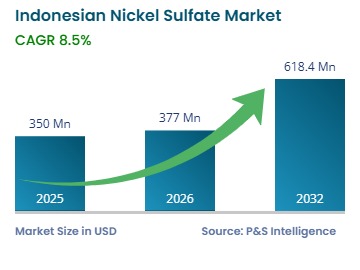
The Indonesian nickel sulfate market valued USD 350.0 million in 2025, and it is anticipated to expand at a CAGR of 8.5% during 2026–2032, reaching approximately USD 618.4 million by 2032.
The Indonesia nickel sulphate market is mainly driven by rapid growth in EV battery manufacturing, abundant domestic nickel reserves, strong government support for downstream processing, and rising global demand for lithium-ion batteries. This growth is supported by Indonesia's position as the world's largest nickel producer, accounting for over 56% of global mined nickel output in 2024. Aggressive downstream processing capacity expansion through high-pressure acid leaching (HPAL) facilities, which convert laterite ore into battery-grade nickel sulfate, also drive the market. Government policies mandating domestic processing following the 2020 ore export ban catalyzed foreign direct investment exceeding USD 30 billion in integrated nickel refining and battery materials production infrastructure across the Sulawesi and Maluku regions.
Key Market Insights
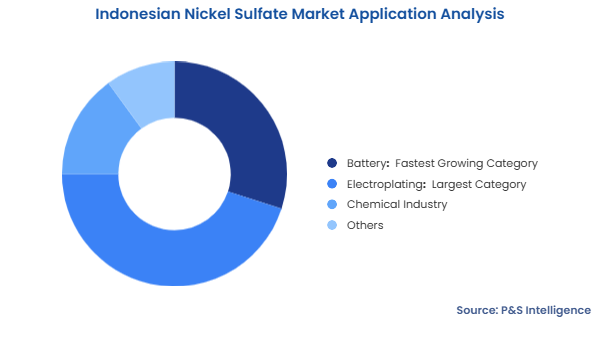
Plating grade commanded the largest market share in 2025, of 55%, driven by its extensive usage in electroplating across the automotive, hardware, electronics, and decorative finishing industries.
The high-purity grade is projected to register the fastest growth during 2026–2032, at 8.7% CAGR, propelled by the booming requirement for Class I nickel for lithium-ion cathodes.
Electroplating accounted for the largest share in 2025, of 45%.
Battery applications are expected to experience the fastest growth during 2026–2032, at 8.8% CAGR, driven by high-volume nickel and EV battery production.
Central Sulawesi leads the market with 40% share, while North Maluku is the fastest‑growing, with 8.6% CAGR.
Indonesia's nickel sulfate production has accelerated since 2023 when commercial-scale HPAL plants commenced operations on Obi Island and in South Halmahera. They produce mixed hydroxide precipitate (MHP), which is subsequently refined into battery-grade nickel sulfate for EV batteries. The International Nickel Study Group (INSG) reports that Indonesia produced 1.750 million tonnes of nickel in 2025, representing 46.9% of global primary nickel production.
The country's vertically integrated supply chain—from laterite mining through HPAL processing to nickel sulfate refinement—supplies cathode material producers, particularly in China, where battery manufacturing capacity continues expanding rapidly. PT Halmahera Persada Lygend operates facilities with annual nickel sulfate capacity exceeding 240,000 tonnes. While, PT Vale Indonesia and Harita Nickel groups have committed to multi-billion dollar HPAL expansions, targeting battery-grade nickel markets through 2027.
Indonesian Nickel Sulfate Market Growth Factors
HPAL Technology Deployment Is Key T rend in Market
Indonesia's nickel sulfate market is being fundamentally transformed by the widespread deployment of HPAL technology for battery-grade nickel sulfate production from previously unsuitable limonite ore deposits. HPAL plants use elevated temperatures (255 degrees Celsius) and pressure (725 psi), combined with sulfuric acid, to extract nickel and cobalt from low-grade laterite ore. This produces MHP as an intermediate product, which undergoes further refining into battery-grade nickel sulfate. Harita Nickel's PT Halmahera Persada Lygend HPAL facility became operational in 2021, and it produced MHP initially and expanded to commercial nickel sulfate production in 2023. By mid-2025, Indonesia had four operational HPAL facilities, three under construction, and two in feasibility phases, located primarily in Morowali (Central Sulawesi) and Obi Island (North Maluku).
This directly responds to the rising demand for high-purity nickel sulfate (99.8%+ nickel content) for nickel–manganese–cobalt (NMC) and nickel–cobalt–aluminum (NCA) EV batteries. HPAL facilities unlock Indonesia's vast limonite reserves, estimated at approximately 60% of total nickel deposits for battery applications, previously inaccessible through conventional ferronickel smelting. Merdeka Battery Materials secured a USD 1.4-billion loan in February 2025 to construct a 90,000-tonne-per-annum-MHP-capacity HPAL plant in Indonesia Morowali Industrial Park. Moreover, Harita Nickel's integrated rotary kiln electric furnace (RKEF) and HPAL facilities on Obi Island currently process 27 million tonnes annually of saprolite and limonite ore.
Ore Processing Mandates and Rising FDI Drive Market
The Indonesian government enforced nickel ore export ban in 2020, originally legislated in 2009's Law No. 4 on Mineral and Coal Mining. This accelerates domestic nickel sulfate processing capacity by mandating that all mined nickel ore is processed within Indonesia before export. This policy compels mining companies to either build their own downstream processing facilities or sell ore to domestic smelters, fundamentally restructuring the industry from raw material extraction toward value-added processing. Presidential Regulation No. 55/2019 designated EV industry development as a national priority, while Indonesia's National Industry Development Master Plan (RIPIN) 2015–2035 explicitly targets nickel sulfate production expansion to support battery manufacturing value chains.
These coordinated policies attracted approximately USD 30 billion in foreign direct investment into Indonesia's nickel processing infrastructure between 2018 and 2025. The funding predominantly came from Chinese companies establishing integrated mining-to-battery materials operations and South Korean firms building battery cell production facilities, including LG Energy Solution and SK On.
Hyundai Motor Group and LG Energy Solution committed USD 9.8 billion in an EV battery cell manufacturing plant with 10-GWh annual capacity. Inaugurated in 2024, it utilizes NCMA battery cells containing 90% nickel in cathodes sourced from Indonesian nickel sulfate. Sino–Indonesian joint ventures dominate midstream processing, with Indonesia Morowali Industrial Park hosting 48 nickel processing facilities, representing 30% of national capacity. They produce MHP intermediates and increasingly expanding into precursor cathode active material production to avoid potential export taxes on nickel products containing less than 70% nickel content.
Vale Indonesia announced plans in July 2025 to raise USD 1–1.2 billion in financing during 2026–2027 specifically for developing new nickel mines and HPAL smelters aimed at supplying battery-grade nickel sulfate. State-owned Indonesia Battery Corporation coordinates domestic battery industry development to create vertically integrated supply chains linking nickel sulfate producers with cathode manufacturers and battery assemblers.
Rising adoption of high-nickel cathode chemistries creates sustained opportunities for Indonesian nickel sulfate producers capable of meeting stringent purity specifications required for lithium-ion battery production. Global nickel consumption for EV batteries reached 384,000 tonnes in 2024 (11.5% of total primary nickel consumption), and it is projected to increase to 543,000 tonnes in 2025 (15.2% share). Battery-grade nickel sulfate consumption specifically was forecast to reach 265 kilotonnes by 2025 from 162 kilotonnes in 2019. This would represent a 28% compound annual growth, driven predominantly by Chinese battery manufacturing expansion.
Indonesia being the world's largest nickel producer with 21 million tonnes of reserves (approximately 24% of global reserves) positions domestic processors to capture disproportionate market share in this premium battery-grade segment. The United States and European Union are diversifying their supply chains through the Inflation Reduction Act and Critical Raw Materials Act, which incentivize sourcing from nations with ESG credentials.
Indonesian nickel sulfate producers benefit from vertically integrated supply chains providing cost advantages compared to international competitors who must source nickel intermediates separately. Harita Nickel's operations integrate mining, HPAL processing, and nickel sulfate refining on Obi Island. While, Vale Indonesia combines established infrastructure, including 365 MW of hydroelectric power generation, with expanding HPAL capacity to produce lower-carbon-intensity nickel sulfate for battery manufacturers.
Indonesian Nickel Sulfate Market Segmentation Analysis
Grade Analysis
Plating grade commanded the largest market share in 2025, of 55%, driven by its extensive usage in electroplating across the automotive, hardware, electronics, and decorative finishing industries. In electrodeposition processes, this grade provides readily available nickel ions at a lower cost than specialty alternatives. while maintaining sufficient purity for functional and decorative plating. The Nickel Institute's electroplating handbook highlights nickel sulfate's role as the primary component in Watts nickel plating baths and sulfate nickel solutions used for corrosion-resistant coatings on steel, aluminum, copper, and zinc substrates across manufacturing sectors.
Plating grade's market lead reflects decades of established infrastructure supporting high-volume electroplating operations on automotive components (bumpers, trim, wheels), consumer hardware (faucets, door handles, tools), and electronic components (circuit boards, connectors). Here, sulfate nickel delivers bright finish characteristics preferred for decorative applications. The grade's cost-effectiveness compared to sulfamate alternatives makes it economically attractive for applications requiring moderate thickness coatings and corrosion protection without demanding ultra-low stress deposits or specialized performance characteristics.
The high-purity grade is projected to register the fastest growth during 2026–2032, at 8.7% CAGR, propelled by the booming requirement for Class I nickel for lithium-ion cathodes. The International Energy Agency's Global EV Outlook 2025 reports that electric car sales touched 17 million units in 2025. Battery manufacturers increasingly adopting NMC chemistries, containing 60–90% nickel content in cathodes, to achieve superior energy density and extended driving range. High-purity nickel sulfate hexahydrate (NiSO4·6H2O) is a critical precursor for cathode active material (CAM) production.
Stringent specifications regarding impurity levels (maximum 100 parts per billion magnetic materials) and crystalline purity enable consistent battery performance. Indonesia's rapid expansion of HPAL facilities producing battery-grade nickel sulfate directly addresses this demand. Automotive OEMs are shifting toward NMC 811 cathodes (80% nickel, 10% manganese, 10% cobalt) to reduce dependence on expensive cobalt, while maintaining battery capacity and safety performance.
The market segments into the following grades:
EN
Plating (Largest Category)
High-Purity (Fastest Growing Category)
Application Analysis
Electroplating accounted for the largest share of Indonesia nickel sulfate market value in 2025, of 45%. A mature and diversified electrodeposition industry in the country utilizes nickel sulfate for protective and decorative coatings across manufacturing applications. Electroplating deposits thin nickel layers on to metal substrates through electrolytic deposition, with nickel sulfate serving as the cathode in Watts baths, all-sulfate solutions. Various specialized plating formulations produce bright, decorative finishes or engineering coatings with enhanced corrosion and wear resistance.
Indonesian electroplating firms apply nickel coatings on steel, copper, zinc, and aluminum parts to support automotive component production, consumer goods fabrication, electronics assembly, and metal finishing operations domestically and in Southeast Asia. Established processing infrastructure, diverse end-use applications spanning decorative and functional coatings, and cost-effective plating-grade nickel sulfate availability meeting industrial volume requirements without demanding battery-grade purity specifications.
Battery applications are expected to experience the fastest growth during 2026–2032, at 8.8% CAGR, driven by Indonesia's strategic position as the world's largest nickel producer and emerging EV battery manufacturing hub. The Indonesian government's 2030 target of reaching 140 GWh annual battery capacity will enable domestic nickel sulfate producers to supply integrated battery value chains. HPAL facilities producing mixed hydroxide precipitate (MHP) would be connected with cathode precursor manufacturers and battery cell assemblers serving global automotive markets.
LG Energy Solution and Hyundai Motor Group's USD 9.8-billion commitment to develop a 10-GWh-capacity EV battery cell manufacturing plant is aimed at meeting the escalating nickel sulfate demand for lithium-ion cathode production. Battery-grade nickel sulfate demand is driven by automakers’ transition toward zero-emission vehicle portfolios and implementation of stringent emission regulations.
The market segments into the following applications:
Battery (Fastest Growing Category)
Electroplating (Largest Category)
Chemical Industry
Others
Drive strategic growth with comprehensive market analysis
Indonesian Nickel Sulfate Market Regional Outlook
Central Sulawesi Nickel Sulphate Market Size
Central Sulawesi leads the market with 40% share, as it hosts the Indonesia Morowali Industrial Park (IMIP), a downstream nickel processing cluster producing nickel sulphate precursors for EV batteries and other lithium‑ion chemistries. IMIP hosts extensive network of HPAL and refining facilities makes Central Sulawesi the largest regional market for nickel sulphate and battery materials in Indonesia. It consistently accounts for the highest production and internal offtake for sulphate and precursor products, feeding both domestic supply chains and export demand.
North Maluku Nickel Sulfate Market Growth
North Maluku is the fastest‑growing regional market for nickel sulphate, with 8.6% CAGR, due to rapid investment in HPAL and refining infrastructure at the Weda Bay Industrial Park (IWIP). The establishment of large HPAL operations and refineries has significantly increased local nickel sulphate output, and the province has been attracting high foreign direct investment. Its production momentum and double‑digit regional growth projections support rapid growth in nickel sulphate capacity and sales.
These provinces are covered:
North Maluku (Fastest-Growing Regional Market)
Southeast Sulawesi
Central Sulawesi (Largest Regional Market)
South Sulawesi
Maluku
West Papua
East Kalimantan
Rest of Indonesia
Indonesian Nickel Sulfate Market Share
The Indonesian nickel sulfate market demonstrates moderate concentration with integrated vertically-structured operations spanning from nickel mining through HPAL processing to battery-grade nickel sulfate refining, differentiating it from fragmented upstream nickel mining while maintaining higher concentration than typical chemical processing industries. Market structure reflects the USD 1–3 billion in investments required per HPAL facility and government policies mandating domestic ore processing, which favor established players securing foreign partnerships and navigating complex regulations.
Concentration intensified following successful commercial-scale HPAL deployment beginning in 2021, as technological barriers prevented widespread replication until proven operational models emerged. Harita Nickel's breakthrough HPAL success on Obi Island established the technical template subsequently adopted by other Indonesian and foreign investors, creating first-mover advantages for early entrants into battery-grade nickel sulfate production.
Competitive dynamics increasingly emphasize vertical integration depth and carbon intensity differentiation as battery manufacturers scrutinize supply chain environmental credentials under pressure from Western regulatory frameworks. Companies possessing integrated operations from ore mining through cathode precursor production capture higher value-added margins compared to pure MHP intermediate producers reliant on external refining partnerships. Geographic concentration in Morowali Industrial Park and North Maluku's Obi Island/Halmahera areas creates infrastructure clustering and supply chain vulnerability. This becomes clear when production disruptions at single facilities affect regional output.
Key Indonesian Nickel Sulfate Companies:
PT Vale Indonesia Tbk
PT Aneka Tambang Tbk (Antam)
PT Trimegah Bangun Persada Tbk (Harita Nickel)
PT Halmahera Persada Lygend
Merdeka Battery Materials (MBMA)
PT Central Omega Resources Tbk (DKFT)
PT Huayue Nickel Cobalt
PT QMB New Energy Materials
PT Indonesia Morowali Industrial Park (IMIP)
PT Freeport Indonesia
Indonesian Nickel Sulfate Market News & Updates
In February 2025, Merdeka Battery Materials secured a USD 1.4-billion seven-year loan from Thai and Indonesian banks to construct a HPAL plant at Indonesia Morowali Industrial Park. It is designed for the production of 90,000 tonnes per annum of contained nickel in MHP. The USD 1.8-billion facility will offer battery-grade nickel sulfate for EVs.
In July 2024, LG Energy Solution and Hyundai Motor Group inaugurated Ien EV battery cell production plant with 10-GWh annual capacity. The facility utilizes nickel-rich NCMA battery cells containing 90% nickel in cathodes sourced from Indonesian nickel sulfate suppliers.
In May 2024, Indonesia Morowali Industrial Park commissioned multiple nickel processing facilities, bringing the total to 48. The expansion supports vertically integrated supply chains linking nickel ore mining with ferronickel smelting, HPAL processing, and downstream nickel sulfate refining for stainless steel and battery manufacturing.
In June 2023, PT Halmahera Persada Lygend, a subsidiary of Harita Nickel, commenced commercial exports of battery-grade nickel sulfate and cobalt sulfate produced via the HPAL technology on Obi Island, North Maluku. The 240,000 tonnes of annual nickel sulfate production capacity targets Chinese and South Korean battery manufacturers.
Frequently Asked Questions About This Report
What was Indonesia nickel sulfate market size in 2025?+
In 2025, the nickel sulfate market in Indonesia size was USD 350.0 million.
Which grade has largest Indonesia nickel sulphate industry share?+
Plating grade has the largest Indonesia nickel sulphate industry share, of 55%.
Which province has largest Indonesia nickel sulfate market share?+
Central Sulawesi is the largest nickel sulphate market in Indonesia, with 40% share.
What are the key Indonesia nickel sulfate industry drivers?+
The Indonesia nickel sulphate industry is driven by rapid growth in EV battery manufacturing, abundant domestic nickel reserves, strong government support for downstream processing, and rising global demand for lithium-ion batteries.
What is the Indonesia nickel sulfate market nature?+
The nickel sulfate market in Indonesia is moderately consolidated.
Want a report tailored exactly to your business need?
Leading companies across industries trust us to deliver data-driven insights and innovative solutions for their most critical decisions. From data-driven strategies to actionable insights, we empower the decision-makers who shape industries and define the future. From Fortune 500 companies to innovative startups, we are proud to partner with organisations that drive progress in their industries.
Client Testimonials
Working with P&S Intelligence and their team was an absolute pleasure – their awareness of timelines and commitment to value greatly contributed to our project's success. Eagerly anticipating future collaborations.
McKinsey & Company
India
Unmatched Standards
Our insights into the minutest levels of the markets, including the latest trends and competitive landscape, give you all the answers you need to take your business to new heights
Complete Data Security
We take a cautious approach to protecting your personal and confidential information. Trust is the strongest bond that connects us and our clients, and trust we build by complying with all international and domestic data protection and privacy laws