Indonesia Renewable Energy Market Size & Share Analysis - Emerging Trends, Growth Opportunities, Competitive Landscape, and Forecasts (2026 - 2032)
This Report Provides In-Depth Analysis of the Indonesia Renewable Energy Market Report Prepared by P&S Intelligence, Segmented by Source (Solar Energy, Wind Energy, Hydropower, Bioenergy, Geothermal Energy), Application (Residential, Commercial, Industrial, Utilities), and Geographical Outlook for the Period of 2021 to 2032
Indonesia Renewable Energy Market Revenue Insights
Key Highlights
Study Period
2021 - 2032
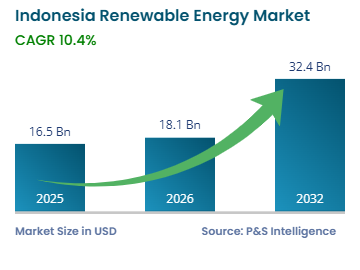
Market Size in 2025
USD 16.5 Billion
Market Size in 2026
USD 18.1 Billion
Market Size by 2032
USD 32.4 Billion
Projected CAGR
10.4%
Largest Region
Java
Fastest-Growing Region
Sulawesi
Market Structure
Fragmented
Market Size
Explore the market potential with our data-driven report
Indonesia Renewable Energy Market Future Outlook
The Indonesian renewable energy market values USD 16.5 billion in 2025, and it is projected to reach USD 32.4 billion by 2032, growing at a CAGR of 10.4% during 2026–2032. Indonesia, the largest economy in Southeast Asia and the fourth most populous nation globally, is undergoing a significant energy transformation driven by government policy initiatives, abundant natural resources, and increasing international investment in clean energy infrastructure.
The market expansion is primarily fueled by Indonesia's commitment to the Just Energy Transition Partnership (JETP), which mobilizes USD 20 billion in public and private financing to accelerate decarbonization of the power sector. Indonesia's total renewable power capacity reached 8.4 GW in 2024 and is projected to expand to 38.1 GW by 2035, representing a compound annual growth rate of 14.7%. Global renewable energy technology costs have declined substantially, making clean energy increasingly competitive with fossil fuels in Indonesia. According to the International Renewable Energy Agency (IRENA), the global average cost of solar energy fell to USD 0.043 per kWh in 2024 and onshore wind to USD 0.034 per kWh.
Indonesia possesses extraordinary renewable energy potential, with geothermal resources accounting for approximately 40% of the world's total reserves. The country ranks as the world's second-largest geothermal energy producer with an installed capacity of 2.65 GW as of 2024. Solar energy presents the highest growth opportunity, with the installed solar capacity reaching 717.71 MW in August 2024 and is expected to expand to 23.2 GW by 2035. This is credited to the rising electricity demand for manufacturing expansion, nickel processing facilities, and the new capital city development in Nusantara.
Indonesia Renewable Energy Market Emerging Trends
Government Policies and International Partnerships Drive Market
The Indonesian government has implemented comprehensive policy reforms to attract investment in renewable energy development.
The government's updated Electricity Supply Business Plan 2025–2034 targets an addition of 69.5 GW of new power capacity by 2034.
Of this, 42.6 GW is to be from renewable energy sources, whereas 10.3 GW will be from batteries and pumped hydro.
In September 2024, the Ministry of Energy and Mineral Resources relaxed local content requirements (LCR) for electricity infrastructure development, reducing solar plant requirements from approximately 40% to 20%.
This policy change aims to attract concessional funding from international development banks and lower project costs.
The Asian Development Bank has approved USD 500 million in loans to PLN, Indonesia's state electricity company, to support the development of 1,200 MW of solar capacity by 2025 and 3,000 MW by 2030.
The JETP agreement, signed at the G20 Summit in Bali in November 2022, represents the largest energy transition financing package in the world.
Under this partnership, Indonesia committed to limiting power sector emissions to 250 million metric tons of carbon dioxide by 2030 and achieving 34% renewable energy generation share by 2030.
The U.S. Department of the Treasury confirmed that 54 projects have already secured USD 1.1 billion in commitments as of early 2025, including nine projects receiving loans or equity investments and 45 projects awarded grants totaling USD 233 million.
Rising Industrial Electricity Demand and Economic Growth Create Opportunities
Recovering from the 1997 financial crisis, Indonesia's GDP grew by 4.9% annually from 2000 to 2021, and in 2021, GDP increased by 3.7% from 2020, rebounding to levels above those seen before the pandemic.
AS per the OECD, since 2000, Indonesia's GDP has more than doubled, while total energy supply has risen by approximately one-and-a-half times, from around 6,500 Petajoules (PJ) in 2000 to nearly 10,400 PJ in 2021.
This relative decoupling of GDP from energy demand indicates significant advancements in the energy intensity of the economy, primarily driven by two factors.
The proportion of electricity in total final consumption grew from a low level in 2010 to approximately 15% in 2021.
During this time, electricity usage in the industrial sector has doubled, and it has nearly doubled in the buildings sector, particularly due to the increasing demand for space cooling.
Throughout the 2000–2021 period, Indonesia's CO2 emissions from the energy sector rose by slightly more than two times, while GDP increased by just over two-and-a-half times.
Consequently, the rise in CO2 emissions has been relatively closely linked to GDP growth.
In 2021, the power sector accounted for about 40% of total CO2 emissions, while transportation and industry each represented around one-quarter of total emissions.
Indonesia's electricity demand is projected to grow between 4.8% and 5.2% annually, increasing from approximately 363–377 TWh in 2023 to 1,846–2,152 TWh by 2060.
Indonesia will become the world's fourth-largest economy by 2050, driving substantial demand growth across residential, commercial, and industrial sectors.
The development of industrial parks and nickel smelters in Sulawesi and Kalimantan presents significant opportunities for captive renewable energy installations.
Indonesia Renewable Energy Market Segmentation Analysis
Source Analysis
Hydropower holds the largest share, of 35%, in the Indonesian renewable energy market in 2025, generating the highest portion of renewable electricity output. The country's total hydropower capacity reached 7 GW in 2024, with Indonesia adding 486 MW of new capacity during the year. According to the International Hydropower Association, Indonesia has committed to expanding hydropower capacity from 6.7 GW to 72 GW by 2070.
Major projects scheduled to commence operations include the Upper Cisokan Pumped Storage Power Plant (1,040 MW), Indonesia's first pumped storage facility located in West Java, and the Batang Toru Hydropower Plant (510 MW) in North Sumatra.
Solar energy is projected to be the fastest-growing category, through 2032, driven by the declining technology costs, favorable government policies, and abundant solar irradiance across the archipelago. Indonesia's location on the equator provides high-intensity solar radiation with an estimated potential capacity of 207,898 MW. The 145 MW Cirata floating solar facility in West Java, operational since November 2023, is Southeast Asia's largest floating solar project.
The Ministry of Energy and Mineral Resources targets 18 GW of solar capacity by 2035, with PLN planning to add 7.9 GW of new solar capacity by 2033. The cost of solar modules in Indonesia dropped from USD 4.12 per Watt in 2008 to USD 0.17 per Watt in 2020, representing a 96% reduction over twelve years.
These sources are covered:
Solar Energy (Fastest-Growing Category)
Solar PV
Concentrated Solar Power (CSP)
Wind Energy
Onshore
Offshore
Hydropower (Largest Category)
Bioenergy
Geothermal Energy
Others
Application Analysis
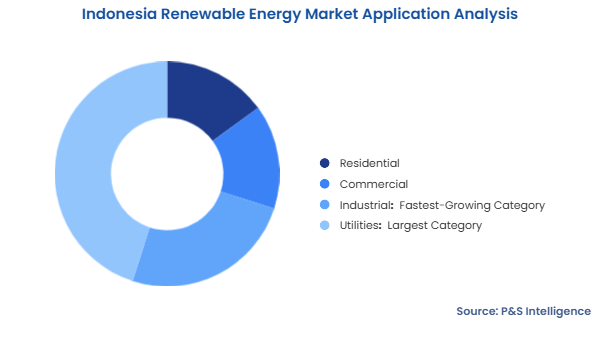
The utilities category dominates the Indonesian renewable energy market in 2025 with 45% share. PT PLN (Persero) operates the majority of grid-connected renewable energy facilities and serves as the primary off-taker for independent power producers. As per projections, 73% of new generation capacity will be developed through private partnerships, with PLN focusing on transmission and grid infrastructure development. Utility-scale projects, including the Cirata floating solar plant (145 MW), geothermal facilities across Java and Sumatra, and planned hydropower developments, drive solar capacity additions.
The industrial category is projected to witness the highest CAGR during 2026–2032, driven by captive renewable energy installations at manufacturing facilities, mining operations, and industrial parks. The expansion of nickel smelters and industrial zones in Sulawesi creates substantial opportunities for captive renewable energy development. The government's strategy to develop green industries in Kalimantan by utilizing hydropower includes the Kayan Hydroelectric Power Plant (9,000 MW) and Mentarang plant (1,375 MW) to supply electricity to manufacturing facilities. Industrial demand growth is further supported by decarbonization commitments from multinational corporations operating in Indonesia.
These applications are covered:
Residential
Commercial
Industrial (Fastest-Growing Category)
Utilities (Largest Category)
Drive strategic growth with comprehensive market analysis
Indonesia Renewable Energy Market Geographical Analysis
Java Renewable Energy Market Value
Java holds the largest share, of 40%, in the Indonesian renewable energy market in 2025, driven by high electricity demand, concentration of industrial activity, and availability of geothermal resources. The Java–Madura–Bali (JAMALI) grid serves 80% of Indonesia's electricity demand, with the region hosting the majority of the country's population and economic activity. Almost half (48.2%) of new capacity under the RUPTL 2025-2034 is earmarked for the Java–Madura–Bali region.
Major renewable energy installations in Java include the Cirata floating solar plant (145 MW) in West Java, the Upper Cisokan pumped storage facility (1,040 MW), and geothermal plants including Salak (377 MW), Wayang Windu (227 MW), and Kamojang (235 MW). West Java hosts the highest concentration of geothermal capacity in Indonesia, leveraging volcanic activity along the Ring of Fire. The region's manufacturing sector and urban population centers create substantial demand for renewable electricity, supporting market expansion through both utility-scale and distributed generation projects.
Sulawesi Renewable Energy Market Forecast
Sulawesi is projected to be the fastest-growing regional market with a CAGR exceeding 11.5% during 2026–2032, driven by industrial development, nickel processing facilities, and favorable wind resources. The region currently accounts for 20% of Indonesia's installed renewable energy capacity at 2.5 GW. North Sulawesi gets a major chunk of its electricity from geothermal sources.
Sulawesi hosts Indonesia's only operational utility-scale wind farms: the Sidrap Wind Farm (75 MW) and Tolo Wind Farm (72 MW), both located in South Sulawesi. The region possesses 4.2 GW of wind potential, with favorable wind speeds making it the most suitable location for wind energy development in the country. The expansion of industrial parks and nickel smelters creates substantial captive market opportunities for renewable energy developers. The RUPTL 2025–2034 allocates 14.9% of new generation capacity to Sulawesi, with the Sulawesi Backbone transmission interconnection planned to improve grid reliability and enable renewable energy integration.
These regions are covered:
Java (Largest Regional Market)
Sumatra
Sulawesi (Fastest-Growing Regional Market)
Kalimantan
Rest of Indonesia
Indonesia Renewable Energy Market Share
The Indonesian renewable energy generation systems market exhibits a fragmented competitive structure, with international equipment manufacturers competing alongside local EPC contractors and system integrators. The market encompasses multiple product categories, each dominated by different sets of suppliers. International manufacturers hold dominant positions in core equipment supply, while local companies provide EPC services, installation, and after-sales support. The relaxation of local content requirements in 2024 has enabled greater participation by foreign suppliers in direct equipment sales.
In the solar segment, Chinese manufacturers supply the majority of PV modules through partnerships with local distributors and EPC contractors. Local EPC contractors provide turnkey installation services, competing on project execution capabilities and local market knowledge.
Wind turbine supply is concentrated among global manufacturers, while hydropower turbine procurement is dominated by European manufacturers. Geothermal equipment supply involves specialized manufacturers, reflecting the technical complexity of steam turbine and binary cycle systems.
Key Indonesia Renewable Energy Companies:
LONGi Green Energy Technology Co. Ltd.
Trina Solar Co. Ltd.
JinkoSolar Holding Co. Ltd.
Huawei Digital Power Technologies Co. Ltd.
Sungrow Power Supply Co. Ltd.
SMA Solar Technology AG
Vestas Wind Systems A/S
Siemens Gamesa Renewable Energy S.A.
GE Vernova Inc.
Xinjiang Goldwind Science & Technology Co. Ltd.
Andritz Hydro GmbH
Voith Hydro GmbH & Co. KG
Toshiba Corporation
Ormat Technologies Inc.
ABB Ltd.
Schneider Electric SE
Eaton Corporation plc
Emerson Electric Co.
Yokogawa Electric Corporation
Yaskawa Electric Corporation
Mitubishi Electric Corporation
Mitsubishi Heavy Industries Ltd.
Hitachi Ltd.
Indonesia Renewable Energy Market News
In January 2025, President Prabowo Subianto inaugurated 37 strategic electricity projects, including PLTA Asahan 3 and Jatigede hydropower facilities, worth IDR 72 trillion in investment and 3.2 GW in capacity.
In November 2024, President Prabowo announced plans to retire all coal and fossil-fuel power plants within 15 years and significantly boost renewable energy capacity by over 75 GW.
In September 2024, the Ministry of Energy and Mineral Resources relaxed local content requirements for solar power plants from 40% to 20%, to attract foreign investment and accelerate renewable energy deployment.
In September 2024, Singapore announced plans to import 1.4 GW more of low-carbon power from Indonesia.
In August 2024, Barito Renewables announced a partnership with ACEN to accelerate the development of renewable wind energy projects throughout Indonesia through PT Barito Wind Energy and ACEN Indonesia Investment Holdings.
In July 2024, PT Sewatama Jasa Mandiri partnered with Daewoo Engineering to expand solar capacity at the Pertamina refinery in Balongan, West Java, from 3.5 MW to 6.5 MW.
In July 2024, Sungrow announced that its inverter solutions were selected for the 15-MW Tanjung Batu floating solar project in Gorontalo, Indonesia.
Want a report tailored exactly to your business need?
Leading companies across industries trust us to deliver data-driven insights and innovative solutions for their most critical decisions. From data-driven strategies to actionable insights, we empower the decision-makers who shape industries and define the future. From Fortune 500 companies to innovative startups, we are proud to partner with organisations that drive progress in their industries.
Client Testimonials
Working with P&S Intelligence and their team was an absolute pleasure – their awareness of timelines and commitment to value greatly contributed to our project's success. Eagerly anticipating future collaborations.
McKinsey & Company
India
Unmatched Standards
Our insights into the minutest levels of the markets, including the latest trends and competitive landscape, give you all the answers you need to take your business to new heights
Complete Data Security
We take a cautious approach to protecting your personal and confidential information. Trust is the strongest bond that connects us and our clients, and trust we build by complying with all international and domestic data protection and privacy laws