Indonesia Industrial Automation Market Size & Opportunities Analysis - Growth Strategies, Competitiveness, and Forecasts (2026 - 2032)
This Report Provides In-Depth Analysis of the Indonesia Industrial Automation Market Report Prepared by P&S Intelligence, Segmented by Component (Sensors, Control Valves, Switches & Relays, HMIs, Industrial Robots), Solution (SCADA, PLC, DCS, MES), Industry (Aerospace & Defense, Automotive, Chemical, Energy & Utilities, Food & Beverage, Healthcare, Manufacturing, Mining & Metal), and Geographical Outlook for the Period of 2021 to 2032
Indonesia Industrial Automation Market Revenue Insights
Key Highlights
Study Period
2021 - 2032
Market Size in 2025
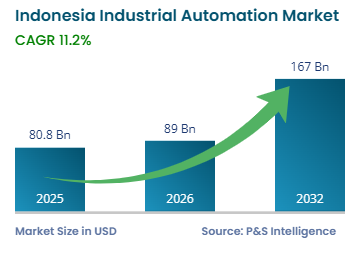
USD 80.8 Billion
Market Size in 2026
USD 89.0 Billion
Market Size by 2032
USD 167.0 Billion
Projected CAGR
11.2%
Largest Region
West Java
Fastest-Growing Region
Central Sulawesi
Market Structure
Fragmented
Market Size
Explore the market potential with our data-driven report
Indonesia Industrial Automation Market Future Outlook
The Indonesian industrial automation market values USD 80.8 billion in 2025, and it is projected to grow at a CAGR of 11.2% during 2026–2032, to reach USD 167.0 billion by 2032. The market growth is driven by the government's Making Indonesia 4.0 initiative, rising labor costs, increasing demand for operational efficiency across manufacturing sectors, and rapid digital transformation in key industries such as automotive, food and beverage, and mining.
The manufacturing sector remains the backbone of Indonesia's economy, contributing approximately 19% to the nation's GDP, according to Statistics Indonesia. This sector has been increasingly adopting automation technologies to enhance productivity, reduce operational costs, and maintain competitiveness in the global market. The Indonesian government has identified industrial automation as a critical enabler for achieving its vision of becoming a top-10 global economy by 2030.
The integration of Industry 4.0 technologies, including IoT, AI, and robotics, is reshaping Indonesia's industrial landscape. According to a survey by the World Economic Forum, 83% of businesses in Indonesia anticipate digitalization to significantly impact their operations by 2030, surpassing the global average of 60%. This heightened awareness is translating into increased investments in automation solutions across various industrial verticals.
The country's strategic position in Southeast Asia, abundant natural resources, and large domestic market present substantial opportunities for automation vendors. Key industrial hubs in West Java, East Java, and Banten are witnessing accelerated adoption of PLCs, SCADA systems, and industrial robots. The mining and metal sector, particularly nickel processing in Sulawesi, is emerging as a significant driver of automation demand as Indonesia positions itself as a global leader in electric vehicle battery materials.
Indonesia Industrial Automation Market Trends & Drivers
Food & Beverage Sector’s Digital Transformation Is Major Trend
Indonesia's food & beverage industry is experiencing rapid digital transformation, driven by food safety requirements, growing domestic consumption, and export market demands.
The sector has been identified as a priority industry under the Making Indonesia 4.0 roadmap, with the government encouraging the deployment of advanced digital technologies and transition toward using local raw ingredients.
The country comprises 52% Gen Z and millennial consumers, compelling food & beverage companies to embrace digital evolutions and automation technologies.
Food and beverage manufacturing facilities are increasingly deploying IIoT, AI, PLC-based control systems, and robotics to enhance production efficiency and quality.
The deployment of robots is particularly valued for improving food safety by reducing human intervention and minimizing cross-contamination risks.
Sophisticated packaging machines are replacing manual methods across Indonesia's food processing facilities, driving demand for advanced automation equipment and integrated control solutions.
Making Indonesia 4.0 Policy Initiative Accelerates Automation Adoption
The Indonesian government's Making Indonesia 4.0 roadmap serves as the primary policy driver for industrial automation adoption across the country.
This comprehensive initiative targets seven priority manufacturing sectors: food & beverage, textile & apparel, automotive, electronics, chemicals, pharmaceuticals, and medical devices.
These sectors collectively contribute approximately 70% of Indonesia's industrial GDP, 65% of manufacturing exports, and employ 60% of the industrial workforce, according to the Ministry of Industry.
The policy framework emphasizes the adoption of IoT, AI, cloud computing, augmented reality, big data analytics, and advanced robotics.
The government projects that the successful implementation of Industry 4.0 technologies could enhance Indonesia's GDP growth by 1–2% annually from baseline levels, generate over 10 million new jobs, and increase the manufacturing sector's contribution to GDP to 25% by 2030.
To support this transformation, the government established the Indonesian Digital Industry Center 4.0 (PIDI 4.0), which serves as a one-stop solution for implementing Industry 4.0 initiatives across the country.
Labor costs in Indonesia have been rising at approximately 10% annually, prompting manufacturers to seek automation solutions to maintain competitiveness.
The monthly minimum wage in Jakarta reached approximately IDR 5 million (USD 320) in 2024, while provinces, according to regional wage regulations.
This wage disparity is influencing location decisions for labor-intensive industries and accelerating automation investments in higher-wage industrial zones.
Manufacturing companies are increasingly investing in robotics, automated material handling systems, and intelligent control solutions to offset rising labor expenses and address skilled workforce shortages.
Most Indonesian enterprises report difficulty finding personnel with the skills required to operate and troubleshoot automation systems, further driving demand for user-friendly and integrated automation solutions.
Smart City Initiatives Offer Lucrative Market Opportunities
The Indonesian government's 100 Smart Cities Movement is creating significant opportunities for automation and control system providers.
This comprehensive digitalization program aims to address urbanization challenges by integrating smart technologies into urban infrastructure, including smart transportation, power grids, and utility meters.
The initiative is driving adoption of industrial process automation solutions such as PLCs, Distributed Control Systems, and SCADA systems across the energy and utilities sectors.
The energy sector presents substantial growth opportunities, with Indonesia targeting 23% renewable energy in its energy mix by 2025 and 31% by 2050.
The state electricity company, Perusahaan Listrik Negara (PLN), has outlined plans for significant renewable energy capacity additions in its RUPTL 2025–2032 plan, including 10 GW of hydro, 3 GW of geothermal, and 4.7 GW of solar PV.
These infrastructure developments require advanced automation and control systems for efficient grid management and power distribution.
Indonesia Industrial Automation Market Segmentation Analysis
Component Analysis
The sensors category holds the largest share in the Indonesian industrial automation market in 2025, of 35%. Sensors serve as fundamental building blocks for automation systems, enabling real-time monitoring and data acquisition across manufacturing processes. The growing adoption of photoelectric sensors for product detection on conveyors, proximity sensors for metal and object presence detection, and level and flow sensors for tank and pipeline control is driving segment growth. The increasing implementation of condition-based monitoring and predictive maintenance strategies across Indonesian manufacturing facilities further supports sensor demand.
Industrial robots represent the fastest-growing category. The adoption of industrial robots in Indonesia has increased by around 20% in recent years, with the food industry emerging as a major user. The automotive sector continues to lead robot adoption, utilizing robots for hazardous production processes such as painting and welding that require precise results.
These components are covered:
Sensors (Largest Category)
Control Valves
Switches & Relays
HMIs
Industrial Robots (Fastest-Growing Category)
Others
Solution Analysis
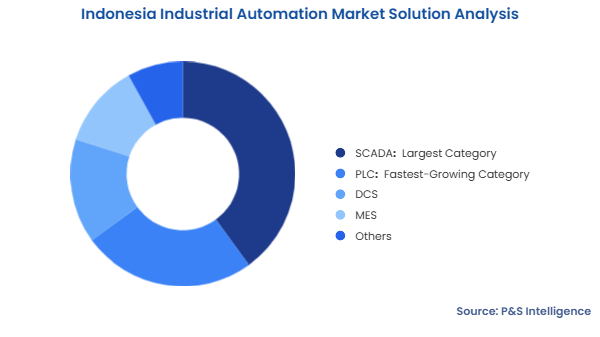
The SCADA category holds the largest share in the Indonesian industrial automation market in 2025, of 40%. SCADA systems are extensively deployed across Indonesia's oil and gas refineries, power generation facilities, water treatment plants, and large-scale manufacturing operations. The growing demand for real-time monitoring, centralized control, and data-driven decision-making is fueling SCADA adoption. The oil and gas sector relies heavily on SCADA systems for monitoring pipeline operations, refinery processes, and LNG terminal management.
PLC represents the fastest-growing category, during the forecast period. PLCs are widely utilized across manufacturing, automotive, and food processing industries due to their versatility, reliability, and ease of programming. The growing trend toward smart factories and Industry 4.0 integration is driving PLC adoption as manufacturers seek programmable control solutions that can interface with higher-level systems. Indonesian manufacturers are increasingly upgrading from relay-based control systems to modern PLCs with Ethernet connectivity, enabling integration with SCADA and MES platforms.
These solutions are covered:
SCADA (Largest Category)
PLC (Fastest-Growing Category)
DCS
MES
Others
Industry Analysis
The manufacturing sector holds the largest share in the Indonesian industrial automation market by industry in 2025, of 25%. General manufacturing encompasses diverse operations, including electronics assembly, consumer goods production, and industrial equipment fabrication. The sector's automation demand is driven by the need for improved production efficiency, quality consistency, and reduced operational costs. West Java alone accounts for 60% of Indonesia's manufacturing activities, including textiles, automotive, machinery, and electronics production.
The mining & metal industry has the highest CAGR, during 2026–2032. Indonesia is the world's largest nickel producer, with around 1.6 million tonnes produced in 2022, up from 1.04 million tonnes in 2021. The government's nickel downstreaming policy has attracted massive investments in smelting facilities, particularly in Sulawesi and North Maluku. The Indonesia Morowali Industrial Park (IMIP) alone employs over 100,000 workers and has become a major hub for battery-grade nickel processing. These large-scale industrial operations require sophisticated automation and control systems for process optimization, safety management, and environmental compliance.
These industries are covered:
Aerospace & Defense
Automotive
Chemical
Energy & Utilities
Food & Beverage
Healthcare
Manufacturing (Largest Category)
Mining & Metal (Fastest-Growing Category)
Others
Drive strategic growth with comprehensive market analysis
Indonesia Industrial Automation Market Geographical Analysis
West Java Industrial Automation Market Share
West Java holds the largest share of the Indonesian industrial automation market in 2025, of 40%, and it is expected to maintain its dominant position throughout the forecast period. This is attributed to its concentration of manufacturing activities, with 60% of Indonesia's industrial operations located within its borders. Major industrial clusters in Bekasi, Cikarang, Karawang, and Purwakarta host numerous multinational corporations and local enterprises across textiles, automotive, electronics, and food and beverage sectors.
The Cikarang area hosts the Kota Jababeka industrial estate, along with MM2100, Bekasi International Industrial Estate (BIIE), East Jakarta Industrial Park (EJIP), and Delta Silicon Industrial Park. These industrial zones provide comprehensive infrastructure, including reliable power supply, logistics connectivity, and access to Tanjung Priok Port. Hyundai's EV assembly plant in Cikarang exemplifies the ongoing automation investments, while the Indonesia-China Integrated Industrial Zone (KITIC) represents growing foreign direct investment in advanced manufacturing capabilities.
Central Sulawesi Automation Market Forecast
Central Sulawesi is projected to be the fastest-growing provincial market, with a CAGR of approx. 11.5%. The province's growth is driven by the massive expansion of nickel mining and processing operations centered around the Indonesia Morowali Industrial Park (IMIP) in North Morowali Regency. IMIP is equipped to process 13 million tonnes of nickel ore annually and employs over 100,000 workers, representing one of the largest industrial complexes in Indonesia. The facility has become a major hub for battery-grade nickel processing, attracting substantial automation investments.
The nickel sector's expansion has created substantial demand for DCS systems, industrial sensors, process analyzers, and safety automation solutions. Smelting operations require precise temperature control, emissions monitoring, and material handling automation. Since 2016, the number of smelters in Indonesia has risen from two to more than 60, with a significant concentration in Central Sulawesi. The province's strategic importance in Indonesia's nickel downstreaming policy, which aims to position the country as a global leader in EV battery materials, ensures continued investment in automation infrastructure.
These provinces are covered:
West Java (Largest Provincial Market)
East Java
Banten
Central Java
Central Sulawesi (Fastest-Growing Provincial Market)
Southeast Sulawesi
North Sumatra
Riau
East Kalimantan
Rest of Indonesia
Indonesia Industrial Automation Market Share
The Indonesian industrial automation market is moderately fragmented, due to the presence of established multinational corporations alongside regional system integrators and local distributors. Global automation leaders maintain strong market positions through comprehensive product portfolios, technical support networks, and strategic partnerships with local enterprises. The competitive landscape is shaped by technological innovation, after-sales service capabilities, pricing strategies, and localization efforts.
The top five key players collectively hold approximately XX% of the market share, indicating a slightly fragmented market structure. Competition intensifies as players pursue product launches, strategic partnerships, and expansion of distribution networks to capture market share. International vendors are increasingly focusing on localization strategies, including the establishment of local subsidiaries, training centers, and partnerships with Indonesian system integrators. Companies are developing solutions tailored to specific industry requirements, particularly for the food and beverage, oil and gas, and mining sectors.
Key Indonesia Industrial Automation Companies:
Siemens AG
ABB Ltd
Schneider Electric SE
Rockwell Automation Inc.
Honeywell International Inc.
Yokogawa Electric Corporation
Mitsubishi Electric Corporation
Emerson Electric Co.
OMRON Corporation
FANUC Corporation
Schneider Electric SE
Texas Instruments Inc.
Robert Bosch GmbH
Indonesia Industrial Automation Market News
In November 2025, Siemens AG showcased version 21 of its engineering framework, Totally Integrated Automation Portal (TIA Portal), at the Smart Production Solutions (SPS) trade show, held in Nuremberg, Germany. This release targets both machine builders who are creating innovative machines through an efficient engineering workflow and discrete manufacturing companies that seek to enhance the power and reliability of their production processes.
In May 2024, Yokogawa Electric Corporation launched the CENTUM VP R6.11.10, introducing a new IO card with redundancy features designed for the PROFINET industrial network communications protocol to enhance plant uptime for Indonesian customers.
In April 2024, OMRON launched its NX-series NX502 automation controllers, alongside new NX-EIP201 EtherNet/IP units, for manufacturing applications in Southeast Asia.
Want a report tailored exactly to your business need?
Leading companies across industries trust us to deliver data-driven insights and innovative solutions for their most critical decisions. From data-driven strategies to actionable insights, we empower the decision-makers who shape industries and define the future. From Fortune 500 companies to innovative startups, we are proud to partner with organisations that drive progress in their industries.
Client Testimonials
Working with P&S Intelligence and their team was an absolute pleasure – their awareness of timelines and commitment to value greatly contributed to our project's success. Eagerly anticipating future collaborations.
McKinsey & Company
India
Unmatched Standards
Our insights into the minutest levels of the markets, including the latest trends and competitive landscape, give you all the answers you need to take your business to new heights
Complete Data Security
We take a cautious approach to protecting your personal and confidential information. Trust is the strongest bond that connects us and our clients, and trust we build by complying with all international and domestic data protection and privacy laws