Indonesia EV Battery Market Size & Share Analysis - Trends, Drivers, Competitive Landscape, and Forecasts (2026 - 2032)
This Report Provides In-Depth Analysis of the Indonesia EV Battery Market Report Prepared by P&S Intelligence, Segmented by Type (Nickel Metal Hydride (NiMH), Lithium-Ion, Sealed Lead-Acid (SLA)), Propulsion (Hybrid Electric Vehicle (HEV), Battery Electric Vehicle (BEV), Plug-in Hybrid Vehicle (PHEV), Fuel Cell Electric Vehicle (FCEV)), Vehicle Type (Passenger Cars, Scooters & Motorcycles, Three-Wheelers, Buses & Trucks), and Geographical Outlook for the Period of 2019 to 2032
Explore the market potential with our data-driven report
Indonesia EV Battery Market Overview
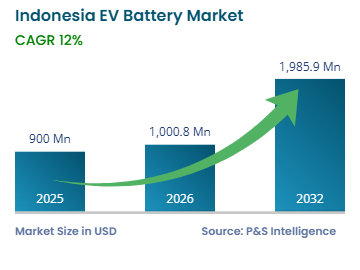
The Indonesian EV battery market values USD 900.0 million in 2025, and it is projected to reach USD 1985.9 million by 2032, growing at a CAGR of 12.0% during 2026–2032. The market expansion is underpinned by the country's strategic position as the world's largest nickel producer, aggressive government policies promoting electric vehicle adoption, and substantial foreign investments in battery manufacturing infrastructure. Indonesia holds approximately 22% of global nickel reserves, a critical raw material for lithium-ion battery production, positioning the nation as a pivotal player in the global EV supply chain.
The Indonesian government has set ambitious targets to deploy 2 million electric cars and 12 million electric two-wheelers by 2030. This policy framework has catalyzed significant growth in the domestic EV market. The establishment of a 10-GWh EV battery cell manufacturing facility by PT HLI Green Power in West Java marks a milestone for the regional battery industry.
Indonesia EV Battery Market Dynamics
Government Incentives Are Key Market Trend
The Indonesian government has implemented comprehensive fiscal incentives to stimulate both EV demand and domestic manufacturing.
Additionally, the luxury goods sales tax has been completely waived for EVs, and import duties on completely built-up EVs have been removed for manufacturers committing to establishing domestic production facilities by 2026.
These incentives contributed to mammoth growth in EV interest during the second quarter of 2024 compared to the same period in 2023.
Beyond consumer incentives, the government offers substantial benefits to battery manufacturers, including a 10-year corporate income tax holiday followed by 50% reduced rates for an additional two years.
Import duties on manufacturing equipment are waived, and streamlined permitting processes have been established in designated industrial zones.
These policies have attracted commitments exceeding USD 15 billion in battery-related investments from Korean, Chinese, and Japanese manufacturers.
Indonesia's position as the world's largest nickel producer serves as the primary driver for EV battery market growth.
According to the U.S. Geological Survey, Indonesia accounted for 54% of global nickel mine production in 2023, with reserves estimated at over 21 million metric tons.
The government's 2020 ban on raw nickel ore exports has successfully attracted foreign investment in domestic processing facilities, transforming the country from a raw material exporter to a value-added manufacturer.
This policy shift has generated substantial downstream investment, with processed nickel exports reaching USD 20 billion in 2022, compared to just USD 1 billion in 2015.
The Indonesian Morowali Industrial Park and Indonesia Weda Bay Industrial Park have emerged as major nickel processing hubs, housing multiple high-pressure acid leaching facilities that produce battery-grade nickel sulfate and mixed hydroxide precipitate.
These intermediate products are essential for manufacturing nickel-manganese-cobalt cathodes used in high-performance EV batteries.
The vertical integration from mining to battery production positions Indonesia as a one-stop destination for global automakers seeking secure supply chains.
Rising Electric Two-Wheeler Adoption Creates Mass Market Opportunity
Indonesia represents one of the world's largest two-wheeler markets, with annual motorcycle sales exceeding 6.3 million units in 2024.
Electric two-wheeler sales surpassed 100,000 units for the first time in 2024, representing a 63% year-on-year increase.
The government's subsidy program provides an up to IDR 7-million discount on electric motorcycle purchases, targeting 800,000 new electric motorcycles and 200,000 conversions from internal combustion engines.
The mass adoption of electric two-wheelers creates substantial demand for smaller lithium-ion battery packs, driving economies of scale in domestic battery production.
Leading manufacturers and domestic players are establishing local assembly operations.
Yadea has committed to an annual production capacity of 300,000 electric two-wheelers at its West Java facility.
Indonesia EV Battery Market Segmentation Analysis
Type Analysis
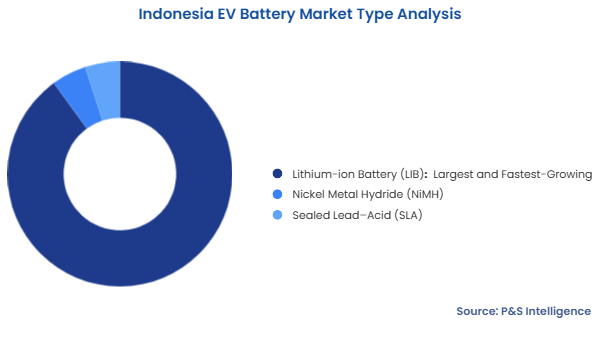
The lithium-ion category holds the largest share in the Indonesian EV battery market in 2025, of 90%, and it is expected to have the highest CAGR of 12.2% over the forecast period. This dominance stems from the superior energy density, longer cycle life, and declining production costs of lithium-ion technology compared to alternatives. The category benefits from Indonesia's integrated nickel-to-battery supply chain, enabling domestic production of nickel-rich cathode materials essential for high-performance lithium-ion cells. Major investments in lithium-ion cell manufacturing, including the 10-GWh HLI Green Power facility and CATL's planned 15-GWh plant, reinforce this category’s market lead.
These battery types are covered:
Lithium-ion Battery (LIB) (Largest and Fastest-Growing Category)
Nickel Metal Hydride (NiMH)
Sealed Lead–Acid (SLA)
Propulsion Analysis
The BEV category held the largest share in the Indonesian EV battery market by propulsion type in 2025, accounting for approximately 75%. This category's dominance reflects the government's prioritization of full electrification, with substantial incentives specifically targeting battery electric vehicles. The removal of luxury goods sales tax exclusively for BEVs, combined with VAT reductions, has made pure electric vehicles increasingly affordable for Indonesian consumers.
The PHEV category is expected to witness the fastest growth with a CAGR of 12.1% during the forecast period, with demand driven by consumers seeking a transitional solution between conventional and fully electric vehicles. PHEVs address range anxiety concerns while offering electric-only driving capability for urban commuting. Japanese automakers are increasingly introducing PHEV models to the Indonesian market, leveraging their established service networks and consumer trust. The category benefits from flexibility in charging infrastructure requirements, as vehicles can operate on conventional fuel when charging stations are unavailable.
These propulsions are covered:
Battery Electric Vehicle (BEV) (Largest Category)
Plug-in Hybrid Electric Vehicle (P-HEV) (Fastest-Growing Category)
Hybrid Electric Vehicle (HEV)
Fuel Cell Electric Vehicle (FCEV)
Vehicle Type Analysis
The scooters & motorcycles category holds the largest share in the Indonesian EV battery market, of 45%. Indonesia ranks as the world's third-largest two-wheeler market, with over 126 million motorcycles and scooters registered across the archipelago. The government's subsidy program and the inherently lower battery capacity requirements of two-wheelers make this segment highly accessible to mass consumers. Manufacturers, including Yadea, Gesits, SWAP, and Gogoro, are actively expanding their presence in this high-volume segment.
Passenger cars represent the fastest-growing category, driven by increasing model availability from global manufacturers, including Hyundai, BYD, Wuling, and Chery. The establishment of local manufacturing facilities by these automakers ensures a consistent supply of competitively priced EVs, stimulating battery demand. Battery capacity requirements for passenger cars typically range from 40 kWh to 80 kWh, creating substantial demand for domestic lithium-ion cell production.
These vehicle types are covered:
Scooters & Motorcycles (Largest Category)
Passenger Cars (Fastest-Growing Category)
Buses & Trucks
Three-Wheelers
Others
Drive strategic growth with comprehensive market analysis
Indonesia EV Battery Market Geographical Analysis
Java EV Battery Market Size
Java holds the largest share in the Indonesian EV battery market in 2025, of 45%, and it is expected to maintain its dominant position throughout the forecast period. The island serves as Indonesia's industrial and economic heartland, hosting the nation's largest urban population centers, including Jakarta, Surabaya, and Bandung. West Java Province received USD 8.3 billion in foreign direct investment in 2023, the highest in Indonesia. The Bekasi–Karawang–Purwakarta industrial corridor houses Indonesia's primary automotive manufacturing cluster, including Hyundai's EV plant, the HLI Green Power battery cell facility, and the planned CATL battery manufacturing complex.
The concentration of EV manufacturing and battery production facilities in West Java creates a self-reinforcing ecosystem, attracting additional investment and skilled labor. Jakarta's role as the pilot city for public transportation electrification, including TransJakarta bus conversion, generates additional battery demand. The island's superior charging infrastructure, with the majority of Indonesia's 2,490 public charging stations concentrated in Greater Jakarta, Bandung, and Surabaya, supports higher EV adoption rates compared to other regions.
North Maluku EV Battery Market Outlook
North Maluku is expected to witness the fastest growth in the Indonesian EV battery market during the forecast period, driven by massive investments in nickel processing and battery material production. The province attracted USD 5 billion in foreign direct investment in 2023, primarily in the nickel sector, making it one of Indonesia's most dynamic regions for industrial development. The Indonesia Weda Bay Industrial Park hosts multiple high-pressure acid leaching facilities producing battery-grade nickel intermediate products. According to industry projections, the province is set to begin independent lithium-ion battery cell production by mid-2026, with planned capacity of 8 GWh expanding to 20 GWh by 2027.
The strategic importance of North Maluku stems from its position in the upstream battery supply chain. While finished battery cell production primarily occurs in West Java, the province supplies critical precursor materials, including mixed hydroxide precipitate and nickel sulfate. Government plans to develop a dedicated Battery Industry Zone with integrated port facilities and power plants, which will further strengthen the province's role in the national EV battery ecosystem.
These provinces are covered:
Java (Largest Regional Market)
North Maluku (Fastest-Growing Regional Market)
Central Sulawesi
Bali
East Kalimantan
Rest of Indonesia
Indonesia EV Battery Market Share
The Indonesian EV battery market exhibits a consolidated competitive structure, and it is characterized by strong participation from Korean, Chinese, and Japanese battery manufacturers, alongside Indonesian state-owned enterprises coordinating the national battery development strategy. Competition intensifies as global battery giants expand their Indonesian presence.
Key competitive strategies include vertical integration, local content optimization, and technology partnerships with domestic automotive manufacturers. Companies achieving the 40% local content threshold benefit from preferential tax treatment, creating incentives for localization of component sourcing. The government's requirement for EV importers to establish domestic manufacturing by 2026 is attracting additional battery-related investments, as automakers seek to secure integrated supply chains. Japanese manufacturers, traditionally dominant in Indonesia's automotive sector, are increasingly pivoting toward hybrid and EV battery technology partnerships to maintain market relevance.
In June 2025, CATL broke ground on its battery cell factory in Karawang, West Java, with an initial production capacity of 6.9 GWh scheduled to commence operations by late 2026. This move is a part of a EUR 5.5-billion investment spanning the entire battery value chain in Indonesia.
In January 2025, Wuling Automobile Company Ltd. commenced the assembly of battery packs for EVs at its battery production facility in Indonesia, advancing the company's localization initiative in the Indonesian market.
In January 2025, Rept Battero announced plans to construct an 8-GWh lithium-ion battery gigafactory in Indonesia through its subsidiary PT Rept Battero Indonesia, backed by USD 139.5 million in joint investment for R&D, manufacturing, and sales of battery components.
In August 2024, the Indonesian government inaugurated a China-built anode plant for EV batteries, funded by BTR New Material Group and Stellar Investment with an initial investment of USD 478 million, targeting annual production of 80,000 metric tons.
In April 2024, PT HLI Green Power began the commercial production of EV battery cells at its Karawang facility, marking Indonesia's entry as Southeast Asia's first domestic EV battery cell producer with an initial capacity of 10 GWh.
In April 2024, BYD announced plans to invest USD 1 billion in a new EV manufacturing facility in Indonesia with annual production capacity targeting 150,000 vehicles, scheduled for operation by 2026.
In March 2024, Yadea Technology Group held the groundbreaking ceremony for its smart manufacturing plant in Suryacipta City of Industry, Karawang. The facility is planned with a target of serving 300,000 electric two-wheelers and investment exceeding USD 150 million through 2028.
Want a report tailored exactly to your business need?
Leading companies across industries trust us to deliver data-driven insights and innovative solutions for their most critical decisions. From data-driven strategies to actionable insights, we empower the decision-makers who shape industries and define the future. From Fortune 500 companies to innovative startups, we are proud to partner with organisations that drive progress in their industries.
Client Testimonials
Working with P&S Intelligence and their team was an absolute pleasure – their awareness of timelines and commitment to value greatly contributed to our project's success. Eagerly anticipating future collaborations.
McKinsey & Company
India
Unmatched Standards
Our insights into the minutest levels of the markets, including the latest trends and competitive landscape, give you all the answers you need to take your business to new heights
Complete Data Security
We take a cautious approach to protecting your personal and confidential information. Trust is the strongest bond that connects us and our clients, and trust we build by complying with all international and domestic data protection and privacy laws