Indonesia Electric Two-Wheeler Market Size & Share Analysis - Trends, Drivers, Competitive Landscape, and Forecasts (2026 - 2032)
This Report Provides In-Depth Analysis of the Indonesia Electric Two-Wheeler Market Report Prepared by P&S Intelligence, Segmented by Product (Scooter, Motorcycle, Bicycle), Battery Type (Sealed Lead-Acid (SLA), Lithium-Ion, Nickel-Metal Hydride (NiMH)), Technology (Plug-in, Battery), Range (<50 km, 50-100 km, 101-150 km, >150 km), Application (Sharing Services, E-Commerce Delivery, Personal), Sales Channel (Online, Offline), and Geographical Outlook for the Period of 2019 to 2032
Indonesia Electric Two-Wheeler Market Growth Potential
Key Highlights
Study Period
2019 - 2032
Market Size in 2025
USD 600.0 Million
Market Size in 2026
USD 664.2 Million
Market Size by 2032
USD 1279.7 Million
Projected CAGR
11.7%
Largest Province
DKI Jakarta
Fastest-Growing Province
East Kalimantan
Market Structure
Fragmented
Market Size
Explore the market potential with our data-driven report
Indonesia Electric Two-Wheeler Market Outlook
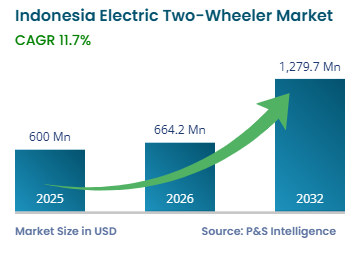
The Indonesian electric two-wheeler market values USD 600.0 million in 2025, and is it projected to reach USD 1279.7 million by 2032, growing at a CAGR of 11.7% during 2026–2032. The market is driven by supportive government policies promoting electrification, rising fuel prices, and the push for low-emission mobility solutions in response to the growing environmental concerns. Indonesia has over 126 million mopeds and motorbikes in circulation. This massive vehicle population creates substantial potential for electric vehicle adoption as the country transitions toward cleaner transportation alternatives.
The increasing urbanization and traffic congestion in major Indonesian cities fuel demand for cost-efficient, compact, and eco-friendly transportation solutions. Decarbonizing the transportation sector is a crucial objective for Indonesia to reach its net-zero emission goal by 2060. This sector accounts for 23% of Indonesia’s emissions, with road transport responsible for 90% of emissions within the sector. This alarming pollution level has accelerated the shift toward electric mobility solutions. The market is further supported by technological advancements in battery efficiency, declining electric vehicle component costs, and improved charging infrastructure across the archipelago.
Indonesia Electric Two-Wheeler Market Growth Factors
Expansion of E-Commerce and Ride-Hailing Services Is Major Market Trend
The rapid expansion of e-commerce delivery and ride-hailing services is a major trend in Indonesia with regards to electric two-wheelers.
Major platforms, including Gojek and Grab, have announced ambitious electrification targets for their fleets.
Gojek, with over 2 million registered drivers for its ride-hailing and delivery services, aims to transition 100% of its fleet to electric vehicles by 2030.
The company has formed Electrum, a joint venture with TBS Energi Utama, planning to supply 2 million e-motorbikes to support this transition.
Grab Indonesia operates approximately 8,500 EVs and plans to increase this number to 26,000 units by 2025.
Gojek has also partnered with Taiwanese battery-swapping electric scooter maker Gogoro and state-owned energy company Pertamina to increase EV infrastructure and supply non-emitting vehicles.
Grab has placed an order for 6,000 electric bikes from local manufacturer Viar Motor and introduced GrabElectric, enabling users to choose electric or hybrid vehicles at the same price as traditional rides.
These fleet electrification initiatives are accelerating infrastructure development while demonstrating the viability of electric two-wheelers for commercial applications.
Rising Fuel Prices and Environmental Concerns Are Driving Consumer Shift
The rising fuel prices and increasing environmental awareness are pushing Indonesian consumers toward electric alternatives.
The September 2022 fuel price hike of approximately 30% significantly impacted the total cost of ownership for conventional motorcycles, making electric options more attractive.
Jakarta and surrounding metropolitan areas recorded PM2.5 levels of 30–55 micrograms per cubic meter in 2024, which is 6–11 times the World Health Organization threshold of 5 micrograms per cubic meter.
The transition to electric vehicles is expected to save 29.79 million barrels of oil equivalent and reduce CO2 emissions by 7.23 million tons.
Government Subsidies and Policy Support Are Offering Opportunities
The Indonesian government has set an ambitious target of deploying 13 million electric two-wheelers by 2030 as part of its broader commitment to achieving net-zero emissions by 2060.
Presidential Regulation No. 55/2019 lays the groundwork for EV industry development, followed by substantial incentives introduced from 2023 onwards.
The government has reduced the VAT from 11% to 1% for electric vehicles meeting the 40% local content requirement.
Additionally, purchase subsidies of IDR 7 million (approximately USD 435) per electric motorcycle have been allocated to support the acquisition of 800,000 new electric motorcycles.
The government also established 1,566 charging stations and 1,772 battery swap facilities by mid-2024, with plans to expand to 48,118 charging stations and 196,179 battery swap units by 2030.
The Low Carbon Emission Vehicle roadmap mandates that electric motorcycles must be produced locally with domestic parts comprising at least 40% in 2023, increasing to 65% in 2024 and expected to reach 80% by 2026.
These localization requirements have attracted significant foreign investment while developing the domestic EV supply chain.
Overall EV sales reached the 100,000 sales milestone for the first time in 2024 with a 62.9% growth rate.
Indonesia Electric Two-Wheeler Market Segmentation Analysis
Product Type Analysis
The scooter category holds the largest share, of 45%, attributed to the preference of first-time buyers and female riders for ease of use and low-seat designs. Electric scooters offer practical features for navigating congested city streets, including compact designs suitable for parking in limited spaces and sufficient storage capacity for daily commuting needs. Major manufacturers have focused their product portfolios on electric scooter models that cater to the Indonesian market's preference for affordable urban mobility solutions.
The motorcycle category is expected to witness the higher CAGR during the forecast period, during 2026–2032, driven by the demand for higher-performance electric two-wheelers, in terms of distance and speed. Electric motorcycles appeal to consumers seeking alternatives to traditional gasoline-powered motorcycles for both urban and intercity travel. The category benefits from technological improvements in battery capacity and motor power, enabling manufacturers to offer electric motorcycles with performance characteristics comparable to conventional models. International brands are entering the Indonesian market with premium electric motorcycle offerings targeting performance-oriented consumers.
These product types are covered:
Scooter (Largest Category)
Motorcycle (Fastest-Growing Category)
Bicycle
Others
Battery Type Analysis
The lithium-ion category dominates the market with 65% share, and it also has the highest CAGR. Lithium-ion batteries are increasingly being preferred due to their higher energy density, longer lifespan, lighter weight, and superior efficiency compared to SLA alternatives. Indonesia Battery Corporation is targeting a local market share of up to 30% for electric motorbikes and has acquired majority stakes in PT Wika Industri Manufaktur and Gesits. The country's position as the world's leading nickel producer provides a strategic advantage for lithium-ion battery manufacturing, with nickel being a critical component in nickel-manganese-cobalt battery cathodes.
These battery types are covered:
Lithium-Ion (Largest and Fastest-Growing Category)
Sealed Lead–Acid (SLA)
Nickel-Metal Hydride (NiMH)
Technology Analysis
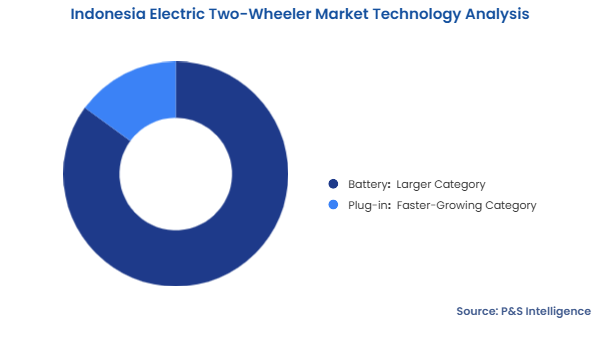
The battery category accounts for the larger share, of 85%, due to their convenience for urban commuters and commercial fleet operators. The battery swapping model addresses range anxiety concerns by enabling quick battery exchanges at designated stations, reducing downtime compared to traditional plug-in charging. Gogoro, partnering with Gojek and Pertamina, has established battery-swapping networks in Jakarta, while PLN, the state-owned electricity company, operates battery swap facilities across the country.
The plug-in category is expected to witness the higher CAGR during the forecast period, driven by improvements in charging infrastructure and consumer preference for home charging convenience. The government's plan to install 31,859 charging stations by 2030 supports the growth of plug-in electric two-wheelers. PLN’s cost of charging is approximately USD 0.11 per kWh, allowing users to travel 100 kilometers for approximately USD 0.57.
These technologies are covered:
Battery (Largest Category)
Plug-in (Fastest-Growing Category)
Range Analysis
The 50–100 km category holds the largest share, of 45%. This range category aligns with the typical daily commuting requirements of Indonesian urban consumers, providing sufficient capacity for round-trip commutes and daily errands without requiring mid-day charging. Most popular electric scooter models from Gesits and Yadea offer ranges between 60 and 100 km on a single charge. The affordability of vehicles in this segment, combined with adequate range for urban use, makes it the preferred choice for personal commuters.
The greater than 150 km category is projected to register the highest growth rate during the forecast period, driven by technological improvements in battery capacity and increasing demand from commercial fleet operators requiring extended range capabilities. Ride-hailing and delivery service providers seek vehicles capable of operating throughout extended work shifts without frequent charging or battery swapping. Premium electric motorcycle models offering ranges exceeding 150 km attract consumers looking for alternatives to conventional motorcycles for intercity travel.
These ranges are covered:
Less than 50 km
50–100 km (Largest Category)
101–150 km
Greater than 150 km (Fastest-Growing Category)
Application Analysis
The personal category dominates the market with 65% share, as individual consumers seek affordable, eco-friendly alternatives for daily commuting. The government subsidy program specifically targeted personal users, prioritizing small and medium enterprises customers and recipients of microcredit programs.
The e-commerce delivery category is expected to register the fastest growth during the forecast period, driven by the expansion of online retail and food delivery services. Gojek and Grab’s large delivery fleets represent a significant potential market for electric two-wheeler conversion. The lower operating costs of electric vehicles, including reduced fuel and maintenance expenses, offer compelling economics for delivery riders who accumulate high daily mileage. E-commerce platforms are increasingly partnering with electric vehicle manufacturers to facilitate fleet electrification, with Gojek forming Electrum to produce electric motorcycles for delivery and ride-hailing.
These applications are covered:
Personal (Largest Category)
E-Commerce Delivery (Fastest-Growing Category)
Sharing Services
Sales Channel Analysis
The offline category holds the larger share, of 70%, reflecting the importance of test rides, warranty discussions, and after-sales service in the purchase decision process. Traditional dealer networks offer consumers the opportunity to physically inspect vehicles, experience handling characteristics, and receive personalized guidance on product selection. Gesits and Yadea have established extensive dealer networks across Indonesia, with Yadea partnering with distributor Indomobil.
The online category is projected to witness the faster growth during the forecast period, as digital-native consumers increasingly research and purchase vehicles through e-commerce platforms. Online channels enable consumers to configure models, compare specifications, and secure loan pre-approvals before visiting showrooms. Manufacturers invest in virtual showrooms and augmented reality applications to preview color options and accessories, while leveraging social media campaigns for marketing. Gesits operates dealerships and service centers that fulfill orders initiated via digital platforms.
These sales channels are covered:
Offline (Largest Category)
Online (Fastest-Growing Category)
Drive strategic growth with comprehensive market analysis
Indonesia Electric Two-Wheeler Market Regional Outlook
DKI Jakarta Electric Two-Wheeler Market Size
DKI Jakarta holds the largest share, of 40%. As the capital city and largest metropolitan area in Indonesia with a population exceeding 10 million, Jakarta represents the primary market for electric two-wheelers driven by severe traffic congestion, air pollution concerns, and concentrated charging infrastructure. Java island had 966 charging stations for electric vehicles as of April 2024, with the majority concentrated in the Greater Jakarta area. The state-owned electricity company, PLN, is establishing battery swap facilities and public charging stations across strategic locations.
The severe pollution has prompted aggressive EV adoption policies and infrastructure investments. The Greater Jakarta area, comprising Jakarta, Bogor, Depok, Tangerang, and Bekasi (Jabodetabek), serves as the testing ground for new electric mobility solutions and battery-swapping networks operated by Gojek, Grab, and Gogoro partnerships.
East Kalimantan Electric Two-Wheeler Market Forecast
East Kalimantan is expected to be the fastest-growing provincial market, with a projected CAGR of approx. 12.5%. The growth is driven by the development of Nusantara, Indonesia's new capital city in this province. The government's plan to transfer key administrative functions to Nusantara has attracted significant investment commitments, with green transportation infrastructure being a core component of the new capital's development plans. The new capital is designed to incorporate sustainable mobility solutions from inception, creating a model for electric vehicle adoption that could influence broader national trends.
The region represents a strategic market given its role in supporting the Indonesian Capital City development. The relatively higher disposable income levels in mining regions and growing environmental awareness among younger demographics support premium electric two-wheeler adoption. Provincial government collaboration with central government agencies is accelerating charging infrastructure deployment ahead of anticipated demand growth from government employees, construction workers, and service providers relocating to support the new capital.
These provinces are covered:
DKI Jakarta (Largest Provincial Market)
West Java
East Java
Central Java
East Kalimantan (Fastest-Growing Provincial Market)
Bali
North Sumatra
South Sulawesi
Rest of Indonesia
Indonesia Electric Two-Wheeler Market Share
The Indonesian electric two-wheeler market is fragmented due to the presence of various local and international players competing across different product segments and price points. The competitive landscape includes established domestic manufacturers, international brands expanding into the Indonesian market, and new entrants backed by technology partnerships and strategic investments.
The market dynamics are characterized by aggressive expansion strategies from international manufacturers seeking to capitalize on Indonesia's position as the third-largest two-wheeler market globally. These entries intensify price and technology competition while driving innovation across the market. Strategic partnerships and joint ventures characterize competitive positioning in the market. These alliances combine manufacturing capabilities, distribution networks, and fleet deployment to accelerate market penetration.
Key Indonesia Electric Two-Wheeler Companies:
PT Wijaya Karya (Persero) Tbk
Yadea Group Holdings Ltd.
Honda Motor Co. Ltd.
PT Astra International Tbk
Yamaha Motor Co. Ltd.
TVS Motor Company Ltd.
Gogoro Inc.
Niu Technologies
Ninebot Technology Co. Ltd.
Vmoto Ltd.
Super Soco Intelligent Technology Group
AIMA Technology Group Co. Ltd.
Luyuan Electric Vehicles Co. Ltd.
TailG Technology Co. Ltd.
Ola Electric Mobility Limited
Ather Energy Pvt. Ltd.
Hero MotoCorp Ltd.
Bajaj Auto Ltd.
Okinawa Autotech Pvt. Ltd.
Kwang Yang Motor Co. Ltd.
Indonesia Electric Two-Wheeler Market News
In June 2025, TVS Motor Company launched its iQube all-electric scooter in Indonesia, featuring a 115-km range and a top speed of 78 km/h, priced at an introductory IDR 29.9 million.
In March 2024, Yadea Technology commences operations at its new Indonesia production base in Cikarang, Bekasi, which has an annual production capacity of 300,000 units.
In July 2024, Hyundai Motor Company inaugurated an EV battery factory in Karawang, built under a joint venture with LG Energy Solution. The factory has an annual capacity of 10 GWh to supply locally-produced battery electric vehicles.
In February 2023, Electrum, a joint venture between Gojek and TBS Energi Utama, formed a partnership with Pertamina and Gogoro to increase EV infrastructure and supply electric vehicles to Gojek's fleet.
Want a report tailored exactly to your business need?
Leading companies across industries trust us to deliver data-driven insights and innovative solutions for their most critical decisions. From data-driven strategies to actionable insights, we empower the decision-makers who shape industries and define the future. From Fortune 500 companies to innovative startups, we are proud to partner with organisations that drive progress in their industries.
Client Testimonials
Working with P&S Intelligence and their team was an absolute pleasure – their awareness of timelines and commitment to value greatly contributed to our project's success. Eagerly anticipating future collaborations.
McKinsey & Company
India
Unmatched Standards
Our insights into the minutest levels of the markets, including the latest trends and competitive landscape, give you all the answers you need to take your business to new heights
Complete Data Security
We take a cautious approach to protecting your personal and confidential information. Trust is the strongest bond that connects us and our clients, and trust we build by complying with all international and domestic data protection and privacy laws