Indonesia Battery Recycling Market Size & Share Analysis - Emerging Trends, Growth Opportunities, Competitive Landscape, and Forecasts (2026 - 2032)
This Report Provides In-Depth Analysis of the Indonesia Battery Recycling Market Report Prepared by P&S Intelligence, Segmented by Battery Type (Lead-Acid, Lithium-Ion, Nickel), Application (Transportation, Consumer Electronics, Industrial), Recycling Process (Hydrometallurgical, Pyrometallurgical, Physical/Mechanical), Material (Metals, Electrolyte, Plastics), and Geographical Outlook for the Period of 2019 to 2032
Explore the market potential with our data-driven report
Indonesia Battery Recycling Market Outlook
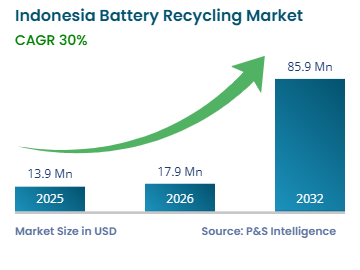
The Indonesian battery recycling market values USD 13.9 million in 2025, and it is projected to reach USD 85.9 million by 2032, registering a CAGR of 30.0% during the forecast period (2026–2032). The market is witnessing substantial growth driven by the rapid expansion of Indonesia's electric vehicle ecosystem, the government's commitment to establishing a circular battery economy, and the country's strategic position as a global leader in nickel production for battery materials. Indonesia's ambitious target of deploying 2 million electric cars and 13 million electric two-wheelers by 2030 is generating significant end-of-life battery volumes that will require efficient recycling infrastructure.
The Indonesian Ministry of Environment and Forestry launched a program in 2023 to establish battery recycling facilities nationwide, targeting at least 30% of used batteries to be recycled by 2025. This initiative aligns with Presidential Regulation No. 55/2019, which mandates that end-of-life batteries from battery-based electric vehicles must be recycled. The government is actively providing fiscal and non-fiscal incentives for companies operating in battery recycling, including tax exemptions and import duty reductions. Indonesian Battery Corporation is coordinating efforts to develop an integrated battery value chain that includes recycling capabilities.
The country's vast nickel reserves, estimated at over 55 million metric tons, position it to benefit from battery material recovery operations. Indonesia dominated global nickel production from 2020 to 2024 with a 47% share, and this share is expected to increase to 63% by 2030. The recovery of nickel, cobalt, lithium, and other valuable metals from spent batteries presents a significant economic opportunity while reducing dependence on primary mining operations.
Indonesia Battery Recycling Market Growth Factors
Rising Sale of Electric Vehicles Is Major Trend
As per the International Council on Clean Transportation, the sales of battery electric vehicles in Indonesia increased from 0.1% of new car sales in 2021 to 4.8% during the initial four months of 2024.
This puts Indonesia's EV penetration at approximately 5% of national car sales.
Electric motorcycle sales crossed 100,000 units for the first time, driven by targeted government subsidies. As of the end of 2024, Indonesia had approximately 195,000 registered EVs, with more than four out of five being electric motorcycles.
The government has committed IDR 7 trillion (USD 455 million) to subsidize 800,000 new electric motorcycle purchases.
This accelerating adoption is creating a substantial pipeline of batteries that will eventually require recycling, particularly as the SLA batteries used in electric mopeds typically last only one to three years.
Government Policies and Circular Economy Initiatives Drive Market
The Indonesian government has established a comprehensive regulatory framework to support battery recycling.
Presidential Regulation No. 55/2019 requires that battery waste from electric vehicles be managed through recycling and proper waste management processes.
The Minister of Industry Regulation 6/2022 sets a target for the battery reuse and recycling industry to be operational by 2030.
Regulation of the Minister of Environment and Forestry No. 9/2024 require individuals and businesses generating hazardous trash, including used batteries, to sort them and implement reduce, recycle, and reuse practices.
The government provides fiscal incentives for battery recycling operations, including tax exemptions and reduced electricity tariffs.
These policy measures are creating a favorable environment for investment in recycling infrastructure and technology.
Indonesia Battery Recycling Market Segmentation Analysis
Battery Type Analysis
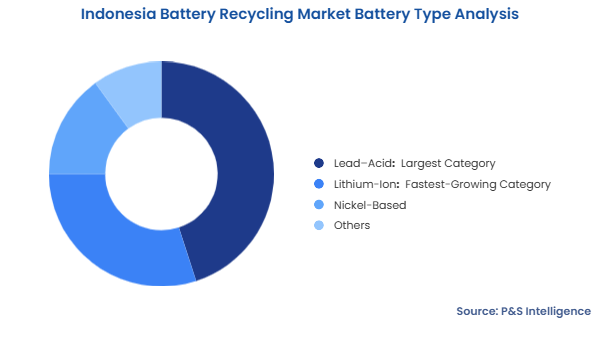
The lead–acid category holds the largest share in the Indonesian battery recycling market in 2025, of 45%. This dominance is attributed to the established recycling infrastructure for lead–acid batteries, which have been used extensively in conventional vehicles and backup power systems for decades. Indonesia has achieved high collection rates for spent lead–acid batteries, among the highest of any consumer product, enabling efficient secondary lead production. Integrated players operate closed-loop systems where scrap is refined and fed back into plates, lowering carbon intensity and raw material risk. The category benefits from formalized core deposits and dealer take-back programs, which improve compliance and reduce leakage into informal channels.
The lithium-ion category is expected to register the fastest growth during the forecast period. This rapid expansion is driven by the accelerating adoption of electric vehicles, consumer electronics, and energy storage systems that predominantly use lithium-ion technology. Indonesia currently has only small-scale recycling operations for lithium batteries, constrained by outdated regulations that classify battery waste simply as waste rather than as a resource. However, major investments like CATL's battery integration project are establishing industrial-scale lithium-ion battery recycling capabilities using advanced hydrometallurgical processes.
These battery types are covered:
Lead–Acid (Largest Category)
Lithium-Ion (Fastest-Growing Category)
Nickel-Based
Others
Application Analysis
The transportation category dominates the Indonesian battery recycling market in 2025 with a share of 45%, driven by the country's extensive vehicle fleet. Indonesia had 125 million motorcycles in circulation as of 2022, and these vehicles predominantly use batteries that require regular replacement. The automotive aftermarket generates significant volumes of spent starter, lighting, and ignition batteries, while the growing electric vehicle category is adding lithium-ion and sealed lead acid batteries to the recycling stream. The government's target of 2 million electric cars and 13 million electric motorcycles by 2030 will substantially increase battery recycling requirements from this category.
The industrial category is set to witness the fastest growth during the forecast period. Indonesia's expanding telecom infrastructure, data centers, and manufacturing facilities require reliable backup power systems that use industrial batteries with finite lifespans. The rapid growth of telecom towers, mobile base stations, and internet backbone facilities drives demand for sealed lead–acid batteries that ensure continuity during grid failures. Additionally, the mining, metals, and pharmaceutical industries rely on batteries for various applications. As Indonesia develops its renewable energy sector and energy storage systems, industrial battery recycling will become increasingly important.
These applications are covered:
Transportation (Largest Category)
Consumer Electronics
Industrial (Fastest-Growing Category)
Others
Recycling Process Analysis
The pyrometallurgical process holds the largest share in the Indonesian battery recycling market in 2025, of 65%. This heat-based extraction process has been the established technology for lead–acid battery recycling in Indonesia for decades, using high temperatures (1,200–1,600°C) to smelt battery materials and recover metals. Pyrometallurgy offers flexibility in handling diverse battery chemistries with minimal sensitivity to feedstock composition, making it ideal for processing mixed battery waste without extensive sorting.
The process generates cobalt, copper, and nickel alloys from the smelting operation, which can then be further refined. Indonesia's mature lead–acid battery recycling infrastructure, which achieves high collection rates, predominantly relies on pyrometallurgical processes. Integrated players operate closed-loop systems where scrap is smelted and refined before being fed back into new battery production.
The hydrometallurgical process is expected to witness the fastest growth during the forecast period, driven by the rapid expansion of lithium-ion battery recycling and major investments in advanced recycling technologies. Hydrometallurgy uses aqueous solutions to extract metals through leaching, purification, and recovery steps, operating at significantly lower temperatures (60–90°C) compared to pyrometallurgy. This results in reduced greenhouse gas emissions and energy consumption by 70–80%. Modern hydrometallurgical facilities can achieve recovery rates of 95–99% for cobalt, nickel, and lithium, whereas pyrometallurgical methods often lose lithium to slag.
These recycling processes are covered:
Pyrometallurgical (Largest Category)
Hydrometallurgical (Fastest-Growing Category)
Physical/Mechanical
Material Analysis
The metals category dominates the Indonesian battery recycling market in 2025 with a share of 40%, driven by the high economic value of recovered materials. Lead recovery from lead–acid batteries represent the most mature recycling stream, with Indonesia achieving high collection and recovery rates. For lithium-ion batteries, recovered metals include lithium, cobalt, nickel, manganese, copper, and aluminum. The cobalt is primarily produced as a by-product of nickel processing through High Pressure Acid Leaching operations that produce mixed hydroxide precipitate containing both nickel and cobalt.
The electrolyte category is expected to witness the fastest growth during the forecast period, driven by increasing environmental regulations and advancing recovery technologies. Electrolyte recovery from spent lithium-ion batteries has become a priority as Indonesia scales up its battery recycling infrastructure to handle the growing volumes from electric vehicle adoption. Battery electrolytes contain hazardous lithium salts, which pose environmental and health risks if improperly disposed, making their recovery essential for regulatory compliance under the Minister of Environment and Forestry Regulation No. 9/2024.
These materials are covered:
Metals (Largest Category)
Lead
Lithium
Cobalt
Nickel
Manganese
Copper
Aluminum
Others
Electrolyte (Fastest-Growing Category)
Plastics
Others
Drive strategic growth with comprehensive market analysis
Indonesia Battery Recycling Market Geographical Analysis
West Java Battery Recycling Market Size
West Java holds the largest share of the Indonesian battery recycling market in 2025, of 40%. The province's dominance stems from its position as Indonesia's industrial heartland, hosting major manufacturing clusters, ports, and logistics infrastructure. Industrial estates in Cikarang and Karawang have been instrumental in attracting battery-related investments.
The groundbreaking of CATL's USD 6-billion Indonesian battery Integration Project at Karawang New Industry City represents a transformative development for the province's battery recycling capabilities. This facility, developed in partnership with PT Aneka Tambang and Indonesian Battery Corporation, will establish Indonesia's largest battery recycling operation with a capacity to process 20,000 tons of recycled batteries annually. West Java's proximity to the greater Jakarta metropolitan area, with its substantial vehicle fleet and consumer electronics market, ensures a steady supply of spent batteries for recycling operations.
North Maluku Battery Recycling Market Outlook
North Maluku is projected to be the fastest-growing province for battery recycling during the forecast period, with 30.5% CAGR. The province has emerged as Indonesia's best-performing region economically, with a remarkable 20.5% GDP growth in 2023 driven primarily by nickel mining and manufacturing. North Maluku attracted USD 5 billion in foreign direct investment in 2023, mainly into the nickel sector. The FHT Industrial Park in East Halmahera will host the battery recycling component of CATL's integrated battery project, establishing Indonesia's first renewable energy circular system with nickel mining and processing, battery materials, and battery recycling operations.
Key projects like the Obi Island Industrial Area and the Sonic Bay HPAL Complex, a USD 2.6 billion venture between Eramet and BASF, are further strengthening the province's position in the battery materials supply chain. The integration of recycling capabilities with primary nickel processing creates synergies that position North Maluku as a hub for circular battery materials production.
These provinces are covered:
West Java (Largest Province)
East Java
Banten
Central Sulawesi
North Maluku (Fastest-Growing Province)
East Kalimantan
Rest of Indonesia
Indonesia Battery Recycling Market Share
The Indonesian battery recycling market is fragmented due to a mix of established lead–acid battery recyclers, emerging lithium-ion battery recycling startups, and major multinational corporations entering through integrated battery value chain investments. The market structure varies significantly by battery type, with lead–acid recycling being relatively consolidated among established players while lithium-ion battery recycling remains nascent with few operational facilities. The top 10 players collectively account for less than 40%, reflecting the market's fragmented nature and the opportunity for new entrants.
Major competitive strategies in the market include vertical integration across the battery value chain, strategic partnerships between domestic companies and international technology providers, and investment in advanced recycling technologies. For lead–acid battery recycling, domestic companies maintain established operations serving the automotive aftermarket. International players have a significant presence in the broader Indonesian lead–acid battery market, with associated recycling activities. The lithium-ion battery recycling category is seeing entry by global players seeking to secure battery material supply chains, with companies like Umicore expanding operations and promoting circular economy initiatives through recycling activities.
Key Indonesia Battery Recycling Companies:
Guangdong Brunp Recycling Technology Co. Ltd.
Indonesian battery Corporation (IBC)
PT Aneka Tambang Tbk (ANTAM)
PT Century Batteries Indonesia
PT Trimitra Baterai Prakasa
PT Yuasa Battery Indonesia
GS Yuasa International Ltd.
Umicore
EnerSys
LG Energy Solution
Indonesia Battery Recycling Market News
In May 2025, Tianneng introduced its TNEP high-temperature VRLA battery series for the Indonesian market, manufactured using over 40% recycled lead, demonstrating the growing integration of recycled materials in battery production.
In July 2024, the Indonesian Ministry of Environment and Forestry promulgated Regulation No. 9/2024 on Management of Trash Containing Hazardous Substances and Hazardous Waste, requiring individuals and businesses to sort used batteries and implement reduce, recycle, and reuse practices.
In March 2024, LG Energy Solution expanded its operations in Indonesia by launching a research and development center in Jakarta focused on developing battery technologies for electric vehicles and renewable energy storage, supporting Indonesia's goal of becoming a major hub for EV production in Southeast Asia.
In January 2024, Indonesian battery Corporation announced plans to build a new lithium-ion battery production facility in partnership with industry leaders, aimed at strengthening the domestic battery supply chain and supporting the development of integrated recycling capabilities.
Want a report tailored exactly to your business need?
Leading companies across industries trust us to deliver data-driven insights and innovative solutions for their most critical decisions. From data-driven strategies to actionable insights, we empower the decision-makers who shape industries and define the future. From Fortune 500 companies to innovative startups, we are proud to partner with organisations that drive progress in their industries.
Client Testimonials
Working with P&S Intelligence and their team was an absolute pleasure – their awareness of timelines and commitment to value greatly contributed to our project's success. Eagerly anticipating future collaborations.
McKinsey & Company
India
Unmatched Standards
Our insights into the minutest levels of the markets, including the latest trends and competitive landscape, give you all the answers you need to take your business to new heights
Complete Data Security
We take a cautious approach to protecting your personal and confidential information. Trust is the strongest bond that connects us and our clients, and trust we build by complying with all international and domestic data protection and privacy laws