India Watch Market Size & Share Analysis - Trends, Drivers, Competitive Landscape, and Forecasts (2026 - 2032)
This Report Provides In-Depth Analysis of the India Watch Market Report Prepared by P&S Intelligence, Segmented by Type (Quartz/Analogue, Digital, Smartwatches), Gender (Men, Women, Unisex), Age group (Below 18, 18, 36, Above 55 Years), Price Range (Low-Range/Mass, Mid-Range, Premium/Luxury), Distribution Channel (Offline, Online), and Geographical Outlook for the Period of 2021 to 2032
Explore the market potential with our data-driven report
India Watch Market Future Prospects
India Watch Market Key Insights
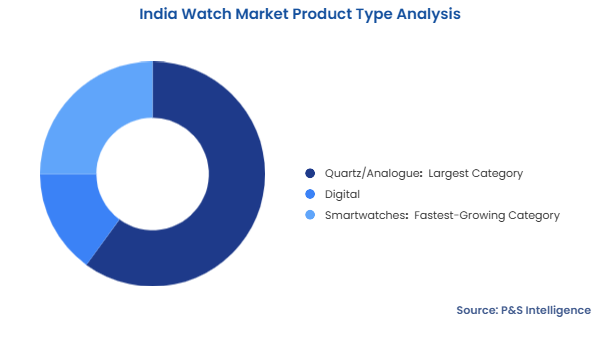
Quartz/analogue watches constitute the largest product category, accounting for 60% market revenue in 2025.
Women have the highest CAGR, of approximately 7.2%, through 2032, primarily driven by the rising female working population.
The 18–35 years category is both the largest and fastest-growing, with 45% share and approximately 7.0% CAGR.
The low-range/mass market category accounts for 60% market revenue in 2025.
Maharashtra is the largest state market in 2025, with 25% share, and Karnataka is the fastest-growing state market, with approximately 7.5% CAGR.
India Watch Market Overview
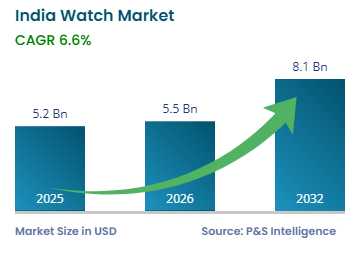
The Indian watch market was valued at USD 5.2 billion in 2025 and it is projected to reach USD 8.1 billion by 2032, expanding at a compound annual growth rate (CAGR) of 6.6% during the forecast period of 2026–2032. This robust growth trajectory is anchored by the rising household disposable incomes, accelerating adoption of smartwatches among digitally native consumers and deepening cultural perception of branded timepieces as status symbols and aspirational lifestyle accessories.
The Production-Linked Incentive (PLI) scheme for electronics and wearables, administered through the Ministry of Electronics and Information Technology, has driven a transformative shift in domestic manufacturing capabilities. The PLI-enabled investments in India cumulatively crossed INR 1.88 lakh crore as of June 2025, generating over INR 17 lakh crore in production output, according to the Department for Promotion of Industry and Internal Trade (DPIIT). Within the watch category specifically, domestic smartwatch assembly surged from just 4% of total shipments in Q3 2022 to 82% in Q3 2023, reducing import dependence and enabling competitive local pricing in the sub-INR 5,000 tier.
Demand-side tailwinds further reinforce the market’s expansion, supported by India’s large working-age population and a significant youth cohort, with over 65% of the population under 35 years of age, driving consumption across segments. Female workforce participation in India reached 41.7% in 2023–24, as reported by the Ministry of Statistics and Programme Implementation Periodic Labour Force Survey (PLFS), contributing to incremental demand for professional and aesthetically designed timepieces targeted at women.
India Watch Market Emerging Trends and Growth Drivers
Smartwatch Integration and Premiumisation Are Key Trends
The key trend in the market is the rising demand for smartwatches, which is shaped by consumer age, income and lifestyle. For the 25–45-year-old urban professionals, the primary purchase trigger is proactive health monitoring, grounded in an escalating and well-documented NCD burden. As per the Indian Council of Medical Research, diabetes prevalence stands at 11.4% (101 million adults), prediabetes at 15.3%, hypertension at 35.5%, generalised obesity at 28.6% and dyslipidaemia at 81.2% of the adult population. Critically, the ICMR-INDIAB study confirmed that all metabolic NCDs except prediabetes are more prevalent in urban than rural areas.
For teens and young adults aged 15–24, the purchase calculus is fundamentally different. Recent surveys have found that most first-time buyers choose models that cost below INR 3,000, mainly for Bluetooth calling, notification access from social media apps and music control. Surveys further found that 72% of the youth users are dissatisfied with durability and fitness tracking accuracy of entry-level devices. This signals a large, structurally motivated upgrade cohort within the 18–25 demographic as income grows and product expectations rise. Notification checking, social media connectivity and messaging/calling functions are the primary use cases among younger users, while health and activity tracking dominates among those aged 30 and above.
Rising Incomes and Female Workforce Participation Drive Market
India's watch market is driven by the sustained growth in household income and a near-doubling of female labour force participation over seven years. These factors create a higher purchasing power and consumer volume, sustaining multi-segment demand across conventional, fashion and connected timepiece categories. As per the National Statistics Office (NSO) of the MoSPI, the per capita net national income rose from INR 1,59,557 in FY 2022–23 to INR 1,76,465 in FY 2023–24 and INR 1,92,774 in FY 2024–25. This income trajectory is reinforced by the escalating household consumption expenditure. MoSPI's Provisional Estimates of Annual GDP (May 2025) confirmed that private final consumption expenditure (PFCE) grew at 7.2% in FY 2024–25, compared to the 5.6% growth recorded in FY 2023–24. The same release confirmed nominal GDP growth of 9.8% in FY 2024–25 and real GDP growth of 6.5%, driven by private consumption.
The female workforce dimension compounds this demand and introduces a new consumer base with distinct preferences, purchase motivations and brand sensitivities are distinct from males’. MoSPI's Periodic Labour Force Survey (PLFS) 2023–24 documents that the female labour force participation rate (LFPR) rose from 23.3% in 2017–18 to 41.7% in 2023–24. This represents an 18.4 percentage point increase at the national level. The female LFPR in urban areas expanded from 20.0% in 2017–18 to 42.2% in 2023–24, while the female worker population ratio (WPR) rose from 22.0% to 40.3% over the same period.
India–EFTA Trade Agreement Offering Opportunities in Luxury Watch Segment
The India–European Free Trade Association (EFTA) Trade and Economic Partnership Agreement is creating a material structural opportunity for the premium and luxury watch category. This is being done by progressively dismantling India’s historically high import duty regime on Swiss timepieces. Under the agreement’s phased schedule, import duties on Swiss watches have declined from 22% to 15.7% and will be fully eliminated to 0% by 2031 under the India–European Free Trade Association (EFTA) Trade and Economic Partnership Agreement (TEPA).
The Federation of the Swiss Watch Industry reported that Swiss watch exports to India reached CHF 128.3 million in the first half of 2025, representing a 12.7% increase year-on-year and a 30.2% increase compared to H1 2023. This signals accelerating pre-tariff and post-announcement demand from India’s luxury consumer base. Initial retail price reductions of 10–20% are already enabling brands such as Rolex, Omega and Breitling to expand their mono-brand boutique networks in Mumbai, Delhi and Bengaluru.
Unorganised Sector and Counterfeit Products Constrain Market Growth
The proliferation of the unorganised watch sector—comprising local assemblers, grey market imports and counterfeit products—represents a material structural constraint on organised market revenue growth, particularly at the mass-market price tier. In Tier III cities and rural markets, unorganised players dominate distribution, frequently underpricing organised brands by 60–80% through the use of unbranded or counterfeit movements.
Coastal states, notably Kerala, have experienced repeated counterfeit watch seizures at major ports, indicating active grey market import channels. While major brands have deployed authentication technologies including QR-coded warranties and serialised packaging, enforcement remains operationally challenging due to geographic dispersion, limiting the deterrent effect of existing anti-counterfeiting measures.
India Watch Market Segmentation Analysis
Product Type Analysis
Quartz/analogue watches constitute the largest product category, accounting for 60% market revenue in 2025, sustained by a deeply embedded cultural preference for traditional timepieces and the mass-market accessibility of models priced below INR 5,000. Titan Company Limited’s Sonata and Fastrack sub-brands, alongside Casio India and Timex, maintain extensive multi-channel distribution networks, which sustain high volume throughput in this category.
Smartwatches represent the fastest-growing product category through 2032. This is driven by health consciousness, PLI-enabled domestic manufacturing and the sub-INR 2,000 price point now accessible through locally assembled models from Xiaomi and boAt. Apart from health tracking, people buy these products for their high social status, office work and hands-free communication features.
The product types analysed in this report include:
Quartz/Analogue (Largest Category)
Digital
Smartwatches (Fastest-Growing Category)
Gender Analysis
Men dominate the market with 55% revenue in 2025, reflecting the enduring cultural association between watches and male professional and social identity across urban and semi-urban India. Men’s watches span the full price spectrum, from mass-market quartz models to ultra-luxury Swiss mechanical pieces, providing brands with broad addressable market width within a single gender category.
Women have the higher CAGR through 2032, primarily driven by the rising female working population, which generates a demand for watches that convey professional credibility and personal style. Titan (Raga collection), Fossil and Citizen are actively expanding women-specific product lines integrating health tracking with fashion-forward aesthetics.
The genders analysed in this report include:
Men (Largest Category)
Women (Fastest-Growing Category)
Unisex
Age Group Analysis
The 18–35 years category is both the largest and fastest-growing, with 45% share and approximately 7.0% CAGR, as it buys everything from affordable smartwatches to premium lifestyle timepieces. The World Economic Forum notes that nearly 65% of India’s population is under 35 years of age, providing an exceptionally large and demographically concentrated consumer base for watch brands. Their digital nativity drives strong online channel preference, accelerating e-commerce watch sales through platforms including Amazon India, Flipkart and brand-operated direct-to-consumer (D2C) storefronts.
The age groups analysed in this report include:
Below 18
18–35 Years (Largest and Fastest-Growing Category)
36–55 Years
Above 55 Years
Price Range Analysis
The low-range/mass market category accounts for 60% market revenue in 2025, reflecting India’s predominantly price-sensitive consumer base and the dominance of Titan’s Sonata and Fastrack labels, alongside Casio and Timex in this tier. This category serves the growing aspirational middle class seeking branded quality without entry into premium price territory, with Citizen, Casio Edifice and Titan’s core range typically priced between INR 5,000 and INR 50,000.
The premium/luxury category is the fastest-growing segment through 2032, driven by rising household incomes, EFTA-enabled duty reductions on Swiss imports and intensifying aspirational consumption among India’s expanding affluent class. Growth is further supported by the rapid expansion of luxury retail, increasing brand visibility through e-commerce and social media, and rising demand for globally recognized Swiss marques among younger, urban, high-net-worth consumers.
The price ranges analysed in this report include:
Low-Range/Mass (Largest Category)
Mid-Range
Premium/Luxury (Fastest-Growing Category)
Distribution Channel Analysis
Offline retail channels retain the dominant position with 75% market revenue in 2025. Mono-brand specialty stores generate highest average transaction values and enable the tactile evaluation experience that Indian consumers especially value for premium and luxury purchases. Titan’s retail network spans over 3,000 touchpoints nationwide, including its World of Titan exclusive brand outlets and a wide network of multi-brand retailers. Multi-brand specialty retailers, including Ethos Watch Boutiques, provide curated multi-label environments for premium and ultra-luxury category consumers. Supermarkets and hypermarkets, convenience and general trade stores, department stores and duty-free airport retail collectively serve the mass-market and impulse-gifting segments.
Online channels are expanding at the highest CAGR, of approximately 6.8%, through 2032. Third-party e-commerce platforms, such as Amazon and Flipkart, are gaining rapid popularity. Brand-owned D2C stores provide controlled premium positioning and higher margin retention. Social and quick commerce, encompassing Instagram Shop and ONDC-enabled transactions, constitutes the fastest-growing online sub-channel. The Department for Promotion of Industry and Internal Trade (DPIIT) Year-End Review reported that ONDC processed 326 million orders by October 2025, reflecting the rapid mainstreaming of open-network commerce channels accessible to watch brands of all sizes.
E-commerce accounts for roughly 7–8% of India’s total retail sales. As per the IBEF, e-retail sales to 270 million shoppers in India generated above INR 5 lakh crore (USD 60 billion) in gross merchandise value (GMV). As internet penetration, digital payments and logistics infrastructure improve, online retail’s share of total retail spending would approach 10% in the coming years.
The distribution channels analysed in this report include:
Offline (Larger Channel)
Mono-Brand Specialty Stores
Multi-Brand Specialty Retailers
Supermarkets/Hypermarkets
Convenience/General Trade
Department Stores
Duty-Free/Airport Retail
Online (Faster-Growing Channel)
Third-Party E-Commerce
Brand Direct-to-Consumer (D2C)
Social/Quick Commerce
Drive strategic growth with comprehensive market analysis
India Watch Market Regional Growth Dynamics
Maharashtra Watch Market Analysis
Maharashtra is the largest state market in 2025, with 25% share, driven by Mumbai’s position as India’s financial capital and its dense concentration of high-net-worth individuals, luxury mono-brand boutiques and ultra-premium retail destinations. Pune and Nagpur further reinforce the state’s contribution through a growing upper-middle-class population with strong aspirational consumption patterns. The state also dominates India’s broader investment ecosystem, attracting USD 19.6 billion in FDI in FY 2024–25, representing 31% of India’s total inflows, as per the DPIIT. This reflects the depth of organised retail and consumer spending infrastructure that enables premium watch market development.
Karnataka Watch Market Share
Karnataka is the fastest-growing state market, with approximately 7.5% CAGR, powered almost entirely by Bengaluru’s expanding IT and startup workforce. This demographic is characterised by high disposable incomes, digital-native consumption behaviour and preference for smartwatches and connected wearables. Brand investment in the state mirrors this trajectory, with DPIIT data confirming Karnataka attracted USD 6.62 billion in FDI during FY 2024–25. This underpins Bengaluru’s emergence as India’s primary nexus for technology-enabled consumer goods, including premium and smart timepieces.
Delhi Watch Market Scenario
Delhi represents one of India's most concentrated watch markets, underpinned by the country's highest per capita income levels and a dense concentration of salaried professionals, government officials and corporate decision-makers. The capital's large government and public sector workforce drives significant gifting demand, particularly around Republic Day, Independence Day, and Diwali corporate gifting cycles. The formal dress codes in bureaucratic and diplomatic circles sustain mechanical and analogue watch purchases at premium price points. A large chunk of the population is employed in the IT/ITeS, finance, law, and consultancy sectors. The expansion of the Delhi Metro network improves footfall to organized retail zones. Moreover, the city's aspiring middle class is increasingly treating branded watches as lifestyle markers rather than functional accessories.
The states analysed in this report include:
Maharashtra (Largest State)
Karnataka (Fastest-Growing State)
Delhi (NCT)
Tamil Nadu
Gujarat
Telangana
Rajasthan
West Bengal
Rest of India
India Watch Market Share Analysis
India’s watch market exhibits a moderately concentrated structure at the organised tier, anchored by a dominant domestic incumbent alongside a cluster of international and technology-sector challengers. This concentration is sustained by significant distribution network advantages, manufacturing scale economies and decades of brand equity investment that create meaningful entry barriers for new participants. The unorganised category—comprising local assemblers and counterfeit products—accounts for a substantial share of total unit volume at the mass-market end. This introduces fragmentation in lower price tiers that contrasts with the tighter competitive structure observed across mid-range and premium categories.
Top Companies in the India Watch Market:
Titan Company Limited
Timex Group B.V.
Casio Computer Co. Ltd.
Citizen Watch Co. Ltd.
Rolex SA
Apple Inc.
Xiaomi Corporation
Imagine Marketing Limited
Fossil Group Inc.
Seiko Holdings Corporation
Swatch Group Ltd.
Movado Group Inc.
LVMH Moet Hennessy Louis Vuitton SE
Huawei Technologies Co. Ltd.
Oppo Electronics Corp.
Garmin Ltd.
TAG Heuer SA
Montblanc International GmbH
India Watch Market News
In December 2025, Titan Company Limited partnered with Ducati as its exclusive licensing and retail distribution partner in India to launch a 43-piece watch collection priced between INR 14,799 and INR 27,999. It is distributed through Helios, World of Titan and multi-brand outlets across major metros. The collaboration extends Titan’s mid-range portfolio into the motorsport lifestyle category, targeting India’s growing base of aspirational male consumers and Ducati enthusiasts seeking branded merchandise beyond motorcycles.
In August 2025, Casio Computer Co. Ltd. unveiled its latest range of locally manufactured watches and commenced nationwide distribution across organised retail channels.
In April 2025, Xiaomi Corporation launched the Redmi Watch Move—priced at INR 1,999 and produced at Optiemus Electronics’ Noida facility. It features a 1.85-inch AMOLED display, 140+ workout modes, Bluetooth calling and Hindi language interface support.
Frequently Asked Questions About This Report
What was India watch market size in 2025?+
In 2025, the watch market in India was valued at USD 5.2 billion.
Which product type has the largest the India watch industry share?+
Quartz/analogue watches have the largest India watch industry share, of 60%.
Which state has the highest India watch market CAGR?+
Karnataka has the highest CAGR in the watch market of India, of approximately 7.5%.
What are the key India watch industry drivers?+
The major drivers for the India watch market are the rising household disposable incomes, accelerating adoption of smartwatches among digitally native consumers and deepening cultural perception of branded timepieces as status symbols and aspirational lifestyle accessories.
What is India watch market nature?+
The watch market in India is moderately consolidated.
Want a report tailored exactly to your business need?
Leading companies across industries trust us to deliver data-driven insights and innovative solutions for their most critical decisions. From data-driven strategies to actionable insights, we empower the decision-makers who shape industries and define the future. From Fortune 500 companies to innovative startups, we are proud to partner with organisations that drive progress in their industries.
Client Testimonials
Working with P&S Intelligence and their team was an absolute pleasure – their awareness of timelines and commitment to value greatly contributed to our project's success. Eagerly anticipating future collaborations.
McKinsey & Company
India
Unmatched Standards
Our insights into the minutest levels of the markets, including the latest trends and competitive landscape, give you all the answers you need to take your business to new heights
Complete Data Security
We take a cautious approach to protecting your personal and confidential information. Trust is the strongest bond that connects us and our clients, and trust we build by complying with all international and domestic data protection and privacy laws