India Two-wheelers, Three-wheelers, and Cab Service Market Size & Share Analysis - Emerging Trends, Growth Opportunities, Competitive Landscape, and Forecasts (2025 - 2032)
This Report Provides In-Depth Analysis of the India Two-wheelers, Three-wheelers, and Cab Service Market Report Prepared by P&S Intelligence, Segmented by Service Type (Two-Wheelers, Three-Wheelers, Cab), Booking Mode (Online, Offline), Propulsion Type (ICE Vehicles, Electric Vehicles), Electric Vehicles (End User, Daily Commuters, Tourists/ Travelers, Corporate/Business Users, Logistics/Delivery Workers), and Geographical Outlook for the Period of 2019 to 2032
India Two-wheelers, Three-wheelers, and Cab Service Market Valuation
Key Highlights
Study Period
2019 - 2032
Market Size in 2024
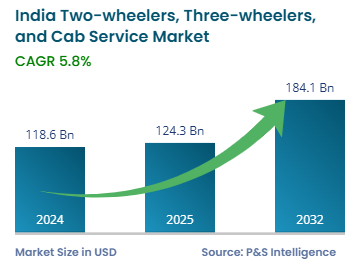
USD 118.6 Billion
Market Size in 2025
USD 124.3 Billion
Market Size by 2032
USD 184.1 Billion
Projected CAGR
5.8%
Largest Region
South
Fastest Growing Region
East
Market Structure
Consolidated
Market Size
Major Companies
Important Takeaways
Market Size and Forecast
Industry Trend
Regulatory Landscape
Demand Trend Analysis
Companies Recent Strategical Developments
Key Stakeholders
Voice of Industry Experts/KOLs
Future Opportunity
Explore the market potential with our data-driven report
India Two-wheelers, Three-wheelers, and Cab Service Market Analysis
The Indian two-wheeler, three-wheeler, and cab service market size was worth USD 118.6 billion in 2024, and it will grow by 5.8% during 2025–2032, to reach USD 184.1 billion by 2032.
The market's remarkable expansion is primarily driven by rapid urbanization, increasing smartphone penetration, and the growing demand for affordable and convenient mobility solutions across India's diverse urban landscape.
The transformation of India's urban mobility ecosystem has been driven by the rise of app-based booking platforms and the shift toward shared mobility services. According to government projections and World Bank estimates, India's urban population is expected to reach 600 million, or 40% of the population by 2036, up from 31% in 2011. By then, urban areas are projected to contribute almost 70% to the country’s GDP. This demographic shift has created unprecedented demand for efficient, affordable, and accessible transportation options, particularly for last-mile connectivity. The integration of electric vehicles across all service categories, supported by government initiatives and technological advancements, is reshaping the market dynamics and creating new opportunities for service providers and commuters alike.
The market has also witnessed a significant shift toward subscription-based revenue models, particularly in the bike taxi and auto-rickshaw segments, making services more affordable for daily commuters while providing stable income opportunities for drivers. This transformation, coupled with the growing emphasis on sustainable mobility solutions and the expansion of services into tier 2 and tier 3 cities, positions the Indian two-wheeler, three-wheeler, and cab services market for sustained growth throughout the forecast period.
India Two-wheelers, Three-wheelers, and Cab Service Market Growth Factors
Subscription-Based Revenue Models Are Key Trend
The shift from commission-based to subscription-based revenue models has completely changed the economics of mobility services in India.
Traditional platforms charged commissions up to 30% on fares, but the subscription-based model allows drivers to pay a fixed fee, which is generally lower.
This transformation has been particularly pronounced in the bike taxi and auto-rickshaw segments, where platforms like Rapido have leveraged this model to offer fares that are 10-15% cheaper than traditional commission-based services.
The subscription model has created a win-win situation for both drivers and platforms.
Drivers benefit from higher take-home earnings as they retain a larger portion of fare revenue after paying the fixed subscription fee.
This predictable cost structure enables better financial planning and has attracted more drivers to join these platforms.
For platforms, the subscription model provides steady, predictable revenue streams while reducing the complexity of transaction-based commission calculations.
The model helped companies expand quickly in new cities by resulting in low running costs, which makes it easier to operate in small towns with reduced fares.
Competition among platforms has intensified as they vie to attract and retain drivers through competitive subscription pricing and additional benefits.
Some platforms offer tiered subscription plans with varying benefits, including priority booking allocation, insurance coverage, and fuel discounts.
This evolution has democratized access to technology platforms for small-scale operators and individual drivers who previously relied on street hailing or informal booking networks.
Smartphone Penetration and Digital Payment Adoption Are Biggest Driver
The exponential growth in smartphone adoption and internet connectivity has revolutionized access to mobility services across India, making it a key driver of market expansion.
The widespread adoption of smartphones and affordable internet access has transformed India's taxi market, with app-based services like Ola, Uber, and Rapido providing immediate trips.
With smartphone penetration reaching over 60% in metropolitan areas and rapidly expanding in smaller cities, millions of commuters now have instant access to multiple transportation options at their fingertips.
According to reports, in January 2023, India had more than 700 million active internet users, including 425 million in rural areas; 650 million have at least one smartphone.
Digital payment infrastructure has emerged as a critical enabler for the mobility services ecosystem.
The widespread adoption of UPI and digital wallets has eliminated the friction of cash transactions, enabling seamless, contactless payments that enhance both safety and convenience.
This digital transformation has been particularly impactful for auto-rickshaw and bike taxi services, where exact change was traditionally a persistent challenge.
The integration of multiple payment options, including postpaid services and corporate billing solutions, has expanded the addressable market to include business travelers and corporate employees.
The sophistication of mobile applications has evolved beyond basic booking functionality to include real-time tracking, driver ratings, estimated arrival times, and dynamic pricing information.
Advanced features such as ride-sharing options, scheduled bookings, and multi-modal journey planning have enhanced user experience and increased service utilization.
The data generated through these digital interactions enables service providers to optimize routes, predict demand patterns, and implement dynamic pricing strategies that balance supply and demand while ensuring service availability during peak hours.
India Two-wheelers, Three-wheelers, and Cab Service Market Segmentation Analysis
Vehicle Type Analysis
The two-wheeler category has the largest share, of 55%, due to the increasing preference for comfortable, air-conditioned travel options among middle-class consumers and the growing adoption of ride-sharing services that make cab travel more affordable. The integration of electric vehicles in cab fleets, supported by partnerships between aggregators and automobile manufacturers, is further accelerating segment growth.
The cab category will have the highest CAGR, of approx. 6%, in 2024, due to its unique ability to navigate through congested urban streets efficiently while offering the most economical fare structure among all service types, and an optimal balance of speed, comfort, and fuel efficiency. Moreover, as of 2023, Ola caters to over 1.64 million rides per day in over 200 Indian cities and towns with various services, such as Mini, Prime Sedan, Prime Plus, Hourly Rental, and Prime SUV.
The vehicle types analyzed in this report are:
Two-Wheeler (Largest Category)
Scooter
Motorcycle
Bicycle
Three-Wheeler
Auto-rickshaw
E-rickshaw
Cab (Fastest-Growing Category)
Economy
Premium
Booking Mode Analysis
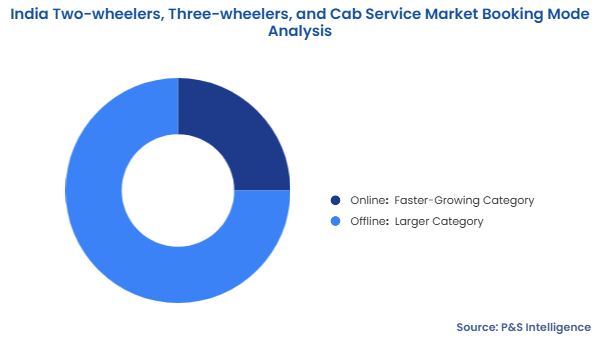
The offline category held the larger market share, of 75%, in 2024. This growth is driven by the expansion of mobility services into smaller cities where digital literacy levels vary and where traditional booking methods remain deeply ingrained in local transportation culture. Many consumers, particularly in rural and semi-urban areas, still prefer the traditional brick-and-mortar approach or street hailing, relying on physical interactions with drivers for information and fare negotiation.
The category also benefits from the significant population that remains unbanked or uncomfortable with digital payments, particularly elderly users and daily wage workers who prefer cash transactions. Moreover, there is no way to book an e-rickshaw or municipal auto-rickshaw ride online, and these modes carry huge numbers of passengers each day.
The online category will have the higher CAGR, due to the successful digital transformation of India's mobility sector, widespread smartphone adoption, and the convenience of app-based booking platforms. The online segment encompasses bookings made through dedicated mobile applications, websites, and integrated booking systems within super apps. Real-time vehicle tracking, upfront pricing transparency, and cashless payment options have made online booking the preferred choice for urban commuters, particularly among millennials and Gen Z users who value the seamless digital experience.
The booking modes analyzed in this report are:
Online (Faster-Growing Category)
Offline (Larger Category)
Propulsion Analysis
The ICE category held the larger market share, of 75%, in 2024, due to the extensive existing fleet of petrol and CNG vehicles, well-established fuel distribution infrastructure, and lower initial capital requirements compared to electric alternatives. The petrol segment dominates within ICE vehicles, especially in two-wheeler services, whereas CNG/LPG dominate in the three-wheeler segment due to their lower operational costs and reduced emissions compared to diesel alternatives.
The electric category will have the higher CAGR, of approx. 6.5%, especially the battery EV due to its improved battery technology, declining costs, and comprehensive government support through subsidies and infrastructure development. Solar power e-rickshaw variants can raise mileage by 10% to 15%, adding another dimension to the electric vehicle ecosystem.
The propulsions analyzed in this report are:
ICE (Larger Category)
Petrol
Diesel
CNG/LPG
Electric (Faster-Growing Category)
Battery electric
Hybrid electric
End User Analysis
The daily commuters category held the largest market share, of 45%, in 2024, driven by India's massive working population that relies on two-wheelers, three-wheelers, and cab services for regular office commutes. As people travel daily, service providers provide better plans and services, such as carpool options, subscription-based options, and dedicated pickup points at major employment areas. Rising fuel prices have made personal vehicle ownership increasingly expensive, pushing more professionals towards shared mobility solutions that offer cost savings of 70-80% compared to private vehicle ownership.
The logistics/delivery workers will have the highest CAGR, due to the explosive growth of e-commerce and quick commerce that has created unprecedented demand for last-mile delivery services, with delivery personnel increasingly relying on rented two-wheelers and three-wheelers for their operations. The gig economy's expansion has transformed thousands of individuals into delivery partners who require flexible, affordable transportation solutions. Platforms are introducing specialized rental plans with daily, weekly, and monthly options tailored to delivery workers' needs, including maintenance support and insurance coverage. Moreover, the rise of hyperlocal delivery services and the expansion of food delivery platforms into tier-2 and tier-3 cities accelerate the market growth in this category.
The ride-hailing category held the largest market share, of 40%, in 2024, and it also has the highest CAGR, due to the widespread adoption of on-demand transportation services across urban India. This model is widely used due to its convenience, transparent pricing, and ability to match supply with demand efficiently through algorithmic optimization. Moreover, the integration of multiple vehicle types within single platforms has enhanced user convenience, allowing seamless switching between bike taxis, auto-rickshaws, and cabs based on specific journey requirements.
The service delivery models analyzed in this report are:
Ride-Hailing (Largest and Fastest-Growing Category)
Ride Sharing
Rental Services
Subscription-based Model
First- and Last-Mile Connectivity
Drive strategic growth with comprehensive market analysis
India Two-wheelers, Three-wheelers, and Cab Service Market Regional Outlook
The Southern region held the largest market share, of 40% in 2024, due to the region's advanced digital infrastructure, high smartphone penetration rates, and progressive regulatory environment that has embraced app-based mobility services. Cities like Bengaluru, Chennai, and Hyderabad have emerged as innovation hubs for mobility startups. The presence of major IT corridors and business parks has created consistent demand for reliable commuting options throughout the day. The region's early adoption of electric vehicles, particularly in the three-wheeler segment, has been facilitated by state government incentives and the availability of charging infrastructure. Tamil Nadu's comprehensive EV policy offering 100% road tax exemption and Karnataka's Clean Mobility Policy 2025–30 provides capital subsidies of up to 25% for charging station installations, which accelerate market growth. The high literacy rates and tech-savvy population in southern states have resulted in greater acceptance of digital payment systems.
The Eastern region will have the highest CAGR, due to the rapid urbanization, rising smartphone penetration, and immense demand for affordable two-wheeler mobility in Tier 2 and Tier 3 cities. Companies such as Ola, Uber, and Rapido have started establishing their operations in the cities of Kolkata, Patna, Bhubaneswar, and Guwahati, to tap into an unserved yet highly receptive consumer base. Additionally, the rapid adoption of electric three-wheelers, a rising interest in two-wheeler sharing services, government-backed smart city initiatives, and clean mobility-related policies accelerate the market growth in this region.
The regions analyzed in this report are:
East (Fastest-Growing Category)
West
North
South (Largest Category)
India Two-wheelers, Three-wheelers, and Cab Service Market Share
The market is semi-consolidated due to major players, including Ola, Rapido, and Uber, controlling a significant share of the market, but no single company dominates in all segments. The market's competitive intensity has increased with the shift towards subscription-based revenue models and the entry of regional players focusing on specific vehicle categories or geographic markets. Moreover, the electric vehicle transition has created opportunities for new entrants, particularly in the e-rickshaw segment, where YC Electric, Saera Electric Auto, Mahindra Electric, Kinetic Green, and Lohia Auto compete with traditional manufacturers. Strategic partnerships between technology platforms and vehicle manufacturers, such as Ola's investment in electric vehicle manufacturing and Uber's collaboration with Tata Motors for electric cabs, are reshaping competitive dynamics and creating barriers to entry for smaller players.
Key India Two-wheelers, Three-wheelers, and Cab Service Companies:
Ola Cabs (ANI Technologies Pvt. Ltd.)
Uber India Systems Pvt. Ltd.
Meru Mobility Pvt. Ltd.
Roppen Transportation Services Private Limited
Yulu Bikes Pvt. Ltd.
Vogo Automotive Private Limited
Baxy Mobility Pvt. Ltd.
MYBYK
Super Highway Labs Pvt. Ltd.
Zypp Electric
Yuja Smart Mobility
Wicked Ride Adventure Services Pvt. Ltd. (Bounce)
India Two-wheelers, Three-wheelers, and Cab Service Market Developments
In November 2024, Rapido (Roppen Transportation Services Private Limited) launched shared taxi services beginning with Bengaluru's Kempegowda International Airport. This was an expansion from its successful shared auto-rickshaw model to address airport connectivity needs with more affordable options for travelers.
In April 2024, Ola (Ani Technology Pvt. Ltd.) announced its exit from all international markets, including the U.K., Australia, and New Zealand, to focus exclusively on the Indian market.
In March 2024, the Government of India approved the Scheme to Promote Manufacturing of Electric Passenger Cars in India, to accelerate EV adoption across mobility services with reduced customs duties and investment incentives.
In February 2023, Uber Technologies India signed a memorandum of understanding with Tata Motors to bring 25,000 XPRES-T EVs into their premium category service across major Indian cities.
In September 2024, Rapido (Roppen Transportation Services Private Limited) achieved unicorn status after raising USD 200 million in Series E funding for a USD 1.1-billion valuation in total. This funding will enable the company to validate its bike taxi model and enable aggressive expansion across tier-2 and tier-3 cities.
Want a report tailored exactly to your business need?
Leading companies across industries trust us to deliver data-driven insights and innovative solutions for their most critical decisions. From data-driven strategies to actionable insights, we empower the decision-makers who shape industries and define the future. From Fortune 500 companies to innovative startups, we are proud to partner with organisations that drive progress in their industries.
Client Testimonials
Working with P&S Intelligence and their team was an absolute pleasure – their awareness of timelines and commitment to value greatly contributed to our project's success. Eagerly anticipating future collaborations.
McKinsey & Company
India
Unmatched Standards
Our insights into the minutest levels of the markets, including the latest trends and competitive landscape, give you all the answers you need to take your business to new heights
Complete Data Security
We take a cautious approach to protecting your personal and confidential information. Trust is the strongest bond that connects us and our clients, and trust we build by complying with all international and domestic data protection and privacy laws