India Smart Factory Market Size & Share Analysis - Trends, Drivers, Competitive Landscape, and Forecasts (2026 - 2032)
This Report Provides In-Depth Analysis of the India Smart Factory Market Report Prepared by P&S Intelligence, Segmented by Technology (Distributed Control Systems, Human-Machine Interface, Manufacturing Execution System, Supervisory Control & Data Acquisition, Programmable Logic Controller, Enterprise Resource Planning, Product Lifecycle Management), Component (Industrial Sensors, Industrial Robots, Machine Vision Systems), End-Use Industry (Automotive & Transportation, Electronics & Semiconductor, Pharmaceutical & Healthcare, Food & Beverage, Chemical & Petrochemical, Oil & Gas, Textile), and Geographical Outlook for the Period of 2019 to 2032
Explore the market potential with our data-driven report
India Smart Factory Market Overview
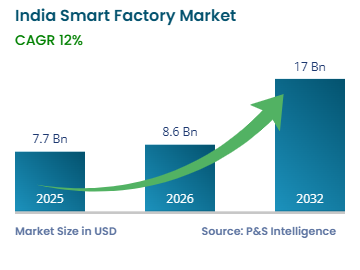
The Indian smart factory market values USD 7.7 billion in 2025, which is projected to grow at a CAGR of 12.0% during 2026–2032, reaching USD 17.0 billion by 2032. The market expansion is driven by the rapid adoption of Industry 4.0 technologies, increasing demand for automation across manufacturing sectors, and substantial government support through initiatives such as Make in India and Production Linked Incentive schemes. India's manufacturing sector, which contributes approximately 17% to the national GDP and employs over 27 million workers, is undergoing significant digital transformation as companies seek to enhance operational efficiency, reduce production costs, and improve product quality.
The convergence of artificial intelligence, internet of things, robotics, and data analytics is revolutionizing India's manufacturing landscape. This paradigm shift encompasses the entire spectrum of factory automation, from raw material sourcing to finished product dispatch. Major industrial hubs, including Bengaluru, Pune, Chennai, and the Delhi-NCR, are witnessing accelerated adoption of smart factory solutions, with multinational corporations and domestic enterprises alike investing in connected manufacturing systems.
The Indian government's INR 14,903-crore Digital India initiative, spanning 2021–2026, is creating favorable conditions for industrial digitization. According to the International Federation of Robotics, sales of industrial robots in India reached a record 8,510 units installed in 2023, with the operational stock reaching 44,958 units in 2023.
India Smart Factory Market Dynamics
Rising Adoption of IoT and Industrial Automation Is Major Trend
The increasing deployment of Industrial Internet of Things solutions across manufacturing facilities is a significant growth driver for the Indian smart factory market.
Foreign direct investment in factory automation has elevated overall budgets, with major players expanding their Indian operations.
Tata Steel uses smart sensors in its blast furnaces, automated-guided vehicles for logistics, and AI-driven predictive maintenance to optimize operations.
Mahindra & Mahindra has deployed collaborative robots (cobots), digital-twin modeling, and IoT-enabled assembly lines to boost speed and flexibility.
Ashok Leyland implemented an IoT-based manufacturing process assurance system across dozens of assembly lines, yielding 10–15% gains in productivity and improved traceability.
Hindustan Unilever (HUL) uses automation and IoT to monitor energy use in its factories, helping reduce waste and lower carbon emissions.
These brownfield upgrades emphasize scalable, modular equipment rather than greenfield capacity, enabling faster returns and higher asset utilization.
Government Initiatives and Policy Support Are Accelerating Market Adoption
The Indian government has implemented several strategic initiatives to promote smart manufacturing and industrial automation.
The Production Linked Incentive, launched in 2020 with a total budget of INR 1.97 lakh crore, targets 14 key sectors, including electronics, pharmaceuticals, automotive components, and renewable energy.
The National Manufacturing Policy aimed to increase the manufacturing sector's contribution to GDP to 25% by 2025, creating an ecosystem that encourages Industry 4.0 adoption.
The National Programme on Artificial Intelligence aims to develop AI-based solutions for manufacturing through skilling initiatives, data management, and establishment of a national center on AI.
The sector's digital transformation could generate over 10 million new jobs, reinforcing India's position as a global industrial hub.
Additionally, the National Mission on Interdisciplinary Cyber-Physical Systems emphasizes the integration of AI in manufacturing processes through smart factories.
Demand for Operational Efficiency and Cost Reduction Offers Opportunities
Manufacturers across India are increasingly adopting smart factory solutions to enhance productivity, reduce operational costs, and maintain consistent quality standards.
Factories implementing automation solutions have reported productivity increases of 15 to 30%, as these technologies streamline processes and ensure reduced waste.
The integration of AI-powered analytics, predictive maintenance systems, and real-time monitoring capabilities enables manufacturers to optimize production schedules, minimize unplanned downtime, and improve overall equipment effectiveness.
The automotive sector has been particularly active in adopting smart factory technologies.
Major automotive manufacturers including Hyundai Motors have implemented advanced manufacturing processes through AI, smart sensors for defect detection, deep learning vision systems for process quality, and VR-based immersive training for employees.
According to the India Brand Equity Foundation, the automotive industry contributes 7.1% to India's GDP and 49% to manufacturing GDP, making it a critical sector for smart factory adoption.
As per the Society of Indian Automotive Manufacturers (SIAM), in the fiscal year 2024–25, the industry manufactured 3.10 crore vehicles, compared to 2.84 crore units in FY 2023–24.
India Smart Factory Market Segmentation Analysis
Technology Analysis
The distributed control systems category holds the largest share in the Indian smart factory market in 2025, of approximately 20%. DCS solutions are widely adopted across process industries including chemicals, pharmaceuticals, oil and gas, and power generation, where they provide centralized control and monitoring of complex industrial processes. The demand for DCS is driven by the need for enhanced process visibility, operational safety, and regulatory compliance in critical manufacturing environments. Major DCS providers including ABB, Honeywell, and Yokogawa have established strong presence in India, offering solutions tailored to local industry requirements.
Human–machine interface solutions are expected to register the highest CAGR of 12.1% during the forecast period, driven by the increasing demand for user-friendly, touch-screen interfaces that facilitate seamless interaction between operators and machines. As industries embrace Industry 4.0, there is a growing emphasis on HMI solutions that enable real-time visualization of production data, alarm management, and integration with SCADA and MES systems. The integration of advanced technologies such as IoT and data analytics further drives HMI adoption as companies seek to leverage real-time data for improved decision-making and process optimization.
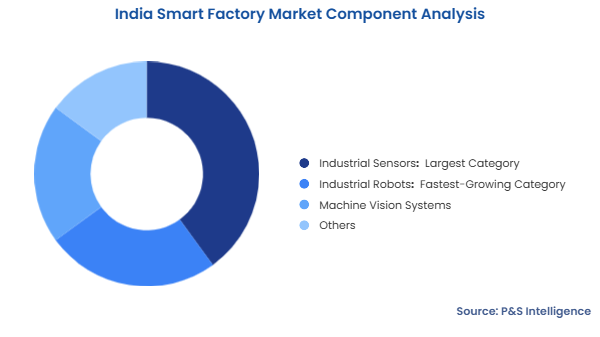
The industrial sensors category holds the largest share of the Indian smart factory market in 2025, of approximately 40%. Sensors are essential components that provide real-time data collection, monitoring, and automation capabilities critical to Industry 4.0 implementation. Smart factories rely on continuous data streams from sensors to monitor parameters such as temperature, pressure, motion, humidity, vibration, and proximity, enabling instant decision-making, predictive maintenance, and automated responses to system variations. The growth of the industrial sensors category is driven by the rising adoption of IIoT technologies and the expanding wireless sensors market.
The industrial robots category is expected to witness the fastest growth during the forecast period. Robots are vital in modern factories because they improve precision, accelerate production, and reduce human error. They handle repetitive or hazardous tasks, enhancing worker safety and overall efficiency. By enabling consistent quality and around-the-clock operation, robots help manufacturers cut costs, scale output, and stay competitive in increasingly automated global markets. The automotive and electronics sectors are the primary drivers of robotics adoption, with companies implementing robotic solutions for assembly, welding, painting, material handling, and quality inspection processes.
These components are covered:
Industrial Sensors (Largest Category)
Industrial Robots (Fastest-Growing Category)
Machine Vision Systems
Others
End-Use Industry Analysis
The automotive & transportation category holds the largest share in the Indian smart factory market in 2025, of approximately 30%, with production facilities increasingly automated to maintain accuracy and efficiency. India is the fourth-largest automobile producer globally, and the growing trend of electric vehicle production is expected to further augment demand for smart factory solutions. Companies such as Tata Motors and Bajaj Auto have pioneered the implementation of smart factories in Pune, leveraging AI and robotics to streamline production.
The electronics & semiconductor category is expected to grow at the highest CAGR of 12.2% during the forecast period, driven by the government's push toward electronics manufacturing and increasing consumer electronics demand. The Production Linked Incentive scheme for electronics has attracted significant investment, with electronics-parts makers committing more than INR 1,15,351 crore across 249 applications by September 2025. Automation is becoming essential for maintaining quality and production speed in assembling, testing, and packaging electronic components.
Drive strategic growth with comprehensive market analysis
India Smart Factory Market Regional Outlook
Maharashtra Smart Factory Market Size
Maharashtra holds the largest share of the Indian smart factory market in 2025, of approximately 20%, attributed to its robust industrial infrastructure, presence of major manufacturing hubs, and strong government support for industrial automation. Pune has emerged as central to the adoption of Industry 4.0 in manufacturing, with Tata Motors and Bajaj Auto implementing smart factories leveraging AI and robotics. Mumbai serves as a key technology and business hub, hosting headquarters of major automation solution providers and system integrators.
According to the Maharashtra Industrial Development Corporation, the state accounts for approximately 15% of India's total industrial output and hosts over 200 industrial estates across various sectors. The automotive industry in Maharashtra contributes significantly to smart factory adoption, with major OEMs and component manufacturers investing in advanced automation systems. The pharmaceutical sector in Maharashtra, particularly in the Aurangabad and Nashik regions, is increasingly adopting MES and quality management solutions to comply with stringent regulatory requirements.
Karnataka Smart Factory Market Outlook
Karnataka is expected to be the fastest-growing state market during the forecast period, driven by Bengaluru's position as the technology and innovation capital of India. The city's strong IT infrastructure supports the growth of robotics and automation companies, attracting significant players like ABB and Fanuc to establish operations. The state government has launched Centers of Excellence for Industry 4.0 technologies to promote smart manufacturing. The state's robust tech ecosystem and availability of skilled workforce make it an ideal location for Industry 4.0 research and development and deployment.
The aerospace & defense manufacturing sector in Karnataka is increasingly adopting smart factory solutions, with Hindustan Aeronautics Limited and private players implementing advanced automation systems. The state's electronics manufacturing cluster in Bengaluru and surrounding areas is driving demand for precision automation and quality inspection systems. Foreign direct investment in the state's manufacturing sector continues to grow, with several multinational corporations establishing smart manufacturing facilities to serve both domestic and export markets.
These states are covered:
Maharashtra (Largest State Market)
Karnataka (Fastest-Growing State Market)
Tamil Nadu
Gujarat
Telangana
Uttar Pradesh
Delhi
Haryana
Rest of India
India Smart Factory Market Share
The Indian smart factory market is moderately fragmented due to the presence of various global and domestic players offering diverse solutions across different technology segments. The market features a mix of established multinational corporations with extensive product portfolios and emerging domestic companies specializing in niche automation solutions. Global players including Siemens, ABB, Honeywell, and Rockwell Automation hold significant market positions due to their comprehensive smart factory solutions, strong brand recognition, and established distribution networks. These companies have invested substantially in local manufacturing capabilities, research and development centers, and technical support infrastructure to serve the Indian market effectively.
The competitive landscape is characterized by strategic partnerships, product launches, and expansion initiatives aimed at capturing market share in the growing industrial automation sector. Companies are focusing on developing scalable, cost-effective solutions tailored to the requirements of small and medium enterprises, which constitute a significant portion of India's manufacturing base. A large number of SMEs indicate budget constraints as a key barrier to implementing smart manufacturing technologies, creating opportunities for players offering modular and affordable automation solutions. Domestic companies including Tata Consultancy Services, Larsen and Toubro, and Wipro are increasingly competing with global players by leveraging their understanding of local market requirements and offering customized solutions.
Key India Smart Factory Companies:
Siemens AG
ABB Ltd.
Honeywell International Inc.
Rockwell Automation Inc.
Schneider Electric SE
Mitsubishi Electric Corporation
Emerson Electric Co.
Yokogawa Electric Corporation
Robert Bosch GmbH
Larsen & Toubro Limited
FANUC Corporation
KUKA AG
GE Vernova
Cognizant Technology Solutions Corporation
Delta Electronics, Inc.
Omron Corporation
Hitachi Ltd.
Wipro Limited
India Smart Factory Market News
In April 2025, Atlas Copco Tools and Assembly Systems unveiled its Smart Factory Innovation Centre in Pune. The facility showcases advanced Industry 4.0 solutions such as automated tightening and dispensing technologies, error-proofing systems, and software-driven smart integrated assembly designed to deliver zero-defect production and sustainable operations.
In March 2025, the Indian Cabinet approved a INR 22,919-crore Production-Linked Incentive scheme for non-semiconductor electronics components, targeting critical items such as multi-layer PCBs, display and camera modules, lithium-ion cells, resistors, capacitors, and inductors to strengthen domestic manufacturing capabilities.
In January 2025, Mitsubishi Electric acquired a stake in Gervigreind Data Science (Itanta Analytics), an Indian software startup, to co-develop no-code data analysis and report generation applications. The move is aimed at enhancing SCADA offerings by integrating these applications with FA equipment and GENESIS64 SCADA software.
In December 2024, ABB announced a strategic alliance with PwC to accelerate digital transformation and ESG initiatives for manufacturers across the country, combining ABB's automation expertise with PwC's consulting capabilities.
In December 2024, Rockwell Automation announced plans to make India a significant manufacturing base, leveraging the country's IT and software capabilities for its international operations while expanding local production and service infrastructure.
In September 2024, Panasonic Smart Factory Solutions unveiled its next-generation smart factory lineup at Productronica India, featuring a fully operational mini production line with advanced SMT machines, inspection systems, PanaCIM MES, and semiconductor assembly tooling.
In August 2024, Neilsoft introduced Industry 4.0 solutions in India to accelerate digital transformation in manufacturing and automation, offering Digital Factory and Manufacturing and Building Automation solutions at the shopfloor, factory, and enterprise levels.
Want a report tailored exactly to your business need?
Leading companies across industries trust us to deliver data-driven insights and innovative solutions for their most critical decisions. From data-driven strategies to actionable insights, we empower the decision-makers who shape industries and define the future. From Fortune 500 companies to innovative startups, we are proud to partner with organisations that drive progress in their industries.
Client Testimonials
Working with P&S Intelligence and their team was an absolute pleasure – their awareness of timelines and commitment to value greatly contributed to our project's success. Eagerly anticipating future collaborations.
McKinsey & Company
India
Unmatched Standards
Our insights into the minutest levels of the markets, including the latest trends and competitive landscape, give you all the answers you need to take your business to new heights
Complete Data Security
We take a cautious approach to protecting your personal and confidential information. Trust is the strongest bond that connects us and our clients, and trust we build by complying with all international and domestic data protection and privacy laws