India Smart Electricity Meter Market Size & Opportunities Analysis - Growth Strategies, Competitiveness, and Forecasts (2025 - 2032)
This Report Provides In-Depth Analysis of the India Smart Electricity Meter Market Report Prepared by P&S Intelligence, Segmented by Type (Advanced Metering Infrastructure (AMI), Automatic Meter Reading (AMR)), Phase (Single Phase, Three Phase), Communication Type (Radio Frequency, Power Line Communication, Cellular), End User (Industrial, Commercial, Residential), and Geographical Outlook for the Period of 2019 to 2032
India Smart Electricity Meter Market Revenue Scope
Key Highlights
Study Period
2019 - 2032
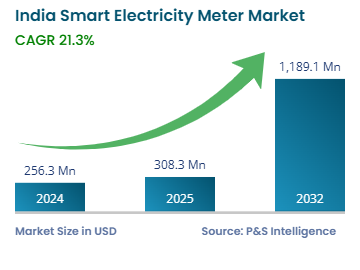
Market Size in 2024
USD 256.3 Million
Market Size in 2025
USD 308.3 Million
Market Size by 2032
USD 1189.1 Million
Projected CAGR
21.3%
Largest Region
North
Fastest Growing Region
East
Market Structure
Fragmented
Market Size
Major Companies
Important Takeaways
Market Size and Forecast
Industry Trend
Regulatory Landscape
Demand Trend Analysis
Companies Recent Strategical Developments
Key Stakeholders
Voice of Industry Experts/KOLs
Future Opportunity
Explore the market potential with our data-driven report
India Smart Electricity Meter Market Outlook
The Indian smart electricity meter market size was worth USD 256.3 million in 2024, and it will grow by 21.3% during 2025–2032, to reach USD 1189.1 million by 2032.
The market growth is driven by the improving T&D efficiency and financial capability, need for higher billing accuracy, and developing smart grid capabilities. The demand for two-way communication between the consumer and utility, remote monitoring, and open billing practices also propel the market growth. The involvement of the private sector through PPPs and TOTEX has raised scalability and investment for mass deployment.
Additionally, the Government of India’s RDSS scheme for advanced prepayment meters, growing demand for live data analytics to control renewable energy penetration, and increasing electricity need drive the market. As per the IBEF, India is the third-largest consumer of electricity in the world and had an installed generation capacity of 442.85 GW in Aoril 2024. Moreover, by 2026, 81 thermal power units are scheduled to switch to renewable sources from coal. Additionally, to meet the projected demand of 458 GW, India has planned an investment of USD 109.50 billion (INR 9.15 lakh crore) to enhance its power infrastructure.
India Smart Electricity Meter Market Growth Factors
Integration of Smart Meters with IoT and Real-Time Data Platforms Is Key Trend
The integration of IoT and live data analytics in smart electricity meters is a key trend in the market.
Various utilities are installing smart meters integrated with advanced technologies, such as NB-IoT, hybrid communication systems, and RF mesh for continuous two-way communication between meters and control centers.
This integration is widely used in live monitoring of electricity consumption, wireless service management, and enhanced fault identification.
Many companies are using cloud-based meter data management systems and high-level data analytics tools to minimize AT&C losses and provide consumers the ability to regulate their energy consumption.
As per government sources, aggregate technical & commercial losses for power utilities in India stand at 25% per year, on average.
The government is also supporting this integration through the RDSS program, which highlights the need for advanced infrastructure and better grid efficiency.
This integration aligns with India’s goal of building smart cities and promoting the use of renewable energy.
India’s first solar-powered smart village in Gujarat uses smart meters and live meter systems to control solar energy, which highlights how smart meters promote renewable energy and smart living.
In 2024, India adopted a new technology, named Wi-SUN, for smart meters in cities to control energy use and rooftop solar generation.
Strong Government Policy and Financial Support Are Biggest Drivers
The strong policy support and investment of the government is a key driver for the market.
The Revamped Distribution Sector Scheme is improving smart meter installation across India.
They have a target of installing 250 million smart electricity meters by 2026 to reduce AT&C losses, digitalize power grids, and boost billing accuracy.
The Government of India has created a budget of INR 3 trillion, making it the largest smart grid advancement globally.
Various financial models are provided to support private and distribution players, including a CAPEX model to provide initial infrastructure funding and the DBFOOT model, which allows companies to create, invest, and operate smart meters.
The TOTEX model covers both capital and maintenance costs.
According to the reports, around 222 million meters have been approved, while 24 million meters had been installed by mid-2025.
The RDSS promotes PPP models, where private companies handle the metering infrastructure, helping reduce the economic pressure on states' DISCOMs and improving efficiency.
India Smart Electricity Meter Market Segmentation Analysis
Type Analysis
The advanced metering infrastructure category held the largest market share, of 70%, in 2024, and it will also have the highest CAGR of 22.9%. They provide two-way communication capabilities between meters and utilities, enable live data exchange, support energy demand management, and activate smart grid operations. They also support time-of-day tariffs and flexible pricing, both of which were regulated by India’s Ministry of Power in 2024. Moreover, the Smart Meter National Programme focuses on AMI installation and offers financial support for its execution.
The types analyzed in this report are:
Advanced Metering Infrastructure (AMI) (Larger and Faster-Growing Category)
Automatic Meter Reading (AMR)
Phase Analysis
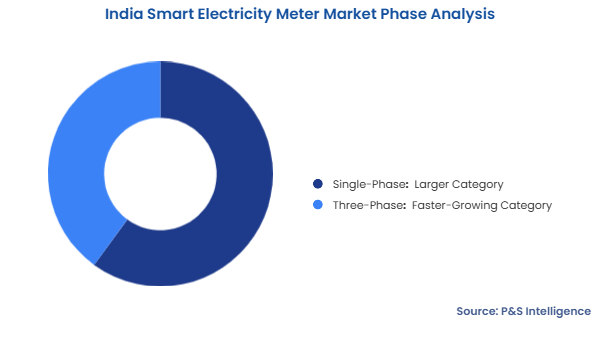
The single-phase category held the larger market share, of 60%, in 2024 because these phases are widely used in commercial and residential sectors, providing electricity to consumers across rural and urban areas. These have an easy installation procedure with an affordable price and are ideal for low-to-medium-duty energy users. Moreover, private companies use these phases under government regulations, such as SMNP and RDSS.
The three-phase category will have the higher CAGR, of 22.5%, due to the high demand for advanced metering solutions across large industrial, commercial, and residential establishments for better energy management. These phases provide better load balancing, live monitoring, and improved efficiency in controlling high energy use and are also installed in malls, hospitals, and smart buildings.
The phases analyzed in this report are:
Single-Phase (Larger Category)
Three-Phase (Faster-Growing Category)
Communication Type Analysis
The power line communication category held the largest market share, of 40%, in 2024, because it can use existing electrical lines, which makes them affordable and scalable in rural, urban, and remote locations via the current networks. These lines are considered stable and reliable for high-precision remote metering and advanced grid features. Furthermore, government programs, such as IPDS and RAPDRP, promote the use of PLC in powerline data transmission.
The radiofrequency category will have the highest CAGR, of 22.9%, because they are flexible, simple to install, and use minimal external infrastructure. These systems can perform real-time data transmission with minimal latency for the management of energy use and balancing of the power grid. Moreover, with the recent developments in dedicated RF networks and narrowband RF mesh, data protection and stability have become possible for heavy interference environments.
The communication types analyzed in this report are:
Radiofrequency (Fastest-Growing Category)
Power Line Communication (Largest Category)
Cellular
Others
End User Analysis
The residential category held the largest market share, of 85%, in 2024, because India has 250 million households, and residential consumers are the primary electricity consumers. Smart electricity meters help consumers in live monitoring, improve billing transparency, and reduce human errors.
The commercial category will have the highest CAGR, of 21.6%. This is due to high energy costs and the rising demand in corporate buildings, retail places, hotels, and malls for live consumption patterns and load management abilities. The consumers are widely adopting clean goals and flexible pricing models, which increases the demand for smart electricity solutions.
The end users analyzed in this report are:
Industrial
Commercial (Fastest-Growing Category)
Residential (Largest Category)
Drive strategic growth with comprehensive market analysis
India Smart Electricity Meter Market Regional Growth Dynamics
The North region held the largest market share, of 35% in 2024, due to the expanding infrastructure and smart meter initiatives in states such as Uttar Pradesh, Madhya Pradesh, Rajasthan, and Delhi. In July 2023, GMR Smart Electricity Distribution Pvt. Ltd. secured INR 7,593 crore to install smart meters in 22 districts of Uttar Pradesh. Furthermore, in February 2023, Punjab State Power Corporation Limited started a project to install more than 100,000 smart meters in households with a budget of INR 9,641 crore.
The East region will have the highest CAGR, of 21.7%, because of large-scale smart meter installation in Assam and Bihar under the RDSS program. In these two states, 28.17 meters and 19.39 lakh meters were installed in 2024. This region is also installing meters quickly due to the strong organizational support from EESL and Genus Power.
The regions analyzed in this report are:
East (Fastest-Growing Category)
West
North (Largest Category)
South
India Smart Electricity Meter Market Competitive Landscape
The market is moderately fragmented due to the presence of large regional and emerging players. The larger companies are enlarging their network across regions, supported by government programs. Additionally, each state runs its tenders, which help niche and emerging companies, such as ITI Ltd. and HPL Electric, compete in the market.
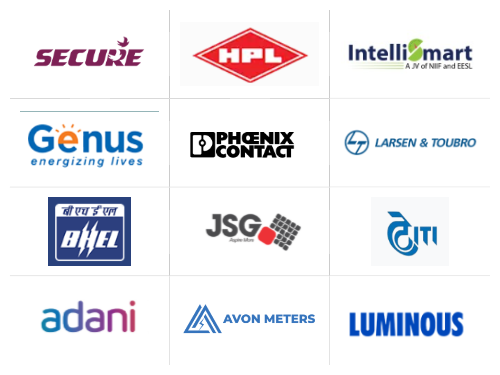
Key India Smart Electricity Meter Companies:
Genus Power Infrastructures Limited
Secure Meters Limited
HPL Electric & Power Limited
IntelliSmart Infrastructure Private Limited
Larsen & Toubro Limited
Phoenix Contact India Private Limited
Bharat Heavy Electricals Limited
Luminous Power Technologies Pvt. Ltd.
JSG InnoTech Private Limited
Indian Telephone Industries Limited
Avon Meters Private Limited
Adani Energy Solutions Limited
India Smart Electricity Meter Market News & Updates
In May 2024, IntelliSmart Infrastructure Pvt. Ltd. partnered with Bharti Airtel Ltd. to connect around 20 million smart meters using the IoT Hub platform, which supports 4G, 2G, and NB-IoT networks.
In March 2024, Adani Energy Solution Ltd. and International Holding Company signed a joint venture to extend smart metering solutions in India.
In December 2023, Adani Energy Solution Ltd. and Esyasolt Holdings collaborated to launch a cloud-based smart metering platform.
In September 2023, HPL Electric & Power Ltd. and Wirepas collaborated to create a wireless RF mesh smart meter solution.
In April 2023, Secure Meters Ltd. and Bharti Airtel Ltd. partnered to provide NB-IoT-based smart meters for 1.3 million households in Bihar.
Want a report tailored exactly to your business need?
Leading companies across industries trust us to deliver data-driven insights and innovative solutions for their most critical decisions. From data-driven strategies to actionable insights, we empower the decision-makers who shape industries and define the future. From Fortune 500 companies to innovative startups, we are proud to partner with organisations that drive progress in their industries.
Client Testimonials
Working with P&S Intelligence and their team was an absolute pleasure – their awareness of timelines and commitment to value greatly contributed to our project's success. Eagerly anticipating future collaborations.
McKinsey & Company
India
Unmatched Standards
Our insights into the minutest levels of the markets, including the latest trends and competitive landscape, give you all the answers you need to take your business to new heights
Complete Data Security
We take a cautious approach to protecting your personal and confidential information. Trust is the strongest bond that connects us and our clients, and trust we build by complying with all international and domestic data protection and privacy laws