India Semiconductor Foundry Market Size & Share Analysis - Emerging Trends, Growth Opportunities, Competitive Landscape, and Forecasts (2026 - 2032)
This Report Provides In-Depth Analysis of the India Semiconductor Foundry Market Report Prepared by P&S Intelligence, Segmented by 65 nm, Application (Communication, Consumer Electronics, Automotive, Industrial), Type (Pureplay, IDMs), Geography (Gujarat, Uttar Pradesh, Andhra Pradesh, Odisha, Karnataka, Tamil Nadu, Maharashtra, Assam), and Geographical Outlook for the Period of 2019 to 2032
Explore the market potential with our data-driven report
India Semiconductor Foundry Market Overview
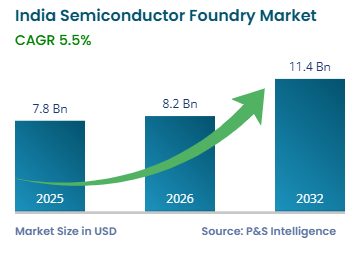
The Indian semiconductor foundry market was valued at USD 7.8 billion in 2025, and it is projected to grow at a CAGR of 5.5% during 2026–2032, to reach USD 11.4 billion by 2032. The substantial growth trajectory reflects India's emergence as a strategic player in the global semiconductor manufacturing ecosystem, driven by robust government initiatives including the Production Linked Incentive (PLI) scheme with an outlay of INR 76,000 crore, rising domestic demand from consumer electronics and automotive sectors, and strategic partnerships with global technology leaders for establishing state-of-the-art fabrication facilities across the nation.
India is transitioning from being primarily a chip design hub to establishing comprehensive manufacturing capabilities across the value chain. Israel's Tower Semiconductor is partnering with India's Adani Group to announce a USD 10 billion semiconductor project in Maharashtra, while Dutch firm NXP Semiconductors has pledged over USD 1 billion to strengthen R&D efforts in India.
The market dynamics are further strengthened with Tata Electronics’ mega fab project in Dholera, Gujarat, in partnership with Taiwan's Powerchip Semiconductor Manufacturing Corporation. This represents a total investment of INR 91,000 crore and targets a production capacity of 50,000 wafers per month by 2026.
The accelerating adoption of advanced technologies including 5G infrastructure, artificial intelligence applications, and electric vehicles is creating substantial demand for domestically manufactured semiconductors across various technology nodes. According to industry estimates, India's semiconductor market is expected to reach USD 143.7 billion by 2032, with electronic devices accounting for 35% of the revenue in 2025.
This growth is complemented by India's strategic advantages including a vast pool of engineering talent contributing 20% of global semiconductor design capabilities, competitive manufacturing costs, and an expanding ecosystem of assembly, testing, marking, and packaging (ATMP) facilities that position the nation as an increasingly attractive destination for global semiconductor investments.
India Semiconductor Foundry Market Dynamics
Government Initiatives and Policy Support Are Major Trends
The primary trend in India's semiconductor foundry market is the comprehensive government support through strategic initiatives and substantial financial incentives aimed at establishing domestic manufacturing capabilities.
The Indian government has announced the roughly INR 76,000-crore Semicon India program to encourage semiconductor and display manufacturing in the country, along with a Design-Linked Initiative (DLI) scheme to drive global and domestic investment related to design software, IP rights.
This policy framework provides fiscal support of up to 50% of project costs on a pari-passu basis for eligible semiconductor fabs and display fabs, creating an attractive investment environment for both domestic and international players.
Multiple states have implemented specialized semiconductor policies, with Gujarat, Tamil Nadu, Karnataka, and Uttar Pradesh offering additional incentives beyond central government support.
Gujarat's semiconductor policy offers capital subsidies of up to 40% over and above central incentives, covering about 20% of a project's cost, with land heavily subsidized up to 75% on the first 200 acres at the Dholera Special Investment Region.
These state-level initiatives create competitive advantages for specific regions, with Tamil Nadu offering up to 50% additional capital subsidy on central incentives.
Karnataka provides R&D grants, patent reimbursements, and exemptions on various fees to attract semiconductor investments.
The Indian semiconductor Mission (ISM) serves as the nodal agency coordinating these initiatives, having already approved multiple projects totaling over USD 20 billion in investments across fabrication, ATMP, and OSAT facilities.
The semiconductor project budget rose to INR 24.99 billion in the Union Budget 2025, while the overall electronics and IT ministry allocation grew by 48% to INR 260.26 billion.
This sustained policy support, combined with expedited clearances, infrastructure development, and skill development programs, establishes a conducive environment for long-term semiconductor manufacturing growth in India.
Expansion of 5G Infrastructure Is Driving Semiconductor Demand
The rapid deployment of 5G networks across India is generating substantial demand for advanced semiconductors, particularly radiofrequency (RF) chips, baseband processors, and power amplifiers essential for telecommunications infrastructure.
Reliance Jio and Bharti Airtel already have around 148 million and 90 million 5G subscribers, respectively, as of August 2024, with India expected to have over 500 million 5G connections by the end of 2024.
This massive scale of network deployment requires continuous supply of specialized semiconductors for base stations, small cells, and network equipment, creating sustained demand for domestically manufactured chips.
The telecommunications sector's significance in driving semiconductor demand extends beyond network infrastructure to encompass the proliferation of 5G-enabled devices and IoT applications.
The increasing adoption of 5G technology is driving the demand for millimeter wave technology chips, application-specific integrated circuits (ASICs), and field-programmable gate arrays (FPGAs), to enable high-speed data processing and low-latency communications.
The convergence of 5G with emerging technologies, such as edge computing, artificial intelligence, and smart city applications, is escalating the demand for specialized semiconductors.
India is expected to become the world's second largest 5G market in 2025, with its telecommunications infrastructure improving and application business opportunities expanding.
Rising Demand from Electric Vehicle Sector Offers Opportunity
The automotive industry is rapidly shifting toward electrification and advanced driver assistance systems (ADAS).
This is leading to the increasing semiconductor content per vehicle, particularly in electric vehicles which require specialized power management chips, microcontrollers, and sensors for battery management systems and motor control applications.
The implementation of stringent safety regulations, such as Bharat NCAP, is compelling automakers to integrate adaptive cruise control, automatic emergency braking, and lane departure warning systems, substantially increasing the demand for automotive-grade semiconductors.
Modern vehicles now contain between 1,400 to 3,000 semiconductor chips, with electric vehicles containing significantly higher semiconductor content compared to traditional internal combustion engine vehicles.
India's electric vehicle market expansion, supported by the INR 10,000-crore FAME II scheme and the PM E-DRIVE program, is accelerating semiconductor demand across power electronics and control systems.
As per the NITI Aayog, the government aims to boost nationwide EV penetration to 30% by 2030, with sales increasing from 50,000 units in 2016 to 2.08 million units in 2024.
The convergence of electrification, connectivity, and automation in vehicles is creating opportunities for semiconductor foundries to develop specialized solutions for inverters, on-board chargers, DC-DC converters, and sophisticated infotainment systems.
India Semiconductor Foundry Market Segmentation Analysis
Technology Analysis
The 28 nm category holds the largest share in 2025, of 25%, driven by its rising demand in automotive applications, power management integrated circuits, and microcontrollers. This node offers the ideal balance between performance, power efficiency, and manufacturing complexity, making it particularly suitable for India's initial phase of semiconductor fabrication as demonstrated by Tata Electronics' Dholera fab, which will commence production with 28 nm technology targeting automotive, AI, and IoT applications.
The 10/7/5 nm category is projected to witness the highest CAGR, of 6.5%, as India progressively develops capabilities for advanced node manufacturing to serve high-performance computing, artificial intelligence, and premium smartphone applications. The preference for 10/7/5 nm nodes for high-volume production of processors for smartphones, data centers, and AI applications is due to its optimal balance between performance and manufacturing maturity. making it the preferred choice. The establishment of advanced 3-nanometer chip design centers in Noida and Bengaluru in 2025 indicates India's commitment to developing expertise in cutting-edge semiconductor technologies.
These technologies are covered:
10/7/5 nm (Fastest-Growing Category)
16/14 nm
20 nm
28 nm (Largest Category)
45/40 nm
65 nm
Application Analysis
The communication category dominates India's semiconductor foundry market in 2025, capturing 35% market share. It is driven by the extensive deployment of telecommunications infrastructure and the proliferation of mobile devices across the nation's vast consumer base. The widespread adoption of 5G technology and the continuous need for RF chips and baseband processors crucial for constructing telecommunication networks drive this category. The category also benefits from the government's Digital India initiatives that are expanding broadband connectivity to rural areas, creating sustained demand for communication semiconductors across various technology nodes.
The automotive category is experiencing the fastest growth, with a projected CAGR of 7.8%, fueled by the rapid adoption of electric vehicles, implementation of advanced safety features, and the increasing electronic content in modern vehicles. The transition towards connected and autonomous vehicles is driving demand for specialized automotive semiconductors including power management ICs for EVs, ADAS processors, and automotive-grade microcontrollers that meet stringent reliability and safety standards. This growth is further supported by India's emergence as a global automotive manufacturing hub, with both domestic and international automakers establishing production facilities that require localized semiconductor supply chains.
These applications are covered:
Communication (Largest Category)
Consumer Electronics
Automotive (Fastest-Growing Category)
Industrial
Others
Type Analysis
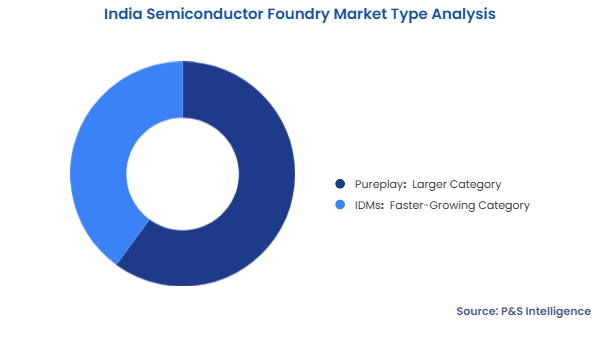
The pureplay category holds the larger share in India's semiconductor foundry market in 2025, of 60%, as specialized contract manufacturers establish dedicated facilities to serve the growing demand from fabless semiconductor companies and system designers. The dominance of pureplay foundries reflects the global trend of specialization in semiconductor manufacturing. PSMC’s partnership with Tata Electronics brings advanced process technologies and manufacturing expertise without competing with their customers in end markets. This model provides flexibility for design companies to access cutting-edge manufacturing capabilities without the massive capital investments required for fab construction.
The IDMs category is witnessing the higher growth rate, of 6.2%, as global semiconductor companies recognize India's strategic importance in diversifying their manufacturing footprint. IDMs are increasingly establishing captive facilities in India to serve both internal requirements and offer foundry services to third parties, leveraging India's cost advantages and growing domestic market. The presence of IDMs enhances India's semiconductor ecosystem by bringing comprehensive capabilities spanning design, manufacturing, and testing, while also facilitating technology transfer and skill development crucial for the industry's long-term sustainability.
These types are covered:
Pureplay (Larger Category)
IDMs (Faster-Growing Category)
Drive strategic growth with comprehensive market analysis
India Semiconductor Foundry Market Regional Outlook
Gujarat Semiconductor Foundry Market Outlook
Gujarat emerged as the largest state in the market, commanding 35% share in 2025. It has established itself as the epicenter of India's semiconductor manufacturing revolution through strategic infrastructure development and comprehensive policy support. The 900-km2 Dholera Special Investment Region hosts Tata Electronics’ INR 91,000-crore semiconductor fab, alongside multiple ATMP facilities. To boost local semiconductor production, Gujarat is offering a 40% capital expenditure subsidy, land subsidies of 75% for the first 200 acres, power subsidy of INR 2 per unit, and exemptions from electricity duty for semiconductor projects.
The state's semiconductor ecosystem is rapidly expanding with multiple projects under implementation, including assembly and testing facilities by CG Power and Micron Technology, creating a comprehensive value chain from wafer fabrication to final packaging. Tata Electronics is building two additional fabrication plants in Dholera, with construction of the first fab already underway and a residential facility to accommodate around 4,000–5,000 workers, demonstrating the scale of infrastructure development. Gujarat's robust power infrastructure with 23,550 MW from conventional sources and 16,588 MW from renewable energy, combined with investments in desalination plants for ultrapure water supply, provides the essential utilities required for semiconductor manufacturing at scale.
Tamil Nadu Semiconductor Foundry Market Share
Tamil Nadu is projected to be the fastest-growing state market, with a CAGR of 8.5% during 2026–2032, leveraging its established electronics manufacturing ecosystem and skilled workforce to attract semiconductor investments. The state's strategic advantages include its existing electronics manufacturing cluster in Sriperumbudur, which hosts major global electronics companies, creating natural synergies for semiconductor manufacturing integration. The Tamil Nadu Semiconductor and Advanced Electronics 2024 policy offers eligible government of India-approved projects a state capital subsidy of up to 50% of the central incentive, with concessional land, full stamp duty and electricity tax exemptions, interest subvention, and funding for VLSI education.
The state government's ambitious target to increase Tamil Nadu's contribution to India's electronics exports from 30% to 40% by 2030 is driving aggressive infrastructure development and skill-building initiatives. With strong educational institutions producing over 200,000 engineering graduates annually and specialized semiconductor curriculum being introduced across technical universities, Tamil Nadu offers a steady pipeline of skilled talent essential for semiconductor manufacturing operations. The state's well-developed supply chain for electronics components, proximity to major ports for import-export operations, and established industrial corridors position it as an attractive destination for semiconductor foundries seeking to establish operations in South India.
These states are covered:
Gujarat (Largest State Market)
Uttar Pradesh
Andhra Pradesh
Odisha
Karnataka
Tamil Nadu (Fastest-Growing State Market)
Maharashtra
Assam
Others
India Semiconductor Foundry Market Share
The Indian semiconductor foundry market exhibits a moderately consolidated structure, characterized by strategic partnerships between domestic conglomerates and established global technology leaders. This concentration is driven by the substantial capital requirements for fab construction, which typically exceed USD 5–10 billion per facility, and the need for proven process technologies that can only be accessed through partnerships with established foundry operators.
Strategic alliances and joint ventures emerge as the predominant competitive strategy, with Indian companies leveraging partnerships to access critical manufacturing technologies while global players benefit from local market knowledge, government incentives, and operational cost advantages. The emphasis on creating integrated ecosystems, where fabrication facilities are complemented by ATMP and OSAT operations within the same region, enhances competitive advantages through supply chain efficiencies and reduced logistics costs. Companies are also differentiating through specialization in specific technology nodes or applications, with some focusing on automotive-grade semiconductors while others target communication or consumer electronics segments.
The entry barriers remain significant due to the massive capital requirements, lengthy facility construction timelines of 3–4 years, and the critical need for skilled workforce in semiconductor manufacturing. However, the market presents opportunities for new entrants in specialized segments such as compound semiconductors, MEMS devices, and mature node manufacturing where technology barriers are relatively lower. The competitive dynamics are further influenced by state-level competition, where different states offer varying incentive packages to attract semiconductor investments, allowing companies to optimize their location strategies based on specific operational requirements.
Key India Semiconductor Foundry Companies:
Tata Electronics Pvt. Ltd.
Vedanta-Foxconn Semiconductor Ltd.
Bharat Electronics Ltd.
MosChip Technologies Ltd.
ASM Technologies Ltd.
Micron Technology Inc.
NXP Semiconductors N.V.
Infineon Technologies AG
Renesas Electronics Corporation
HCL-Foxconn JV
Kaynes Technology India Ltd.
L&T Semiconductor Technologies
India Semiconductor Foundry Market News
In June 2025, India launched the locally developed Shakti RISC-V microprocessor for IoT and edge computing applications.
In February 2025, Lam Research committed over USD 1 billion investment to develop Karnataka's semiconductor infrastructure, focusing on advanced manufacturing equipment and process technology development.
In January 2025, the HCL–Foxconn joint venture began site preparation for their semiconductor assembly and testing facility in Greater Noida, targeting production of 36 million display driver chips monthly, beginning in 2027.
In December 2024, Micron Technology Inc. announced the commencement of equipment installation at its USD-2.75 billion ATMP facility in Sanand, Gujarat, with production of DRAM and NAND memory chips expected to begin by early 2025.
In September 2024, Tower Semiconductor and Adani Group received the Maharashtra Cabinet’s approval for their joint venture to establish a USD 10-billion semiconductor manufacturing unit in Taloja, Panvel.
In August 2024, the Indian government approved four new semiconductor projects, including a packaging plant in Odisha, a semiconductor manufacturing unit in Andhra Pradesh, and expansion of existing facilities, demonstrating continued momentum in ecosystem development.
Want a report tailored exactly to your business need?
Leading companies across industries trust us to deliver data-driven insights and innovative solutions for their most critical decisions. From data-driven strategies to actionable insights, we empower the decision-makers who shape industries and define the future. From Fortune 500 companies to innovative startups, we are proud to partner with organisations that drive progress in their industries.
Client Testimonials
Working with P&S Intelligence and their team was an absolute pleasure – their awareness of timelines and commitment to value greatly contributed to our project's success. Eagerly anticipating future collaborations.
McKinsey & Company
India
Unmatched Standards
Our insights into the minutest levels of the markets, including the latest trends and competitive landscape, give you all the answers you need to take your business to new heights
Complete Data Security
We take a cautious approach to protecting your personal and confidential information. Trust is the strongest bond that connects us and our clients, and trust we build by complying with all international and domestic data protection and privacy laws