India Robotics in Manufacturing Market Size & Share Analysis - Trends, Drivers, Competitive Landscape, and Forecasts (2026 - 2032)
This Report Provides In-Depth Analysis of the India Robotics in Manufacturing Market Report Prepared by P&S Intelligence, Segmented by Offering (Hardware, Software), Type (Articulated, Cartesian, Cylindrical, Polar, SCARA, Delta), Payload (Small-Medium, Large, Extra Large), Application (Material Handling, Welding, Assembling, Material Removal, Painting, Inspection, Machine Tending, Sealing/Dispensing), Industry (Automotive, Electricals & Electronics, Aerospace, Military, & Defense, Chemicals & Materials, Industrial Manufacturing, Food & Beverages, Retail & E-Commerce, Warehousing & Logistics, Medical Devices & Pharmaceuticals), and Geographical Outlook for the Period of 2019 to 2032
India Robotics in Manufacturing Market Size Forecast
Key Highlights
Study Period
2019 - 2032
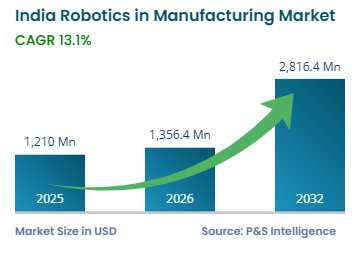
Market Size in 2025
USD 1210.0 Million
Market Size in 2026
USD 1356.4 Million
Market Size by 2032
USD 2816.4 Million
Projected CAGR
13.1%
Largest State
Maharashtra
Fastest-Growing State
Karnataka
Market Structure
Consolidated
Market Size
Explore the market potential with our data-driven report
India Robotics in Manufacturing Market Overview
The Indian robotics in manufacturing market values USD 1210.0 million in 2025, which is projected to grow at a CAGR of 13.1% during 2026–2032, to reach USD 2816.4 million by 2032. The market is driven by increasing automation adoption across manufacturing sectors, government initiatives supporting domestic production, and rising labor costs prompting industrial transformation. According to the International Federation of Robotics, India installed a record 9,100 industrial robots in 2024, representing a 7% increase from the previous year, positioning the country as the sixth-largest installer of industrial robots worldwide.
The manufacturing sector in India is undergoing a significant transformation as industries embrace Industry 4.0 technologies to enhance productivity and competitiveness. The government's INR 1.97-lakh-crore Production Linked Incentive scheme has approved 755 applications and attracted investments of over INR 1.23 lakh crore. The automotive industry remains the dominant customer for industrial robots, accounting for 45% of total installations in 2024, as per the International Federation of Robotics.
India Robotics in Manufacturing Market Dynamics
Integration of Industry 4.0 Technologies Is Main Trend
The convergence of robotics with artificial intelligence, internet of things, and machine learning technologies is reshaping manufacturing processes across India.
Smart factory technologies allow manufacturers to combine robotics with cutting-edge digital tools, enabling real-time monitoring, predictive maintenance, and improved operational efficiency.
The integration of IoT enables robots to communicate with each other and other systems, fostering enhanced collaboration and efficiency.
The adoption of Industry 4.0 technologies leads to improved efficiency, productivity, and quality in manufacturing processes, enabling manufacturers to optimize operations, reduce costs, and deliver high-quality products.
Vision-guided systems integrated with delta robots can perform sorting and packaging tasks at high speed with accuracy and minimum imperfections.
These technological advancements are propelling the Indian industrial sector towards smart manufacturing, where intelligent and collaborative automation systems redefine production standards.
The SAMARTH Udyog Bharat 4.0 initiative has established several Industry 4.0/smart-manufacturing centers—including labs at Pune, Delhi (IIT-Delhi), Bengaluru (IISc, CMTI)—to help manufacturers, especially MSMEs, adopt Industry 4.0.
As of December 2024, over 100 digital-maturity assessments for auto companies had been completed, more than 500+ improvement initiatives identified, and over 500 Digital Champions trained.
Government Initiatives Are Offering Driving Market
The Indian government has implemented several strategic initiatives to promote manufacturing automation and robotics adoption.
The Make in India initiative, launched in 2014, aims to increase manufacturing's contribution to GDP from 17% to 25%, creating substantial demand for automated production systems.
The Production Linked Incentive scheme has emerged as a significant catalyst, with the government providing INR 4,500 crore in incentives to approximately 2,000 companies implementing robotic systems in 2024.
These programs support investment in domestic production capacity across key sectors, including automotive, electronics, pharmaceuticals, and food processing.
The OECD expects India's GDP to grow at a robust rate of 6.3% in the fiscal year 2025 and 6.4% in 2026, creating favorable conditions for continued industrial automation investment.
The National Programme on Artificial Intelligence seeks to create AI-driven solutions for the manufacturing sector by implementing skilling initiatives, managing data, and setting up a national center dedicated to AI.
The digital transformation of this sector has the potential to create more than 10 million new jobs, thereby strengthening India's status as a global industrial center.
Furthermore, the National Mission on Interdisciplinary Cyber-Physical Systems highlights the importance of incorporating AI into manufacturing processes via the development of smart factories.
India Robotics in Manufacturing Market Segmentation Analysis
Offering Analysis
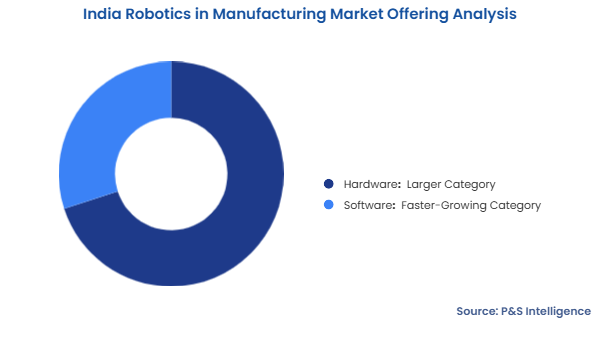
The hardware category accounts for the larger share, of approximately 70%, in the Indian robotics in manufacturing market in 2025. This dominance is attributed to the widespread adoption of robotic arms, controllers, sensors, drives, and end effectors across automotive, electronics, and general manufacturing industries. Hardware components form the operational backbone of automation systems, with large manufacturing facilities investing in articulated robots, SCARA robots, and delta robots to enhance production capabilities. The demand for robotic arms has intensified as manufacturers seek precision equipment for welding, assembly, material handling, and packaging applications. Controllers and sensor devices are critical for enabling precise movements and real-time environmental monitoring, while drives provide the power necessary for robot operation.
The software category is expected to register the higher CAGR during the forecast period, driven by increasing demand for intelligent control systems, digital twins, and AI-powered optimization platforms. As installed hardware bases mature, decision-makers are shifting budget toward cloud-based warehouse management systems, machine learning engines, and predictive maintenance software that unlock latent capacity and improve utilization above 85%. Software platforms enable multi-vendor fleet orchestration and inject machine learning into slotting, labor assignment, and energy management processes.
These offerings are covered:
Hardware (Larger Category)
Controllers
Sensors
Drives
Robotic Arms
End Effectors
Software (Faster-Growing Category)
Type Analysis
The articulated robots category holds the largest share in the Indian robotics in manufacturing market in 2025, of approximately 40%, due to their multi-jointed arms offering a wide range of motion ideal for welding, painting, and complex assembly operations. Their flexibility to perform multiple functions and enhanced payload capability through technological innovation drive widespread adoption across automotive OEMs and parts manufacturers. These robots can operate in spherical space and are highly advantageous in manufacturing industries for pick and assembly operations.
SCARA robots are expected to grow at the highest CAGR during the forecast period, driven by rising adoption in the electronics and semiconductor industries, where precision and speed are essential. SCARA robots are widely used for pick-and-place and assembly operations requiring high speed and accuracy. Electronic manufacturers are adopting SCARA robots due to their incredible speed, ideal for high-volume production of devices like smartphones. Their small size and ability to be tabletop frees up floor space and makes integration into production lines easier.
These robot types are covered:
Articulated (Largest Category)
Cartesian
Cylindrical
Polar
SCARA (Fastest-Growing Category)
Delta
Payload Analysis
The small–medium category dominates the market in 2025 with 60% share. This dominance reflects the widespread adoption of robots with payload capacities up to 15 kg across electronics assembly, packaging, and precision manufacturing applications. The growing demand from the electrical & electronics industry, which needs to handle lightweight components with high precision, has driven the adoption of small–medium payload robots. These systems are particularly suitable for tasks such as PCB handling, component assembly, and quality inspection, where speed and accuracy are paramount.
The large category is set to witness the fastest growth during the forecast period, driven by expanding automotive manufacturing and heavy machinery production. Automotive clusters are investing in robots capable of handling heavier workpieces for welding, painting, and assembly applications. The introduction of advanced robots with payloads ranging from 20 kg to 150 kg is supporting adoption across metal fabrication and machinery manufacturing sectors.
These payload categories are covered:
Small–Medium (Largest Category)
Large (Fastest-Growing Category)
Extra Large
Application Analysis
The material handling category accounts for the largest market share in 2025, of 30%. Material handling robots are extensively deployed across warehouses, distribution centers, and manufacturing floors for tasks, including picking, sorting, palletizing, and transportation. The surge in e-commerce activities and the need for efficient order fulfillment have accelerated the adoption of automated guided vehicles and robotic pickers. According to industry analysis, modular robotic sorters and pick-assist systems can process bursts of orders during peak periods faster than manual operations, reducing cycle times and delivery delays.
The welding category is expected to register the fastest growth during the forecast period, driven by expanding automotive production and the need for consistent weld quality. Robotic welding systems offer precision, speed, and repeatability that manual welding cannot match, reducing defects and improving structural integrity. The automotive industry's transition toward electric vehicle production is creating additional demand for specialized welding applications.
These applications are covered:
Material Handling (Largest Category)
Welding (Fastest-Growing Category)
Assembling
Material Removal
Painting
Inspection
Machine Tending
Sealing/Dispensing
Others
Industry Analysis
The automotive industry holds the largest share in the Indian robotics in manufacturing market in 2025, of 30%. Robots are vital in modern automotive plants because they deliver high efficiency, precision, quality, and safety. In car factories, robots handle tasks like welding, painting, parts assembly, material handling, and inspection—often faster and more consistently than humans, reducing defects and rework. By working 24/7 without fatigue, they boost throughput and enable just-in-time production, while also taking on hazardous or repetitive jobs — improving workplace safety.
Major automakers have announced substantial investments to expand manufacturing capabilities, with Toyota investing approximately INR 3,300 crore to expand its Karnataka plant and Maruti Suzuki planning INR 35,000 crore for a new Gujarat facility.
The electrical & electronics category is expected to witness the highest CAGR, of approx. 12.9%. The electronics sector has emerged as a major end-user with higher adaptability due to growing digitalization. Since accuracy and precision are critical factors in electronic production, the sector has proactively adopted industrial robots for high-precision tasks. The category is driven by increasing semiconductor production and consumer electronics manufacturing. The government approved a PLI scheme worth INR 22,919 crore for electronic components in March 2025, targeting critical components, such as PCBs, SMD passives, and lithium-ion cells.
Drive strategic growth with comprehensive market analysis
India Robotics in Manufacturing Market Regional Outlook
Maharashtra Robotics in Manufacturing Market Size
Maharashtra holds the largest share, of 40%, in the Indian robotics in manufacturing market in 2025, and it is expected to maintain its lead throughout the forecast period. The state's dominance is attributed to its well-established industrial infrastructure, presence of major automotive manufacturing hubs in Pune and Mumbai, and proactive state policies supporting industrial growth. Maharashtra's gross state domestic product was INR 45,31,518 crore in 2024–25. The Maharashtra Industrial Development Corporation has been instrumental in attracting automation investments, while the state continues to invest heavily in Industry 4.0 and smart manufacturing technologies.
The state benefits from excellent connectivity, access to skilled talent, and a diverse manufacturing base spanning automotive, aerospace, electronics, and FMCG sectors. Pune has emerged as a key robotics adoption center, with several global automotive manufacturers and their suppliers implementing extensive automation in assembly and manufacturing processes. The concentration of engineering talent and proximity to major industrial corridors make Maharashtra an attractive destination for robotics companies establishing operations in India.
Karnataka Robotics in Manufacturing Market Forecast
Karnataka is expected to be the fastest-growing state market, projected to register a CAGR of approx. 13.5% during the forecast period. The state has developed into a robust manufacturing base for electronics, aerospace, and precision engineering alongside its traditional IT strength. Karnataka's economy is projected to create over 2 million jobs in the service and manufacturing sectors by 2025, with significant investments flowing into automation technologies. The state's focus on high-tech manufacturing translates into demand for specialized robotics solutions across electronics manufacturing, aerospace, and precision engineering applications.
Bengaluru serves as a key hub for robotics adoption, with major global companies establishing automation centers. In October 2025, Omron opened an Automation Center in Bengaluru to support manufacturers adopting robotic solutions. The state government's supportive policies and infrastructure development initiatives continue to attract automation investments from both domestic and international players.
These states are covered:
Maharashtra (Largest State Market)
Karnataka (Fastest-Growing State Market)
Tamil Nadu
Gujarat
Telangana
Uttar Pradesh
Delhi
Haryana
Rest of India
India Robotics in Manufacturing Market Share
The Indian robotics in manufacturing market is moderately consolidated. The competitive landscape is characterized by the presence of established global robotics manufacturers alongside emerging domestic players. Global companies maintain significant market positions through their comprehensive product portfolios and established service networks. These companies offer an extensive range of industrial robots from articulated and SCARA variants to collaborative robots, supported by robust after-sales service infrastructure.
Domestic players have gained prominence by addressing local market requirements, offering cost-competitive solutions, and expanding their presence in warehouse automation and logistics robotics. These Indian companies are leveraging their understanding of local manufacturing challenges to develop customized solutions suitable for small and medium enterprises. The market has witnessed strategic partnerships between global robotics manufacturers and Indian system integrators to enhance market penetration and service delivery.
Key India Robotics in Manufacturing Companies:
ABB Ltd.
FANUC Corporation
KUKA AG
Yaskawa Electric Corporation
Mitsubishi Electric Corporation
Panasonic Holdings Corporation
Shibaura Machine CO. LTD.
Nachi?Fujikoshi Corp.
Seiko Epson Corporation
Staubli International AG
Kawasaki Heavy Industries Ltd.
Denso Corporation
Delta Electronics Inc.
HD Hyundai Robotics
Comau SpA
Robert Bosch GmbH
Rockwell Automation Inc.
Mitsubishi Heavy Industries Ltd.
Teradyne Inc.
Siemens AG
Schneider Electric SE
India Robotics in Manufacturing Market News
In October 2025, Omron Corporation inaugurated an Automation Center in Bengaluru to provide comprehensive support for manufacturers adopting robotic and automation solutions across India.
In February 2025, Delta Electronics showcased its D-Bot series collaborative robots at ELECRAMA 2025, featuring a 30-kg payload capacity and 200°/sec operational speed.
In November 2024, Addverb Technologies announced plans to develop next-generation humanoid robots for deployment in 2025, expanding its automation solutions portfolio for Indian manufacturers.
In September 2024, ABB Robotics introduced the IRB 930 SCARA robot, enhancing pick-and-place and assembly capabilities for electronics, automotive, and renewable energy sectors with 10% improved throughput and 200% stronger push-down capability.
In July 2024, Techman Robot launched the TM30S collaborative robot with a 35-kg payload capacity, targeting heavy-duty applications in automotive and metal manufacturing industries.
In June 2024, Universal Robots organized Collaborate India 2024 conference in Pune, attracting over 500 participants to discuss collaborative robotics adoption strategies for Indian manufacturing.
Want a report tailored exactly to your business need?
Leading companies across industries trust us to deliver data-driven insights and innovative solutions for their most critical decisions. From data-driven strategies to actionable insights, we empower the decision-makers who shape industries and define the future. From Fortune 500 companies to innovative startups, we are proud to partner with organisations that drive progress in their industries.
Client Testimonials
Working with P&S Intelligence and their team was an absolute pleasure – their awareness of timelines and commitment to value greatly contributed to our project's success. Eagerly anticipating future collaborations.
McKinsey & Company
India
Unmatched Standards
Our insights into the minutest levels of the markets, including the latest trends and competitive landscape, give you all the answers you need to take your business to new heights
Complete Data Security
We take a cautious approach to protecting your personal and confidential information. Trust is the strongest bond that connects us and our clients, and trust we build by complying with all international and domestic data protection and privacy laws