India Residential Diesel Genset Market Size & Share Analysis - Trends, Drivers, Competitive Landscape, and Forecasts (2026 - 2032)
This Report Provides In-Depth Analysis of the India Residential Diesel Genset Market Report Prepared by P&S Intelligence, Segmented by Type (Stationary, Portable), Power Rating (Up to 5 kVA, 5 kVA, 11 kVA), Operating Mode (Standby, Prime & Continuous), and Geographical Outlook for the Period of 2021 to 2032
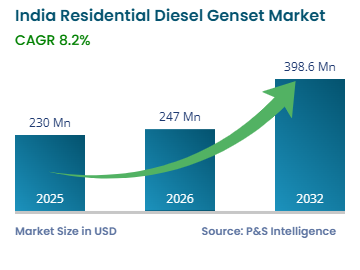
India Residential Diesel Genset Market Size Forecast
Key Highlights
Study Period
2021 - 2032
Market Size in 2025
USD 230.0 Million
Market Size in 2026
USD 247.0 Million
Market Size by 2032
USD 398.6 Million
Projected CAGR
8.2%
Largest Region
South
Fastest-Growing Region
East
Market Structure
Fragmented
Market Size
Explore the market potential with our data-driven report
India Residential Diesel Genset Market Overview
The India residential diesel genset market size was USD 230.0 million for 2025, and it will grow by 8.2% during 2026–2032, to reach USD 398.6 million by 2032.
The market growth is driven by sustained residential construction activity, recurring voltage fluctuations across semi-urban and rural pockets, and rising ownership of backup power systems among gated communities and independent households. Stationary units continue to account for the majority of demand for continuous residential backup, while compact portable gensets are gaining traction among urban apartment dwellers seeking flexible, lower-cost protection for pumps, refrigeration, and lighting circuits.
India's expanding residential sector continues to support demand for household backup power solutions. According to the India Brand Equity Foundation (IBEF), residential transactions across major cities increased by 77% between FY19 and FY25. This increase reflects sustained housing demand and continued investment in new residential developments. Although India's overall power supply has improved, localized peak demand constraints and distribution-level outages in several states continue to sustain the need for residential diesel generator sets in areas with inconsistent grid reliability.
Key Market Insights
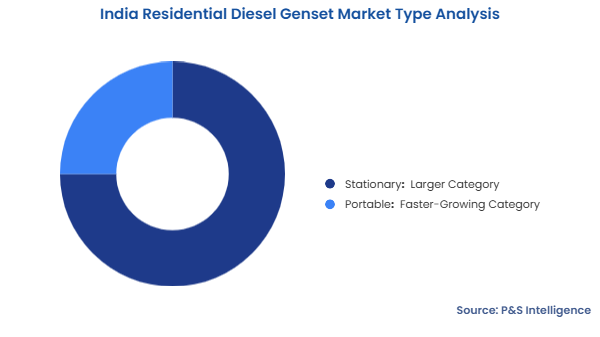
The stationary category holds the larger market share, of 75%, in 2025, due to permanent installation and residential suitability.
The portable category will have the higher CAGR, of approximately 8.4%, driven by rising demand for flexible and cost-effective backup solutions.
The 5 kVA–10 kVA category holds the largest market share, of 60%, in 2025, due to its suitability for household backup power needs.
South region holds the largest market share, of 40%, in 2025, due to strong residential construction and high backup power demand.
East region will have the highest CAGR, of approximately 9.1%, due to rising residential construction and grid reliability challenges.
India Residential Diesel Genset Market Trends and Drivers
Emission Compliance Is a Key Trend
The residential diesel genset market is undergoing a transition toward cleaner, more technologically advanced products as emission regulations become increasingly stringent. The Ministry of Environment, Forest and Climate Change (MoEFCC), in consultation with the Central Pollution Control Board (CPCB), notified revised emission standards for power-generating sets up to 800 kW in November 2022, with the norms becoming applicable from July 2023. These regulations have prompted manufacturers to redesign diesel gensets with advanced emission-control technologies and gradually phase out older CPCB II-compliant models. Manufacturers are increasingly focusing on developing diesel gensets that comply with the latest regulatory framework. These next-generation models are engineered for improved fuel efficiency and lower emissions.
The transition is accelerating product innovation across the residential segment. Manufacturers are introducing upgraded engine platforms and refining combustion technologies to meet the revised emission norms, and enhanced fuel-efficiency features are becoming standard across new product lines. The regulatory shift is encouraging investments in research and development and modernization of manufacturing processes, enabling companies to offer cleaner and more reliable backup power solutions without compromising operational performance.
Persistent Peak-Hour Power Deficits Is a Biggest Driver
India's national grid has largely closed its aggregate power gap, but peak-hour reliability continues to lag demand growth, sustaining demand for residential backup power solutions. According to the Central Electricity Authority (CEA) Load Generation Balance Report (LGBR) 2025–26, the country is expected to record an all-India peak power deficit of 3,271 MW (1.2%) despite an energy surplus of 15,797 million units (0.9%). This divergence highlights that localized peak-hour constraints persist even when overall energy availability is adequate.
Peak demand pressures are most pronounced during summer months and evening hours, when residential electricity consumption rises sharply because of cooling and household appliance usage. As Tier-II and Tier-III cities continue to expand their residential housing stock, distribution infrastructure upgrades often struggle to keep pace with growing electricity demand. This infrastructure shortfall is prompting households to invest in diesel gensets as a reliable backup power solution during localized outages and peak-load conditions.
Rooftop Solar Adoption Is a Key Restraint
Government-backed rooftop solar adoption is emerging as a structural restraint on the residential diesel genset market, particularly in grid-connected urban and semi-urban areas. According to the Ministry of New and Renewable Energy (MNRE), the PM Surya Ghar; Muft Bijli Yojana reached 10 lakh rooftop solar installations by March 2025, with the government targeting 1 crore households by 2026–27. Expanding rooftop solar capacity is giving more households the ability to generate their own electricity during daylight hours. This shift is reducing household dependence on conventional grid power for routine residential consumption.
As rooftop solar deployment continues to increase, residential consumers in areas with relatively reliable grid infrastructure are expected to rely less on diesel-powered backup for short-duration power interruptions. Diesel gensets remain essential when outages are prolonged, weather turns adverse, or emergencies arise. The increasing adoption of rooftop solar is expected to moderate demand growth for residential diesel gensets by reducing reliance on conventional backup power solutions among a growing segment of households.
Rising Gated-Community Construction Is a Biggest Opportunity
The expansion of organized residential housing, including gated apartment complexes and integrated townships, is creating new opportunities for centralized backup power solutions. According to the Ministry of Housing and Urban Affairs (MoHUA), the government sanctioned over 2.88 lakh additional houses under Pradhan Mantri Awas Yojana–Urban (PMAY-U) 2.0, taking the total number of sanctioned houses under the scheme to more than 13.61 lakh. This continued expansion of planned urban housing is strengthening demand for reliable backup power infrastructure in multi-dwelling residential developments.
Unlike independent homes, these developments require diesel gensets capable of supporting common infrastructure such as elevators, water-lifting pumps, fire safety systems, lighting, and security equipment during grid outages. The growing preference for professionally managed residential communities is increasing demand for higher-capacity stationary diesel gensets designed for shared facilities and continuous standby operation. This shift is creating opportunities for manufacturers to expand their portfolios with integrated backup power solutions while offering installation, maintenance, and long-term service agreements tailored to residential housing societies and facility management companies.
India Residential Diesel Genset Market Segmentation Analysis
Type Analysis
The stationary category holds the largest market share, of 75%, in 2025, supported by permanent installation, dedicated wiring integration, and their suitability for independent homes and organized residential developments. The growing complexity of residential electricity consumption, driven by increasing ownership of appliances, cooling equipment, elevators, water pumps, and security systems, is strengthening demand for fixed backup power solutions. According to the Central Electricity Authority (CEA), India recorded a peak electricity demand of 250 GW on May 30, 2024, highlighting the increasing pressure on the power system during periods of high consumption and the continued need for reliable backup solutions. Stationary units remain preferred for residential societies and premium homes due to their higher reliability, longer operating capability, and ability to support multiple connected loads.
The portable category will have the highest CAGR, of approximately 8.4%, driven by increasing demand from smaller households, renters, and consumers in Tier-II and Tier-III cities seeking flexible and cost-effective backup solutions. Their lower installation requirements, ease of mobility, and suitability for essential household loads such as lighting, refrigeration, and small appliances are expanding adoption among price-sensitive residential users. The growing availability of products through online and retail distribution channels is further improving accessibility and supporting portable genset adoption.
The types analyzed in this report are:
Stationary (Larger Category)
Portable (Faster-Growing Category)
Power Rating Analysis
The 5 kVA-10 kVA category holds the largest market share in 2025, aligning with the electricity requirements of typical households operating essential appliances such as lighting, fans, refrigerators, and water pumps simultaneously. According to the Bureau of Energy Efficiency (BEE), around 64% of Indian households own refrigerators and 13% own air conditioners. The combined electricity requirements of these appliances, along with lighting, fans, and water pumps, align with the operating capacity of 5–10 kVA diesel gensets. This supports demand for mid-range residential gensets that can provide reliable backup across independent homes, apartments, and small residential communities.
The up to 5 kVA category will have the highest CAGR, of approximately 8.7%, driven by their lower upfront cost, ease of installation, and suitability for compact urban housing where consumers primarily require backup for essential loads such as lighting, fans, and mobile charging. This entry-level category is expanding the residential buyer base by attracting first-time users, smaller households, and price-sensitive consumers in emerging Tier-II and Tier-III cities seeking affordable and flexible backup power solutions.
The power ratings analyzed in this report are:
Up to 5 kVA (Fastest-Growing Category)
5 kVA–10 kVA (Largest Category)
11 kVA–20 kVA
Operating Mode Analysis
The standby category holds the larger market share, of 80%, in 2025, reflecting the country's widespread household electricity access, which positions diesel gensets primarily as backup solutions against intermittent outages rather than as primary power sources. According to the Ministry of Power, the Pradhan Mantri Sahaj Bijli Har Ghar Yojana (Saubhagya) scheme provided electricity connections to approximately 2.86 crore households, significantly improving household electricity access across India. This expansion of grid connectivity has reinforced the standby-use pattern, with residential consumers adopting gensets mainly for backup during power interruptions and voltage fluctuations.
The prime & continuous category will have the higher CAGR, driven by reliability gaps in rural and semi-urban areas where households and residential clusters require longer-duration backup beyond occasional outages. These applications are particularly relevant in locations where grid availability remains inconsistent despite formal electricity connections.
The operating modes analyzed in this report are:
Standby (Larger Category)
Prime & Continuous (Faster-Growing Category)
Drive strategic growth with comprehensive market analysis
India Residential Diesel Genset Market Geographical Analysis
South Residential Diesel Genset Market Size
South region holds the largest market share, of 40%, in 2025, supported by dense residential construction across Bengaluru, Chennai, and Hyderabad. A structural gap between energy availability and peak demand, distinct to the region, is reinforcing continued reliance on backup power. According to the Central Electricity Authority (CEA) Load Generation Balance Report (LGBR) 2025–26, the Southern region faced the country's largest peak power deficit of 6,489 MW (-8.2%), while recording a marginal energy surplus of 0.4%. This divergence indicates that localized peak demand and transmission constraints persist despite adequate annual energy availability. These localized supply-demand imbalances continue to support diesel genset adoption among apartment complexes and independent households that require reliable backup power during peak evening and summer cooling hours. Karnataka and Tamil Nadu combine high housing density with relatively high residential purchasing power, supporting continued demand for higher-capacity stationary diesel gensets.
East Residential Diesel Genset Market Size
East region will have the highest CAGR, of approximately 9.1%, driven by residential construction from a comparatively small installed base together with persistent grid reliability challenges across states such as Bihar, Jharkhand, and Odisha.According to the Central Electricity Authority (CEA) Load Generation Balance Report (LGBR) 2025–26, the Eastern region recorded a peak power deficit of 3,951 MW (-11.0%), the widest percentage peak deficit among all regions.The region recorded the deficit despite an energy surplus of 23,905 million units. This contrast indicates that localized transmission and distribution constraints continue to affect power reliability despite adequate regional energy availability. Consequently, residential consumers continue to invest in diesel gensets as dependable backup power solutions against localized outages. Rising housing construction across Tier-II cities such as Patna, Ranchi, and Bhubaneswar is expected to support the region's above-average market growth.
The regions of the market are as follows:
North
South (Largest Region)
East (Fastest-Growing Region)
West
India Residential Diesel Genset Market Competitive Landscape
The market is fragmented because demand is dispersed across independent houses, apartment complexes, gated communities, and rural households, where power requirements, budgets, and regional preferences vary across these segments. The market comprises numerous domestic manufacturers, multinational companies, regional assemblers, and local dealers, with no single company holding a dominant nationwide share. Leading players such as Cummins India Limited, Kirloskar Oil Engines Limited, Greaves Cotton Limited, and Cooper Corporation compete alongside several regional manufacturers and assemblers, strengthening their positions through diverse product portfolios. Expanding dealer and service networks is giving them wider reach, and targeting different customer segments and geographic markets is helping them defend share against regional players. Additionally, pricing, fuel efficiency, emission compliance, product reliability, and after-sales service are the primary axes of competition, preventing significant market concentration.
Key Players in the India Residential Diesel Genset Market:
Cummins India Limited
Kirloskar Oil Engines Limited
Mahindra & Mahindra Limited
Greaves Cotton Limited
Ashok Leyland Limited
Caterpillar Inc.
Jakson Engineers Limited
Kohler India Corporation Private Limited
Honda India Power Products Limited
Sudhir Power Limited
Cooper Corporation Pvt. Ltd.
Powerica Limited
India Residential Diesel Genset Market Developments
In July 2024, Greaves Engineering launched its CPCB IV+ compliant diesel generator portfolio ranging from 5 kVA to 500 kVA. The introduction of the 5–25 kVA range strengthened the company's offerings for residential and small commercial users by delivering lower-emission, fuel-efficient backup power systems.
In May 2024, Jakson Group launched its next-generation CPCB IV+ compliant diesel gensets, powered by Cummins engines. The new product range offers improved fuel efficiency, lower emissions, compact design, and enhanced reliability, supporting India's transition to cleaner backup power solutions for residential and commercial applications.
Frequently Asked Questions About This Report
What are the key factors driving the growth of the India Residential Diesel Genset Market?+
Growth is driven by expanding residential construction, persistent peak-hour power deficits, and increasing demand for reliable backup power in semi-urban and rural areas.
What is the expected CAGR of the India Residential Diesel Genset Market during 2026+
The market is growing at a CAGR of 8.2% during 2026
What is the key trend shaping the India Residential Diesel Genset Market?+
The adoption of CPCB IV+ compliant diesel gensets with improved fuel efficiency and lower emissions is the key market trend.
Why is demand for residential diesel gensets increasing in Tier-II and Tier-III cities?+
Rapid residential development, localized power reliability issues, and increasing household electrification are driving demand for backup power solutions.
How is rooftop solar affecting the India Residential Diesel Genset Market?+
Rooftop solar is reducing reliance on diesel-powered backup during short-duration power interruptions, while diesel gensets remain essential during prolonged outages and emergencies.
Want a report tailored exactly to your business need?
Leading companies across industries trust us to deliver data-driven insights and innovative solutions for their most critical decisions. From data-driven strategies to actionable insights, we empower the decision-makers who shape industries and define the future. From Fortune 500 companies to innovative startups, we are proud to partner with organisations that drive progress in their industries.
Client Testimonials
Working with P&S Intelligence and their team was an absolute pleasure – their awareness of timelines and commitment to value greatly contributed to our project's success. Eagerly anticipating future collaborations.
McKinsey & Company
India
Unmatched Standards
Our insights into the minutest levels of the markets, including the latest trends and competitive landscape, give you all the answers you need to take your business to new heights
Complete Data Security
We take a cautious approach to protecting your personal and confidential information. Trust is the strongest bond that connects us and our clients, and trust we build by complying with all international and domestic data protection and privacy laws