India Quantum Computing Market Size & Share Analysis - Emerging Trends, Growth Opportunities, Competitive Landscape, and Forecasts (2026 - 2032)
This Report Provides In-Depth Analysis of the India Quantum Computing Market Report Prepared by P&S Intelligence, Segmented by Offering (Hardware, Software, Services), Deployment Type (On-Premises, Cloud-Based), Application (Optimization, Simulation and Data Problems, Sampling, Machine Learning), Technology (Quantum Dots, Trapped Ions, Quantum Annealing), Industry (BFSI, Aerospace & Defense, Manufacturing, Healthcare, IT & Telecom, Energy & Utilities), and Geographical Outlook for the Period of 2019 to 2032
Explore the market potential with our data-driven report
India Quantum Computing Market Future Outlook
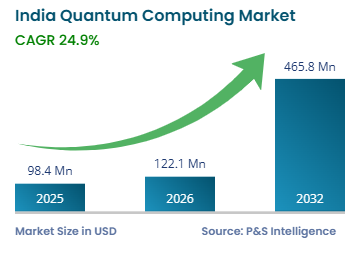
The Indian quantum computing market values USD 98.4 million in 2025, and it is projected to grow at a CAGR of 24.9% during 2026–2032, to reach USD 465.8 million by 2032. The market expansion is driven by substantial government investments through the National Quantum Mission (NQM), increasing adoption across banking, healthcare, and defense sectors, and the emergence of indigenous quantum computing startups that are developing full-stack quantum solutions.
The growing emphasis on quantum-safe cybersecurity is emerging as a major market trend. With traditional encryption methods facing potential obsolescence against quantum attacks, Indian enterprises, particularly in the BFSI sector, are investing in post-quantum cryptography solutions. Karnataka's announcement of a INR 1,000 crore Quantum Mission and plans to establish India's first Quantum City in Bengaluru further demonstrate the regional commitment to developing a robust quantum ecosystem.
The market is witnessing increasing participation from both public and private sectors. Government agencies, including DRDO and ISRO, are actively developing quantum communication and sensing technologies for defense and space applications. Simultaneously, leading IT services companies such as TCS, Infosys, Wipro, and HCL Technologies have established dedicated quantum computing practices to serve enterprise
clients. The emergence of indigenous startups developing full-stack quantum solutions, from hardware to application software, is creating a comprehensive domestic quantum technology ecosystem that reduces dependence on foreign providers.
India Quantum Computing Market Trends & Drivers
Rising Demand for Quantum Computing in BFSI Sector Is Main Trend
The banking, financial services, and insurance sector represents a significant demand driver for quantum computing in India.
The BFSI sector believes quantum computing will pose a significant threat to current cybersecurity within the next three years.
This urgency is driving financial institutions to explore quantum-resistant encryption and quantum-enhanced risk management solutions.
Major Indian IT services companies, including TCS, Infosys, Wipro, and HCL Technologies, have established dedicated quantum computing practices.
TCS has partnered with IBM and the Andhra Pradesh government to establish the Quantum Valley Tech Park in Amaravati.
Infosys launched the Quantum Living Labs for clients exploring quantum applications, while HCL Technologies operates Quantum Labs as part of the Azure Quantum Network.
These corporate initiatives are accelerating enterprise adoption of quantum solutions across the financial services sector.
In September 2025, HDFC Bank invested in QNu Labs, which offers a full-stack end-to-end quantum-safe cybersecurity platform.
The move signals that major Indian banks are beginning to back indigenous quantum-security solutions—recognizing the eventual threat of quantum-enabled attacks on classical cryptography and aiming to build quantum-resilient infrastructure proactively.
National Quantum Mission Is Accelerating Market Growth
The Union Cabinet approved the National Quantum Mission in April 2023 with a budget allocation of INR 6,003.65 crore, spanning from 2023–24 to 2030–31.
This mission aims to develop intermediate-scale quantum computers with 50–1000 physical qubits within eight years across platforms, including superconducting and photonic technologies.
The National Quantum Mission represents the cornerstone of India's quantum technology development strategy.
The mission has established four Thematic Hubs (T-Hubs) at premier institutions: quantum computing at Indian Institute of Science (IISc) Bengaluru, quantum communication at IIT Madras along with Centre for Development of Telematics (C-DOT), quantum sensing and metrology at IIT Bombay, and quantum materials and devices at IIT Delhi.
These hubs involve 152 researchers from 43 institutions, creating a comprehensive research ecosystem.
The Defence Research and Development Organisation (DRDO) and Indian Space Research Organisation (ISRO) are actively contributing to quantum technology development.
DRDO has successfully demonstrated quantum key distribution over 100 kilometers of optical fiber and opened a Quantum Technology Research Centre in Delhi.
ISRO demonstrated free-space quantum communication over 300 meters, encrypting a live video conference using quantum keys, marking significant progress toward satellite-based quantum communication networks.
Emergence of Indigenous Quantum Startups Is Creating Opportunities
India's quantum startup ecosystem has grown significantly, with 57 quantum computing startups operating in the country according to industry tracking platforms.
QpiAI, a Bengaluru-based startup, secured USD 32 million in Series A funding co-led by the National Quantum Mission and launched India's first full-stack 25-qubit superconducting quantum computer in April 2025.
The company's roadmap includes scaling to 64, 128, and 1000 qubits, with applications spanning scientific research, healthcare, and finance.
QNu Labs, another prominent Bengaluru startup, has secured USD 11.9 million in funding for developing quantum cryptography solutions, including quantum key distribution systems.
BosonQ Psi is developing quantum-powered engineering simulation software for aerospace and automotive sectors.
These startups, selected under the NQM's support framework, are receiving grants of up to INR 30 crore each, fostering indigenous innovation and reducing dependence on foreign quantum technology providers.
India Quantum Computing Market Segmentation Analysis
Offering Analysis
The hardware category holds the largest share in the Indian quantum computing market in 2025, of 55%. This dominance is attributed to substantial investments in developing indigenous quantum processors, cryogenic systems, and control electronics. Major initiatives include the development of superconducting quantum processors at institutions like TIFR Mumbai and the creation of quantum hardware components by startups such as Dimira Technologies (cryogenic cables) and Prenishq (precision diode-laser systems).
The services category is expected to witness the highest CAGR of 25.1% during 2026–2032 owing to increasing demand for quantum consulting, training, and support services. As enterprises seek to integrate quantum solutions into existing IT infrastructure, the need for specialized consulting services is growing. Training and education services are particularly critical given the shortage of quantum-skilled professionals, with organizations like IIT Madras and IISc Bengaluru establishing dedicated quantum training programs to address this gap.
These offerings are covered:
Hardware (Largest Category)
Software
Services (Fastest-Growing Category)
Consulting
Training & Education
Support & Maintenance
Deployment Type Analysis
The cloud-based deployment category dominates the Indian quantum computing market in 2025 with 60% market share, and it also has the higher CAGR. Cloud-based quantum computing services address the high cost and complexity of managing on-premises quantum hardware, making quantum capabilities accessible to a broader range of enterprises. IBM, Google, and Microsoft offer cloud-based quantum platforms accessible to Indian organizations, while indigenous providers are developing quantum computing as a service (QCaaS) solutions.
These deployment types are covered:
On-Premises
Cloud-Based (Larger and Faster-Growing Category)
Application Analysis
The optimization category holds the largest share in 2025, of 40%. Quantum optimization algorithms are being applied across logistics, supply chain management, portfolio optimization, and resource allocation problems. Indian enterprises are leveraging quantum computing to solve complex combinatorial optimization challenges that are intractable for classical computers, particularly in financial services and manufacturing sectors.
The machine learning category is projected to register the highest CAGR of 25.0% during 2026–2032. Quantum machine learning offers enhanced capabilities for pattern recognition, predictive analytics, and data classification. Indian IT companies are exploring quantum-enhanced AI applications, with Wipro's Lab45 focusing on quantum computing impacts on AI and machine learning applications. The integration of quantum algorithms with classical machine learning models is creating hybrid solutions that deliver improved accuracy for complex analytical tasks.
These applications are covered:
Optimization (Largest Category)
Simulation and Data Problems
Sampling
Machine Learning (Fastest-Growing Category)
Others
Technology Analysis
The trapped ions category accounts for the largest market share in 2025, due to its relatively higher qubit coherence times and gate fidelities compared to other technologies. Research institutions, including Raman Research Institute and IISc Bengaluru, are actively pursuing trapped ion quantum computing research. The technology's maturity and demonstrated capabilities in quantum simulation make it particularly suitable for scientific research applications.
The quantum annealing category is expected to exhibit the fastest growth during the forecast period, of 25.2%. Quantum annealing is particularly effective for optimization problems prevalent in logistics, finance, and manufacturing industries. Indian companies are partnering with D-Wave and other quantum annealing providers to explore practical applications, while indigenous research focuses on developing annealing algorithms suited to Indian enterprise requirements.
These technologies are covered:
Quantum Dots
Trapped Ions (Largest Category)
Quantum Annealing (Fastest-Growing Category)
Industry Analysis
The BFSI category dominates the Indian quantum computing market in 2025 with 30% share. Financial institutions are leveraging quantum computing for portfolio optimization, risk assessment, fraud detection, and cryptographic security. Major banks and financial services companies are collaborating with quantum technology providers to develop specialized applications that can deliver competitive advantages in algorithmic trading and risk management.
The healthcare category is set to witness the fastest growth during 2026–2032. Quantum computing enables accelerated drug discovery through molecular simulation, personalized medicine development, and complex protein folding analysis. India's pharmaceutical industry, which maintains a strong global position in generic drug manufacturing, is exploring quantum computing to enhance R&D capabilities and reduce drug development timelines. According to industry experts, quantum simulations could potentially reduce drug discovery timelines from 10-15 years to under 24 months.
These industries are covered:
BFSI (Largest Category)
Aerospace & Defense
Manufacturing
Healthcare (Fastest-Growing Category)
IT & Telecom
Energy & Utilities
Others
Drive strategic growth with comprehensive market analysis
India Quantum Computing Market Geographical Analysis
Karnataka Quantum Computing Market Size
Karnataka has the largest share in the Indian quantum computing market in 2025, of 20%, and it is expected to maintain its dominant position through 2032. Bengaluru has emerged as the quantum computing hub of India, hosting the Quantum Computing Thematic Hub at IISc, multiple quantum startups, including QpiAI, QNu Labs, and BosonQ Psi, and research facilities at premier institutions like Raman Research Institute and International Centre for Theoretical Sciences.
The Karnataka government has announced a INR 1,000 crore Quantum Mission and approved the establishment of India's first Quantum City in Hesaraghatta, Bengaluru. The initiative includes development of advanced laboratories, a Quantum Hardware Park, cryogenic testing facilities, quantum cloud infrastructure, and a deep-tech startup zone. Additionally, the state has approved INR 48 crore for the second phase of the Quantum Research Park at IISc, which will support 55 R&D projects and host 13 startups. The concentration of IT companies, research institutions, and skilled talent makes Karnataka the natural choice for quantum technology development in India.
Telangana Quantum Computing Market Forecast
Telangana is expected to be the fastest-growing state market during 2026–2032. The state government has launched an ambitious plan to transform Hyderabad into India's first Quantum City, with a comprehensive Telangana Quantum Strategy aligned with the national vision. In January 2025, Telangana signed a letter of intent with QuantumBasel, Switzerland's quantum and AI innovation hub, to establish India's first Quantum Hub in Hyderabad focusing on quantum computing, AI, and innovative solutions for finance, life sciences, and logistics sectors.
The state is establishing a Centre of Excellence in Quantum Technologies at IIIT-Hyderabad, which will conduct frontier research, prototype validation, and high-end skilling. Telangana's existing IT ecosystem, contributing over 10% of India's IT exports, provides a strong foundation for quantum technology development. The state government aims to nurture 10,000 quantum-trained professionals and hundreds of startups, with plans to deploy India's first intra-city quantum key distribution network by 2027 for secure communications in financial institutions and critical infrastructure.
These states are covered:
Maharashtra
Karnataka (Largest State Market)
Tamil Nadu
Telangana (Fastest-Growing State Market)
Delhi
Gujarat
West Bengal
Haryana
Uttar Pradesh
Rest of India
India Quantum Computing Market Share
The Indian quantum computing market exhibits a fragmented competitive landscape due to the presence of global technology giants, domestic IT services companies, indigenous startups, and research institutions. The market is characterized by diverse participation across hardware development, software solutions, and professional services, with no single entity commanding dominant market share. This fragmentation reflects the nascent stage of the industry and the varied technological approaches being pursued.
Global players maintain significant presence through cloud-based quantum computing platforms and partnerships with Indian enterprises and research institutions. IBM's collaboration with TCS and the Andhra Pradesh government for the Quantum Valley Tech Park exemplifies this engagement model. Indigenous IT services companies have emerged as important integrators, establishing dedicated quantum practices to deliver enterprise solutions.
The startup ecosystem represents a dynamic competitive force, with companies like QpiAI leading in quantum hardware development and QNu Labs pioneering quantum cryptography solutions. Strategic partnerships between Indian companies and international quantum technology firms are accelerating capability development. Tech Mahindra has signed MOUs with IQM (Finland) and Pasqal (France) to jointly develop quantum applications for finance and telecom sectors. These collaborations combine global quantum expertise with Indian market knowledge and talent resources.
Key India Quantum Computing Companies:
QpiAI India Private Limited
QNu Labs
Tata Consultancy Services Limited
Infosys Limited
Wipro Limited
HCL Technologies Limited
Tech Mahindra Limited
BosonQ Psi Private Limited
IBM Corporation
Microsoft Corporation
Quanfluence Private Limited
Fortytwo Labs
India Quantum Computing Market News
In July 2025, QpiAI secured USD 32 million in Series A funding co-led by the National Quantum Mission and Avataar Ventures at a post-money valuation of USD 162 million, positioning the company to develop utility-scale quantum computers for global markets.
In June 2025, DRDO and IIT Delhi successfully demonstrated India's first free-space quantum communication trial using entangled photons over a 1 km free-space link, achieving a quantum bit error rate under 7% and secure key rate of 240 bits per second.
In June 2025, Karnataka Cabinet approved INR 48 crore for the second phase of the Quantum Research Park at IISc Bengaluru, which will support 55 R&D projects and host 13 quantum startups.
In May 2025, IBM, TCS, and the Government of Andhra Pradesh formed a partnership to participate in the state's Quantum Valley Tech Park in Amaravati and develop India's largest quantum computer.
In May 2025, DRDO inaugurated the Quantum Technology Research Centre in Delhi, equipped with advanced experimental setups for quantum key distribution, atomic clocks, magnetometers, and secure photonic systems.
In April 2025, QpiAI launched QpiAI-Indus, India's first full-stack 25-qubit superconducting quantum computer, on World Quantum Day, marking a significant milestone in indigenous quantum hardware development.
In January 2025, Telangana government signed a Letter of Intent with QuantumBasel, Switzerland's quantum and AI innovation hub, to establish India's first Quantum Hub in Hyderabad for advancing quantum computing and AI applications across finance, life sciences, and logistics.
Want a report tailored exactly to your business need?
Leading companies across industries trust us to deliver data-driven insights and innovative solutions for their most critical decisions. From data-driven strategies to actionable insights, we empower the decision-makers who shape industries and define the future. From Fortune 500 companies to innovative startups, we are proud to partner with organisations that drive progress in their industries.
Client Testimonials
Working with P&S Intelligence and their team was an absolute pleasure – their awareness of timelines and commitment to value greatly contributed to our project's success. Eagerly anticipating future collaborations.
McKinsey & Company
India
Unmatched Standards
Our insights into the minutest levels of the markets, including the latest trends and competitive landscape, give you all the answers you need to take your business to new heights
Complete Data Security
We take a cautious approach to protecting your personal and confidential information. Trust is the strongest bond that connects us and our clients, and trust we build by complying with all international and domestic data protection and privacy laws