This Report Provides In-Depth Analysis of the India Printed Circuit Board Market Report Prepared by P&S Intelligence, Segmented by Rigid-Flex, Layer (Single-Sided, Double-Sided, Multi-Layer), Segment (Rigid PCBs, Flexible PCBs), Manufacturing Type (Bare PCBs, Populated PCBs), Laminate Type (FR-4, Polyamide, CEM-1, Paper), Application (Consumer Electronics, IT & Telecommunications, Industrial Electronics, Military & Aerospace, Automotive, Medical Devices), and Geographical Outlook for the Period of 2019 to 2032
Explore the market potential with our data-driven report
India Printed Circuit Board Market Outlook
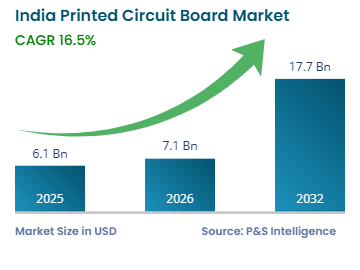
The Indian printed circuit board (PCB) market values USD 6.1 billion in 2025, and it is projected to reach USD 17.7 billion by 2032, expanding at a CAGR of 16.5% during 2026–2032. The market growth is primarily driven by rising domestic electronics manufacturing, strong government incentives under Production-Linked Incentive (PLI) schemes, growing demand for smartphones and electric vehicles, and increased localization of supply chains across the country.
India's electronics manufacturing sector has witnessed remarkable growth, with the country emerging as the world's second-largest mobile phone manufacturer. The production value of electronics in India rose nearly six times from INR 1.9 lakh crore in the fiscal year 2014–15 to INR 11.3 lakh crore in the fiscal year 2024–25, driven by strategic policy interventions. This expansion directly correlates with PCB demand, as these boards serve as the fundamental backbone of all electronic devices, enabling miniaturization and efficient construction of complex circuitry across consumer electronics, automotive systems, telecommunications, industrial automation, and renewable energy applications.
The surge in electric vehicle adoption represents a significant growth catalyst for the Indian PCB market. The Indian electric car market sales volume is projected to reach 430,603 units by 2030. Electric vehicles require advanced multilayer PCBs for battery management systems, power electronics, and smart vehicle controls, creating substantial demand for high-reliability circuit boards. The government's ambitious target of achieving 30% EV penetration by 2030 is expected to further accelerate PCB consumption across the automotive sector.
Furthermore, the rapid deployment of 5G infrastructure across India is generating significant opportunities for PCB manufacturers. India has seen the fastest rollout of 5G services in the world, with 4,62,084 BTS deployed across 779 districts, as of December 2024, making it one of the fastest 5G rollouts globally. This telecom infrastructure expansion requires high-frequency PCBs capable of handling advanced signal processing, driving demand for multilayer and HDI boards in network equipment, base stations, and consumer devices. The convergence of these growth drivers positions India's PCB manufacturing sector for sustained expansion throughout the forecast period.
India Printed Circuit Board Market Growth Factors
Multilayer, HDI, Flexible & Rigid-Flex PCBs and Sustainable Manufacturing Are Key Trends
India’s PCB industry is rapidly moving from basic single-/double-layer boards to multilayer, HDI, flexible, and rigid-flex PCBs, driven by demand from the telecom, EVs, defense, aerospace, and wearables sectors.
This shift is backed by concrete domestic investments.
Kaynes Circuits is building a large advanced PCB facility in Tamil Nadu with capabilities for high-layer-count, HDI, and flexible boards — a major step in reducing import dependence for complex PCBs.
Similarly, Ascent-K Circuit is establishing a unit within the Noida EMC 2.0 cluster focused on HDI and flexible boards, positioning it close to major electronics OEMs.
Syrma SGS is also constructing a multilayer PCB plant in Andhra Pradesh to support high-reliability applications in defense and industrial electronics. Collectively, these initiatives are expanding India’s capacity for sophisticated PCB technology.
Sustainability is becoming a core pillar of India’s PCB ecosystem.
EPPL has set up facilities using indigenous PCB-recycling technology to recover metals from e-waste, helping reduce landfill and dependence on mined materials.
PCB-materials company PCBL has integrated eco-friendly materials and energy-efficient production systems into its plants, supporting greener supply chains.
Wipro Electronic Materials is localizing production of copper-clad laminates and resins, reducing carbon footprint from imports and enabling cleaner material choices.
Across the sector, manufacturers are also adopting lead-free solder, halogen-free laminates, and improved wastewater treatment, making India’s PCB production progressively more compliant with global environmental standards.
Expanding Consumer Electronics Manufacturing Is Fueling PCB Consumption
The rising consumer electronics production in India is a major driver of the country’s PCB market.
As smartphones, TVs, wearables, smart home devices, and personal computing products see rapid domestic manufacturing growth—boosted by PLI schemes and global brands shifting assembly to India—the demand for locally produced PCBs has surged.
Higher value-addition is moving onshore, with OEMs and EMS companies increasingly sourcing boards domestically to shorten supply chains and cut import costs.
This expansion is also pushing demand for multilayer, HDI, and flexible PCBs used in compact consumer devices. Overall, the consumer electronics boom is directly accelerating India’s PCB manufacturing capacity and technology upgrades.
As per the Ministry of Electronics and Information Technology (MeitY), domestic manufacturing of electronic products has risen from INR 3,17,331 crore (USD 49 billion) in 2016–17 to INR 6,40,810 crore (USD 87.1 billion) in 2021–22, and it will further reach USD 300 billion by 2026.
Moreover, India's smartphone production reached USD 49.55 billion in FY24, establishing the country as the world's second-largest mobile phone manufacturer after China.
Major manufacturers, including Apple, Samsung, Xiaomi, and Vivo, have established production facilities in India, with Apple reportedly planning to manufacture over 50 million iPhones annually within the country.
This localization of smartphone manufacturing directly increases demand for domestically produced PCBs to support supply chain resilience.
India Printed Circuit Board Market Segmentation Analysis
Product Type Analysis
The rigid 1–2-sided category holds the largest market share, of approximately 50%, in 2025, driven by its widespread application in consumer electronics, LED lighting, and white goods manufacturing. These PCBs offer cost-effectiveness and reliability for standard electronic applications, making them the preferred choice for high-volume production. The expanding consumer durables sector, coupled with government incentives for domestic manufacturing of air conditioners and LED lights under the PLI scheme for white goods, continues to sustain demand for rigid single and double-sided boards.
The HDI/microvia/build-up category is expected to register the highest CAGR, of 16.6%, during 2026–2032, driven by increasing adoption of advanced smartphones, tablets, and wearable devices that require miniaturized, high-density circuitry. The proliferation of 5G-enabled devices and the growing automotive electronics sector are accelerating demand for HDI PCBs that offer superior signal integrity and thermal management capabilities.
These product types are covered:
Rigid 1–2-Sided (Largest Category)
Standard Multilayer
Flexible Circuit
HDI/Microvia/Build-Up (Fastest-Growing Category)
Rigid-Flex
Others
Manufacturing Type Analysis
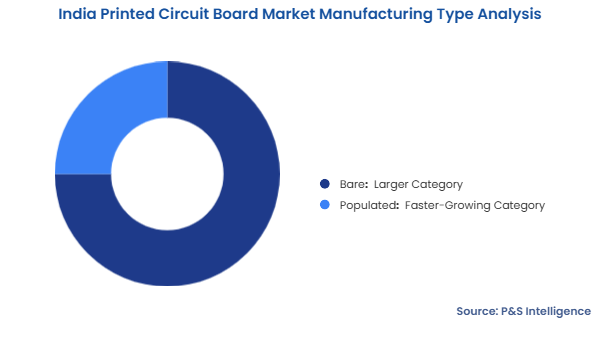
Bare PCBs represent the larger category in 2025, holding approximately 75% market value. Bare PCBs consist of substrate, metal coating, conductive pathways, and patterns without mounted components, serving as the foundation for electronics manufacturing across industries. Kaynes Technology and Amber Enterprises are expanding bare PCB production lines to meet growing domestic demand for innovative techniques, such as laser-drilled microvias, for high-speed applications.
Populated PCBs, pre-fitted with electronic components, have the higher CAGR as manufacturers seek integrated, ready-to-use solutions. Precision-critical industries, including automotive, medical electronics, and telecommunications, increasingly demand assembled circuit boards that reduce production complexity and time-to-market for end products.
These manufacturing types are covered:
Bare (Larger Category)
Populated (Faster-Growing Category)
Layer Analysis
Single-sided PCBs account for the largest share of the Indian PCB market in 2025, driven by their extensive use in cost-sensitive applications, including LED lighting, power supplies, and basic consumer electronics. These boards offer simplicity in design and manufacturing, making them ideal for high-volume production where component density requirements are moderate.
Multi-layer PCBs are expected to witness the fastest growth during 2026–2032, registering a CAGR of 16.7%. The increasing complexity of electronic devices, particularly in smartphones, automotive electronics, and telecom equipment, necessitates boards with multiple conductive layers for enhanced functionality. Kaynes Technology and Amber Enterprises are investing in multi-layer PCB production capabilities to capture this growing market category.
These layer types are covered:
Single-Sided (Largest Category)
Double-Sided
Multi-Layer (Fastest-Growing Category)
Type Analysis
The rigid bifurcation dominates the Indian PCB market in 2025 with approximately 85% share. Rigid PCBs are constructed using solid, inflexible substrate materials that provide excellent mechanical support for electronic components. These boards are extensively used in consumer electronics, computers, telecommunications equipment, and industrial applications where structural stability and cost-effectiveness are primary requirements. The expanding smartphone manufacturing sector, coupled with the growing demand for televisions, air conditioners, and LED lights, continues to drive the consumption of rigid PCBs across the country.
Flexible PCBs are expected to register the higher CAGR, of 16.8% during 2026–2032, driven by increasing adoption in wearable devices, medical electronics, and automotive applications requiring bendable circuit solutions. The demand for flexible and rigid-flex PCBs is accelerating as device miniaturization trends intensify across consumer electronics and healthcare sectors. Shogini Technoarts and Epitome Components are expanding their flexible PCB production capabilities to cater to the demand for them in foldable smartphones, smartwatches, and advanced medical monitoring devices.
These segments are covered:
Rigid PCBs (Largest Category)
Flexible PCBs (Fastest-Growing Category)
Laminate Type Analysis
FR-4 laminate holds the largest share of the Indian PCB market in 2025. FR-4 is a glass-reinforced epoxy laminate that offers excellent electrical insulation, mechanical strength, and thermal stability at competitive costs. These properties make FR-4 the preferred choice for standard PCB applications across consumer electronics, telecommunications, computers, and industrial equipment. The widespread availability of FR-4 materials with domestic and international suppliers, combined with established manufacturing processes, sustains its dominant position in the market.
Polyamide laminate is expected to witness the fastest growth during 2026–2032. Polyamide-based laminates offer superior flexibility, thermal resistance, and chemical stability, making them essential for flexible PCBs and high-temperature applications. The growing adoption of flexible circuits in automotive electronics, aerospace systems, and medical devices is driving demand for polyamide laminates. According to industry sources, the expansion of electric vehicle manufacturing in India is particularly boosting polyamide consumption, as EV battery management systems and power electronics require laminates capable of withstanding elevated operating temperatures.
These laminate types are covered:
FR-4 (Largest Category)
Polyamide (Fastest-Growing Category)
CEM-1
Paper
Others
Application Analysis
The consumer electronics category dominates the Indian PCB market in 2025 with approximately 35% share. This is attributed to India's position as a major hub for smartphone, television, and home appliance manufacturing. Rising disposable incomes, increasing urbanization, and growing digital literacy among the population continue to drive demand for consumer electronic devices, subsequently boosting PCB consumption.
The automotive category is projected to witness the fastest growth during the forecast period, with a CAGR of 16.9%. Electric vehicles, advanced driver-assistance systems (ADAS), battery management systems, and infotainment modules require sophisticated multilayer PCBs with high reliability and thermal stability. Battery electric vehicle production in India is projected to nearly triple to 377,000 units in 2025 from 130,000 in 2024, directly correlating with increased automotive PCB demand.
These applications are covered:
Consumer Electronics (Largest Category)
IT & Telecommunications
Industrial Electronics
Military & Aerospace
Automotive (Fastest-Growing Category)
Medical Devices
Others
Drive strategic growth with comprehensive market analysis
India Printed Circuit Board Market Regional Outlook
Maharashtra PCB Market Share
Maharashtra holds the largest share in the Indian PCB market in 2025, of approximately 30%. The state benefits from its position as a major industrial hub with extensive electronics manufacturing infrastructure concentrated in cities such as Pune, Mumbai, and Nashik. The presence of well-established automotive, consumer electronics, and industrial equipment manufacturers creates consistent demand for PCBs across multiple application segments.
The state hosts numerous PCB manufacturers, including Shogini Technoarts, which has operated from Pune since 1982 and was recently acquired by Amber Enterprises' subsidiary IL JIN Electronics to strengthen domestic manufacturing capabilities. The state has attracted significant investments in electronics manufacturing clusters, with dedicated zones for component production supporting the PCB ecosystem. The availability of a skilled workforce, robust logistics infrastructure, and proximity to major ports for raw material imports and finished goods exports reinforce Maharashtra's leadership position in the market.
Karnataka PCB market Growth
Karnataka is expected to register the highest CAGR during 2026–2032, driven by substantial investments in advanced PCB manufacturing facilities and strong government support for electronics manufacturing. The state has emerged as a focal point for PCB investments, with Schneider Electric announcing plans in December 2024 to establish a new PCB manufacturing plant that will create 5,000 additional jobs.
Kaynes Technology operates multiple facilities in the state, focusing on multilayer and HDI PCBs for telecom and automotive applications. The state offers competitive incentives under its Electronics System Design and Manufacturing (ESDM) policy, including capital subsidies, stamp duty exemptions, and land allocation benefits, that attract both domestic and international PCB manufacturers.
Bengaluru's established electronics ecosystem, hosting major OEMs, EMS suppliers, and semiconductor firms, creates stable and diversified PCB demand. The concentration of R&D centers and technical talent in the state supports innovation in advanced PCB technologies, including HDI and flexible circuits.
These states are covered:
Maharashtra (Largest State Market)
Karnataka (Fastest-Growing State Market)
Tamil Nadu
Gujarat
Others
India Printed Circuit Board Market Share
The Indian PCB market exhibits a fragmented competitive landscape characterized by the presence of several domestic manufacturers alongside international players. Market players are actively pursuing capacity expansion, technological upgrades, and strategic partnerships to strengthen their competitive positions. AT&S, an Austrian multinational, primarily manufactures high-end PCBs for export markets. In recent times, domestic companies, including Amber Enterprises, Kaynes Technology, and Syrma SGS, have made significant investments in PCB manufacturing capabilities, leveraging government incentives and growing domestic demand. The 30% anti-dumping duty imposed on imported PCBs with fewer than six layers in 2024 has created favorable conditions for domestic manufacturers to expand market share.
Key India Printed Circuit Board Companies:
Kaynes Technology India Limited
Syrma?SGS Technology Limited
Austria Technologie & Systemtechnik AG
Ascent Circuits Pvt. Ltd.
Circuit Systems India Limited
Genus Electrotech Pvt. Ltd.
Shogini?Technoarts Pvt. Ltd.
Epitome Components Pvt. Ltd.
CIPSA?TEC India Pvt. Ltd.
Meena Circuits Pvt. Ltd.
Fine?Line Circuits Pvt. Ltd.
India Circuits Limited
Sulakshana Circuits Pvt. Ltd.
Vintek Circuits Pvt. Ltd.
Akasaka Electric Co. Ltd.
India Printed Circuit Board Market News
In November 2025, IL JIN Electronics India, a subsidiary of Amber Enterprises, signed definitive agreements to acquire a majority stake in Shogini Technoarts, to strengthen in-house production capabilities and reduce external supplier dependence.
In December 2024, Schneider Electric announced plans to establish a new PCB manufacturing plant in Karnataka.
In October 2024, Amber Enterprises India Ltd. formed a 50:50 joint venture with Korea Circuit Co. Ltd., named Amber Korea Circuit Pvt Ltd, to bring advanced PCB manufacturing capabilities to India for automotive, industrial, medical, and consumer electronics applications.
In October 2024, Ascent Circuits, a subsidiary of Amber Group, announced an investment of INR 650 crore to establish a PCB manufacturing facility in Hosur, Tamil Nadu.
In September 2024, Karnataka announced the establishment of India's first PCB and Supply Chain Cluster in Mysuru to enhance local production and strengthen the country's electronics manufacturing capabilities.
In June 2024, BPL established a PCB manufacturing facility in Doddaballapur, Bengaluru, with an investment of Rs 20 crore, featuring upgraded single-side, double-side, and multi-layer PCB production lines.
Want a report tailored exactly to your business need?
Leading companies across industries trust us to deliver data-driven insights and innovative solutions for their most critical decisions. From data-driven strategies to actionable insights, we empower the decision-makers who shape industries and define the future. From Fortune 500 companies to innovative startups, we are proud to partner with organisations that drive progress in their industries.
Client Testimonials
Working with P&S Intelligence and their team was an absolute pleasure – their awareness of timelines and commitment to value greatly contributed to our project's success. Eagerly anticipating future collaborations.
McKinsey & Company
India
Unmatched Standards
Our insights into the minutest levels of the markets, including the latest trends and competitive landscape, give you all the answers you need to take your business to new heights
Complete Data Security
We take a cautious approach to protecting your personal and confidential information. Trust is the strongest bond that connects us and our clients, and trust we build by complying with all international and domestic data protection and privacy laws