India Power Electronics Market Size & Share Analysis - Emerging Trends, Growth Opportunities, Competitive Landscape, and Forecasts (2026 - 2032)
This Report Provides In-Depth Analysis of the India Power Electronics Market Report Prepared by P&S Intelligence, Segmented by Material (Silicon, Silicon Carbide, Gallium Nitride), Product (Power Discretes, Power Modules, Power ICs), Voltage (Low, Medium, High), Vertical (Consumer Electronics, Automotive, Industrial, Power & Energy, Aerospace & Defense), and Geographical Outlook for the Period of 2019 to 2032
Explore the market potential with our data-driven report
India Power Electronics Market Future Outlook
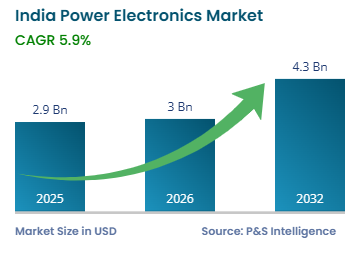
The Indian power electronics market values USD 2.9 billion in 2025, and it is projected to grow at a CAGR of 5.9% during 2026–2032, to reach USD 4.3 billion by 2032. The market expansion is driven by the rapid growth of renewable energy installations, increasing adoption of electric vehicles, and rising demand for energy-efficient solutions across industrial and consumer applications. India's ambitious target of achieving 500 GW of non-fossil fuel-based energy capacity by 2030 is creating substantial demand for advanced power electronic components, including inverters, converters, and power modules essential for grid integration and energy management systems. The Indian government's focus on semiconductor manufacturing and the 'Make in India' initiative is transforming the power electronics landscape in the country.
The Indian government's INR-76,000 crore Semicon India program aims to position India as a global hub for electronics manufacturing and design through infrastructure development, skill enhancement, and fostering innovation. In February 2024, the Indian government approved the establishment of three new semiconductor manufacturing facilities, including a commercial semiconductor fabrication facility at Dholera, Gujarat, with a capacity of 50,000 wafers per month.
The government is offering 50% financial support for setting up semiconductor manufacturing facilities, with state governments also playing a key role in this effort. These initiatives are creating a foundation for domestic power electronics component manufacturing, reducing import dependency, and attracting global semiconductor leaders to establish production facilities in India.
India Power Electronics Market Trends & Drivers
Wide-Bandgap Semiconductors Are Trending In India
The transition from traditional silicon-based power devices to wide bandgap semiconductors, particularly silicon carbide and gallium nitride, represents a transformative trend.
SiC and GaN offer higher breakdown voltage, faster switching speeds, lower conduction and switching losses, and enhanced thermal conductivity, enabling devices to operate efficiently at higher temperatures and voltages.
These attributes make wide-bandgap semiconductors particularly suited for high-power, high-efficiency EV powertrain applications, traction inverters, onboard chargers, and DC–DC converters.
Here, they improve energy efficiency, reduce system weight, and enable more compact designs.
SiC and GaN devices are increasingly being adopted in solar and wind inverters, smart grid infrastructure, and industrial motor drives.
Here their ability to handle higher voltages and switching frequencies translates into lower energy losses, better thermal management, and longer system lifetimes.
In India, the growing emphasis on industrial automation and local manufacturing of electronics, to reduce reliance on imports, is also driving the demand for these advanced semiconductors.
This shift enhances the performance and reliability of power electronics systems, positions India to compete in the global semiconductor landscape, fosters innovation and supports the country’s broader sustainability and energy-efficiency goals.
Expansion of Renewable Energy Infrastructure Is Boosting Market Growth
India's commitment to achieving 500 GW of non-fossil fuel-based energy capacity by 2030 is a major driver for the power electronics market.
These achievements have propelled India's total non-fossil fuel-based energy capacity to 217.62 GW as of January 2025, increasing the demand for power electronic devices used in solar inverters, wind turbine converters, and energy storage systems.
Solar energy installations require sophisticated power electronic systems for DC to AC conversion, maximum power point tracking, and grid synchronization.
The rooftop solar sector grew by 53% in 2024, adding 4.59 GW of new capacity, driven by the PM Surya Ghar: Muft Bijli Yojana scheme.
Wind energy installations in Gujarat, Karnataka, and Tamil Nadu accounted for 98% of the new wind capacity additions in 2024, creating concentrated demand for power converters and frequency inverters in these states.
Grid-scale solar farms, wind installations, and hybrid energy systems increasingly rely on SiC-based inverters and power modules to reduce conversion losses and improve thermal performance.
Electric Vehicle Revolution Is a Major Opportunity
The rapid growth of India's electric vehicle market is significantly propelling demand for power electronics, particularly power inverters, converters, and onboard chargers.
Industry data suggests that 430,603 electric cars will sell in India in 2030, compared to 19,778 in 2023, while the Indian electric bus market value could reach USD 905.4 million by decade-end.
India has set an ambitious target to elevate EV sales to 30% of private cars, 70% of commercial vehicles, 40% of buses, and 80% of two- and three-wheelers by 2030.
Electric two-wheeler and e-rickshaw sales also continue to grow, propelled by people’s rising eco-consciousness and the declining prices of these vehicles.
Power ICs are increasingly popular in two-wheelers and compact EVs for battery monitoring, motor control, and infotainment systems.
Power modules and discrete devices are drawing attention in high-power applications, such as inverters and converters for electric buses and four-wheelers.
This growth in EV adoption is also driving demand for power modules, onboard chargers, and DC–DC converters, positioning the automotive vertical as a key contributor to market expansion.
India Power Electronics Market Segmentation Analysis
Material Analysis
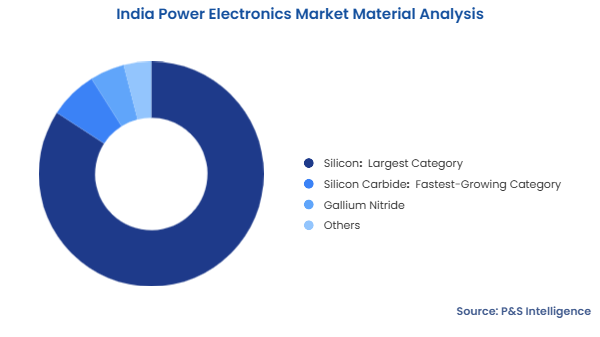
The silicon category holds the largest share in the Indian power electronics market in 2025, of 85%, due to its established manufacturing infrastructure, lower cost, and wide availability across various power device applications. Traditional silicon-based devices, including MOSFETs, IGBTs, and power diodes, continue to serve the majority of consumer electronics, industrial automation, and general power supply applications where extreme performance characteristics are not required.
Silicon carbide is expected to register the highest CAGR of 6.2% during the forecast period, driven by its superior performance in high-voltage, high-temperature, and high-frequency applications. SiC power devices are increasingly being adopted in electric vehicle powertrains, renewable energy inverters, and industrial motor drives due to their ability to reduce power losses by 50% to 70% compared to silicon devices. The growing domestic SiC manufacturing capability, including RIR Power Electronics' facility in Odisha, is expected to accelerate market adoption. Gallium nitride is gaining traction in high-frequency power conversion applications, particularly in consumer electronics charging systems and data center power supplies, though it currently represents a smaller share of the overall market.
These materials are covered:
Silicon (Largest Category)
Silicon Carbide (Fastest-Growing Category)
Gallium Nitride
Others
Product Analysis
The power discretes category dominates the Indian power electronics market in 2025, with 50% share, as MOSFETs, IGBTs, thyristors, and rectifiers are used across virtually all power electronic applications. Their widespread adoption in consumer electronics, industrial equipment, automotive systems, and power supplies ensures consistent demand. The category benefits from established supply chains, competitive pricing, and continuous technological improvements in efficiency and thermal performance.
Power modules are anticipated to witness the fastest growth during the forecast period, driven by the increasing adoption of integrated power solutions in electric vehicles and renewable energy applications. Module solutions offer reduced assembly complexity, improved thermal management, and higher power density compared to discrete component assemblies. The electric vehicle sector is particularly driving demand for IGBT and SiC power modules used in traction inverters and onboard chargers. Power ICs continue to show strong growth in smartphone, laptop, and wearable device applications, where compact size and high efficiency are critical requirements.
These products are covered:
Power Discretes (Largest Category)
Power Modules (Fastest-Growing Category)
Power ICs
Others
Voltage Analysis
The low category holds the largest market share in 2025, of 60%. Low voltage power electronics devices, typically operating below 600V, are extensively used in consumer electronics, computing devices, telecommunications equipment, and general-purpose power supplies. The proliferation of smartphones, laptops, tablets, and IoT devices in India continues to drive demand for low-voltage power management ICs and converters.
The high category is expected to exhibit the fastest growth during the forecast period, supported by the expansion of renewable energy infrastructure, electric vehicle charging networks, and industrial power systems. Power devices operating above 1,200 V are essential for grid-connected solar inverters, wind turbine converters, railway traction systems, and high-power industrial drives. India's ambitious renewable energy targets and the development of ultra-fast EV charging infrastructure are creating substantial demand for high-voltage SiC and IGBT devices capable of handling elevated power levels with minimal losses.
These voltage categories are covered:
Low (Largest Category)
Medium
High (Fastest-Growing Category)
Vertical Analysis
The consumer electronics category holds the largest share in the Indian power electronics market in 2025, of 35%. India's position as one of the world's largest consumer electronics markets drives the demand for power management ICs, battery chargers, and voltage regulators. The value of electronic production in India rose from INR 1.9 lakh crore in the fiscal year 2014–15 to INR 11.3 lakh crore in the fiscal year 2024–25. The increasing adoption of fast-charging technologies and GaN-based chargers is further elevating power electronics content per device.
The automotive category is projected to register the highest CAGR of 6.1% during the forecast period, driven by the rapid electrification of India's transportation sector. Electric vehicles require substantially higher power electronics content compared to conventional vehicles, including traction inverters, DC–DC converters, onboard chargers, and battery management systems. Two- and three-wheeler sales revenue in India could rise to 14,951.4 million by 2030.
These verticals are covered:
Consumer Electronics (Largest Category)
Automotive (Fastest-Growing Category)
Industrial
Power & Energy
Aerospace & Defense
Others
Drive strategic growth with comprehensive market analysis
India Power Electronics Market Regional Outlook
Maharashtra Power Electronics Market Value
Maharashtra held the largest share in the Indian power electronics market in 2025, accounting for approximately 20% of the national market. The state's dominance is attributed to its strong industrial base, presence of major electronics manufacturing clusters, and concentrated automotive industry around Pune and Mumbai. Maharashtra hosts significant investments in semiconductor and electronics manufacturing, including the recently approved USD 10 billion chip fabrication plant joint venture between Tower Semiconductor and the Adani Group in Panvel.
The state leads in public EV charging infrastructure with 3,728 charging stations as of 2024, reflecting strong alignment between EV adoption and power electronics demand. According to the International Council on Clean Transportation, Maharashtra is among the top states driving India's EV transition, creating sustained demand for power electronic components used in charging stations and electric vehicles. The presence of major automotive manufacturers, including Tata Motors, Mahindra, and several global OEMs, ensures consistent demand for automotive-grade power semiconductors in the region.
Gujarat Power Electronics Market Forecast
Gujarat is anticipated to emerge as the fastest-growing state with an approximate CAGR of 6.0% for power electronics during the forecast period. The state is at the forefront of India's semiconductor manufacturing ambitions, hosting a massive commercial semiconductor fabrication facility at Dholera Special Investment Region. Gujarat contributed 1,250 MW to India's wind capacity additions in 2024, creating substantial demand for power electronic converters and inverters.
The 2025 edition of the Gujarat SemiConnect Conference witnessed the signing of eight memoranda of understanding worth over INR 1.04 lakh crore. The state's proactive industrial policies, established chemical and petrochemical industries, and growing automotive manufacturing presence are driving power electronics demand across multiple verticals. Siemens committed INR 10,000 million (USD 120.5 million) to expand production of drives and controllers in Gujarat, reflecting the state's growing importance in industrial automation equipment manufacturing.
These states are covered:
Maharashtra (Largest State Market)
Tamil Nadu
Karnataka
Gujarat (Fastest-Growing State Market)
Haryana
Delhi
Uttar Pradesh
Rajasthan
Telangana
Andhra Pradesh
Rest of India
India Power Electronics Market Share
The Indian power electronics market is fragmented and characterized by the presence of global semiconductor leaders alongside emerging domestic players. International companies dominate the high-performance power semiconductor category, leveraging their advanced manufacturing capabilities, established supply chains, and strong R&D investments. However, the market is witnessing increased activity from domestic manufacturers, supported by government incentives and the growing emphasis on indigenous semiconductor production under the Make in India initiative.
Key competitive strategies in the market include product innovation focused on wide bandgap semiconductors, strategic partnerships with local manufacturers, and capacity expansion to meet growing demand. The emergence of domestic players in SiC manufacturing, such as RIR Power Electronics, is expected to intensify competition and create opportunities for supply chain localization in the coming years.
Key India Power Electronics Companies:
Analog Devices Inc.
Infineon Technologies AG
Microchip Technology Incorporated
NXP Semiconductors NV
STMicroelectronics NV
ON Semiconductor Corporation
Renesas Electronics Corporation
Texas Instruments Incorporated
Toshiba Corporation
Vishay Intertechnology Inc.
Fuji Electric Co. Ltd.
ROHM Co. Ltd.
Murata Manufacturing Co. Ltd.
Bharat Heavy Electricals Limited
Havells India Limited
India Power Electronics Market News
In December 2025, RIR Power Electronics announced the commencement of phase 1 production of Silicon Carbide Epitaxy Wafers at its facility in Odisha, marking a milestone for indigenous SiC semiconductor manufacturing in India.
In April 2025, Infineon Technologies AG launched the CoolSiC MOSFET 750V G2, a next-generation SiC power transistor, offering improved efficiency and power density in automotive and industrial applications.
In January 2025, Turntide Technologies made its debut in India with a comprehensive range of low and high-voltage power electronics series at the Bharat Mobility Global Expo 2025, targeting the sustainable mobility sector.
In September 2024, the Government of Maharashtra approved an investment proposal of INR 83,947 crore (USD 10 billion) for a joint venture between Tower Semiconductor and the Adani Group to establish a chip manufacturing plant in Panvel with a capacity of 40,000 wafers per month.
In September 2024, NXP Semiconductors announced an investment exceeding USD 1 billion to strengthen its research and development operations in India, expanding its semiconductor design capabilities.
In September 2024, the Indian government approved Kaynes Technology's proposal to establish a semiconductor assembly, testing, marking and packaging facility in Sanand, Gujarat, with an investment of INR 3,307 crore.
In February 2024, the Indian government approved the establishment of three semiconductor manufacturing facilities, including a commercial fab in Dholera, Gujarat, and OSAT facilities in Morigaon, Assam; and Sanand, Gujarat, with total investments of approximately INR 1.25 lakh crore.
Want a report tailored exactly to your business need?
Leading companies across industries trust us to deliver data-driven insights and innovative solutions for their most critical decisions. From data-driven strategies to actionable insights, we empower the decision-makers who shape industries and define the future. From Fortune 500 companies to innovative startups, we are proud to partner with organisations that drive progress in their industries.
Client Testimonials
Working with P&S Intelligence and their team was an absolute pleasure – their awareness of timelines and commitment to value greatly contributed to our project's success. Eagerly anticipating future collaborations.
McKinsey & Company
India
Unmatched Standards
Our insights into the minutest levels of the markets, including the latest trends and competitive landscape, give you all the answers you need to take your business to new heights
Complete Data Security
We take a cautious approach to protecting your personal and confidential information. Trust is the strongest bond that connects us and our clients, and trust we build by complying with all international and domestic data protection and privacy laws