India Microcontroller Market Size & Share Analysis - Key Trends, Future Opportunities, Growth Strategies, and Forecasts (2026 - 2032)
This Report Provides In-Depth Analysis of the India Microcontroller Market Report Prepared by P&S Intelligence, Segmented by Product (8-bit, 16-bit, 32-bit), Application (Automotive, Consumer Electronics & Telecom, Industrial, Medical Devices, Aerospace & Defense), and Geographical Outlook for the Period of 2019 to 2032
Explore the market potential with our data-driven report
India Microcontroller Market Analysis
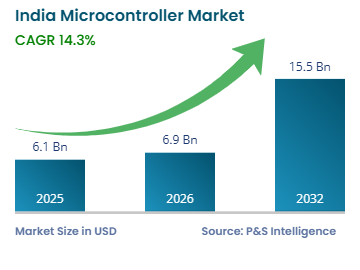
The Indian microcontroller market values USD 6.1 billion in 2025, and it is projected to grow at a CAGR of 14.3% during 2026–2032, to reach USD 15.5 billion by 2032. The market growth is primarily driven by rapid industrialization, increasing adoption of electric vehicles, expanding consumer electronics manufacturing, and government initiatives promoting domestic semiconductor production. India is emerging as one of the fastest-growing microcontroller markets in the Asia Pacific region, fueled by the country's digital transformation initiatives and robust manufacturing sector expansion.
The Indian government's Semicon India program, with an allocation of INR 76,000 crore, has catalyzed significant investments in semiconductor manufacturing infrastructure across the country. Semiconductor consumption in India could more than double from USD 45–50 billion in 2024–2025 to USD 100–110 billion by 2030, according to industry estimates. The increasing penetration of microcontrollers in automotive electronics, particularly in electric vehicles, represents a substantial growth opportunity. India is expected to witness 430,603 unit sales of electric cars by the year 2030, which directly translates to higher microcontroller demand for battery management systems, motor controllers, and vehicle infotainment systems.
The consumer electronics sector in India continues to drive significant microcontroller consumption, with the market valued at approximately USD 85 billion in 2024. The proliferation of smart home devices, wearables, and connected appliances has intensified the demand for 32-bit microcontrollers that offer enhanced processing capabilities and energy efficiency. Additionally, India's industrial automation market is accelerating microcontroller adoption in programmable logic controllers, human-machine interfaces, and IoT-enabled manufacturing systems.
India Microcontroller Market Emerging Trends & Growth Drivers
Rising Electric Vehicle Adoption Is Key Trend
The electric vehicle revolution in India is significantly propelling microcontroller demand.
Electric vehicles require substantially more microcontrollers than conventional vehicles for battery management systems, motor control units, charging infrastructure, and advanced driver assistance systems (ADAS).
A typical electric two-wheeler uses 15–20 microcontrollers, while electric cars can employ 50-100 microcontrollers depending on feature complexity.
India’s EV sales grew by 16.9% in FY25 to 1.97 million units, up from 1.75 million in FY24.
Electric passenger vehicles crossed the 100,000-unit mark with 18.2% growth, e-two-wheeler registrations rose 21.2% to 1.15 million units, and e-three-wheelers increased 10.5% to around 700,000 units.
Major automotive electronics players are expanding their India operations, with Honda Cars India announcing over 50,000 ADAS-enabled vehicles in March 2024, underscoring the increasing sophistication of automotive electronics.
Government Semiconductor Initiatives Are Driving Market Growth
The Indian government's proactive approach to establishing a domestic semiconductor ecosystem is a major driver for the microcontroller market.
The Semicon India program, launched with an outlay of INR 76,000 crore, aims to position India as a global hub for semiconductor manufacturing.
Under this program, the government offers fiscal support of 50% of project costs for setting up semiconductor fabrication facilities.
India has approved four semiconductor manufacturing units as part of this initiative, expected to generate approximately 15,710 direct jobs.
The Production Linked Incentive (PLI) scheme for electronics manufacturing has further attracted investments exceeding INR 8,803 crore in semiconductor components, creating a favorable ecosystem for microcontroller manufacturing and design.
Industrial Automation and IoT Integration Present Significant Opportunities
The rapid adoption of Industry 4.0 practices and IoT technologies across Indian manufacturing is creating substantial opportunities for microcontroller suppliers.
Indian companies are rapidly embracing digital transformation initiatives, driving demand for smart manufacturing solutions.
The declining cost of industrial sensors, which fell by 30–40% between 2023 and 2024, has made IoT-enabled automation viable for mid-tier manufacturing plants.
The Digital India initiative, with a budget allocation of INR 14,903 crore for 2021 to 2026, is further accelerating the adoption of automation technologies across sectors.
This, in turn, is creating sustained demand for microcontrollers in programmable logic controllers, distributed control systems, and edge computing devices.
India Microcontroller Market Segmentation Analysis
Product Type Analysis
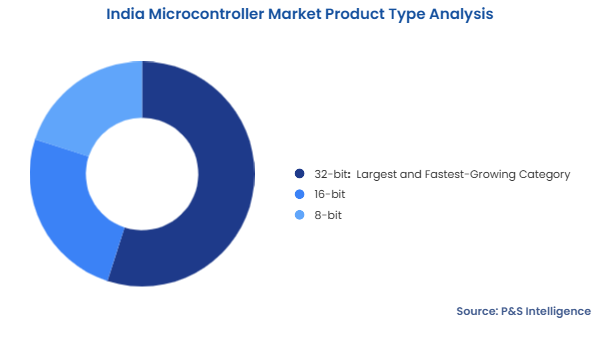
The 32-bit category holds the largest share in the Indian microcontroller market in 2025, of 55%, and it is also expected to witness the fastest growth during the forecast period, with a CAGR of 14.5%. This is primarily attributed to the increasing demand for high-performance computing in automotive electronics, industrial automation, and advanced consumer devices. 32-bit microcontrollers, particularly those based on the ARM Cortex-M architecture, offer superior processing power, energy efficiency, and integrated peripheral sets that meet the requirements of modern embedded applications.
The automotive sector's transition toward electric vehicles and ADAS has particularly accelerated 32-bit microcontroller adoption, as these applications require sophisticated real-time processing capabilities. According to industry estimates, a modern electric vehicle can contain over 100 32-bit microcontrollers for various functions, including battery management, motor control, infotainment, and vehicle connectivity. The popularity of 32-bit MCUs is also credited to the proliferation of IoT devices, which require advanced processing capabilities for edge computing and machine learning applications.
These product types are covered:
32-bit (Largest and Fastest-Growing Category)
16-bit
8-bit
Application Analysis
The automotive application category holds the largest share in the Indian microcontroller market in 2025, of 40%. India's automotive sector produced 32.5 million vehicles annually, which is why it is a substantial consumer of microcontrollers. The increasing vehicle electrification, adoption of advanced driver assistance systems, and integration of connected car technologies are primary growth catalysts. India ranked fourth globally in vehicle production in 2023, underscoring the scale of automotive microcontroller demand.
The consumer electronics & telecom category is expected to witness the fastest growth during the forecast period. This growth is fueled by India's expanding smartphone market, where the country already has 931 million users with projections reaching 1.1 billion by 2025. India had seen the deployment of 4,62,084 BTS across 779 districts, as of December 2024. India's 5G subscriber count is expected to increase from 290 million in 2024 to 980 million by 2030, accelerating the adoption of connected devices that require sophisticated microcontrollers. Additionally, the proliferation of smart home devices, wearables, and IoT-enabled consumer electronics is contributing to segment growth.
India's emergence as a global consumer electronics manufacturing hub is driving consistent microcontroller demand. The country currently has over 931 million smartphone users, expected to reach 1.1 billion by 2025. Each smartphone contains multiple microcontrollers for power management, sensor processing, and peripheral control. The growing adoption of smart home devices, wearables, and connected appliances is further amplifying microcontroller consumption.
Drive strategic growth with comprehensive market analysis
India Microcontroller Market Regional Outlook
Maharashtra Microcontroller Market Size
Maharashtra holds the largest share in the Indian microcontroller market in 2025, of 20%. The state's dominance is attributed to its robust industrial infrastructure, thriving automotive sector, and established electronics manufacturing ecosystem centered around Pune and Mumbai. Maharashtra hosts multiple automobile manufacturing plants, including those of Tata Motors, Mahindra & Mahindra, and Bajaj Auto, which collectively drive substantial microcontroller demand for vehicle electronics.
The state government approved an investment proposal of INR 83,947 crore for semiconductor manufacturing in September 2024, including a joint venture between Tower Semiconductor and the Government of Maharashtra for chip production. Additionally, Maharashtra's strong industrial base, comprising chemical, pharmaceutical, and manufacturing sectors, contributes to microcontroller consumption in process automation and industrial control applications.
Tamil Nadu Microcontroller Market Share
Tamil Nadu is expected to be the fastest-growing state market, with a CAGR of 14.4% during 2026–2032. The state has firmly established itself as India's leading hub for electronics hardware manufacturing and exports. According to industry data, Tamil Nadu recorded a 53% year-on-year increase in electronics exports in FY 2024-25, reaching USD 14.65 billion, contributing 41.3% to India's total electronics exports. The Sriperumbudur industrial belt hosts some of the largest electronics manufacturing facilities in the country, including major operations by Foxconn, Samsung, and Dell. Tamil Nadu's Semiconductor and Advanced Electronics Policy 2024 aims to position the state as a key player in India's high-tech manufacturing sector.
Karnataka Microcontroller Market Outlook
Karnataka holds significant market share as Bengaluru serves as India's semiconductor design capital. The state hosts over 100 fabless chip design houses and more than 400 multinational corporations operating global R&D centers. Major semiconductor companies, including Intel, Qualcomm, Texas Instruments, and NXP, have established R&D centers in Bengaluru. Karnataka contributed USD 7.85 billion in electronics exports in FY 2024-25, representing 22% of India's total electronics exports.
The International Semiconductor Consortium (ISMC), a joint venture between Abu Dhabi-based Next Orbit Ventures and Tower Semiconductor, has signed an MoU with the Government of Karnataka to set up a 65-nanometer analog semiconductor fabrication unit with an investment of USD 3 billion. The state's strong technology talent pool, with universities producing a large number of engineering graduates annually, supports the semiconductor ecosystem's growth.
These states are covered:
Maharashtra (Largest State Market)
Karnataka
Tamil Nadu (Fastest-Growing State Market)
Gujarat
Uttar Pradesh
Telangana
Delhi
Haryana
Rest of India
India Microcontroller Market Share
The Indian microcontroller market exhibits a consolidated competitive landscape, with the top five global players collectively holding 60% market share. The market is dominated by established multinational semiconductor companies that have significant presence through local sales offices, design centers, and distribution networks. These companies leverage their extensive product portfolios, advanced technology offerings, and strong application engineering support to maintain competitive advantages. The major players compete on parameters, including processing performance, power efficiency, integrated peripherals, security features, and total cost of ownership.
Key competitive strategies include new product introductions targeting emerging applications, expansion of local design and support capabilities, and strategic partnerships with Indian OEMs. Global players are increasingly focusing on India-specific solutions, recognizing the country's unique requirements for cost-effective, energy-efficient devices suitable for the price-sensitive market.
The competitive intensity is expected to increase with the entry of domestic players and the expansion of Chinese microcontroller manufacturers seeking market share. Companies are investing in application-specific solutions for high-growth segments, including automotive electronics, industrial automation, and IoT applications. The establishment of local manufacturing and assembly facilities is emerging as a key differentiator, with several players exploring opportunities under the government's semiconductor incentive programs. In September 2024, Analog Devices signed an agreement with Tata Group subsidiaries and Tejas Networks to explore semiconductor fabrication in India, indicating the growing interest of major players in local manufacturing.
Key India Microcontroller Companies:
Analog Devices Inc.
ROHM Co. Ltd.
Microchip Technology Inc.
Renesas Electronics Corporation
NXP Semiconductors N.V.
STMicroelectronics N.V.
Infineon Technologies AG
Texas Instruments Incorporated
Samsung Electronics Co. Ltd.
Intel Corporation
Broadcom Inc.
ON Semiconductor Corporation
Qualcomm Incorporated
MediaTek Inc.
Toshiba Corporation
India Microcontroller Market News
In September 2024, Analog Devices signed an agreement with Tata Group subsidiaries and Tejas Networks to explore semiconductor fabrication in India for integration into diverse Tata products.
In September 2024, the Government of India approved the Kaynes Technology ATMP unit in Gujarat for INR 3,307 crore, with a daily production capacity of 6.3 million chips.
In May 2024, Mindgrove Technologies launched a commercial high-performance RISC-V-based microcontroller SoC, named Secure IoT. It enables domestic OEMs to reduce costs by integrating Indian-designed silicon into their devices.
In March 2024, STMicroelectronics unveiled advanced STM32H7 microcontrollers that merge microprocessor-level performance with MCU simplicity, targeting smart appliances, building controllers, and industrial automation applications.
In March 2024, Renesas Electronics Corporation introduced the RA2A2 microcontroller series powered by ARM Cortex-M23 processor, featuring a 24-bit Sigma-Delta analog-to-digital converter for energy-efficient applications.
In March 2025, Ennoconn, a subsidiary of Foxconn, commenced operations at its industrial automation facility in Tamil Nadu, aiming to introduce industrial IoT and embedded technology solutions to the Indian market.
In January 2024, Infineon Technologies and GlobalFoundries announced a multi-year agreement to supply Infineon's AURIX TC3x 40nm automotive microcontrollers, power management, and connectivity solutions to support business growth from 2024 to 2030.
Want a report tailored exactly to your business need?
Leading companies across industries trust us to deliver data-driven insights and innovative solutions for their most critical decisions. From data-driven strategies to actionable insights, we empower the decision-makers who shape industries and define the future. From Fortune 500 companies to innovative startups, we are proud to partner with organisations that drive progress in their industries.
Client Testimonials
Working with P&S Intelligence and their team was an absolute pleasure – their awareness of timelines and commitment to value greatly contributed to our project's success. Eagerly anticipating future collaborations.
McKinsey & Company
India
Unmatched Standards
Our insights into the minutest levels of the markets, including the latest trends and competitive landscape, give you all the answers you need to take your business to new heights
Complete Data Security
We take a cautious approach to protecting your personal and confidential information. Trust is the strongest bond that connects us and our clients, and trust we build by complying with all international and domestic data protection and privacy laws