India Green Hydrogen Market Size & Share Analysis - Emerging Trends, Growth Opportunities, Competitive Landscape, and Forecasts (2026 - 2032)
This Report Provides In-Depth Analysis of the India Green Hydrogen Market Report Prepared by P&S Intelligence, Segmented by Solid-Oxide Electrolyzer Cell (SOEC), Distribution Channel (Pipeline, Cargo), Renewable Energy Source (Wind Energy, Solar Energy), End Use (Residential and Commercial Heating, Industrial, Transportation, Power generation), and Geographical Outlook for the Period of 2019 to 2032
Explore the market potential with our data-driven report
India Green Hydrogen Market Future Outlook
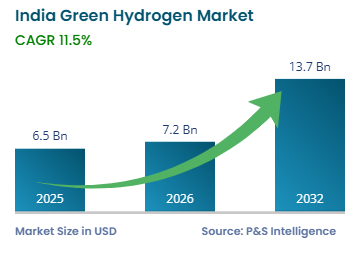
The Indian green hydrogen market values USD 6.5 billion in 2025, which is projected to reach USD 13.7 billion by 2032, growing at a CAGR of 11.5% during 2026–2032. The market expansion is driven by the country's ambitious National Green Hydrogen Mission, substantial government investments, and growing industrial demand for clean energy alternatives. India's strategic positioning as a potential global hub for green hydrogen production and export is reshaping the country's energy landscape and attracting significant investments from both domestic conglomerates and international partners.
The Government of India approved the National Green Hydrogen Mission in January 2023 with an initial outlay of INR 19,744 crore to support the development of a comprehensive hydrogen ecosystem. According to the Ministry of New and Renewable Energy, the mission targets a green hydrogen production capacity of at least 5 million metric tonnes (MMT) per annum by 2030, with an associated renewable energy capacity addition of approximately 125 GW. The mission is expected to attract over INR 8 lakh crore in total investments and create more than 600,000 jobs while enabling abatement of nearly 50 MMT of annual greenhouse gas emissions.
India's abundant renewable energy resources present a significant advantage for cost-competitive green hydrogen production. As per the International Energy Agency, India's clean energy investment reached USD 68 billion in 2023, representing nearly 40% growth from the 2016–2020 average. The country's total non-fossil fuel energy capacity reached 217.62 GW as of January 2025, with solar and wind accounting for the majority of capacity additions. This renewable energy infrastructure serves as the foundation for scaling green hydrogen production across industrial applications, including refineries, fertilizers, steel manufacturing, and transportation.
India Green Hydrogen Market Trends & Drivers
Government Policy Support and Investment Incentives Are Key Trends
The Indian government's comprehensive policy framework is driving the green hydrogen market through multiple incentive mechanisms.
The Strategic Interventions for Green Hydrogen Transition (SIGHT) program allocates INR 17,490 crore for providing incentives for domestic manufacturing of electrolyzers and production of green hydrogen.
The program includes INR 4,440 crore for electrolyzer manufacturing and INR 13,050 crore for green hydrogen production incentives.
Additionally, green hydrogen and ammonia projects commissioned by December 2030 receive a waiver of inter-state transmission charges for 25 years, significantly reducing operational costs for producers.
State-level policies are complementing federal initiatives with substantial additional incentives.
State-level policies embed around INR 5.05 lakh crore in incentives, which is 26 times the National Green Hydrogen Mission budget.
Odisha, Maharashtra, Tamil Nadu, Uttar Pradesh, Rajasthan, Andhra Pradesh, and Gujarat account for over 90% of this incentive ecosystem.
Around 62% of these incentives target power costs through tariff, transmission, and duty waivers, while the remaining 38% support capital expenditure through subsidies and interest subvention.
Declining Renewable Energy Costs Are Driving Green H2 Consumption
The significant reduction in renewable energy costs is transforming green hydrogen production economics in India.
Solar power generation costs have declined to approximately INR 2.1–2.4 per kWh in renewable energy-rich states such as Gujarat, Maharashtra, and Rajasthan.
According to the Rocky Mountain Institute, green hydrogen production costs are anticipated to decline by an average of 46% from 2024 to 2030, falling from approximately USD 4.4 per kg to USD 2.4 per kg.
This cost trajectory is driven by technological advancements, economies of scale, and increased infrastructure development across the hydrogen value chain.
India added 24.5 GW of solar capacity and 3.4 GW of wind capacity in 2024, which supports green hydrogen production.
Rajasthan, Gujarat, and Tamil Nadu contributed 71% of utility-scale solar installations that year.
The country's target of a 500-GW non-fossil fuel energy capacity by 2030 will provide substantial renewable power availability for electrolysis-based hydrogen production, further improving cost competitiveness against grey hydrogen alternatives.
India Green Hydrogen Market Segmentation Analysis
Technology Insights
The alkaline electrolysis category holds the largest market share, of approximately 65%, in 2025, driven by its established technology base, lower capital costs, and suitability for large-scale hydrogen production. Alkaline electrolyzers are the most commercially mature technology with proven durability and the ability to produce high volumes of hydrogen. Many major Indian players have secured significant electrolyzer orders based on alkaline technology.
The polymer electrolyte membrane (PEM) electrolysis category is expected to register the highest CAGR, during 2026–2032, owing to its higher efficiency, compact design, and superior dynamic response characteristics that enable integration with intermittent renewable energy sources. PEM electrolyzers offer quick start-up times and can handle variable power loads effectively, making them suitable for coupling with solar and wind generation.
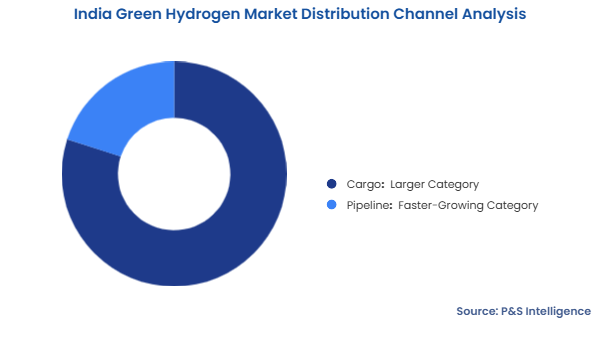
The cargo category accounts for the larger share, of approximately 80%, in 2025, primarily due to the nascent stage of dedicated hydrogen pipeline infrastructure in India. Transportation through tube trailers, liquid hydrogen tankers, and compressed gas cylinders dominates current distribution patterns. The infrastructure includes truck and rail loading facilities for local delivery and ship-loading facilities for export-oriented projects. India requires substantial investments in hydrogen storage tanks, trailers, and distribution networks to support the growing production capacity.
The pipeline category is set to witness the faster growth during the forecast period, supported by government initiatives to develop hydrogen-ready infrastructure. India has an authorized a natural gas pipeline network of around 33,000 km, with 24,000 km operational, providing potential infrastructure for hydrogen transport through blending. The Petroleum and Natural Gas Regulatory Board is assessing the feasibility of using existing natural gas pipelines for hydrogen transport. Studies conducted by Engineers India Limited and IIT Kanpur suggest that up to 3% green hydrogen can be safely blended into existing city gas distribution pipelines. Tata Steel became India's first steel company to demonstrate capabilities to develop API X65 grade steel pipes compliant with hydrogen transportation requirements.
These distribution channels are covered:
Cargo (Larger Category)
Pipeline (Faster-Growing Category)
Renewable Energy Source Analysis
The solar energy category dominates the market with approximately 65% share in 2025, reflecting India's abundant solar irradiance. India's installed solar capacity reached approximately 97.86 GW as of January 2025, with strong growth driven by utility-scale installations in Rajasthan, Gujarat, and Tamil Nadu. Solar-powered green hydrogen projects benefit from competitive power costs, with on-site solar generation costs as low as INR 2.1 per kWh in favorable locations. The co-location of solar generation facilities with electrolyzer installations eliminates transmission costs and maximizes renewable energy utilization.
The wind energy category is projected to grow at the faster rate during the forecast period, supported by increasing hybrid solar-wind project development that ensures a more-stable power supply for hydrogen production. India's installed wind capacity exceeds 48.16 GW, with Gujarat, Karnataka, and Tamil Nadu accounting for 98% of new capacity additions in 2024. Coastal and offshore wind resources offer particularly good conditions for continuous hydrogen production.
These renewable energy sources are covered:
Solar (Largest Category)
Wind (Fastest-Growing Category)
Others
End Use Analysis
The industrial category has the largest share, of approximately 40%, in 2025, driven by substantial hydrogen demand from refineries, fertilizer plants, and steel manufacturers. India's refining sector and fertilizer industry represent the primary consumption centers for hydrogen, with existing grey hydrogen demand providing a clear pathway for green hydrogen substitution. Indian Oil Corporation is developing green hydrogen plants at its refineries, including the Mathura facility with an investment of approximately INR 2,000 crore. The steel industry is exploring hydrogen-based direct reduced iron technology, with pilot projects underway at major facilities to reduce carbon emissions in steelmaking.
The transportation category is expected to register the fastest growth during the forecast period, supported by government pilot projects and increasing focus on heavy-duty vehicle decarbonization. Five pilot projects for hydrogen-fueled buses and trucks have been launched across 10 key routes, with 37 hydrogen fuel cell and internal combustion engine vehicles being tested and nine refueling stations being implemented. NTPC's green hydrogen mobility project in Leh operates hydrogen fuel cell buses capable of running up to 300 km on a single fill, expected to save 350 tonnes of CO2 emissions annually. India targets the deployment of 500 hydrogen buses across major cities and 1,000 hydrogen trucks and buses by 2030.
These end uses are covered:
Industrial (Largest Category)
Transportation (Fastest-Growing Category)
Power Generation
Residential and Commercial Heating
Others
Drive strategic growth with comprehensive market analysis
India Green Hydrogen Market Regional Outlook
Gujarat Green Hydrogen Market Size
Gujarat holds the largest share, of approximately 40%, in the Indian green hydrogen market in 2025. The state's dominance is attributed to its exceptional renewable energy resources, established industrial infrastructure, proximity to major ports, and proactive policy support. Gujarat benefits from favorable conditions for both solar and wind power generation, with the Khavda facility development targeting 30 GW of combined renewable energy capacity. The state hosts major green hydrogen initiatives, including Reliance Industries' Green Energy Giga Complex in Jamnagar and the Adani Mundra Cluster, which is positioned to become one of the world's largest integrated green hydrogen hubs with an initial production target of 1 MMT per annum by 2030.
Gujarat's strategic advantages include the Mundra and Deendayal (Kandla) ports, which have been identified as Green Hydrogen Hubs under the National Green Hydrogen Mission. The state accounts for 9% of India's GDP, 18% of industrial output, and handles 40% of the country's cargo, providing substantial industrial demand for green hydrogen. Major companies, including NTPC, Torrent Power, and multiple international players have signed agreements for green hydrogen and renewable energy projects worth billions of dollars in the state.
Andhra Pradesh Green Hydrogen Market Size
Andhra Pradesh is expected to witness the highest CAGR, of approx. 12.0%, during 2026–2032, driven by the landmark NTPC Green Energy Limited Green Hydrogen Hub project at Pudimadaka near Visakhapatnam. This project, inaugurated in January 2025, represents India's first Green Hydrogen Hub under the National Green Hydrogen Mission, with a total investment of INR 1.85 lakh crore. The project will develop 20 GW of renewable energy capacity to produce 1,500 tonnes per day (TPD) of green hydrogen and 7,500 tpd of green hydrogen derivatives, including green urea, sustainable aviation fuel, and green methanol, primarily targeted for export markets.
The state government has established supportive policies for green hydrogen development, including the Andhra Pradesh Renewable Energy Export Policy. Hindustan Petroleum Corporation Limited is developing a green hydrogen project in Visakhapatnam with an investment of INR 7,300 crore. NTPC Simhadri in Andhra Pradesh hosts a low-carbon desalination facility using waste heat from thermal power plants to produce hydrogen-grade water, addressing the significant water requirements for hydrogen production. Tata Power Renewable Energy Limited has announced investment of INR 49,000 crore for 7-GW green energy projects in the state.
These states are covered:
Gujarat (Largest State Market)
Andhra Pradesh (Fastest-Growing State Market)
Rajasthan
Tamil Nadu
Maharashtra
Karnataka
Odisha
Madhya Pradesh
Uttar Pradesh
Rest of India
India Green Hydrogen Market Share
The Indian green hydrogen market is fragmented with the presence of large conglomerates, public sector undertakings, and emerging specialized players. The competitive landscape is characterized by substantial capital investments from established energy companies diversifying into green hydrogen, strategic partnerships between domestic and international technology providers, and government-backed initiatives driving market participation. The market has witnessed intense activity in securing electrolyzer manufacturing capacity and green hydrogen production incentive.
Major players are pursuing integrated strategies spanning electrolyzer manufacturing, renewable energy generation, hydrogen production, and derivative manufacturing. Public sector oil and gas companies have joined to achieve a combined annual green hydrogen production capacity of 700,000 tonnes annually by 2030. The competitive intensity is expected to increase as production-linked incentives drive domestic electrolyzer manufacturing scaling and cost reductions across the value chain.
Key India Green Hydrogen Companies:
Reliance Industries Limited
Adani New Industries Limited
NTPC Limited
Indian Oil Corporation Limited
Bharat Petroleum Corporation Limited
GAIL (India) Limited
Larsen & Toubro Limited
Greenko Group
ACME Group
Ohmium International
Thermax Limited
Tata Power Company Limited
JSW Energy Limited
India Green Hydrogen Market News
In January 2025, India dedicated a budget of approximately USD 513.7 million to support electrolyzer manufacturing capacity of up to 3 GW per year through two tender rounds of 1.5 GW each under the SIGHT program, with the second round completing allocation of USD 255.48 million.
In December 2024, SECI opened bids for green hydrogen production under SIGHT Scheme Mode-1 Tranche-II, attracting participation from 14 players with a cumulative bid capacity of 626,500 mt per annum, significantly exceeding the allocated capacity of 450,000 mt per annum.
In November 2024, NTPC and ONGC formed a 50:50 joint venture, ONGC NTPC Green Private Limited, to initiate renewable energy projects and conduct feasibility studies for green hydrogen production, targeting 180 ktpa of green hydrogen and 1–2 Mtpa of green ammonia by 2035.
In October 2024, AM Green secured an order with John Cockerill Hydrogen for 1.3 GW of pressurized alkaline electrolyzers for its green ammonia plant at Kakinada, Andhra Pradesh.
In October 2024, GreenH Electrolysis unveiled a 1-MW PEM electrolyzer at its manufacturing facility in Jhajjar, Haryana. It is designed to produce 430 kg of hydrogen daily for India's first hydrogen train under the Indian Railways' Hydrogen for Heritage initiative.
In May 2024, Reliance Industries signed a technology licensing agreement with Nel ASA of Norway, granting an exclusive license for Nel's alkaline electrolyzers in India and allowing Reliance to manufacture Nel's electrolyzers for captive purposes globally.
Want a report tailored exactly to your business need?
Leading companies across industries trust us to deliver data-driven insights and innovative solutions for their most critical decisions. From data-driven strategies to actionable insights, we empower the decision-makers who shape industries and define the future. From Fortune 500 companies to innovative startups, we are proud to partner with organisations that drive progress in their industries.
Client Testimonials
Working with P&S Intelligence and their team was an absolute pleasure – their awareness of timelines and commitment to value greatly contributed to our project's success. Eagerly anticipating future collaborations.
McKinsey & Company
India
Unmatched Standards
Our insights into the minutest levels of the markets, including the latest trends and competitive landscape, give you all the answers you need to take your business to new heights
Complete Data Security
We take a cautious approach to protecting your personal and confidential information. Trust is the strongest bond that connects us and our clients, and trust we build by complying with all international and domestic data protection and privacy laws