India Energy Storage Market Size & Share Analysis - Key Trends, Future Opportunities, Growth Strategies, and Forecasts (2026 - 2032)
This Report Provides In-Depth Analysis of the India Energy Storage Market Report Prepared by P&S Intelligence, Segmented by Type (Electrochemical, Mechanical, Thermal, Chemical), End Use (Residential, Commercial & Industrial, Utilities), and Geographical Outlook for the Period of 2019 to 2032
Explore the market potential with our data-driven report
India Energy Storage Market Analysis
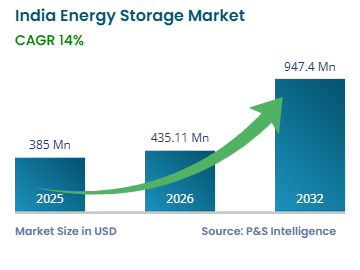
The Indian energy storage system market values USD 385.0 million in 2025, and it is projected to reach USD 947.4 million by 2032, growing at a CAGR of 14.0% during 2026–2032. The market encompasses multiple storage technologies including mechanical, electrochemical, thermal, and chemical systems that collectively support India's ambitious renewable energy integration targets. The Central Electricity Authority has projected a storage requirement of 74 GW/411.4 GWh by 2031–2032, comprising 47 GW/236 GWh of battery storage and 27 GW/175 GWh of pumped hydro capacity, underscoring the critical role energy storage plays in India's energy transition.
The rapid expansion of renewable energy capacity is a fundamental driver of market growth. India added approximately 24.5 GW of solar capacity and 3.4 GW of wind capacity in 2024, with renewable sources now accounting for nearly 29% of the country's electricity capacity. Since these sources generate intermittently, they necessitate substantial storage infrastructure to ensure grid stability and reliable power supply. Government initiatives, including the Viability Gap Funding scheme, allocating INR 3,760 crore for 4,000 MWh of BESS development; the Production Linked Incentive program of INR 18,100 crore for domestic cell manufacturing, and mandated Energy Storage Obligations for distribution companies, are accelerating market momentum.
The transportation sector represents a significant growth catalyst, with the Indian electric car market recording a sale of 19,778 units in 2023, which are further projected to reach 430,603 units by 2030. According to government sources, public charging infrastructure expanded to 29,277 stations by August 2025, creating additional demand for energy storage systems to support charging networks and grid stabilization.
India Energy Storage Market Emerging Trends
Growing Renewable Energy Integration Is Major Market Trend
A key trend in India's energy storage market is the imperative to integrate variable renewable energy sources into the national grid.
India has committed to achieving 500 GW of non-fossil fuel capacity by 2030, up from approximately 180 GW in 2024.
This ambitious target implies annual solar and wind additions of nearly 45 GW, requiring substantial storage infrastructure to manage intermittency challenges.
According to the Central Electricity Authority, the grid requires four-hour storage for at least 10% of incremental renewable capacity to maintain stability.
Evening ramp rates of 15–20 GW compel thermal plants to cycle inefficiently, adding approximately INR 12,000 crore in annual system costs that energy storage can help mitigate through capacity and energy payments.
Burgeoning Electricity Consumption Is Biggest Market Driver
The Ministry of New and Renewable Energy has evaluated the total electricity consumption across India for the years 2021–22, 2026–27, and 2031–32 at 1,138.4 billion units (BU), 1,610.1 BU, and 2,133.4 BU, respectively.
The overall electrical energy requirement for the same years has been determined to be 1,381.6 BU, 1,907.8 BU, and 2,473.8 BU, respectively.
Furthermore, the peak electricity demand is projected to reach 203.1 GW in 2021–22, 277.2 GW in 2026–27, and 366.4 GW in 2031–32.
In 2024, the residential sector alone accounted for 31% of total electricity consumption, while industry contributed 32%, with agriculture 22% and commercial 10%.
Residential consumption has been growing at roughly 10% annually over the past three years—propelled by population growth, urbanization, increasing appliance and air-conditioning adoption, and more reliable electricity access.
This broad-based growth across sectors—households, industry, agriculture, and services—reflects India’s deepening electrification, rising living standards, and expanding economic activity.
It also underscores the mounting pressure on generation, transmission, and distribution systems, making efficient management (and storage + renewables integration) increasingly essential.
Electric Vehicle Adoption Is Creating New Opportunities
The surging electric vehicle market presents substantial opportunities for energy storage systems supporting charging infrastructure and grid integration.
The Indian electric car market recorded a sale of 19,778 units in 2023, and it is projected to reach 430,603 units by the year 2030.
The Indian e-rickshaw market produced a revenue of USD 291.9 million in 2023, and it is projected to attain USD 463.9 million by 2030.
In the same way, the Indian electric scooter and motorcycle market is projected to reach approximately USD 14,487.5 million by the year 2030 from USD 681.3 million by 2024.
BESS installations are essential for stabilizing grids during EV charging, preventing overloading during peak hours, and enabling efficient utilization of renewable energy for transportation electrification.
This growth is driven by the expanding EV ecosystem requiring charging infrastructure support, battery swapping stations, and grid-integrated charging solutions.
The PM E-DRIVE scheme allocated INR 2,000 crore specifically for charging station development.
India Energy Storage Market Segmentation Analysis
Type Analysis
The electrochemical category holds the largest share in the Indian energy storage system market in 2025, of approximately 40%, led by lithium-ion batteries, particularly lithium–iron phosphate chemistry. The category's lead stems from high energy density, declining costs, fast response times, and modular scalability that enables deployment across residential, commercial, and utility applications. Lead-acid batteries retain relevance in off-grid and backup power applications due to cost-effectiveness and established distribution networks.
The mechanical category is the fastest-growing, during 2026–2032, driven by the rising pumped hydro storage capacity. India has 4.75 GW of installed pumped storage capacity, with 3.3 GW operational in pumping mode. According to TERI, approximately 44.5 GW of pumped storage projects are at various development stages, with the Central Electricity Authority targeting 27 GW/175 GWh by 2031–2032. The commissioning of India's first variable-speed pumped storage unit at the 1-GW Tehri facility in June 2025 demonstrates advancing technological capabilities.
These types are covered:
Electrochemical (Largest Category)
Lithium-Ion Batteries
Lead–Acid Batteries
Flow Batteries
Sodium–Sulfur Batteries
Mechanical (Fastest-Growing Category)
Pumped Hydro Storage
Compressed Air Energy Storage
Flywheel Energy Storage
Liquid Air Energy Storage
Thermal
Sensible Heat Storage
Latent Heat Storage
Thermochemical Storage
Chemical
Hydrogen Storage
Ammonia Storage
End Use Analysis
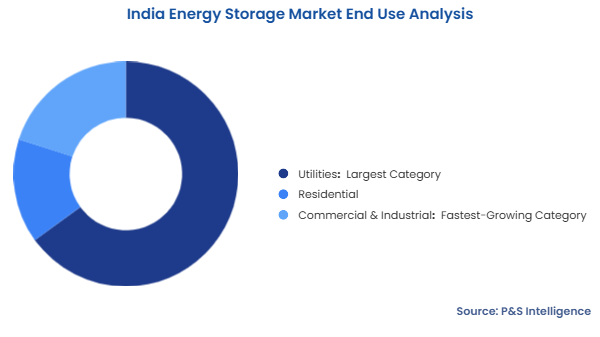
The utilities category commands the largest share in 2025, of approximately 65%. Large-scale BESS and pumped hydro projects developed by state and central utilities drive this dominance. NTPC leads utility-scale deployment, having issued six BESS tenders totaling 5.75 GW since 2022. Gujarat Urja Vikas Nigam Limited and Maharashtra State Electricity Distribution Company Limited have issued large-scale tenders addressing regional grid requirements.
The commercial & industrial category demonstrates the fastest growth, during 2026–2032. Commercial and industrial customers are increasingly adopting energy storage to reduce peak demand charges, ensure backup power, and integrate rooftop solar installations. Data centers are particularly shifting from diesel gensets to lithium-ion BESS for improved sustainability credentials and operational uptime.
Drive strategic growth with comprehensive market analysis
India Energy Storage Market Geographical Analysis
Karnataka Energy Storage Market Growth
Karnataka holds the largest share in India's energy storage market in 2025, of approximately 40%. The state's leadership stems from early renewable energy policy adoption, strong solar infrastructure development, and proactive fleet electrification initiatives. Karnataka hosts approximately 6,097 public EV charging stations as of 2025, the highest among Indian states. The state has emerged as a preferred destination for renewable energy investments, with the 2-GW Sharavathy pumped storage project under development through Karnataka Power Corporation Limited.
Rajasthan Energy Storage Market Forecast
Rajasthan is emerging as the fastest-growing state market, with a CAGR, of approx. 14.5%, in the forecast period, as its Clean Energy Policy targets 10 GW of storage by FY2030 with incentives including transmission and wheeling charge exemptions. The state has mandated distribution companies to source 1% of supply from storage-backed contracts in FY 2024-25, rising to 3% by FY 2026-27, driving continued deployment acceleration. As of 2025, Rajasthan has over 28,617 MW of renewable energy installed, including 22,860 MW of solar—the highest among Indian states.
Gujarat Energy Storage Market Development
The state's favorable renewable energy policies, extensive solar parks, and strategic coastal location for green hydrogen hubs drive investment attraction. Gujarat Urja Vikas Nigam Limited has issued multiple large-scale BESS tenders, including a 500 MW/500 MWh standalone BESS auction in April 2025. Agratas Energy Storage Solutions, a Tata Group subsidiary, signed an agreement with the Gujarat government to establish a lithium-ion gigafactory with INR 13,000-crore investment. Gujarat also possesses 1.4 GW of installed pumped storage capacity.
These states and regions are covered:
Karnataka (Largest State Market)
Gujarat
Rajasthan (Fastest-Growing State Market)
Maharashtra
Chhattisgarh
Tamil Nadu
Andhra Pradesh
Uttar Pradesh
Rest of India
India Energy Storage Market Share
The Indian energy storage system market exhibits a moderately fragmented structure with both established conglomerates and specialized technology providers competing across segments. The market features participation from domestic battery manufacturers, international technology suppliers, integrated power utilities, and independent power producers. Large players are pursuing vertical integration strategies spanning manufacturing, project development, and system integration to capture value across the energy storage value chain. Established domestic players leverage existing energy sector presence and distribution networks, while international technology providers contribute advanced battery management systems and power electronics expertise.
Strategic partnerships and joint ventures characterize competitive dynamics. Exide Industries announced plans to expand battery production capacity for the growing electric vehicle market. The market is witnessing diversification with new entrants, including IndiGrid and HG Infra Engineering, focusing on BESS, while Greenko concentrates on pumped hydro storage development.
Key India Energy Storage Companies:
Luminous Power Technologies Private Limited
HBL Power Systems Limited
Okaya Power Private Limited
Tata Sons Private Limited
Bharat Heavy Electricals Limited
Greaves Electric Mobility Private Limited
LG Energy Solution Ltd.
Contemporary Amperex Technology Co. Limited
BYD Company Limited
Panasonic Holdings Corporation
Hitachi Limited
Siemens Energy AG
Reliance Industries Limited
Adani Green Energy Limited
Exide Industries Limited
Amara Raja Energy & Mobility Limited
JSW Energy Limited
Delta Electronics Inc.
India Energy Storage Market News
In June 2025, GE Vernova commissioned a variable-speed pumped storage unit at THDC India Limited's Tehri facility, as part of a 1-GW expansion to 2.4 GW total capacity.
In February 2025, JSW Energy won the Solar Energy Corporation of India auction to develop a 500-MWh battery energy storage system in Kerala.
In January 2025, BSES Rajdhani received the approval of the Delhi Electricity Regulatory Commission approval for a utility-owned 20-MW/40 MWh commercial BESS project in South Delhi's Kilokri area, scheduled for March 2025 commissioning.
In October 2024, Adani Energy Solutions commissioned a 40 MW/120-MWh BESS in Gujarat, paired with 300-MW solar capacity, under a 25-year power purchase agreement at INR 5.95 per kWh.
In September 2024, Reliance Power secured a 500 MW/1,000-MWh standalone BESS contract from SECI under the broader 1,000 MW/2,000 MWh procurement program. The project is expected to be operational within 24 months.
In September 2024, Reliance New Energy energized a 5 MW/50-MWh vanadium flow battery in Gujarat.
In August 2024, Tata Power commissioned a 100 MW/200-MWh standalone BESS project in Rajasthan at INR 5.85 per kWh under a 25-year power purchase agreement.
Want a report tailored exactly to your business need?
Leading companies across industries trust us to deliver data-driven insights and innovative solutions for their most critical decisions. From data-driven strategies to actionable insights, we empower the decision-makers who shape industries and define the future. From Fortune 500 companies to innovative startups, we are proud to partner with organisations that drive progress in their industries.
Client Testimonials
Working with P&S Intelligence and their team was an absolute pleasure – their awareness of timelines and commitment to value greatly contributed to our project's success. Eagerly anticipating future collaborations.
McKinsey & Company
India
Unmatched Standards
Our insights into the minutest levels of the markets, including the latest trends and competitive landscape, give you all the answers you need to take your business to new heights
Complete Data Security
We take a cautious approach to protecting your personal and confidential information. Trust is the strongest bond that connects us and our clients, and trust we build by complying with all international and domestic data protection and privacy laws