India Electronic Waste Recycling Market Size & Opportunities Analysis - Growth Strategies, Competitiveness, and Forecasts (2026 - 2032)
This Report Provides In-Depth Analysis of the India Electronic Waste Recycling Market Report Prepared by P&S Intelligence, Segmented by Material (Metals, Plastics, Glass), Source (Entertainment & Consumer Electronics, IT & Telecom, Household Appliances, Medical Equipment), Technology (Hydrometallurgical Process, Pyrometallurgical Process, Electrostatic Separation), Service (Precious Metal Extraction, Refurbishment & Reuse, Collection & Transportation, Dismantling & Component Recovery, Shredding & Separation, Landfilling & Incineration), and Geographical Outlook for the Period of 2019 to 2032
India Electronic Waste Recycling Market Growth Potential
Key Highlights
Study Period
2019 - 2032
Market Size in 2025
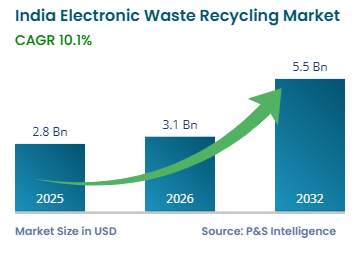
USD 2.8 Billion
Market Size in 2026
USD 3.1 Billion
Market Size by 2032
USD 5.5 Billion
Projected CAGR
10.1%
Largest State
Maharastra
Fastest-Growing State
Telangana
Market Structure
Fragmented
Market Size
Explore the market potential with our data-driven report
India Electronic Waste Recycling Market Outlook
The Indian electronic waste recycling market values USD 2.8 billion in 2025, and it is projected to reach USD 5.5 billion by 2032, growing at a CAGR of 10.1% during 2026–2032. The market expansion is driven by stringent regulatory frameworks, rising e-waste generation volumes, growing awareness about environmental sustainability, and increasing focus on circular economy practices across the country.
India ranks as the third-largest electronic waste producer globally, generating approximately 1.75 million metric tons of e-waste in the financial year 2023-24. According to reports, e-waste generation has increased by 73% over the past five years, while the formal e-waste recycling rate improved from approximately 22% in 2019–20 to over 70% in 2024–25, demonstrating significant progress in channelizing waste through authorized recycling facilities.
The E-Waste (Management) Rules, 2022 mandates manufacturers and producers to achieve specific recycling targets, starting with 60% collection for FY 2023–24 and increasing to 80% by FY 2027–28. The regulatory push has significantly benefited organized players in the Indian electronic waste recycling industry. Environmental compensation provisions and verification audits have been introduced to ensure compliance, with penalties for violations tied to restoration funds. In February 2025, CPCB intensified audits and penalties for E-Waste Management Rules 2024 violations, demonstrating the government's commitment to effective implementation. These regulatory developments have created favorable conditions for formal recyclers operating with state-of-the-art facilities.
India Electronic Waste Recycling Market Emerging Trends
Growing Focus on Critical Metals’ Recovery Is Major Market Trend
The economic viability of precious metals extraction from e-waste represents a significant ideological shift in India.
The gold content in printed circuit boards averages 250–300 grams per tonne, approximately 60 times higher than natural ore grades.
The rising bullion and palladium prices have lifted recovery margins, with precious metals now supplying over 80% of the recycling revenue for advanced facilities.
Hydrometallurgical refiners now achieve 93% copper and nearly 100% precious metal yields through advanced leaching and electrowinning processes.
Due to the increasing e-waste volumes and improving recycling infrastructure, companies are investing in selective leaching technologies that minimize dioxin emissions and energy consumption compared to conventional smelting processes.
The rapid adoption of electric vehicles and consumer electronics is creating a substantial demand for lithium-ion battery recycling in India.
According to studies, lithium-ion battery waste is projected to grow 6 times by 2030 and 50 times by 2035 compared to 2025 levels.
India lacks major operational lithium and cobalt mines, relying almost entirely on imports costing approximately USD 2.5 billion annually.
Battery recycling could address 30–40% of India's lithium demand by 2030, reducing import dependence and strengthening supply security.
The Battery Waste Management Rules, 2022 mandate Extended Producer Responsibility for all battery types, including EV batteries, portable batteries, automotive batteries, and industrial batteries.
Modern hydrometallurgical recovery efficiency now exceeds 95% for cobalt and nickel extraction.
Recycling lithium is increasingly cost-competitive compared with mining. Traditional lithium mining can cost up to USD 12,000 per tonne due to high energy use, water consumption, and complex extraction processes.
On the contrary, the cost of recycling spent lithium-ion batteries is USD 7,000 per tonne.
As recycling technologies improve, costs continue to decline, making recovered lithium not only cheaper in many cases but also far more energy-efficient—using up to 70% less energy than mining.
This combination of lower costs, reduced environmental impact, and rising battery waste makes recycling an economically and strategically attractive alternative.
Rising Consumer Electronics Waste Is Accelerating Market Growth
The exponential growth in consumer electronics consumption constitutes a primary driver for the Indian electronic waste recycling market.
India has emerged as one of the fastest-growing electronics markets globally, with smartphone penetration increasing to 85.5% of the households in 2024, creating dispersed e-waste streams that demand regionally distributed collection infrastructure.
India has seen the fastest rollout of 5G services in the world, with 4,62,084 BTS deployed across 779 districts, as of December 2024.
The government's Digital India initiative has accelerated technology adoption, translating into higher volumes of end-of-life electronics requiring responsible recycling and material recovery solutions.
India’s rapidly growing consumption of smartphones, laptops, appliances, and IoT devices has led to a sharp rise in consumer electronics waste, making it the fastest-growing waste stream in the country.
Shorter device lifecycles, frequent upgrades, and rising incomes accelerate this trend.
As e-waste volumes climb, concerns over toxic materials and lost valuable metals push the government and industry to strengthen recycling systems.
This drives formal recycling efforts, including stricter Extended Producer Responsibility (EPR) rules, increased collection centers, and investments in advanced recycling technologies that recover precious metals while reducing environmental harm.
India Electronic Waste Recycling Market Segmentation Analysis
Material Analysis
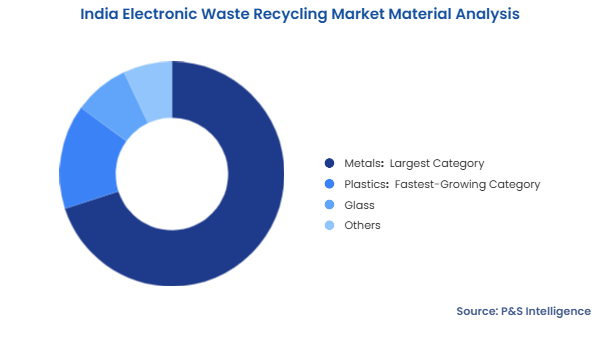
The metals category holds the largest share in the Indian electronic waste recycling market in 2025, of 70%. This is attributed to the high intrinsic value of precious and base metals recovered from electronic waste, including gold, silver, copper, aluminum, and rare-earth elements. Hydrometallurgical and pyrometallurgical processes enable efficient extraction of these materials, with advanced facilities achieving recovery rates exceeding 95% for copper and nearly 100% for precious metals. The strong demand for recycled metals from manufacturing sectors, coupled with rising commodity prices, sustains the growth momentum of this category.
Plastics are expected to witness the highest CAGR, of 10.3%, during 2026–2032, driven by maturing flame-retardant polymer recycling technologies. Pyrolysis combined with ultrasonication enables segregation of brominated ABS, polycarbonate, and HIPS into reusable grades, opening circular feedstock opportunities for domestic electronics manufacturers. Glass recovery continues as CRT volumes decline, though niche lead-glass recovery persists through refurbishing operations.
These materials are covered:
Metals (Largest Category)
Gold
Lithium
Silver
Copper
Aluminum
Rare-earth metals
Other metals
Plastics (Fastest-Growing Category)
Glass
Others
Source Analysis
Entertainment & consumer electronics have emerged as the largest source in 2025, with 40% share. Smartphones, tablets, laptops, televisions, and gaming consoles have relatively short lifecycle spans and are rapidly replaced due to technological advancements. The burgeoning sale of consumer electronics generates substantial quantities of end-of-life devices requiring recycling. Consumer electronics also contain high-value printed circuit boards and cobalt-rich batteries, making them attractive feedstock for material recovery operations.
The IT & telecom category is projected to register the fastest growth during 2026–2032, driven by rapid 5G infrastructure deployment and enterprise technology upgrades. The government, public sector companies, and private sector enterprises collectively generate nearly 75% of electronic waste, with individual households contributing approximately 16%. India is seeing rising recycling of IT and telecom e-waste as device usage surges and replacement cycles shorten.
The growing volumes of discarded mobiles, laptops, routers and servers have pushed the government to strengthen e-waste rules and enforce Extended Producer Responsibility. Formal recyclers are expanding capacity, using better collection networks and advanced processes to recover valuable materials like copper, gold and rare metals. Increased awareness, stricter compliance requirements and corporate sustainability goals are accelerating the shift toward organized e-waste recycling.
These sources are covered:
Entertainment & Consumer Electronics (Largest Category)
IT & Telecom (Fastest-Growing Category)
Household Appliances
Medical Equipment
Others
Technology Analysis
The hydrometallurgical process holds the largest share in the Indian electronic waste recycling market in 2025, of 45%, and it also has the highest CAGR of 10.2% during the forecast period. This aqueous solution-based method is preferred for its higher selectivity in extracting specific metals, lower energy consumption compared to pyrometallurgy, and reduced greenhouse gas emissions. Hydrometallurgical processes typically involve leaching, solvent extraction, and electrowinning to recover copper, gold, silver, and palladium from complex e-waste matrices. According to industry data, hydrometallurgy is projected to grow at a 9.2% CAGR through 2030, driven by selective leaching capabilities that minimize dioxin emissions.
These technologies are covered:
Hydrometallurgical Process (Largest and Fastest-Growing Category)
Pyrometallurgical Process
Electrostatic Separation
Others
Recycling Process Analysis
Precious metal extraction holds the largest revenue share in the Indian electronic waste recycling market in 2025. The economic significance of recovering gold, silver, palladium, and platinum from PCBs and electronic components drives investment in advanced extraction technologies. Hydrometallurgical and electrowinning processes enable recovery of battery-grade purity metals, with certified recyclers achieving over 98% efficiency in reclaiming up to 22 valuable metals from end-of-life electronics. This segment directly contributes to the circular economy by supplying secondary raw materials to manufacturing industries.
Refurbishment & reuse is projected to register the fastest growth during 2026–2032, driven by circular procurement mandates and increasing corporate sustainability requirements. Flipkart's exchange initiative and similar programs feed repair lines in major cities, extending device lifecycles and reducing waste generation. India is placing increasing emphasis on refurbishment and reuse as a key part of its e-waste management strategy.
With the growing demand for affordable electronics, refurbished devices such as laptops and smartphones extend product lifecycles and reduce waste generation. Government policies and Extended Producer Responsibility frameworks encourage producers to integrate repair and reuse into collection models. Formal refurbishers are expanding, driven by circular-economy goals and rising consumer acceptance. This shift reduces environmental impact, lowers resource consumption, and supports a more sustainable e-waste ecosystem.
These recycling processes are covered:
Precious Metal Extraction (Largest Category)
Refurbishment & Reuse (Fastest-Growing Category)
Collection & Transportation
Dismantling & Component Recovery
Shredding & Separation
Landfilling & Incineration
Drive strategic growth with comprehensive market analysis
India Electronic Waste Recycling Market Geographical Analysis
Maharashtra holds the largest share in the Indian electronic waste recycling market in 2025, of 25%. The state benefits from significant electronics manufacturing density, established metallurgical clusters, and strategic port access facilitating cross-border material flows. Mumbai and Pune rank among the top metropolitan areas for e-waste generation, driven by the concentration of IT companies, financial institutions, and consumer electronics markets. The state houses numerous authorized e-waste recycling facilities operating with CPCB registration and state pollution control board compliance. The state government has been proactive in implementing awareness programs and supporting formal recycling infrastructure development, positioning Maharashtra as a hub for responsible e-waste management in India.
Telangana is expected to be the fastest-growing state market during 2026–2032, due to exceptional growth in e-waste processing volumes. Hyderabad's emergence as a major IT and pharmaceutical hub generates substantial quantities of electronic waste from corporate offices, research facilities, and manufacturing operations. The state government has implemented supportive policies for e-waste management, creating favorable conditions for recycling infrastructure development.
The rapid expansion of technology parks and special economic zones in Telangana continues to drive e-waste generation and subsequent recycling demand. The state benefits from skilled workforce availability and established logistics networks connecting major cities in South India. Telangana's success in scaling e-waste processing demonstrates the potential for formal recycling capacity expansion through coordinated policy implementation and private sector engagement. The growing presence of EV manufacturers and battery assembly operations further positions the state for future growth in lithium-ion battery recycling.
These states are covered:
Maharashtra (Largest State Market)
Telangana (Fastest-Growing State Market)
Tamil Nadu
Karnataka
Gujarat
Delhi
Haryana
Uttar Pradesh
West Bengal
Kerala
Madhya Pradesh
Rest of India
India Electronic Waste Recycling Market Share
The Indian electronic waste recycling market is fragmented due to the presence of numerous formal and informal operators across the recycling value chain. The formal sector comprises approximately 450 authorized recycling facilities registered with CPCB as of 2024, though these handle only about 40-45% of total e-waste generated. Market consolidation is gradually occurring as regulatory compliance requirements favor established players with advanced processing capabilities and EPR management infrastructure.
Key competitive strategies include technology investments in AI-based sorting and robotic PCB depopulation to address labor cost inflation of 10–12% annually in urban centers. Companies are bundling certified disposal with carbon-credit consulting to tap multinational decarbonization budgets. Strategic partnerships between formal recyclers and informal collectors are expanding collection networks while ensuring traceability and compliance. The entry of global players and increasing venture capital investment in recycling startups are intensifying competition and driving innovation across the value chain.
Key India Electronic Waste Recycling Companies:
Attero Recycling Pvt. Ltd.
RecycleKaro
Eco Recycling Limited (Ecoreco)
E-Parisara Pvt. Ltd.
Exigo Recycling Pvt. Ltd.
Cerebra Integrated Technologies Ltd.
Namo eWaste Management Ltd.
GreenTek Reman Pvt. Ltd.
Sims Lifecycle Services India
Blue Planet E-waste Solutions Pvt. Ltd.
Spas Recycling Pvt. Ltd.
Aman E?Waste Recyclers Pvt. Ltd.
Hindusthan Recycling
Pure Earth Recyclers
Ecovita Recyclers
E Waste Recyclers India (EWRI)
Techazar
Gravita India Ltd.
India Electronic Waste Recycling Market News
In July 2025, Eco Recycling Ltd. announced expansion of overall e-waste processing capacity to 31,200 Mtpa, including lithium-ion battery recycling, with the commissioning of a 40,000-square-foot plant in Vasai, near Mumbai.
In June 2025, the Indian government cleared a INR 1,500-crore incentive for critical minerals recycling focused on lithium and rare-earth element recovery from electronic waste and batteries.
In May 2025, Casio India launched the Recycle Responsibly CSR initiative in Delhi-NCR, collecting 5,488 kilograms of e-waste from over 450 touchpoints, including residential societies and corporate campuses.
In January 2025, Attero launched MetalMandi, a digital platform to formalize India's unorganized scrap market, targeting 1,000 tonnes of daily transactions by mid-2025 with AI-driven pricing and secure logistics.
In November 2024, Blue Planet Environmental Solutions completed the acquisition of Pegasus Waste Management Pvt Ltd subsidiaries in Haryana and Karnataka, rebranding as Blue Planet E-waste Solutions Pvt Ltd.
In July 2024, Attero launched Selsmart, a direct-to-consumer e-waste take-back platform offering doorstep pickup, fair market pricing, and DoD-standard data wiping for discarded electronics.
Want a report tailored exactly to your business need?
Leading companies across industries trust us to deliver data-driven insights and innovative solutions for their most critical decisions. From data-driven strategies to actionable insights, we empower the decision-makers who shape industries and define the future. From Fortune 500 companies to innovative startups, we are proud to partner with organisations that drive progress in their industries.
Client Testimonials
Working with P&S Intelligence and their team was an absolute pleasure – their awareness of timelines and commitment to value greatly contributed to our project's success. Eagerly anticipating future collaborations.
McKinsey & Company
India
Unmatched Standards
Our insights into the minutest levels of the markets, including the latest trends and competitive landscape, give you all the answers you need to take your business to new heights
Complete Data Security
We take a cautious approach to protecting your personal and confidential information. Trust is the strongest bond that connects us and our clients, and trust we build by complying with all international and domestic data protection and privacy laws