India EV Charging Station Market Size & Opportunities Analysis - Growth Strategies, Competitiveness, and Forecasts (2025 - 2032)
This Report Provides In-Depth Analysis of the India EV Charging Station Market Report Prepared by P&S Intelligence, Segmented by Charging Type (AC Charging, DC Charging, Inductive Charging), Charging Infrastructure (Public, Private, Fleet), Vehicle Type (Two-Wheelers, Three-Wheelers, Passenger Cars, Commercial Vehicles), Installation Type (Portable, Fixed), and Geographical Outlook for the Period of 2019 to 2032
Explore the market potential with our data-driven report
India EV Charging Station Market Overview
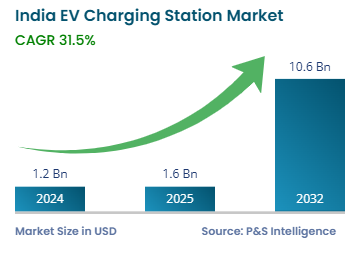
The Indian electric vehicle charging station market size was worth USD 1.2 billion in 2024, and it will grow by 31.5% during 2025–2032, to reach USD 10.6 billion by 2032.
The market growth is primarily ascribed to the Indian government's ambitious shift toward electric mobility, increasing environmental consciousness among consumers, and substantial investments in charging infrastructure development across the country. Moreover, India's transition to electric mobility has experienced rapid acceleration, especially after the deployment of various state and central government policies aimed at reducing vehicular emissions and dependence on fossil fuels.
The Faster Adoption and Manufacturing of (Hybrid &) Electric Vehicles scheme, along with state-specific EV policies, has created a supportive ecosystem for the growth of charging infrastructure. According to the Ministry of Heavy Industries, in 2024, India had over 12,146 public charging stations. According to the Federation of Automobile Dealers Associations report, in 2023, around 1.66 million units of electric vehicles were sold in India, highlighting a strong shift in consumer demand.
This growth in EV adoption is directly linked with the demand for accessible and reliable charging infrastructure. Major metropolitan areas, including Delhi-NCR, Mumbai, Bengaluru, and Chennai, are leading the charge in establishing broad charging networks, with both public and private sector investors fueling infrastructure growth.
India EV Charging Station Market Growth Factors
Technological Advancements in Charging Solutions Are Key Trend
The rise in the adoption of DC fast charging solutions is a key trend in the Indian EV charging landscape.
The Indian government’s PM E-DRIVE scheme, launched in 2024 with a INR 10,900-crore budget through 2026, plans to install over 72,000 DC fast chargers across the country.
The scheme includes 22,100 charge points for four-wheelers, 48,400 for two- and three-wheelers, and 1,800 for buses—via public-private partnerships targeting highways and urban centers.
Smart charging solutions integrated with IoT sensors, mobile applications, and dynamic pricing mechanisms are gaining traction.
These technologies provide optimal utilization of charging infrastructure, reduce grid stress during peak hours, and provide users with live information about availability and pricing.
Indian manufacturers and technology providers are building charging solutions which is capable of providing 50–150 kW of power output and minimizing charging times from hours to minutes.
The Indian Institute of Technology Madras has developed a local fast-charging technology that can charge an electric car to 80% capacity within 30 minutes, alleviating one of the primary concerns of potential EV buyers.
The battery swapping technology has arisen as a viable alternative, especially for two and three-wheelers, contributing more than 80% of India's vehicle population.
As per the Road Transport and Highways, companies are establishing battery swapping networks in urban areas to ensure compatibility.
According to NITI Aayog, battery swapping stations require 90% less space than conventional charging stations, making them ideal for India’s high-density urban settings.
As of 2023, India operates approximately 1,000–1,100 battery swapping stations, primarily serving electric two- and three-wheelers.
The government envisions the establishment of around 450,000 stations by 2030, necessitating an investment of approximately USD 100 billion (INR 8.3 lakh crore).
The Bureau of Energy Efficiency (BEE) is overseeing the phased implementation of this infrastructure, with metropolitan cities prioritized in the initial phase.
The integration of renewable energy sources with charging stations, especially solar-powered charging infrastructure, along with India's sustainability goals, reduces operational costs for charging station operators.
Government Initiatives and Policy Support Are Biggest Driver
The rising initiative governed by the Indian government for easy accessibility of EV charging stations is a key driver for the market.
The FAME II scheme has a budget of INR 11,500 crore, specifically providing substantial funds for charging infrastructure development.
Under this scheme, the government has sanctioned 2,877 charging stations across 68 cities and 16 highways, with execution started within multiple states.
State governments have introduced complementary policies to accelerate charging infrastructure deployment.
Delhi's EV policy commanded that all commercial and institutional buildings should reserve 20% of parking spaces for EV charging.
Karnataka provides capital subsidies of up to 25% for charging station installations.
The FAME II scheme promotes the utilization of EVs by providing subsidies ranging from INR 10,000–15,000 per kWh for different EV categories, such as e-buses, e-four-wheelers.
According to the Bureau of Energy Efficiency, these policy measures have resulted in a 180% increase in public charging points between 2022 and 2024.
According to the Ministry of Heavy Industries, India is targeting 30% EV penetration by 2030, which continues to drive long-term infrastructure planning and investment decisions.
India EV Charging Station Market Segmentation Analysis
Charging Type Analysis
The AC charging category held the largest market share, of around 80%, in 2024, due to its extensive presence at residential, corporate, and public locations. They are affordable and have easy installation, making them the most-common option across the country.
The DC charging category will have the highest CAGR due to the rising demand for quick charging solutions in urban areas, where time efficiency is critical. These chargers are capable of charging vehicles to 80% capacity within 30 minutes. The government is prioritizing setting up DC stations on highways and public spaces. Moreover, various companies, such as Bharat Petroleum, are installing EV chargers at their fuel stations.
For instance, Delhi’s EV Policy 2.0 envisions 95% of new vehicle registrations to be electric by 2027. As of mid‑2025, about 4,646 charging points and 250 swapping stations are operational. The plan aims to install roughly 13,200–13,700 stations by 2030 across the city.
The charging types analyzed in this report are:
AC Charging (Slow Charging) (Largest Category)
DC Charging (Fast Charging) (Fastest-Growing Category)
Inductive Charging
Charging Infrastructure Analysis
The public category held the largest market share, of about 65%, in 2024, due to the rising government initiatives and the demand to ease range concerns among EV users. The strategic placement of public charging stations in shopping malls, commercial complexes, parking lots, and along highways has been instrumental in building consumer confidence in electric mobility. Major cities have initiated the establishment of private EV charging hubs, with Delhi aiming to establish 18,000 EV charging points by 2024.
The fleet category will have the highest CAGR due to its rapid electrification of commercial fleets, particularly in the e-commerce and ride-hailing sectors, which necessitate dedicated charging infrastructure to assure operational efficiency. Fleet operators are investing in high-capacity charging solutions at depots and logistics hubs, often integrated with fleet management systems for optimal utilization. Moreover, various companies, such as Ola Electric, have established captive charging networks to encourage their electric vehicle fleets, establishing a model for other operators.
The charging infrastructure analyzed in this report are:
Public (Largest Category)
Private
Residential
Commercial
Fleet (Fastest-Growing Category)
Vehicle Type Analysis
The two-wheelers category held the largest market share in 2024, due to its easy availability of cost-effective electric scooters. Companies like Ola Electric, Ather Energy, and TVS, integrate lower operating costs and government subsidies which drives rapid utilization of two-wheelers. Moreover, the infrastructure benefits from lower power requirements and the feasibility of home charging.
The passenger cars will have the highest CAGR, of 32.5%, due to its growing adoption of electric cars among urban consumers and the availability of multiple EV models across price segments. Companies such as Tata Motors and Mahindra & Mahindra, provide affordable cars along with premium offerings, thus expanding the addressable market. Charging infrastructure development has primarily focused on catering to four-wheeler requirements, with charging stations offering multiple connector types and power outputs suitable for various car models.
The vehicle types analyzed in this report are:
Two-wheelers (Largest Category)
Three-wheelers
Passenger Cars (Fastest-Growing Category)
Commercial Vehicles
Installation Type Analysis
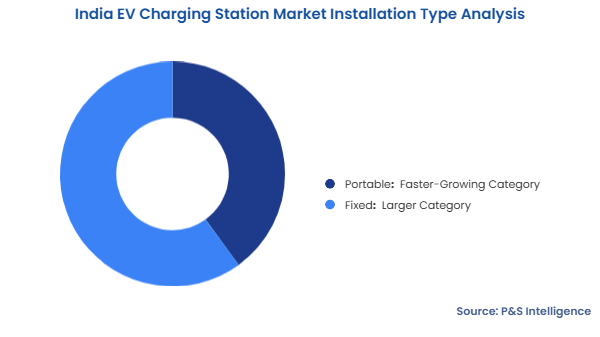
The fixed category held the larger market share in 2024, due to the rising preference for permanent charging infrastructure that enables reliability and consistent availability. They are used to provide the stability and security required for long-term EV adoption. These permanent setups ensure higher power output capabilities, weather-resistant designs, and integration with existing electrical infrastructure. Municipal corporations and government agencies are primarily approving fixed installations for public charging networks, with proper safety standards and urban planning requirements.
The portable category will have the higher CAGR due to its high flexibility to address specific use cases, including emergency charging, temporary event setups, and locations where fixed infrastructure installation faces challenges. They are widely used in the residential sector, where EV owners rely on portable solutions without dedicated parking spaces. Moreover, various technological advances have improved portable charger capacities, with newer models offering up to 22kW AC charging capabilities while maintaining portability. The development of battery-integrated portable chargers that can store energy and provide charging without a grid connection opens new solutions for remote areas.
The installation types analyzed in this report are:
Portable (Faster-Growing Category)
Fixed (Larger Category)
Drive strategic growth with comprehensive market analysis
India EV Charging Station Market Regional Outlook
The Southern region held the largest market share, of approx. 35% in 2024, due to the proactive state policies, higher purchasing power, and the presence of major IT hubs, which drive corporate EV adoption. The presence of major EV and component manufacturers also propels the market growth. States such as Karnataka, Tamil Nadu, and Telangana have implemented extensive EV policies with specific targets for charging infrastructure deployment, creating a favorable ecosystem for market growth. The Karnataka Electric Vehicle and Energy Storage Policy aims to establish charging stations every 25 km on highways and one station per 3x3-km grid in cities.
Tamil Nadu aims to deploy 3,000 charging stations by 2025 with the Tamil Nadu Generation and Distribution Corporation's active involvement in infrastructure development. The industrial presence creates high demand for charging infrastructure at manufacturing plants and supports the development of local supply chains for charging equipment. Additionally, South India's relatively stable power infrastructure and higher renewable energy penetration make it conducive for sustainable charging station operations.
The Northern region will have the highest CAGR due to the rapid policy deployment, rapid urbanization, and strong government support at both the central and state levels. According to the Delhi Transport Department, the national capital has witnessed a 300% increase in public charging points between 2022 and 2024.
The Uttar Pradesh EV Manufacturing and Mobility Policy targets one million EVs by 2027, which necessitates broad charging infrastructure development. According to the Uttar Pradesh New and Renewable Energy Development Agency, the state has approved locations for more than 2,000 charging stations along highways and in urban areas. Haryana is providing capital subsidies up to INR 10 lakh per charging station. The region's extreme weather conditions are driving innovations in charging technology, with manufacturers developing solutions capable of operating efficiently in temperatures ranging from 0 °C to 50 °C.
The regions analyzed in this report are:
East
West
North (Fastest-Growing Category)
South (Largest Category)
India EV Charging Station Market Share Analysis
The market is fragmented due to the presence of numerous players from established energy companies to emerging companies providing charging infrastructure, equipment manufacturers, and service operators. Moreover, the absence of a dominant national provider, combined with local infrastructure constraints and state-level EV policies, has contributed to decentralized expansion.
Key India EV Charging Station Companies:
Tata Power Company Limited
Fortum India Private Limited
Mass-Tech Controls Private Limited
Nawgati Tech Private Limited
Ather Energy Private Limited
Delta Electronics India Private Limited
ABB India Limited
Exicom Tele-Systems Limited
Magenta EV Solutions Private Limited
ACME Cleantech Solutions Private Limited
Okaya Power Private Limited
Numocity Technologies Private Limited
India EV Charging Station Market News & Updates
In May 2025, the central government announced its intention to set up 72,000 public EV charging stations with a budget allocation of INR 2,000 crore, as part of the PM E-Drive initiative. These charging stations will be systematically positioned along 50 national highway corridors, targeting high-traffic areas including metropolitan cities, toll plazas, railway stations, airports, fuel stations, and state highways. Bharat Heavy Electrical Limited (BHEL) will be the nodal agency overseeing this project.
In January 2025, Exicom and ChargeZone partnered to co-develop and deploy over 500 high‑power EV charging stations, integrating renewable energy solutions across India.
In September 2024, The Climate Pledge (co-founded by Amazon.com Inc. and Global Optimism) unveiled the Joint Operation Unifying Last-mile Electrification (JOULE) initiative, aimed at establishing shared EV charging stations in Bengaluru. This USD 2.65-million project, powered by renewable energy, aims to support more than 5,500 EVs by 2030 and enable the transition of corporate fleets to EVs. The first EV charging station in Doddakallasandra is now fully operational.
In August 2024, Delta Electronics Inc., Tata Motors Ltd., and ThunderPlus Solutions Pvt. Ltd. announced an MoU to install up to 250 fast charging stations for light commercial vehicles in approximately 50 Indian cities, including Delhi, Mumbai, Chennai, Bengaluru, Pune, and Kochi.
In December 2023, Tata Power EV Charging Solutions and Indian Oil Corporation Ltd. signed an MoU to deploy more than 500 fast and ultra-fast EV charging points across IOCL’s retail outlets.
Want a report tailored exactly to your business need?
Leading companies across industries trust us to deliver data-driven insights and innovative solutions for their most critical decisions. From data-driven strategies to actionable insights, we empower the decision-makers who shape industries and define the future. From Fortune 500 companies to innovative startups, we are proud to partner with organisations that drive progress in their industries.
Client Testimonials
Working with P&S Intelligence and their team was an absolute pleasure – their awareness of timelines and commitment to value greatly contributed to our project's success. Eagerly anticipating future collaborations.
McKinsey & Company
India
Unmatched Standards
Our insights into the minutest levels of the markets, including the latest trends and competitive landscape, give you all the answers you need to take your business to new heights
Complete Data Security
We take a cautious approach to protecting your personal and confidential information. Trust is the strongest bond that connects us and our clients, and trust we build by complying with all international and domestic data protection and privacy laws