India Edge Computing Market Size & Share Analysis - Key Trends, Future Opportunities, Growth Strategies, and Forecasts (2026 - 2032)
This Report Provides In-Depth Analysis of the India Edge Computing Market Report Prepared by P&S Intelligence, Segmented by Component (Hardware, Platform, Service), Enterprise Size (Large Enterprise, SMEs), Application (Predictive Maintenance, Video Analytics and Surveillance, IoT Device Processing/Real-Time Data Analytics, Remote Asset Monitoring, AR/VR and Immersive Applications, Content Delivery Optimization/Edge Caching, Environmental Monitoring ), Vertical (BFSI, IT & Telecommunication, Retail & E-Commerce, Healthcare, Transportation & Logistics, Government & Public Services, Media & Entertainment), and Geographical Outlook for the Period of 2019 to 2032
Explore the market potential with our data-driven report
India Edge Computing Market Outlook
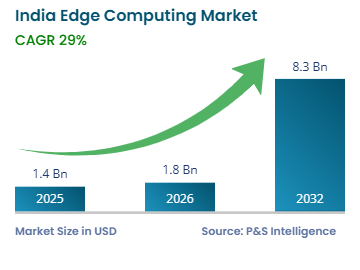
The Indian edge computing market values USD 1.4 billion in 2025, and it is projected to grow at a CAGR of 29.0% during 2026–2032, to reach USD 8.3 billion by 2032. Edge computing represents a decentralized computational framework strategically designed to bring data processing and storage closer to the point of use, typically located at the network edge. The primary aim is to minimize latency, optimize bandwidth utilization, and improve response times, facilitating swift and near real-time processing and analysis of data.
India's rapid digital transformation is driving substantial edge computing adoption across multiple sectors. 5G services have been launched in all states and union territories throughout the nation, and currently, they are accessible in 99.6% of the districts nationwide. As of February 28, 2025, telecom service providers have installed 469,000 5G base transceiver stations across the country. This extensive 5G infrastructure creates the foundational connectivity layer essential for edge computing deployments. India now ranks as the second-largest telecom market globally, with over 1.18 billion telephone subscribers and 941 million broadband users.
The manufacturing sector leads edge computing adoption in India, driven by Industry 4.0 initiatives and smart factory implementations. As per estimates, over 14,000 manufacturing facilities deployed industrial IoT solutions for predictive maintenance, power management, and smart supply chains in 2023. The integration of AI and ML inference at the edge, massive industrial automation initiatives, and widespread 5G edge deployments by major telecom providers are expected to transform India’s edge computing landscape through 2032.
India Edge Computing Market Emerging Trends & Growth Drivers
Rapid 5G Network Deployment Is Major Trend in Market
India's telecommunications infrastructure has witnessed unprecedented growth with the rollout of 5G services.
According to the Telecom Regulatory Authority of India (TRAI), there were 1.15 billion wireless connections in India at the end of January 2025.
By October 2024, 5G services were available in 779 out of 783 districts, with telecom operators Reliance Jio and Bharti Airtel leading the deployment.
Jio deployed over 1 million 5G cells within 12 months of launch, achieving one of the fastest nationwide 5G rollouts globally.
By the close of 2024, 5G networks covered over 70% of India's population, with 320 million 5G users.
By early 2025, 5G services had reached nearly all districts nationwide, supported by ~469,000 active 5G base stations, with subscriber numbers climbing to approximately 365 million.
Reliance Jio leads in coverage and availability, while Bharti Airtel provides strong network performance and speeds.
This near‑national reach of 5G creates a large potential user base and device network for edge computing services, enabling not only niche applications but also broad adoption across industries and geographies.
This extensive 5G infrastructure provides the low-latency, high-bandwidth connectivity essential for edge computing applications, supporting real-time processing closer to devices rather than relying solely on distant cloud servers.
Industries such as autonomous vehicles, industrial automation, immersive AR/VR experiences, smart manufacturing, remote asset monitoring, and IoT-driven solutions can now leverage this network backbone for scalable, high-performance edge deployments.
Furthermore, telecom operators are opening up network APIs and digital services over 5G, lowering the barrier for developers and enterprises to build innovative edge-computing applications.
With supportive policies, increasing 5G coverage, and rising subscriber numbers, edge computing in India is transitioning rapidly from pilot projects to large-scale, real-world deployment, spanning multiple sectors, including smart cities, healthcare, transportation, energy, and retail.
Smart City Initiatives Are Significant Driver for Market
The development of smart cities is one of the biggest drivers for the demand for edge computing solutions in India.
As of November 15, 2024, under the Smart Cities Mission, work orders have been issued for 8,066 projects totaling INR 1,64,669 crore, of which 7,352 projects, amounting to INR 1,47,366 crore, have been completed.
The establishment of integrated command & control centers in all 100 smart cities, the installation of 84,000 CCTV surveillance cameras, the deployment of 1,884 emergency call boxes, and the implementation of over 3,000 public address systems have been completed.
Additionally, 17,026 kilometers of the water supply system are being monitored through a SCADA system.
More than 65 cities are utilizing technology for solid waste management, approximately 9,194 vehicles have been equipped with RFID for automatic vehicle location, over 9,433 smart classrooms and 41 digital libraries have been established, and 172 e-health centers and clinics have been developed, along with the installation of 152 health ATMs.
These large-scale smart city deployments rely on edge computing infrastructure to process massive volumes of video analytics and IoT data locally.
This, in turn, enables real-time traffic management, public safety monitoring, emergency response, environmental monitoring, and energy optimization without the latency constraints of centralized cloud systems.
As more cities integrate AI-powered surveillance, smart lighting, connected utilities, and sensor networks, the demand for distributed edge nodes—capable of handling high-throughput, low-latency workloads—continues to grow.
Edge computing allows municipal authorities to analyze data close to the source, reducing bandwidth requirements, improving response times, and supporting advanced analytics for urban planning.
India Edge Computing Market Segmentation Analysis
Component Analysis
The hardware category holds the largest share, of 65% in the Indian edge computing market in 2025, and it is expected to maintain its dominance throughout the forecast period. This dominance is attributed to the fundamental requirement for physical edge infrastructure, including servers, gateways, sensors, and networking equipment, that form the backbone of edge deployments. The rising demand for edge computing gear in manufacturing, telecom, retail, and smart city applications continues to drive hardware investments. Organizations require robust edge devices capable of processing data locally while maintaining connectivity with cloud resources.
The services category is projected to witness the highest CAGR, of 29.2%, during 2026–2032. As enterprises deploy edge nodes across distributed locations, the demand for specialized expertise in installation, integration, optimization, and maintenance is increasing rapidly. Managed edge services enable organizations to focus on core operations while ensuring seamless edge infrastructure management. Professional services for AI model deployment, security implementation, and performance optimization are driving this category's growth.
These components are covered:
Hardware (Largest Category)
Platform
Service (Fastest-Growing Category)
Enterprise Size Analysis
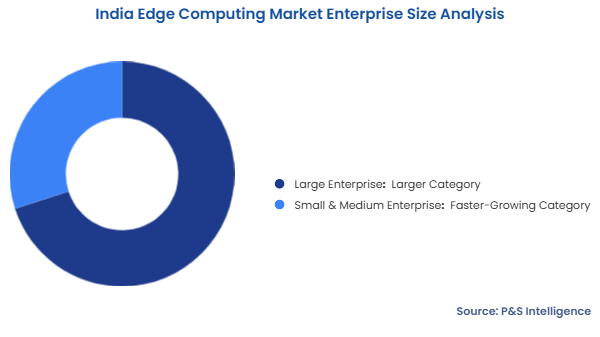
Large enterprises account for the larger share, of 70%, in 2025. Large organizations possess the capital, technical expertise, and complex operational requirements that justify edge computing investments. Multinational corporations, large manufacturers, major retailers, and telecom operators are leading edge adoption to enhance operational efficiency, reduce latency, and improve customer experiences. These enterprises operate extensive IT infrastructures requiring distributed computing capabilities across multiple locations.
The SME category is expected to witness faster growth, at a CAGR of 29.3%, during the forecast period. SMEs in India are increasingly adopting edge computing to enhance operational efficiency, reduce costs, and enable real-time decision-making. By processing data locally, SMEs can minimize cloud bandwidth expenses, improve latency for IoT and automation applications, and maintain greater data privacy and security. Edge computing also provides scalable, flexible, and resilient infrastructure, allowing SMEs to implement smart manufacturing, retail analytics, and logistics tracking without heavy upfront investments, while ensuring business continuity even in connectivity-challenged areas.
These enterprise sizes are covered:
Large Enterprise (Larger Category)
Small & Medium Enterprise (SME) (Faster-Growing Category)
Application Analysis
The IoT device processing/real-time data analytics category has the largest share in 2025, as manufacturers deploy connected devices for real-time monitoring, predictive maintenance, and process optimization. Edge computing enables immediate processing of sensor data from production lines, reducing the need to transmit massive data volumes to centralized cloud servers. This localized processing is mission-critical for applications requiring sub-millisecond response times in manufacturing, energy, and logistics sectors.
The AR/VR & immersive applications category is projected to grow at the highest CAGR, during 2026–2032. AR/VR applications require ultra-low latency and high bandwidth for seamless immersive experiences. Edge computing provides the real-time processing capabilities essential for gaming, virtual training, remote collaboration, and industrial visualization applications that cannot tolerate cloud round-trip delays.
These applications are covered:
Predictive Maintenance
Video Analytics and Surveillance
IoT Device Processing/Real-Time Data Analytics (Largest Category)
Remote Asset Monitoring
AR/VR and Immersive Applications (Fastest-Growing Category)
Content Delivery Optimization/Edge Caching
Environmental Monitoring
Others
Vertical Analysis
The IT & telecommunication category holds the largest share, of 30%, in 2025. India's telecom capital expenditure has soared, with operators deploying 5G base stations and expanding fiber-optic backbone to support enhanced mobile broadband and enterprise MEC services. The presence of major IT hubs in Bengaluru, Hyderabad, Chennai, Pune, and Mumbai drives demand for edge infrastructure to support cloud services, data centers, and enterprise applications. Telecom operators are deploying edge compute infrastructure at network points of presence and tower sites to enable enterprise-grade applications close to user traffic.
The healthcare category is expected to witness the highest CAGR, of 29.1%, during the forecast period. India's e-Sanjeevani telemedicine platform has provided over 10 million teleconsultations in underserved areas. Edge computing enables real-time patient monitoring, AI-powered diagnostics, surgical assistance, and telemedicine services requiring immediate data processing. The growing adoption of IoMT devices, remote patient monitoring systems, and hospital automation is driving healthcare edge computing adoption.
These verticals are covered:
BFSI
IT & Telecommunications (Largest Category)
Retail & E-Commerce
Healthcare (Fastest-Growing Category)
Transportation & Logistics
Government & Public Services
Media & Entertainment
Others
Drive strategic growth with comprehensive market analysis
India Edge Computing Market Geographical Analysis
Maharashtra Edge Computing Market Value
Maharashtra holds the largest share, of 20%, in the Indian edge computing market in 2025, attributed to Mumbai's position as India's financial capital and the concentration of BFSI, IT services, and media & entertainment industries. Maharashtra has implemented a comprehensive data center policy offering incentives, including favorable industrial power tariffs and investment support. The state hosts the majority of India's large-scale data centers, with Navi Mumbai emerging as a major hub featuring facilities like Sify's 377-MW Rabale hyperscale data center.
Karnataka Edge Computing Market Share
Karnataka is projected to witness the highest CAGR during 2026–2032, due to Bengaluru's position as India's Silicon Valley and technology hub. Bengaluru hosts over 16,000 startups and received 47% of India's USD 12 billion+ startup funding in 2024. The city is home to 400+ global R&D centers and 600,000 AI/ML professionals. Karnataka has announced initiatives, including a Centre of Excellence in AI with IIT Alumni Centre and partnerships with Microsoft, Intel, Accenture, and IBM, to train 1 lakh individuals in advanced IT domains. The state's IT Policy 2025–2030 emphasizes sovereign digital capability and deep-tech leadership, while initiatives like SWIFT City in Sarjapur aim to create dedicated innovation hubs for startups and technology companies.
These states are covered:
Maharashtra (Largest State Market)
Karnataka (Fastest-Growing State Market)
Tamil Nadu
Telangana
Delhi
Gujarat
West Bengal
Haryana
Uttar Pradesh
Rest of India
India Edge Computing Market Share
The Indian edge computing market is moderately consolidated, led by major IT and telecom players coupling infrastructure with computing capabilities. These companies hold strong influence across enterprise and telecom verticals, reflecting concentration in both services and hardware-led edge deployments. The top 10 players collectively account for approximately 70% of the market share, with the remaining market distributed among regional system integrators and emerging technology startups.
Key competitive strategies include partnerships between telecom operators and technology companies to deliver integrated edge solutions. Major cloud operators such as Microsoft Azure, Amazon Web Services, and Google Cloud operate in India with dedicated cloud regions and are expanding edge computing capabilities. Domestic players are focusing on cost-effective and scalable edge solutions suited to local market requirements. Indian startups are emerging in specialized areas, including edge AI, IoT platforms, and industry-specific applications, supported by government initiatives and venture capital investment.
Key India Edge Computing Companies:
Tata Communications Ltd.
Hewlett Packard Enterprise Development LP
Cisco Systems Inc.
IBM Corporation
Tech Mahindra Ltd.
Infosys Ltd.
Wipro Ltd.
Dell Technologies Inc.
Microsoft Corporation
Amazon Web Services
Palo Alto Networks Inc.
SAP SE
India Edge Computing Market News
In November 2024, Karnataka hosted the 27th edition of Bengaluru Tech Summit, unveiling partnerships with Microsoft, Intel, Accenture, and IBM under the Nipuna Karnataka Skilling Program, to train 1 lakh individuals in DeepTech, AI, Cyber Technologies, and Cloud Computing.
In November 2024, Karnataka signed a letter of intent with Nvidia to establish an AI Data Centre, reinforcing the state's commitment to fostering cutting-edge innovation in edge computing and AI infrastructure.
In September 2024, Princeton Digital Group announced plans to invest approximately USD 1 billion to expand its data center portfolio across Chennai and Mumbai, including expansion of the MU1 data center campus in Mumbai and development of a new CH1 campus in Chennai.
In July 2024, NES Data launched edge and containerized data center solutions targeting tier II and remote towns and cities, aiming to democratize data access and enable low-latency, high-efficiency solutions for India's AI-first digital ecosystem.
In January 2024, MeitY launched the Centre of Excellence in Intelligent IoT Sensors and India's first graphene center, the India Innovation Centre for Graphene (IICG), in Kochi, Kerala, to develop intelligent IoT sensors for edge computing applications.
In January 2024, IBM and American Tower announced an alliance to accelerate adoption of edge computing, aiming to deploy a multi-cloud, hybrid cloud computing platform at the edge, bringing business applications closer to essential data sources.
Want a report tailored exactly to your business need?
Leading companies across industries trust us to deliver data-driven insights and innovative solutions for their most critical decisions. From data-driven strategies to actionable insights, we empower the decision-makers who shape industries and define the future. From Fortune 500 companies to innovative startups, we are proud to partner with organisations that drive progress in their industries.
Client Testimonials
Working with P&S Intelligence and their team was an absolute pleasure – their awareness of timelines and commitment to value greatly contributed to our project's success. Eagerly anticipating future collaborations.
McKinsey & Company
India
Unmatched Standards
Our insights into the minutest levels of the markets, including the latest trends and competitive landscape, give you all the answers you need to take your business to new heights
Complete Data Security
We take a cautious approach to protecting your personal and confidential information. Trust is the strongest bond that connects us and our clients, and trust we build by complying with all international and domestic data protection and privacy laws